6. Solving Rational Equations and Inequalities
Sign In
An error ocurred, try again later!
Chapter 4
6.
Solving Rational Equations and Inequalities
Rational equations and inequalities play a pivotal role in mathematical studies. This lesson delves into methods for solving equations that contain one or more rational expressions. While the techniques for solving these equations have been previously discussed, the focus here is on inequalities containing rational expressions. Real-life scenarios, such as Dominika's winning record in basketball games and her chemistry experiments, are used to illustrate the application of these mathematical concepts. Additionally, the lesson touches upon strategies like using the Cross Products Property and finding the Least Common Denominator. It's essential to verify solutions to ensure they are not extraneous, meaning they don't fit within the domain of the given problem.
Show less Show more expand_more 


Lesson Settings & Tools
| | 11 Theory slides |
| | 8 Exercises - Grade E - A |
| | Each lesson is meant to take 1-2 classroom sessions |
Solving Rational Equations and Inequalities
Slide of 11
This lesson focuses on solving equations that contain one or more rational expressions. Since methods for solving this type of equations has already been covered, this lesson will focus on inequalities that contain rational expressions.
Catch-Up and Review
Here are a few recommended readings before getting started with this lesson.
Challenge
Share
Report error
Dominika's Winning Percentage in Basketball
Heichi and Dominika like to play basketball. About two months ago, they decided to keep track of how many games they each win. Until now, Dominika has won 24 out of the 40 games against Heichi.

a How many games would Dominika have to win in a row to have a 75 % winning record?
b How many games would Dominika have to win in a row to have a 90 % winning record?
c Is Dominika able to reach a 100 % winning record? Explain why or why not.
d Suppose that after reaching a winning record of 90 %, Dominika had a losing streak. How many games in a row would Dominika have to lose to drop down to a winning record below 50 % again?
Discussion
Share
Report error
Rational Equations and Finding Their Solutions
A rational equation is an equation that contains at least one rational expression. 1/x + x/2 = x+4/2x If a rational equation is expressed as a proportion, it can be solved by using the Cross Products Property. Otherwise, to eliminate the fractions, each side of the equation is multiplied by the least common denominators of the expressions.
| Rational Equation | Method |
|---|---|
| x/2x+7 = 2/x-1 | Cross Products Property |
| x/x-5+x/x+5 = 2/x^2-25 | LCD |
Method
Share
Report error
Solving a Rational Equation by Using the Cross Products Property
Rational equations can be solved by using different methods. The main idea is to move the variables out of the denominators. Furthermore, since the domain of rational functions is restricted, some solutions might be extraneous. Therefore, it is necessary to verify the solutions in the original equation. Consider this rational equation as an example.
- 1/x-3 = - x+4/x^2-2
The equation is basically a proportion. Therefore, it can be solved by using the Cross Products Property.
1
Use the Cross Products Property
expand_more To get the variable terms out of the denominators, the Cross Product Property will be used. - 1/x-3 = - x+4/x^2-2 ⇓ -1* (x^2-2) = (x-3)(- x+4) As shown, the property eliminates the rational expressions in the equation. Now the equation can be solved for x.
2
Solve the Resulting Equation
expand_more To solve the resulting equation, use the Distributive Property and combine like terms.
The value that satisfies the equation is 2. Next, check if it also satisfies the original equation.
-1* (x^2-2) =(x-3)(- x+4)
Distr
Distribute - 1
- x^2+2 = (x-3)(- x+4)
- x^2+2 = - x^2+7x-12
▼
Solve for x
AddEqn
LHS+x^2=RHS+x^2
2 = 7x-12
AddEqn
LHS+12=RHS+12
14=7x
DivEqn
.LHS /7.=.RHS /7.
2 =x
RearrangeEqn
Rearrange equation
x = 2
3
Check for Extraneous Solutions
expand_more The solution found in the previous step might be extraneous. It must be verified in the original equation.
Substiting x=2 in the original equation produced a true statement. Therefore, it is a solution to the original equation.
- 1/x-3 = - x+4/x^2-2
Substitute
x= 2
- 1/2-3 ? = - 2+4/2^2-2
1 ? = - 2+4/2^2-2
▼
Evaluate right-hand side
CalcPow
Calculate power
1 ? = - 2+4/4-2
AddSubTerms
Add and subtract terms
1 ? = 2/2
CalcQuot
Calculate quotient
1 = 1 ✓
Example
Share
Report error
Creating a 45 % Acid Solution
In her chemistry lab, Dominika adds some 60 % acid solution to 15 milliliters of a solution with 15 % acid.

{"type":"text","form":{"type":"math","options":{"comparison":"1","nofractofloat":false,"keypad":{"simple":true,"useShortLog":false,"variables":["x"],"constants":["PI"]},"rendered":false},"text":" "},"formTextBefore":null,"formTextAfter":"milliliters","answer":{"text":["30"]}}
Hint
The percentage of acid in the final solution must equal the total amount of acid divided by the total amount of solution.
Solution
Let x be the amount of 60 % acid solution to be added to 15 milliliters of a 15 % acid solution. The amount of each solution in terms of x can be organized in a table.
| Original | Added | New | |
|---|---|---|---|
| Amount of Acid | 0.15(15) | 0.6(x) | 0.15(15)+0.6(x) |
| Total Solution | 15 | x | 15+x |
45/100=0.15(15)+0.6(x)/15+x
Multiply
Multiply
45/100=2.25+0.6x/15+x
CrossMult
Cross multiply
45(15+x)=100(2.25+0.6x)
x = 30
Discussion
Share
Report error
Solving a Rational Equation by Using the Least Common Denominator
To solve a rational equation, the first step is to eliminate all the fractions in the equation. This can be done by multiplying each side of the equation by the least common denominator of the rational expressions. Any time an equation is multiplied by an algebraic expression, an extraneous solution might be introduced, so it will also be necessary to verify the solutions. 5/x+2 - 4/x+5 = 16/x^2+7x+10
Consider solving the this equation as an example.
1
Find the Least Common Denominator
expand_more To find the least common denominator (LCD) of the rational expressions in the equation, their factored form must be found. 5/x+2 - 4/x+5 = 16/x^2+7x+10
The denominator of the rational expression on the left-hand side cannot be factored further. Factor the denominator of the other expression.
Since the LCD is the product of the factors with the highest power appearing in any denominator, the LCD is (x+2)(x+5).
x^2+7x+10
(x+2)(x+5)
| Rational Expression | LCD |
|---|---|
| 5/x+2 | (x+2)(x+5) |
| 4/x+5 | |
| 16/(x+2)(x+5) |
2
Multiply the Equation by the Least Common Denominator
expand_more Multiply each side of the equation by the LCD found in the previous step. This will reduce each term and get rid of the denominators.
5/x+2 - 4/x+5 = 16/x^2+7x+10
MultEqn
LHS * (x+2)(x+5)=RHS* (x+2)(x+5)
(x+2)(x+5)(5/x+2 - 4/x+5 )= (x+2)(x+5)(16/x^2+7x+10)
▼
Simplify
Distr
Distribute (x+2)(x+5)
5(x+2)(x+5)/x+2 - 4(x+2)(x+5)/x+5 = 16(x+2)(x+5)/x^2+7x+10
CancelCommonFac
Cancel out common factors
5(x+2)(x+5)/x+2 - 4(x+2)(x+5)/x+5 = 16(x+2)(x+5)/x^2+7x+10
SimpQuot
Simplify quotient
5(x+5)-4(x+2) = 16
3
Solve the Resulting Equation
expand_more Now the resulting equation can be solved by using the Distributive Property and inverse operations.
4
Check for Extraneous Solutions
expand_more Finally, check if the solution found in Step 3 is an extraneous solution or not. To do so, substitute it in the original equation and simplify.
The value made a true statement. Therefore, it is a solution to the equation.
5/x+2 - 4/x+5 = 16/x^2+7x+10
Substitute
x= - 1
5/- 1+2 - 4/- 1+5 ? = 16/( - 1)^2+7( - 1)+10
4 ? = 16/(- 1)^2+7(- 1)+10
▼
Evaluate right-hand side
CalcPow
Calculate power
4 ? = 16/1+7(- 1)+10
MultPosNeg
a(- b)=- a * b
4 ? = 16/1-7+10
AddSubTerms
Add and subtract terms
4 ? = 16/4
CalcQuot
Calculate quotient
4 = 4 ✓
Example
Share
Report error
Canoe Trip
Dominika and Heichi are taking a canoe trip. They are going up the river for 1 kilometer and then returning to their starting point. The river current flows at 3 kilometers per hour. The total trip time will be 1 hour and 30 minutes.

{"type":"text","form":{"type":"math","options":{"comparison":"1","nofractofloat":false,"keypad":{"simple":true,"useShortLog":false,"variables":["x"],"constants":["PI"]},"rendered":false},"text":" "},"formTextBefore":"About","formTextAfter":"km\/h","answer":{"text":["3.74"]}}
Hint
Let x represent the speed, in kilometers per hour, that the canoe would travel with no current. Write two rational expressions for the time it takes to go and return in terms of x.
Solution
The two students are on the river for 1 hour and 30 minutes, or 1.5 hours. This round trip time represents the time it takes to go upriver and return. Recall the formula that relates distance to time, d=rt. This formula can be maniuplated to represent distance in terms of time. d = rt ⇔ t = d/r Let x represent the speed, in kilometers per hour, that the canoe would travel with no current. When Dominika and Heichi are traveling with the current, their speed is x+3 km/h, and when they travel against the current, their speed is x-3 km/h. The trip takes 1x+3 hours for the outbound portion and 1x-3 hours for the return portion.
| Going | Returning | |
|---|---|---|
| Distance (km) | 1 | 1 |
| Speed (km/h) | x+3 | x-3 |
| Time (h) | 1/x+3 | 1/x-3 |
1/x+3 + 1/x-3 = 1.5
MultEqn
LHS * (x+3)(x-3)=RHS* (x+3)(x-3)
(x+3)(x-3) (1/x+3 + 1/x-3 ) = (x+3)(x-3)1.5
▼
Simplify left-hand side
Distr
Distribute (x+3)(x-3)
(x+3)(x-3)/x+3 + (x+3)(x-3)/x-3 = (x+3)(x-3)1.5
CancelCommonFac
Cancel out common factors
(x+3)(x-3)/x+3 + (x+3)(x-3)/x-3 = (x+3)(x-3)1.5
SimpQuot
Simplify quotient
x-3+x+3 = (x+3)(x-3)1.5
AddTerms
Add terms
2x = (x+3)(x-3)1.5
▼
Simplify right-hand side
2x = 1.5x^2-13.5
SubEqn
LHS-2x=RHS-2x
0 = 1.5x^2-2x-13.5
RearrangeEqn
Rearrange equation
1.5x^2-2x-13.5 = 0
1.5x^2-2x-13.5 = 0
MultEqn
LHS * 2=RHS* 2
3x^2-4x-27 = 0
▼
Solve using the quadratic formula
UseQuadForm
Use the Quadratic Formula: a = 3, b= - 4, c= -27
x_(1,2)=-( - 4)±sqrt(( - 4)^2 - 4( 3)( -27))/2( 3)
NegNeg
- (- a)=a
x_(1,2)=4±sqrt(( - 4)^2 - 4( 3)( -27))/2( 3)
CalcPowProd
Calculate power and product
x_(1,2)=4±sqrt(16 + 324)/6
AddTerms
Add terms
x_(1,2)=4±sqrt(340)/6
SplitIntoFactors
Split into factors
x_(1,2)=4±sqrt(4 * 85)/6
SqrtProd
sqrt(a* b)=sqrt(a)*sqrt(b)
x_(1,2) = 4 ± sqrt(4) * sqrt(85)/6
CalcRoot
Calculate root
x_(1,2) = 4 ± 2 * sqrt(85)/6
FactorOut
Factor out 2
x_(1,2) = 2(2 ± sqrt(85))/6
SimpQuot
Simplify quotient
x = 2 ± sqrt(85)/3
| x=2±sqrt(85)/3 | |
|---|---|
| x_1=2+sqrt(85)/3 | x_2=2-sqrt(85)/3 |
| x_1=2/3+sqrt(85)/3 | x_2=2/3-sqrt(85)/3 |
| x_1 ≈ 3.74 | x_2≈ - 2.41 |
1/x+3 + 1/x-3 ? = 1.5
Substitute
x= 3.74
1/3.74+3 + 1/3.74-3 ? = 1.5
▼
Evaluate left-hand side
AddTerms
Add terms
1/6.74 + 1/3.74-3 ? = 1.5
SubTerm
Subtract term
1/6.74 + 1/0.74 ? = 1.5
ExpandFrac
a/b=a * 0.74/b * 0.74
0.74/4.9876 + 1/0.74 ? = 1.5
ExpandFrac
a/b=a * 6.74/b * 6.74
0.74/4.9876 + 6.74/4.9876? = 1.5
AddFrac
Add fractions
7.48/4.9876 ? = 1.5
CalcQuot
Calculate quotient
1.499719 ... ? = 1.5
RoundInt
Round to nearest integer
1.5 = 1.5 ✓
Example
Share
Report error
Identifying an Extraneous Solution
Heichi is trying to solve the following rational equation. 2/x^2-1 - 1/x-1 = 1/x+1 However, he cannot be sure about his solution, so he shares his thoughts with Dominika.
|
If I clear the denominators I find that the only solution is x=1, but when I substitute x=1 into the equation, it does not make any sense. |
Answer
Yes, see solution.
Hint
Solve the given rational equation. Is the solution in the domain of the rational expressions on both sides?
Solution
To check if Heichi's claim is correct or not, the given equation will be solved by using the least common denominator. Notice that x^2−1=(x+1)(x−1), so x^2−1 is the common denominator for the three rational expressions. Multiply the equation by this common denominator and solve for x.
Heichi is correct that when the denominators are eliminated, the solution to the resulting equation is 1. However, the rest of his statement is also correct because the denominators of the expressions on the left hand side are 0 when x=1.
2/1^2-1_0 - 1/1- 1_0 = 1/x+1
Therefore, the value Heichi found is not in the domain of the rational expressions on the left-hand side, which makes it an extraneous solution.
2/x^2-1 - 1/x-1 = 1/x+1
MultEqn
LHS * (x-1)(x+1)=RHS* (x-1)(x+1)
(x-1)(x+1) (2/x^2-1 - 1/x-1) = (x-1)(x+1)(1/x+1 )
▼
Solve for x
Distr
Distribute (x-1)(x+1)
2(x-1)(x+1)/x^2-1 - (x-1)(x+1)/x-1 = (x-1)(x+1)(1/x+1 )
MoveLeftFacToNumOne
a* 1/b= a/b
2(x-1)(x+1)/x^2-1 - (x-1)(x+1)/x-1 = (x-1)(x+1)/x+1
FacDiffSquares
a^2-b^2=(a+b)(a-b)
2(x-1)(x+1)/(x-1)(x+1) - (x-1)(x+1)/x-1 = (x-1)(x+1)/x+1
CancelCommonFac
Cancel out common factors
2(x-1)(x+1)/(x-1)(x+1) - (x-1)(x+1)/x-1 = (x-1)(x+1)/x+1
SimpQuot
Simplify quotient
2-(x+1)=x-1
Distr
Distribute - 1
2-x-1 = x-1
AddEqn
LHS+1=RHS+1
2-x = x
AddEqn
LHS+x=RHS+x
2 = 2x
DivEqn
.LHS /2.=.RHS /2.
1 = x
RearrangeEqn
Rearrange equation
x =1
Extra
Why x=1 is an extraneous solution?An alternative explanation for why x=1 are extraneous solutions can be explained as follows. In the example, both sides of the equation are multiplied by x^2-1 to create an equivalent equation.

Multiplying both sides by x^2-1 is legitimate unless x=1 or x=- 1. When x=1 or x=- 1, this is equivalent to multiplying both sides by 0. Therefore, the operation only produces an equivalent equation if those two values are excluded. Excluded Values x = -1 and x=1 After the equation was solved for x, it was found that x=1 is a solution. However, since x=1 is excluded, it is an extraneous solution.
Example
Share
Report error
Finding the Time Spent Painting the Canoe
Dominika and Heichi want to paint their canoe before their next trip up the river.

a Dominika thinks that if she works alone, it would take her 3 times as long as it would take Heichi to paint the entire canoe by himself. However, by working together, they can complete the job in 3 hours. How long would it take Heichi to complete the job?
{"type":"text","form":{"type":"math","options":{"comparison":"1","nofractofloat":false,"keypad":{"simple":true,"useShortLog":false,"variables":["x"],"constants":["PI"]},"rendered":false},"text":" "},"formTextBefore":null,"formTextAfter":"hours","answer":{"text":["4"]}}
b Heichi thinks that if he works alone, it would take him 6 hours less than it would take Dominika to paint the entire canoe by herself. If they worked together, they could complete the job in 4 hours. How long would it take Dominika to paint the canoe if Heichi were not there to help?
{"type":"text","form":{"type":"math","options":{"comparison":"1","nofractofloat":false,"keypad":{"simple":true,"useShortLog":false,"variables":["x"],"constants":["PI"]},"rendered":false},"text":" "},"formTextBefore":null,"formTextAfter":"hours","answer":{"text":["12"]}}
Hint
a Let t be the time it takes Heichi to complete the work. The amount of work done W is the product of the rate of work r and the time spent working t.
b The amount of work done W is the product of the rate of work r and the time spent working t.
Solution
a Let t be the time it takes Heichi to complete the work alone. Then, the time it would take Dominika to complete the work by herself would be 3t. The work in this case is painting 1 canoe, or 1. Now an expression to represent each person’s rate can be written using the formula r= Wt.
3 (1/3t + 1/t ) =1
▼
Solve for t
ExpandFrac
a/b=a * 3/b * 3
3 (1/3t + 3/3t ) =1
AddFrac
Add fractions
3 (4/3t ) =1
Multiply
Multiply
12/3t = 1
MultEqn
LHS * 3t=RHS* 3t
12 = 3t
DivEqn
.LHS /3.=.RHS /3.
4 = t
RearrangeEqn
Rearrange equation
t = 4
3 (1/3t + 1/t ) =1
Substitute
t= 4
3 (1/3( 4) + 1/4 ) ? = 1
▼
Evaluate left-hand side
Multiply
Multiply
3 (1/12 + 1/4 ) ? = 1
ExpandFrac
a/b=a * 3/b * 3
3 (1/12 + 3/12 ) ? = 1
AddFrac
Add fractions
3 (4/12 ) ? = 1
Multiply
Multiply
12/12 ? = 1
CalcQuot
Calculate quotient
1 = 1 ✓
b Let t be the time it takes Dominika to complete the work. Then, the time it would Heichi to complete the same amount of work would be t-6. The work in this case is painting 1 canoe, or 1. Now an expression to represent each person’s rate can be written using the formula r= Wt.
4 (1/t + 1/t-6 ) =1
▼
Rewrite
Distr
Distribute 4
4/t + 4/t-6 =1
MultEqn
LHS * t(t-6)=RHS* t(t-6)
t (t-6) ( 4/t + 4/t-6 ) = t(t-6)
Distr
Distribute t(t-6)
4t(t-6)/t + 4t(t-6)/t-6 = t(t-6)
CancelCommonFac
Cancel out common factors
4t(t-6)/t + 4t(t-6)/t-6 = t(t-6)
SimpQuot
Simplify quotient
4 (t-6) + 4t = t(t-6)
Distr
Distribute 4
4t-24 + 4t = t(t-6)
AddTerms
Add terms
8t-24 = t(t-6)
Distr
Distribute t
8t-24 = t^2 -6t
AddEqn
LHS+24=RHS+24
8t = t^2 -6t+24
SubEqn
LHS-8t=RHS-8t
0 = t^2 -14t +24
RearrangeEqn
Rearrange equation
t^2-14t+24 = 0
t^2-14t+24 = 0
▼
Solve using the quadratic formula
UseQuadForm
Use the Quadratic Formula: a = 1, b= - 14, c= 24
t=- ( - 14)±sqrt(( - 14)^2 -4* 1* 24)/2* 1
NegNeg
- (- a)=a
t=14±sqrt((- 14)^2 -4*1* 24)/2* 1
CalcPowProd
Calculate power and product
t=14±sqrt(196-96)/2
SubTerm
Subtract term
t=14±sqrt(100)/2
CalcRoot
Calculate root
t = 14 ± 10/2
| t = 14 ± 10/2 | |
|---|---|
| t = 14 + 10/2 | t = 14 - 10/2 |
| t = 12 | t = 2 |
4 (1/t + 1/t-6 ) =1
Substitute
t= 12
4 (1/12 + 1/12-6 ) ? = 1
▼
Evaluate left-hand side
SubTerm
Subtract term
4 (1/12 + 1/6 ) ? = 1
ExpandFrac
a/b=a * 2/b * 2
4 (1/12 + 2/12 ) ? = 1
AddFrac
Add fractions
4 (3/12 ) ? = 1
Multiply
Multiply
12/12 ? = 1
CalcQuot
Calculate quotient
1 = 1 ✓
Discussion
Share
Report error
Rational Inequalities and Finding Their Solution Sets
A rational inequality is an inequality that contains a rational expression. x+4/x+3 + 1/x-5 > x-2/x-5 The general form of a rational inequality has a rational expression on the left-hand side of the inequality and 0 on the right-hand side of the inequality. x^2-2x-8/x-6 ≥ 0
The steps followed to solve a rational inequality are quite similar to those followed to solve linear inequalities.Method
Share
Report error
Solving a Rational Inequality
To solve a rational inequality, the excluded values are first identified. The related rational equation is solved, then the excluded values and solutions of the equation are used to divide the number line into intervals. Finally, the solution set is determined by testing a value in each interval. Consider the following rational inequality.
4/x+1+x+1/x^2-4x-5 ≥ - 3/x-5
To solve this inequality, these steps can be followed.
1
Identify the Excluded Values
expand_more Take a look at the denominators of the rational expressions in the inequality. 4/x+1+x+1/x^2-4x-5 ≥ - 3/x-5 The excluded values are the ones that make the denominator 0.
| Denominator | Factored Form | Excluded Values |
|---|---|---|
| x+1 | - | x=- 1 |
| x^2-4x-5 | (x+1)(x-5) | x=- 1 and x=5 |
| x-5 | - | x= 5 |
The excluded values for this inequality are - 1 and 5.
2
Solve the Related Rational Equation
expand_more The related rational equation can be written by replacing the inequality sign with an equals sign.
Rational Inequality [0.6em]
4/x+1+x+1/x^2-4x-5 ≥ - 3/x-5 [1.2em] ⇓ [0.8em] Related Rational Equation [0.6em]
4/x+1+x+1/x^2-4x-5 = - 3/x-5
To solve this rational equation, all of the denominators must be eliminated. Notice that (x+1)(x-5) is the least common denominator.
Now that an equation without any denominators is obtained, it can be solved for x.
This is another value of interest.
4/x+1+x+1/x^2-4x-5 = - 3/x-5
▼
Simplify
MultEqn
LHS * (x+1)(x-5)=RHS* (x+1)(x-5)
(4/x+1+x+1/x^2-4x-5 )(x+1)(x-5) = (- 3/x-5 ) (x+1)(x-5)
Distr
Distribute (x+1)(x-5)
4(x+1)(x-5)/x+1+(x+1)(x+1)(x-5)/x^2-4x-5 = - 3(x+1)(x-5)/x-5
Substitute
x^2-4x-5= (x+1)(x-5)
4(x+1)(x-5)/x+1+(x+1)(x+1)(x-5)/(x+1)(x-5) = - 3(x+1)(x-5)/x-5
CancelCommonFac
Cancel out common factors
4(x+1)(x-5)/x+1+(x+1)(x+1)(x-5)/(x+1)(x-5) = - 3(x+1)(x-5)/x-5
SimpTerms
Simplify terms
4(x-5)+x+1= - 3(x+1)
3
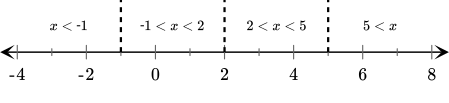
Use the Values Found to Divide the Number Line Into Intervals
expand_more Next, the number line will be divided into intervals. The intervals are determined by the excluded values x=- 1 and x=5, and the solution to the related equation x=2.
4
Test a Value in Each Interval
expand_more Finally, a value in each interval will be tested to determine which intervals contain values that satisfy the inequality. Start with the interval x<- 1. The arbitrary point x=- 2 can be used. If substituting this point into the original inequality produces a true statement, then the numbers in this interval are solutions. If not, they are not solutions.
Solving for x=-2 resulted in a false statement. Therefore, the numbers less than - 1 are not solutions to the inequality. The same process can be applied to the other intervals to determine whether or not they are solutions to the inequality.
4/x+1+x+1/x^2-4x-5 ≥ - 3/x-5
Substitute
x= - 2
4/- 2+1+- 2+1/( - 2)^2-4( - 2)-5 ? ≥ - 3/- 2-5
▼
Evaluate left-hand side
CalcPow
Calculate power
4/-2+1+- 2+1/4-4(- 2)-5 ? ≥ - 3/- 2-5
MultNegNegOnePar
- a(- b)=a* b
4/-2 +1+- 2+1/4+8-5 ? ≥ - 3/- 2-5
AddSubTerms
Add and subtract terms
4/-1+- 1/7 ? ≥ - 3/- 2-5
ExpandFrac
a/b=a * 7/b * 7
28/-7+- 1/7 ? ≥ - 3/- 2-5
MoveNegDenomToNum
Put minus sign in numerator
- 28/7+- 1/7 ? ≥ - 3/- 2-5
AddFrac
Add fractions
- 29/7 ? ≥ - 3/- 2-5
- 29/7 ≱ 3/7 *
| x < - 1 | - 1 < x < 2 | 2 < x <5 | x > 5 | |
|---|---|---|---|---|
| Test Value | - 2 | 0 | 3 | 6 |
| Statement | - 29/7 ≱ 3/7 | 19/5 ≥ 3/5 | 1/2 ≱ 3/2 | 11/7 ≥ 3 |
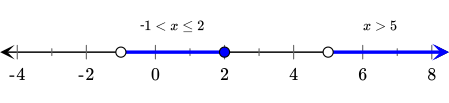
The solutions to the given inequality are all the real numbers between - 1 and 2 or all the numbers greater than 5. (- 1, 2) or (5,∞) Notice that the given inequality is a non-strict inequality. Consequently, some of the endpoints might satisfy the inequality. The solution of the related equation, x=2, it also results in a true statement. Therefore, the square bracket is used for that endpoint to indicate that it is also a solution. Solution Set (- 1, 2] ⋃ (5,∞) This solution set can also be shown on the number line.
Example
Share
Report error
The Average Cost of a Basketball
The cost of producing x basketballs is represented by C(x). C(x) = 5x+2000
a Find the average cost function, A(x).
{"type":"text","form":{"type":"math","options":{"comparison":"1","nofractofloat":false,"keypad":{"simple":false,"useShortLog":false,"variables":["x"],"constants":[]},"rendered":false},"text":" "},"formTextBefore":"A(x)=","formTextAfter":null,"answer":{"text":["\\dfrac{5x+2000}{x}","5+\\dfrac{2000}{x}"]}}
b How many basketballs should be produced so that the average cost is less than $30? Write the answer as an inequality.
{"type":"text","form":{"type":"math","options":{"comparison":"1","nofractofloat":false,"keypad":{"simple":false,"useShortLog":false,"variables":["x"],"constants":[]},"rendered":false},"text":" "},"formTextBefore":null,"formTextAfter":null,"answer":{"text":["x >80","80 < x"]}}
Hint
a Divide the cost function by x.
b Start by writing a rational inequality. Then, solve the rational inequality. Do negative x-values make sense in this context?
Solution
a The average cost function is found by dividing the cost function by the total number of items produced. The average cost function of producing x basketballs is then A(x) = C(x)x.
A(x) =C(x)/x ⇕ [0.8em] A(x) = 5x+2000/x
b The values of x that make the average cost less than $30 need to be found. This can be represented algebraically by an inequality.
A(x) <30 ⇔ 5x+2000/x <30 To solve this rational inequality, these four steps will be followed.
- State the excluded values.
- Solve the related rational equation.
- Use the values determined in the previous steps to divide a number line into intervals.
- Test a value in each interval to determine which intervals contain values that satisfy the inequality.
Excluded Values
Consider the inequality. 5x+2000/x <30 The denominator is 0 only when x=0. The excluded value for this inequality is 0.
Solve the Related Equation
The related equation is obtained by replacing the inequality sign with an equals sign. c|c Rational Inequality & Related Equation [0.8em] 5x+2000/x < 30 & 5x+2000/x = 30 To solve the equation, multiply both sides by x.5x+2000/x = 30
▼
Solve for x
MultEqn
LHS * x=RHS* x
5x+2000 = 30x
SubEqn
LHS-5x=RHS-5x
2000 = 25x
DivEqn
.LHS /25.=.RHS /25.
80 = x
RearrangeEqn
Rearrange equation
x=80
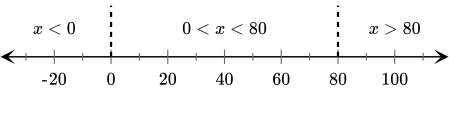
Divide the Number Line Into Intervals
Next, the number line will be divided into intervals using the excluded value x=0 and the solution to the related equation x=80.
Test Values
Select an arbitrary value from each interval to see if it produces a true statement. Starting with the interval x<0, the point x=- 1 will be tested. If substituting this point into the inequality produces a true statement, then the numbers in this interval are solutions. If not, they are not solutions.5x+2000/x < 30
Substitute
x= - 1
5( - 1)+2000/- 1 ? < 30
▼
Evaluate left-hand side
MultPosNeg
a(- b)=- a * b
- 5+2000/- 1 ? < 30
AddTerms
Add terms
1995/- 1 ? < 30
MoveNegDenomToFrac
Put minus sign in front of fraction
- 1995/1 ? < 30
DivByOne
a/1=a
- 1995 < 30 ✓
| x < 0 | 0 < x <80 | x >80 | |
|---|---|---|---|
| Choose a Test Value | - 1 | 1 | 100 |
| Statement | - 1995 <30 | 2005 < 30 | 25 < 30 |
The solutions to the inequality are all the numbers below 0 or above 80. Solution Set of Inequality x<0 or x> 80 However, x cannot be negative because it represents the number of basketballs produced. Therefore, that part of the solution can be ignored. Additionally, there is no need to check for endpoints as the inequality is strict. As a result, the average cost will be less than $30 as long as more than 80 basketballs are produced. x > 80
Closure
Share
Report error
Calculating Dominika’s Winning Percentages for Different Situations
When solving rational equations, the goal is to eliminate the rational denominators. However, the mechanics of solving rational inequalities are quite different. With all the methods discussed in this lesson, the challenge presented at the beginning can be reconsidered now. Dominika and Heichi keep track of how many games each of them win.

Given that Dominika has won 24 out of the 40 games against Heichi, the following situation will be analyzed.
a How many games would Dominika have to win in a row to have a 75 % winning record?
b How many games would Dominika have to win in a row to have a 90 % winning record?
c Is Dominika able to reach a 100 % winning record? Explain why or why not.
d Suppose that after reaching a winning record of 90 %, Dominika had a losing streak. How many games in a row would Dominika have to lose to drop down to a winning record below 50 % again?
Answer
a 24 games
b 120 games
c No, see solution.
d More than 128 games
Hint
a Let x be the number of games that Dominika wins. Write a proportion using x.
b Repeat the same procedure as in the previous section.
c Is there a scenario where Dominika wins all the games?
d Consider the answer found in Part B. Write a rational inequality for the number of games that Dominika loses without winning any.
Solution
a The ratio of Dominika's wins to the total number of games is currently 2440.
b The number of games x that Dominika has to win can be found by following the same process as in the previous part. In this case, Dominika wants to win 90 % of the games. Therefore, the ratio of 24+x to 40+x should be equal to 0.90.
c In order for Dominika to have won 100 % of the games, she must have won all of them. However, this is not the case because she has already lost 16 out of the 40 games played.
| Dominika | |
|---|---|
| Win | Loss |
| 24 | 16 |
This fact cannot be changed, no matter how many more games she wins. Try following the same procedure as the previous sections to see what happens. 24 + x/40+x = 1 ⇓ 24 + x = 40 + x ⇓ 24 = 40 * Attempting to solve this equation results in a false statement. This means that there is no value of x that will bring Dominika's record up to 100 %.
d Earlier it was determined that Dominika has to win 120 consecutive games in order to bring her winning record up to 90 %. In other words, Dominika will have to win 144 out of 160 games.
144/160+x = 0.50
▼
Solve for x
MultEqn
LHS * 160+x=RHS* 160+x
144 = 0.50(160+x)
Distr
Distribute 0.50
144 = 80 + 0.50x
SubEqn
LHS-80=RHS-80
64 = 0.50x
DivEqn
.LHS /0.5.=.RHS /0.5.
128 = x
RearrangeEqn
Rearrange equation
x=128

Finally, a value from each interval is chosen and tested. If substituting this point into the inequality produces a true statement, then the numbers in this interval are solutions. If not, these numbers are not solutions.
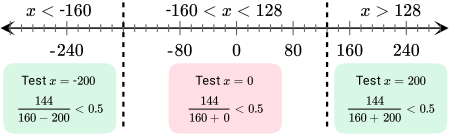
Therefore, the solutions to the inequality are all the numbers below - 160 and above 128. Solution Set of Inequality x< - 160 or x > 128 Notice that x cannot be negative because it is a number of games. Dominika cannot lose a negative number of games. As such, that part of the solution can be ignored. Additionally, there is no need to check for endpoints because the inequality is strict. If Dominika loses more than the next 128 games, she will have won less than 50 % of the total games she and Heichi played. x > 128
Solving Rational Equations and Inequalities
Exercise 3.1
Determine if each given statement is sometimes, always, or never true.
{"type":"choice","form":{"alts":["sometimes","always","never"],"noSort":true},"formTextBefore":"","formTextAfter":"","answer":1}
{"type":"choice","form":{"alts":["sometimes","always","never"],"noSort":true},"formTextBefore":"","formTextAfter":"","answer":0}
security
report
code
security
report
code
Let's solve the rational equation as if we knew the value of m. 3/x-m=x/x-m To do so, we will use cross multiplication.
We obtained a quadratic equation whose coefficients are 1, (- m-3), and 3m. Let's substitute them into the Quadratic Formula.
We will now find the solutions by using the positive and negative signs.
| x=m+3±(m-3)/2 | |
|---|---|
| x=m+3+(m-3)/2 | x=m+3-(m-3)/2 |
| x=m+3+m-3/2 | x=m+3-m+3/2 |
| x=2m/2 | x=6/2 |
| x=m | x=3 |
We obtained that x=m is a potential solution. We will now substitute it in the original equation to see if it is an extraneous solution.
We see that when x=m, the denominators become 0. Since division by zero is undefined, x=m is an extraneous solution. Therefore, the statement is always true.
Let's solve the rational equation as if we knew the value of b.
5/x-b=x/b-x
To do so, we will use cross multiplication.
We obtained a quadratic equation whose coefficients are 1, (5-b), and - 5b. Let's substitute them into the Quadratic Formula.
We will now find the solutions by using the positive and negative signs.
| x=- 5+b ±( 5+b)/2 | |
|---|---|
| x=- 5 + b+(5+b)/2 | x=- 5 + b-(5+b)/2 |
| x=- 5 + b+5+b/2 | x=- 5 + b-5-b/2 |
| x=2b/2 | x=- 10/2 |
| x=b | x=- 5 |
We obtained that two potential solutions. We will now substitute each of them in the original equation to see if they are extraneous solution.
We see that when x=b, the denominators become 0. Since division by zero is undefined, x=b is an extraneous solution. Now let's substitute x=- 5.
We obtained a true statement after substituting x = - 5. Therefore, it is the only solution to the original equation. Notice that when b= - 5, the denominators of the resulting equation above become zero. 5/- 5-5=- 5/- 5+5 ⇒ 5/0 = - 5/0 In this case, the rational equation does not have any solution. Therefore, the given equation has exactly one solution, which is x = - 5, as long as b ≠ - 5. The given statement is sometimes true.
security
report
code
Solving Rational Equations and Inequalities
Recommended exercises
To get personalized recommended exercises, please login first.
Loading content
≤
>
■2
■▢
e▢
7
8
9
×
÷■1
=
=
√▢
▢√
∫▢▢
4
5
6
+
−
≤
<
log
ln
log▢
1
2
3
()
∣
sin
cos
tan
0
.
π
x
y
Loading content