{{ tocSubheader }}
{{ 'ml-label-loading-course' | message }}
An error ocurred, try again later!
Chapter {{ article.chapter.number }}
{{ article.number }}.
{{ article.displayTitle }}
{{ article.intro.summary }}
Show less Show more expand_more Lesson Settings & Tools
| | {{ 'ml-lesson-number-slides' | message : article.intro.bblockCount }} |
| | {{ 'ml-lesson-number-exercises' | message : article.intro.exerciseCount }} |
| | {{ 'ml-lesson-time-estimation' | message }} |
It is possible to perform basic operations such as multiplication, division, and exponentiation on monomials. This lesson will discuss how powers of monomials operate.
Catch-Up and Review
Here are a few recommended readings before getting started with this lesson.
Challenge
Finish Your Homework Before Playing!
Kriz wants to play some video games with their little cousin. However, Kriz's cousin has not finished his homework yet.
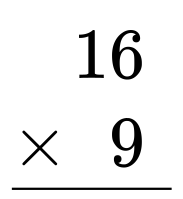
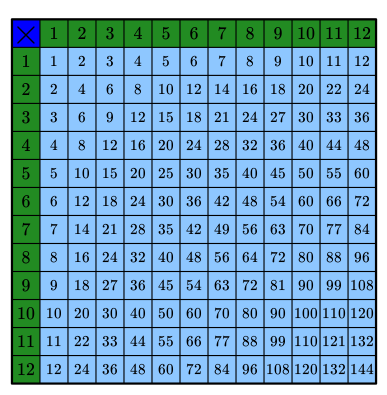
Kriz does not want to spill out the answer right away. They want to help their cousin understand math! Kriz's cousin only knows how to use multiplication tables.
Discussion
Power of a Power Property
Discussion
Power of a Product Property
Example
Bonus for Same Color
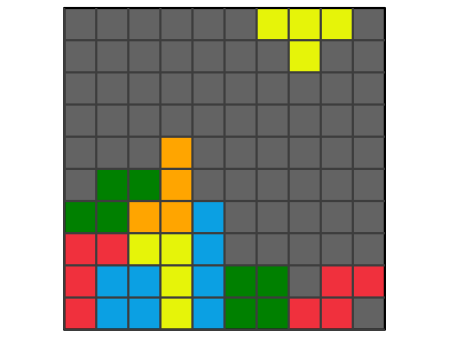
While waiting for their cousin to finish his homework,Kriz plays a single-player game video game.
x2y3
Each time Kriz completes a line of the same color, their score is raised by a power. 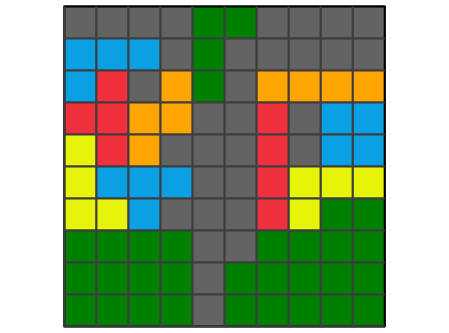
(x2y3)3
Write the monomial that represents Kriz's score. {"type":"text","form":{"type":"math","options":{"comparison":"1","nofractofloat":false,"keypad":{"simple":false,"useShortLog":false,"variables":["x","y"],"constants":[]},"rendered":false},"text":"<span class=\"katex\"><span class=\"katex-html\" aria-hidden=\"true\"><\/span><\/span>"},"formTextBefore":null,"formTextAfter":null,"answer":{"text":["x^6y^9"]}}
Hint
Use the Power of a Product Property and the Power of a Power Property.
Solution
After dropping the green L-shaped block, Kriz will complete three lines of the same color.
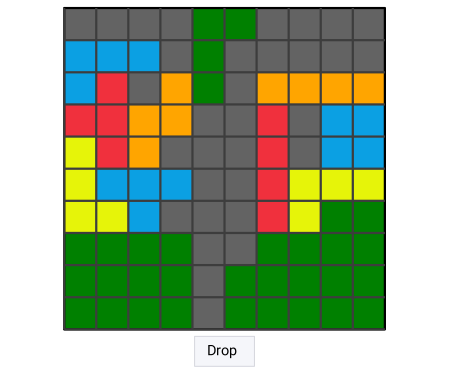 This means that their score will be raised to the third power.
Kriz's score becomes x6y9 after clearing three lines of the same color. What a skilled player!
This means that their score will be raised to the third power.
Kriz's score becomes x6y9 after clearing three lines of the same color. What a skilled player!
(x2y3)3
The expression can be expanded by using the Power of a Product Property and the Power of a Power Property.
(x2y3)3
PowProd
(a⋅b)m=am⋅bm
(x2)3⋅(y3)3
PowPow
(am)n=am⋅n
(x2⋅3)⋅(y3⋅3)
Multiply
Multiply
x6⋅y9
Multiply
Multiply
x6y9
Discussion
Zero Exponent Property
Discussion
Negative Exponent Property
If a is a non-zero real number and n is a positive integer, then a raised to the power of -n is equal to 1 over a raised to the power of n.
a-n=an1
Example
Watch the Boosters!
Still waiting for their cousin, Kriz switches to a racing game. In this game, passing through a green panel increases the speed of the kart. However, there are also purple panels that will slow the kart down. 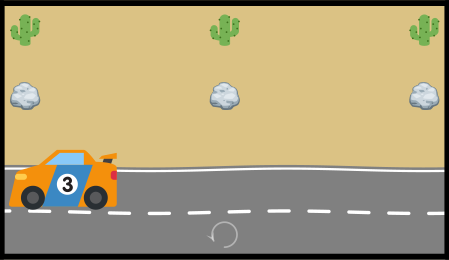 Kriz's initial speed is represented by s. Hitting a green panel multiplies this speed by x. Hitting a purple panel multiplies the speed by x-1.
 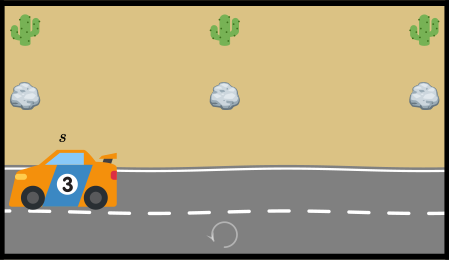 On the first lap, Kriz crosses a green panel, followed by a purple panel. Which of the following expressions represents Kriz's speed after passing over the panels?
{"type":"choice","form":{"alts":["<span class=\"katex\"><span class=\"katex-html\" aria-hidden=\"true\"><span class=\"base\"><span class=\"strut\" style=\"height:0.8141079999999999em;vertical-align:0em;\"><\/span><span class=\"mord mathdefault\">s<\/span><span class=\"mord\"><span class=\"mord mathdefault\">x<\/span><span class=\"msupsub\"><span class=\"vlist-t\"><span class=\"vlist-r\"><span class=\"vlist\" style=\"height:0.8141079999999999em;\"><span style=\"top:-3.063em;margin-right:0.05em;\"><span class=\"pstrut\" style=\"height:2.7em;\"><\/span><span class=\"sizing reset-size6 size3 mtight\"><span class=\"mord mtight\">2<\/span><\/span><\/span><\/span><\/span><\/span><\/span><\/span><\/span><\/span><\/span>","<span class=\"katex\"><span class=\"katex-html\" aria-hidden=\"true\"><span class=\"base\"><span class=\"strut\" style=\"height:0.8141079999999999em;vertical-align:0em;\"><\/span><span class=\"mord mathdefault\">s<\/span><span class=\"mord\"><span class=\"mord mathdefault\">x<\/span><span class=\"msupsub\"><span class=\"vlist-t\"><span class=\"vlist-r\"><span class=\"vlist\" style=\"height:0.8141079999999999em;\"><span style=\"top:-3.063em;margin-right:0.05em;\"><span class=\"pstrut\" style=\"height:2.7em;\"><\/span><span class=\"sizing reset-size6 size3 mtight\"><span class=\"mord mtight\"><span class=\"mord text mtight\"><span class=\"mord mtight\">-<\/span><\/span><span class=\"mord mtight\">2<\/span><\/span><\/span><\/span><\/span><\/span><\/span><\/span><\/span><\/span><\/span><\/span>","<span class=\"katex\"><span class=\"katex-html\" aria-hidden=\"true\"><span class=\"base\"><span class=\"strut\" style=\"height:0.43056em;vertical-align:0em;\"><\/span><span class=\"mord mathdefault\">s<\/span><\/span><\/span><\/span>","<span class=\"katex\"><span class=\"katex-html\" aria-hidden=\"true\"><span class=\"base\"><span class=\"strut\" style=\"height:0.43056em;vertical-align:0em;\"><\/span><span class=\"mord mathdefault\">x<\/span><\/span><\/span><\/span>"],"noSort":true},"formTextBefore":"","formTextAfter":"","answer":2}
Hint
Use the Product of Powers Property and the Zero Exponent Property. Remember, any number or expression multiplied by 1 is equal to itself.
Solution
After passing over a green panel, Kriz gets a boost to their speed represented by x. This bonus speed multiplies the current speed of the kart s.
s⋅x=sx
Right after that, they hit a purple panel. This will slow the kart down by multiplying its speed by x-1.
sx⋅x-1=sxx-1
If a number or a variable has no power written on it, it is assumed to be 1.
sxx-1=sx1x-1
This monomial can be simplified using the Product of Powers Property.
Because of the Zero Exponent Property, x0 is equal to 1.
Any number or variable multiplied by 1 is equal to itself.
This means that the speed of Kriz's kart after passing over the green and purple panels is simply s.
Example
The Cousins Play the Hardest Level
Kriz's cousin has finally finished his homework, so they can play a cooperative game together.
{"type":"choice","form":{"alts":["<span class=\"katex\"><span class=\"katex-html\" aria-hidden=\"true\"><span class=\"base\"><span class=\"strut\" style=\"height:2.00744em;vertical-align:-0.686em;\"><\/span><span class=\"mord\"><span class=\"mopen nulldelimiter\"><\/span><span class=\"mfrac\"><span class=\"vlist-t vlist-t2\"><span class=\"vlist-r\"><span class=\"vlist\" style=\"height:1.32144em;\"><span style=\"top:-2.314em;\"><span class=\"pstrut\" style=\"height:3em;\"><\/span><span class=\"mord\"><span class=\"mord\"><span class=\"mord mathdefault\">x<\/span><span class=\"msupsub\"><span class=\"vlist-t\"><span class=\"vlist-r\"><span class=\"vlist\" style=\"height:0.740108em;\"><span style=\"top:-2.9890000000000003em;margin-right:0.05em;\"><span class=\"pstrut\" style=\"height:2.7em;\"><\/span><span class=\"sizing reset-size6 size3 mtight\"><span class=\"mord mtight\">2<\/span><\/span><\/span><\/span><\/span><\/span><\/span><\/span><\/span><\/span><span style=\"top:-3.23em;\"><span class=\"pstrut\" style=\"height:3em;\"><\/span><span class=\"frac-line\" style=\"border-bottom-width:0.04em;\"><\/span><\/span><span style=\"top:-3.677em;\"><span class=\"pstrut\" style=\"height:3em;\"><\/span><span class=\"mord\"><span class=\"mord\">1<\/span><\/span><\/span><\/span><span class=\"vlist-s\">\u200b<\/span><\/span><span class=\"vlist-r\"><span class=\"vlist\" style=\"height:0.686em;\"><span><\/span><\/span><\/span><\/span><\/span><span class=\"mclose nulldelimiter\"><\/span><\/span><\/span><\/span><\/span>","<span class=\"katex\"><span class=\"katex-html\" aria-hidden=\"true\"><span class=\"base\"><span class=\"strut\" style=\"height:0.8141079999999999em;vertical-align:0em;\"><\/span><span class=\"mord\"><span class=\"mord mathdefault\">x<\/span><span class=\"msupsub\"><span class=\"vlist-t\"><span class=\"vlist-r\"><span class=\"vlist\" style=\"height:0.8141079999999999em;\"><span style=\"top:-3.063em;margin-right:0.05em;\"><span class=\"pstrut\" style=\"height:2.7em;\"><\/span><span class=\"sizing reset-size6 size3 mtight\"><span class=\"mord mtight\"><span class=\"mord mtight\">1<\/span><span class=\"mord mtight\">2<\/span><\/span><\/span><\/span><\/span><\/span><\/span><\/span><\/span><\/span><\/span><\/span>","<span class=\"katex\"><span class=\"katex-html\" aria-hidden=\"true\"><span class=\"base\"><span class=\"strut\" style=\"height:2.00744em;vertical-align:-0.686em;\"><\/span><span class=\"mord\"><span class=\"mopen nulldelimiter\"><\/span><span class=\"mfrac\"><span class=\"vlist-t vlist-t2\"><span class=\"vlist-r\"><span class=\"vlist\" style=\"height:1.32144em;\"><span style=\"top:-2.314em;\"><span class=\"pstrut\" style=\"height:3em;\"><\/span><span class=\"mord\"><span class=\"mord\"><span class=\"mord mathdefault\">x<\/span><span class=\"msupsub\"><span class=\"vlist-t\"><span class=\"vlist-r\"><span class=\"vlist\" style=\"height:0.740108em;\"><span style=\"top:-2.9890000000000003em;margin-right:0.05em;\"><span class=\"pstrut\" style=\"height:2.7em;\"><\/span><span class=\"sizing reset-size6 size3 mtight\"><span class=\"mord mtight\"><span class=\"mord mtight\">1<\/span><span class=\"mord mtight\">2<\/span><\/span><\/span><\/span><\/span><\/span><\/span><\/span><\/span><\/span><\/span><span style=\"top:-3.23em;\"><span class=\"pstrut\" style=\"height:3em;\"><\/span><span class=\"frac-line\" style=\"border-bottom-width:0.04em;\"><\/span><\/span><span style=\"top:-3.677em;\"><span class=\"pstrut\" style=\"height:3em;\"><\/span><span class=\"mord\"><span class=\"mord\">1<\/span><\/span><\/span><\/span><span class=\"vlist-s\">\u200b<\/span><\/span><span class=\"vlist-r\"><span class=\"vlist\" style=\"height:0.686em;\"><span><\/span><\/span><\/span><\/span><\/span><span class=\"mclose nulldelimiter\"><\/span><\/span><\/span><\/span><\/span>","<span class=\"katex\"><span class=\"katex-html\" aria-hidden=\"true\"><span class=\"base\"><span class=\"strut\" style=\"height:0.8141079999999999em;vertical-align:0em;\"><\/span><span class=\"mord\"><span class=\"mord mathdefault\">x<\/span><span class=\"msupsub\"><span class=\"vlist-t\"><span class=\"vlist-r\"><span class=\"vlist\" style=\"height:0.8141079999999999em;\"><span style=\"top:-3.063em;margin-right:0.05em;\"><span class=\"pstrut\" style=\"height:2.7em;\"><\/span><span class=\"sizing reset-size6 size3 mtight\"><span class=\"mord mtight\">2<\/span><\/span><\/span><\/span><\/span><\/span><\/span><\/span><\/span><\/span><\/span>"],"noSort":true},"formTextBefore":"","formTextAfter":"","answer":0}
Hint
Use the Quotient of Powers Property and the Negative Exponent Property to reach the final answer.
Solution
While playing in the hardest level, Kriz and their cousin slay a total of 5 enemies. This will give them a score of x raised to the power of 5.
x5
Unfortunately, they also get taken down a total of 7 times. This is the hardest level, after all! This means that their score will be divided by x raised to the power of 7.
x7x5
The expression can be simplified using the Quotient of Powers Property.
Their score is represented by x-2. Since no option from the pool is written with a negative exponent, use the Negative Exponent Property to rewrite it with a positive exponent.
The previous expression represents Kriz and his cousin's score.
Closure
Solving the Problem With a Table
Kriz's cousin needs to finish his homework. He is down to the last multiplication problem.
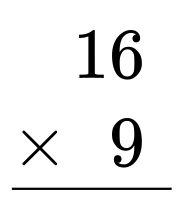
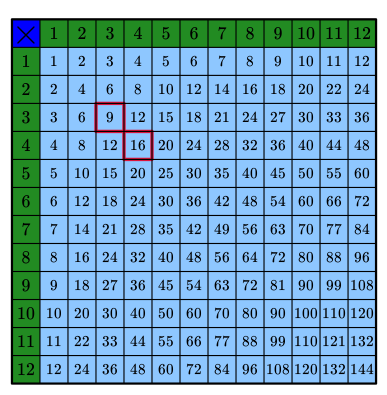
Note that both 16 and 9 are perfect squares. This can be shown in the multiplication table.
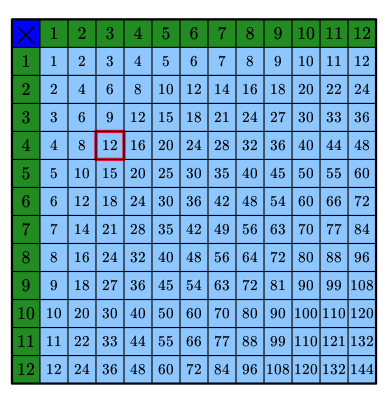
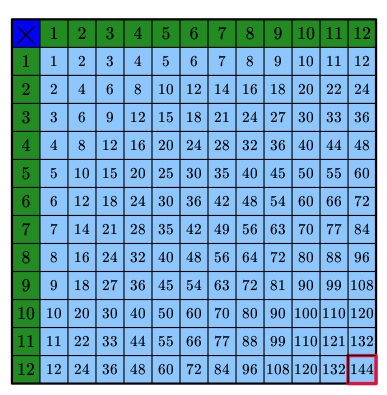
Finally, the answer can be given using only information from the multiplication table.
16×9=144
Loading content