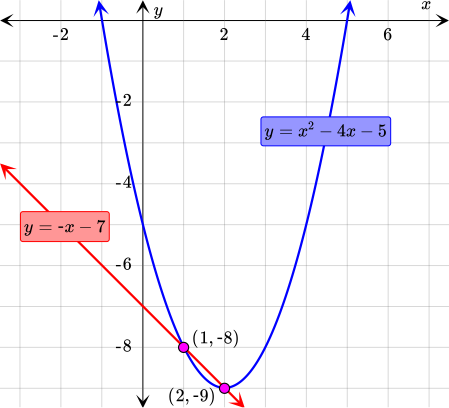
We want to solve the given system of equations using the Elimination Method.
y=- x-7 & (I) y=x^2-4x-5 & (II)
The y-variable is isolated and has the same coefficients in both equations. This allows us to subtract Equation (I) from Equation (II) to eliminate the y-variable.
Notice that the resultant equation is a quadratic equation in terms of only the x-variable.
- x^2+3x-2=0 ⇔ - 1x^2+ 3x+( - 2)=0We can substitute a= - 1, b= 3, and c= - 2 into the Quadratic Formula.
We found that y=- 8 when x=1. One solution of the system, which is a point of intersection of the two parabolas, is (1,- 8). To find the other solution, we will substitute 2 for x in Equation (I) again.
We found that y=- 9 when x=2. Therefore, our second solution, which is the other point of intersection of the two parabolas, is (2,- 9).
Checking Our Answer
Checking the answer
We can check our answers by substituting the points into both equations. If they produce true statements, our solutions are correct. Let's start by checking (1, - 8). We will substitute 1 and - 8 for x and y, respectively, in Equation (I) and Equation (II).