5. Solving Systems of Equations Including Quadratics
Sign In
An error ocurred, try again later!
Chapter 9
5.
Solving Systems of Equations Including Quadratics
Systems of equations can be a mix of linear and quadratic equations. These systems present unique challenges and require specific techniques for resolution. One might encounter a system where both equations are quadratic or where one is linear and the other quadratic. Identifying the type of system is a pivotal step, guiding the choice of solution methods. Graphical representations can be particularly enlightening, revealing points of intersection that correspond to system solutions. Furthermore, various methods like substitution and elimination can be employed to find these solutions. For instance, in a skydiving scenario, quadratic equations can model the height of a skydiver over time, offering insights into moments like parachute release. In another example, acrobats might high-five mid-air, with their heights modeled by quadratic equations. Finding their intersection points can determine the exact moment of their high-five. Such real-world applications underscore the importance and relevance of understanding and solving these systems.
Show less Show more expand_more 


Lesson Settings & Tools
| | 18 Theory slides |
| | 9 Exercises - Grade E - A |
| | Each lesson is meant to take 1-2 classroom sessions |
Solving Systems of Equations Including Quadratics
Slide of 18
A system of equations does not always consist of only linear equations. The aim of this lesson is to show different ways to solve a system of equations if there are quadratic equations in the system.
Catch-Up and Review
Here are a few recommended readings before getting started with this lesson.
Challenge
Share
Report error
Finding Intersections with a Circle
Consider the equation of a circle centered at the origin with a radius of 2sqrt(2). x^2 + y^2 = (2sqrt(2))^2 [0.5em] ⇓ [0.5em] x^2 + y^2 = 8
b At what points does the parabola y= 12x^2 intersect the circle?
Discussion
Share
Report error
Nonlinear System
A nonlinear system is a system of equations in which at least one of the equations is nonlinear. Consider the following system of equations. 2x + 4y = 10 & (I) 4x^2 + y = - 5 & (II)
Even if the first equation in the system is linear, the system is a nonlinear system because the x-term of Equation (II) is elevated to the power of 2, making it nonlinear.Pop Quiz
Share
Report error
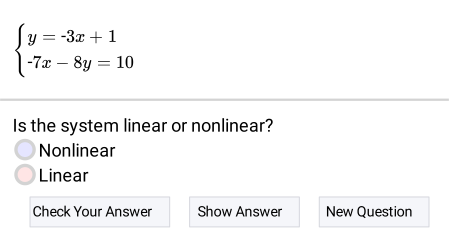
Is the System Nonlinear?
Determine if the given system of equations is nonlinear or linear.
Illustration
Share
Report error
The Solutions of a Linear-Quadratic System
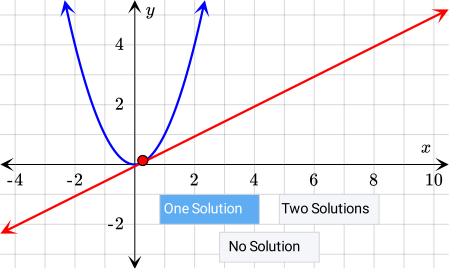
Some common nonlinear systems are linear-quadratic systems, which are systems of two equations that consist of a linear equation and a quadratic equation. These systems can have zero, one, or two different solutions. These solutions are the point of intersection of the graphs.
 What happens if both equations in a system of two equations are quadratic equations?
Discussion
Share
Report error
System of Quadratic Equations
A system of equations does not necessarily consist of linear equations. Different types of equations can be grouped into a system.
A system of quadratic equations is a system of equations that consists of only quadratic equations. y=x^2-6x+3 y=- x^2+2x-5 Similar to systems of linear equations, the solution to a system of quadratic equations are the values of the variables that make all the equations true. In the example above, x= 2 and y= - 5 are a solution to the system. This can be verified by substituting the values into each equation.
| y=x^2-6x+3 | y=- x^2+2x-5 |
|---|---|
| -5 = 2^2-6( 2)+3 | -5=- 2^2+2( 2)-5 |
| -5 = 4 - 12 + 3 | -5 =-4 + 4-5 |
| -5 = -5 | -5 =-5 |
Pop Quiz
Share
Report error
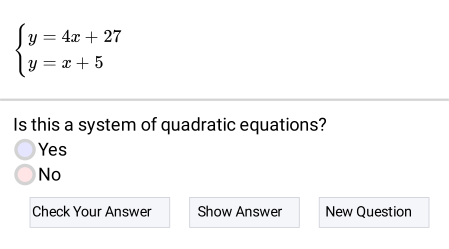
Is the System Quadratic?
For every given system of equations shown in the applet, determine if the system is a system of quadratic equations or not. Note that every equation in such a system needs to be a quadratic equation.
Illustration
Share
Report error
The Solutions of a Quadratic-Quadratic System
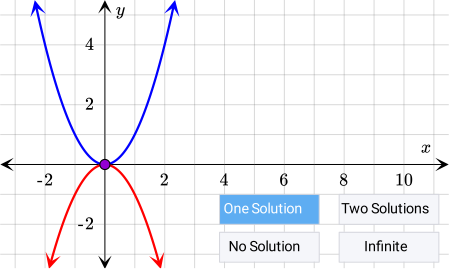
Another type of non-linear system is a quadratic-quadratic system, which consists of two quadratic equations. These systems can have zero, one, two, or infinitely many different solutions. These solutions are the points of intersection of the graphs.
Discussion
Share
Report error
Solving Nonlinear Systems Graphically
Graphing the equations of a system of equations is helpful. Sometimes it is even possible to solve the system by referencing the graph only.
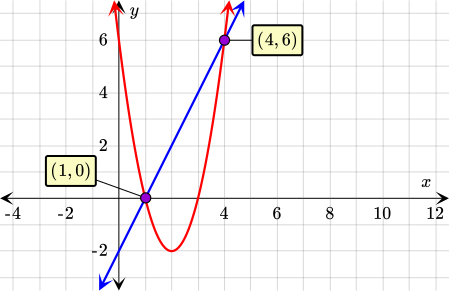
If the equations can be graphed, the solutions of a nonlinear system are the points of intersection of the graphs of every equation that makes the system. Therefore, by finding the points of intersection of the graphs, it is possible to solve a nonlinear system. As an example, consider a linear-quadratic system.
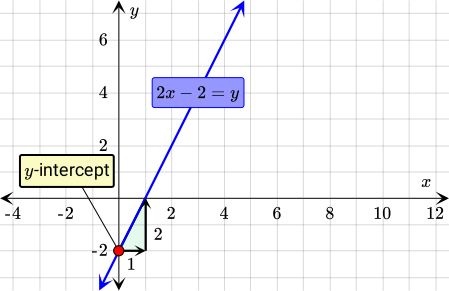
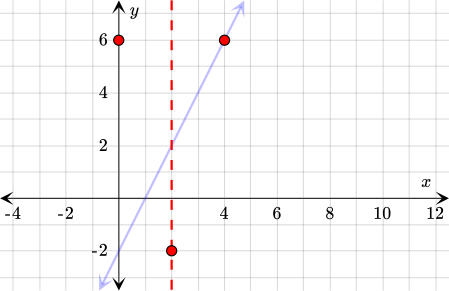
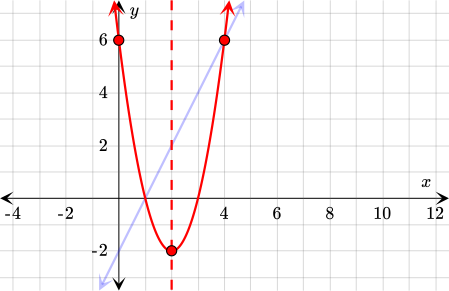
2x - 2 = y 2x^2 - 8x + 6 = y
To find the solutions, first each equation is graphed.
1
Graphing the First Equation
expand_more The first equation of the nonlinear system is a linear equation written in slope-intercept form. By using the slope of 2 and the y-intercept of -2, the equation is graphed in a coordinate plane.
Then, the second equation needs to be graphed.
2
Graphing the Second Equation
expand_more The second equation is a quadratic equation written in standard form.
ax^2 + bx + c = y ⇓ 2x^2 + ( - 8)x + 6 = y
To graph a quadratic equation in standard form, first the axis of symmetry needs to be identified and graphed. To do so, the values are substituted into the formula.
This indicates that the axis of symmetry is a vertical line on x=2. 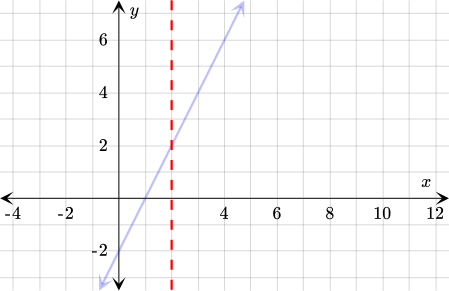 Then, to find the vertex of the parabola, the equation is evaluated to find the value of y when x=2.
This means that the vertex lies on point (2,-2).
Then, to find the vertex of the parabola, the equation is evaluated to find the value of y when x=2.
This means that the vertex lies on point (2,-2). 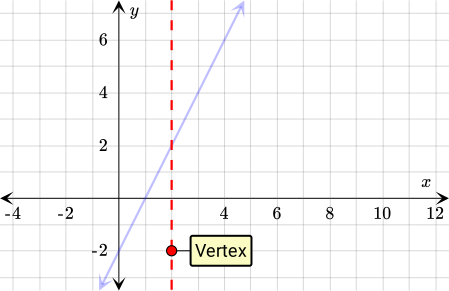
2x^2 - 8x + 6 = y
Substitute
x= 2
2( 2)^2 - 8( 2) + 6 = y
▼
Solve for y
CalcPow
Calculate power
2(4) - 8(2) + 6 = y
Multiply
Multiply
8 - 16 + 6 = y
AddTerms
Add terms
-2 = y
RearrangeEqn
Rearrange equation
y = - 2
Then, the y-intercept is the value of c of the equation, which in this case is 6. Since the axis of symmetry divides the graph into two mirror images, the parabola also goes through point in (4,6).
Using these points, it is possible to draw the parabola.
3
Finding the Points of Intersection
expand_more Finally, finding the points in which the graph intersect, the solutions of the nonlinear system are found.
This means that the points (1,0) and (4,6) are the solutions of the nonlinear system.
Example
Share
Report error
Graphing a Linear-Quadratic System
Emily received a scholarship this summer and attended a camp for skydiving. She has always dreamed of feeling like flying in the sky. Surprisingly, her first task given by her instructor Sky Flyer is to solve a nonlinear system graphically.

Answer
Hint
Graph both equations and find the points of intersection.
Solution
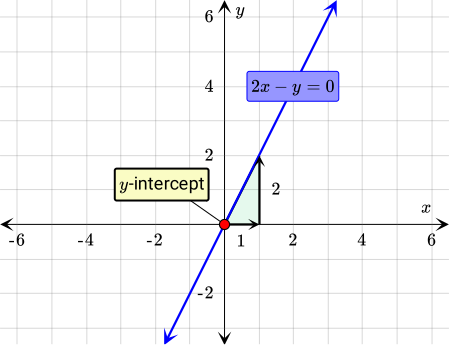
To solve this system graphically, the points of intersection of the graphs need to be found. To do so, each equation should be graphed. Equation (I) is a linear equation that can be written in slope-intercept form. 2x - y =0 ⇒ y = 2x The slope of 2 and the y-intercept of 0 can be used to graph this line in the coordinate plane.
x = - b± 0/2a
IdPropAdd
Identity Property of Addition
x = - b/2a
SubstituteII
a= 1, b= 2
x = - 2/2( 1)
Multiply
Multiply
x = - 2/2
CalcQuot
Calculate quotient
x = -1
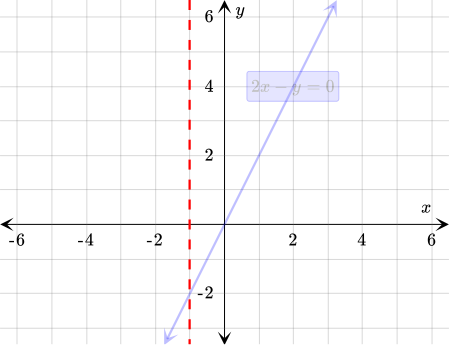
x^2 + 2x - 1 = y
Substitute
x= -1
( -1)^2 + 2( -1) - 1 = y
▼
Simplify
CalcPow
Calculate power
1 + 2(-1) -1 = y
Multiply
Multiply
1 - 2 - 1 = y
SubTerms
Subtract terms
-2 = y
RearrangeEqn
Rearrange equation
y = -2
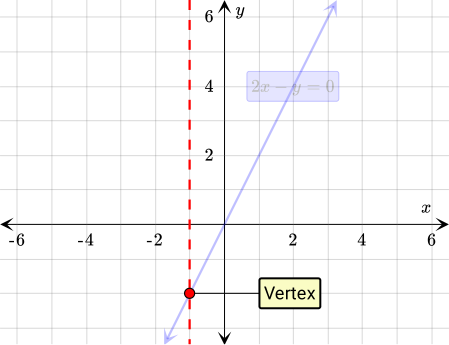
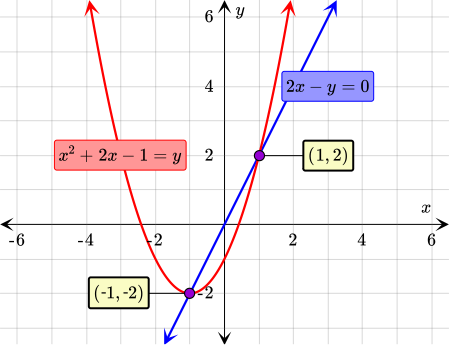
The value of c on a quadratic equation written in standard form indicates the value of the y-intercept. In this case, the value of the y-intercept is -1. Since the axis of symmetry divides the graph into mirror images, the points (0,-1) and (-2,-1) can be added.
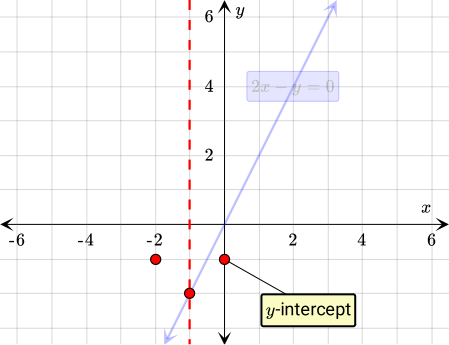
These points can be used to graph the parabola.
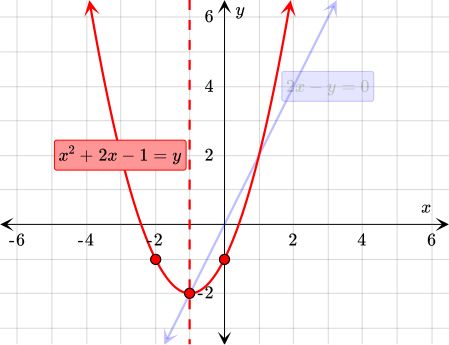
Looking at the graph, the points of intersection can be located.
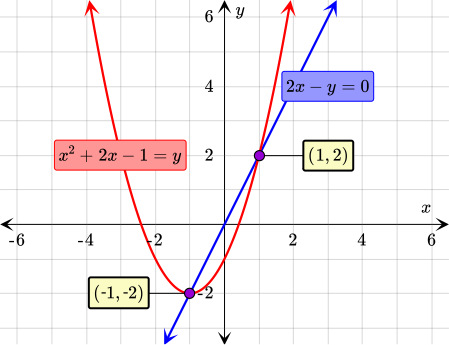
The solutions of the nonlinear system are the points (-1,-2) and (1,2).
Example
Share
Report error
Graphing a Quadratic-Quadratic System
Instructor Sky Flyer continues teaching Emily about nonlinear systems. Emily is unsure but thinks they must be getting closer to applying this knowledge to something spectacular.

Answer
Hint
How do you find the axis of symmetry of a parabola if the quadratic equation is written in standard form?
Solution
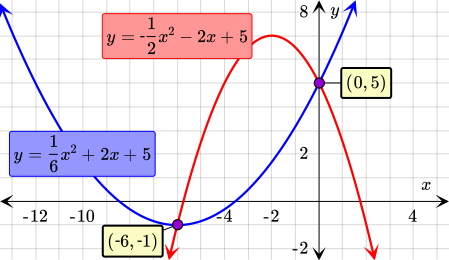
To solve a quadratic-quadratic system graphically, both quadratic equations are graphed to identify the points of intersection. Looking at the system, it can be noted that both equations of the system are written in standard form.
| y= ax^2 + bx + c | |
|---|---|
| y = 1/6x^2 + 2x + 5 | y = -1/2x + ( -2)x + 5 |
x = - b/2a
SubstituteII
a= 16, b= 2
x = - 2/2( 16)
▼
Solve for x
CancelCommonFac
Cancel out common factors
x = - 2/2( 16)
SimpQuot
Simplify quotient
x = - 1/16
DivOneByFracD
1/a/b= b/a
x = - 6
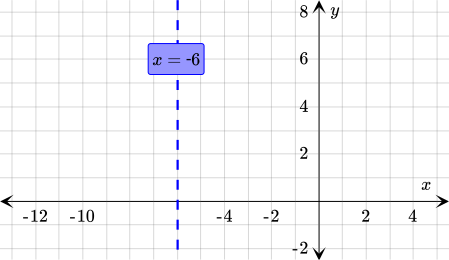
y = 1/6x^2 + 2x + 5
Substitute
x= - 6
y = 1/6( -6)^2 + 2( -6) + 5
▼
Solve for y
CalcPow
Calculate power
y = 1/6(36) + 2(-6) + 5
Multiply
Multiply
y = 1/6(36) - 12 + 5
MoveRightFacToNum
a/c* b = a* b/c
y = 36/6 - 12 + 5
CalcQuot
Calculate quotient
y = 6 - 12 + 5
AddTerms
Add terms
y = -1
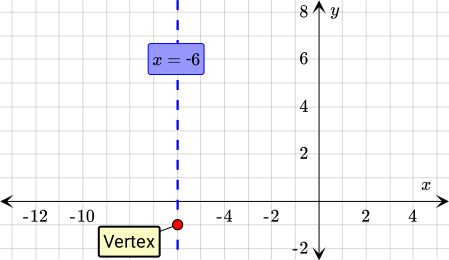
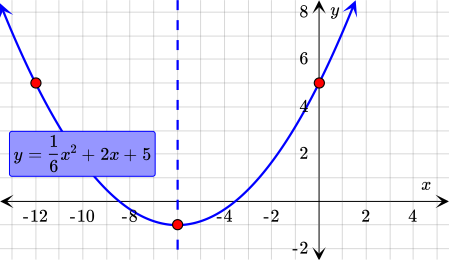
It is possible to find the y-intercept of the parabola with the value of c. In Equation (I), this value is 5. Also, since the axis of symmetry mirrors the image of the parabola, there is another known point at (-12, 5). These points can be used to graph the parabola.
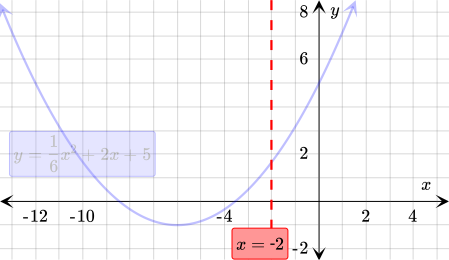
x = - b/2a
SubstituteII
a= - 12, b= -2
x = - -2/2( - 12)
▼
Solve for x
MultPosNeg
a(- b)=- a * b
x =- -2/-2( 12)
MultFracByInverse
a/b* b/a=1
x = --2/-1
CalcQuot
Calculate quotient
x = -2
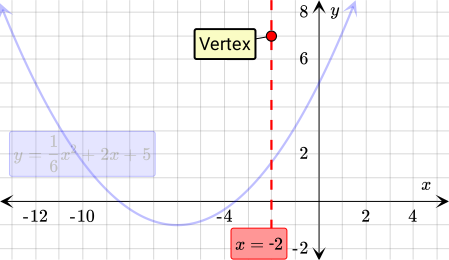
The value c=5 on Equation (II) indicates that the y-intercept of the second parabola is y=5. Since the axis of symmetry mirrors the image, there is another known point (-4,5).

Now that the two equations are graphed, the solutions of the nonlinear system can be determined. They are the points of intersection of the graphs.
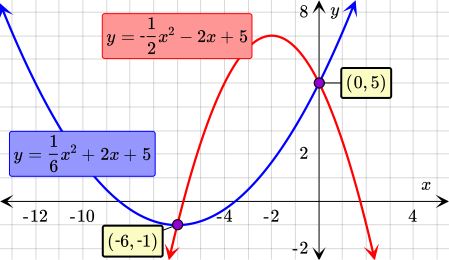
The points (0,5) and (-6,-1) are the solutions of the nonlinear system.
Discussion
Share
Report error
Solving Nonlinear Systems Using Elimination
Just like in a system of linear equations, there are many methods that can be used to solve a nonlinear system.
Some nonlinear systems can be solved by eliminating one of the variables of the equations involved, similar to the elimination method used in systems of linear equations. Consider the following example.
- 2x^2 + 8x + 16 = 2y & (I) x+4 = y & (II)
Since Equation (I) is a quadratic equation, the system is nonlinear. The system can be solved by elimination following the steps below.
It should be noted that not every nonlinear system can be solved using this method.
1
Find a Variable to Eliminate
expand_more There are two different variables in the nonlinear system, x and y. The equations have different powers for the terms of x, as one is quadratic and the other is linear. An the other hand, both equations have linear terms of y. Therefore, variable y will be eliminated. - 2x^2 + 8x + 16 = 2y & (I) x+4 = y & (II)
2
Eliminating the Variable
expand_more For a variable to be eliminated, its coefficient has to be the same in both equations. This can be achieved by dividing Equation (I) by 2 and then subtracting Equation (II) from Equation (I).
It can be noted that one of the equations only depends on x now.
3
Solving the Single Variable Equation
expand_more Equation (II) is a quadratic equation in terms of x. The equation is already written in standard form.
ax^2 + bx + c = 0 ⇓ ( -1 )x^2 + ( 3)x + 4 = 0
This equation can be solved using the quadratic formula.
There are two possible values for x. These can be found by adding or subtracting 5.
- x^2 + 3x + 4 = 0
UseQuadForm
Use the Quadratic Formula: a = -1, b= 3, c= 4
x=- 3±sqrt(3^2 - 4( -1)( 4))/2( -1)
CalcPow
Calculate power
x=-3±sqrt(9 - 4(-1)(4))/2(-1)
Multiply
Multiply
x=-3±sqrt(9 + 16)/-2
AddTerms
Add terms
x=-3±sqrt(25)/-2
CalcRoot
Calculate root
x = -3 ± 5/-2
| x = -3 ± 5/-2 | |
|---|---|
| x = -3 + 5/-2 | x = -3 - 5/-2 |
| x = 2/-2 | x = -8/-2 |
| x = -1 | x = 4 |
Therefore, the values of x that solve the nonlinear system are -1 and 4.
4
Substituting the Values
expand_more Now that there are two known values for x, the solution values for y can be found by substituting the values of x into either equation. Since Equation (II) is linear, it is easier to do so in this equation.
| x + 4 = y | |
|---|---|
| -1 + 4 = y | 4+4 = y |
| y = 3 | y = 8 |
Combining each x-value value with its correspondent y-value, it can be seen that the solutions can be written as the points (-1,3) and (4,8).
Example
Share
Report error
Skydiving
Instructor Sky Flyer takes the students out to the yard. Emily, super excited, looks up and sees someone free falling with a parachute!  The height above the ground of the skydiver can be modeled by a quadratic equation.
h = -4.9t^2 + 5450
In this equation, t is the time passed in seconds after the jump and h is the skydiver's height above the ground in meters. After releasing her parachute, the rate at which she is falling slows. The model for that height is given by the following linear equation.
h = -5t + 4450
How long after jumping did the jumper release their parachute? Use the elimination method to find the solution, and round that time to one decimal place.
The height above the ground of the skydiver can be modeled by a quadratic equation.
h = -4.9t^2 + 5450
In this equation, t is the time passed in seconds after the jump and h is the skydiver's height above the ground in meters. After releasing her parachute, the rate at which she is falling slows. The model for that height is given by the following linear equation.
h = -5t + 4450
How long after jumping did the jumper release their parachute? Use the elimination method to find the solution, and round that time to one decimal place.
{"type":"text","form":{"type":"math","options":{"comparison":"1","nofractofloat":false,"keypad":{"simple":true,"useShortLog":false,"variables":["x"],"constants":["PI"]},"rendered":false},"text":" "},"formTextBefore":null,"formTextAfter":"seconds","answer":{"text":["14.8"]}}
Hint
Which variable is the easiest to eliminate?
Solution
First of all, the given equations can be combined to make a nonlinear system.
h = -4.9t^2 + 5450 & (I) h = -5t + 4450 & (II)
Finding how long after jumping did the jumper release his parachute is the same as finding the time t where the model changed from Equation (I) to Equation (II). This can be done by solving the nonlinear system. The first step to solve the nonlinear system by elimination is to find a variable to eliminate.
h = -4.9t^2 + 5450 h = -5t + 4450
The variable h is chosen because there are only linear terms of that variable. Then, the elimination is done by subtracting Equation (II) from Equation (I).
Now a quadratic equation was obtained. The equation is already written in standard form.
at^2 + bt + c = 0 ⇓ -4.9t^2 + 5t + 1000 = 0
This equation is solved using the quadratic formula.
The ± sign indicates that there are two possible values for t. These can be found by either adding or subtracting the value of the root.
h = -4.9t^2 + 5450 h = -5t + 4450
SysEqnSub
(I): Subtract (II)
h - h = -4.9t^2 + 5450 - ( -5t + 4450) h = -5t + 4450
SubTerms
(I): Subtract terms
0 = - 4.9 t^2 + 5t + 1000 h = -13t + 450
t=- b±sqrt(b^2 - 4ac)/2a
SubstituteValues
Substitute values
t=- ( 5)±sqrt(5^2-4( - 4.9)( 1000))/2( -4.9)
CalcPow
Calculate power
t=-5±sqrt(25 - 4(-4.9)(1000))/2(-4.9)
Multiply
Multiply
t=-5±sqrt(25 + 19 600)/-9.8
AddTerms
Add terms
t=-5±sqrt(19 625)/-9.8
| t=-5±sqrt(19 625)/-9.8 | |
|---|---|
| t = -5 + sqrt(19 625)/-9.8 | t = -5 - sqrt(19 625)/-9.8 |
| t = - 13.7846 | t = 14.8050 |
| t ≈ -13.8 | t ≈ 14.8 |
The two possible values for t are about 14.8 seconds and about -13.8 seconds. Only positive numbers make sense in this case since the skydiver cannot wait a negative time before releasing the parachute. This means that the jumper waited about 14.8 seconds to release the parachute.
Example
Share
Report error
Acrobats on the Circus
Before having the chance to skydive, Instructor Sky Flyer wants to show how the students can train by practicing acrobatics. They all walk into a large gym to see a few pros practice. One acrobat jumped from a platform, and another dove from another higher platform just a split second later. Mid-air, they did a high-five while spinning!

The heights above the floor of both acrobats at which they did a high five can be modeled using a system of quadratic equations. These heights are measured from the moment the first acrobat jumps. h = -16(t-1)^2+16 & (I) h = -16(t-2)^2+16 & (II) In these equations, h is the distance of the acrobats from the floor in feet, and t is the time in seconds.
a How long after jumping from their platforms did the acrobats high-five? Solve using elimination.
{"type":"text","form":{"type":"math","options":{"comparison":"1","nofractofloat":false,"keypad":{"simple":true,"useShortLog":false,"variables":["x"],"constants":["PI"]},"rendered":false},"text":" "},"formTextBefore":"t=","formTextAfter":"seconds","answer":{"text":["1.5"]}}
b At what height above the floor were the acrobats when they did the high-five?
{"type":"text","form":{"type":"math","options":{"comparison":"1","nofractofloat":false,"keypad":{"simple":true,"useShortLog":false,"variables":["x"],"constants":["PI"]},"rendered":false},"text":" "},"formTextBefore":"h =","formTextAfter":"feet","answer":{"text":["12"]}}
Solution
a The first step to solve the given system using elimination is to find a variable to eliminate. The objective is to obtain a single equation that depends on a single variable. The variable h is present in only one term, so it can be eliminated to obtain an equation in terms of t.
h = -16(t-1)^2+16 h = -16(t-2)^2+16
ExpandNegPerfectSquare
(I): (a-b)^2=a^2-2ab+b^2
h = -16(t^2-2t+1)+16 h = -16(t-2)^2+16
ExpandNegPerfectSquare
(II): (a-b)^2=a^2-2ab+b^2
h = -16(t^2-2t+1)+16 h = -16(t^2-4t+4)+16
Distr
(I): Distribute - 16
h = -16 t^2 + 32t - 16+16 h = -16(t^2-4t+4)+16
Distr
(II): Distribute -16
h = -16 t^2 + 32t - 16+16 h = -16 t^2 + 64t - 64+16
AddTerms
Add terms
h = -16 t^2 + 32t h = -16 t^2 + 64t - 48
SysEqnSub
(I): Subtract (II)
h - h = -16 t^2 + 32t - ( -16 t^2 + 64t - 48) h = -16 t^2 + 64t - 48
SubTerms
(I): Subtract terms
0 = -32t + 48 h = -16 t^2 + 64t - 48
0 = -32t + 48
SubEqn
LHS--32t=RHS--32t
32t = 48
DivEqn
.LHS /32.=.RHS /32.
t = 48/32
ReduceFrac
a/b=.a /16./.b /16.
t = 3/2
b To find the height above the floor at which the acrobats did the high-five, the time found in Part A needs to be substituted into either equation of the given system. In this case, Equation (I) will be used.
h = -16(t-1)^2+16
Substitute
t= 1.5
h = -16( 1.5-1)^2+16
SubTerm
Subtract term
h = -16(0.5)^2+16
CalcPow
Calculate power
h = -16(0.25)+16
Multiply
Multiply
h = -4+16
AddTerms
Add terms
h = 12
Discussion
Share
Report error
Solving Nonlinear Systems Using Substitution
In a similar way that a system of linear equations can be solved using the substitution method, there are nonlinear systems that can be solved by substituting. As an example, consider the following linear-quadratic system.
y = x^2 + 2x - 19 & (I) y = 5x - 1 & (II)
This system is solved using substitution following the steps below.
1
Finding a Term to Substitute
expand_more The first step to solve a nonlinear system using substitution is to identify which term is substituted from one equation to the other. The given system has the y variable already isolated so it is easy to select that term. y = x^2 + 2x - 19 & (I) y = 5x - 1 & (II)
2
Substituting a Term
expand_more Now the value of y from Equation (II) is substituted into Equation (I). Then, the resulting equation is simplified as much as possible.
A quadratic equation that only depends on x was obtained.
y = x^2 + 2x - 19 y = 5x - 1
Substitute
(I): y= 5x - 1
5x - 1 = x^2 + 2x - 19 y = 5x - 1
SubEqn
(I): LHS-5x=RHS-5x
- 1 = x^2 - 3x - 19 y = 5x - 1
AddEqn
(I): LHS+1=RHS+1
0 = x^2 - 3x - 18 y = 5x - 1
RearrangeEqn
(I): Rearrange equation
x^2 - 3x - 18 = 0 y = 5x - 1
3
Solving the Resulting Equation
expand_more A quadratic equation was obtained from the previous step. This equation is written in standard form. ax^2 + bx + c = 0 ⇓ 1x^2 + ( -3)x + ( -18) = 0
These values can be substituted into the quadratic formula.
There are two possible values for x depending if there is a subtraction or an addition. These values are calculated individually.
x=- b±sqrt(b^2 - 4ac)/2a
SubstituteValues
Substitute values
x=-( -3)±sqrt(( - 3)^2 - 4( 1)( -18 ))/2( 1)
CalcPow
Calculate power
x=-(-3)±sqrt(9 - 4(1)(-18))/2(1)
Multiply
Multiply
x=-(-3)±sqrt(9 +72)/2
NegNeg
- (- a)=a
x=3±sqrt(9 +72)/2
AddTerms
Add terms
x=3±sqrt(81)/2
CalcRoot
Calculate root
x = 3 ± 9/2
| x=3± 9/2 | |
|---|---|
| x_1 = 3+9/2 | x_2 = 3-9/2 |
| x_1 = 12/2 | x_2 = -6/2 |
| x_1 = 6 | x_2 = -3 |
4
Substituting the Values
expand_more To find the values of y, the values of x_1 and x_2 are substituted into either equation of the system. It is easier to substitute the values into Equation (II) because it is a linear equation, instead of quadratic.
| y=5x -1 | ||
|---|---|---|
| y_1 = 5( 6) - 1 | y_2 = 5( -3) - 1 | |
| y_1 = 29 | y_2 = -16 | |
This indicates that the solutions of the system are the points (6,29) and (-3,-16).
Example
Share
Report error
Skydive Recording
Finally, all the math and practice is making sense. Emily is now ready for her first jump! Instructor Sky Flyer prepared an equation to record Emily's height above the ground.
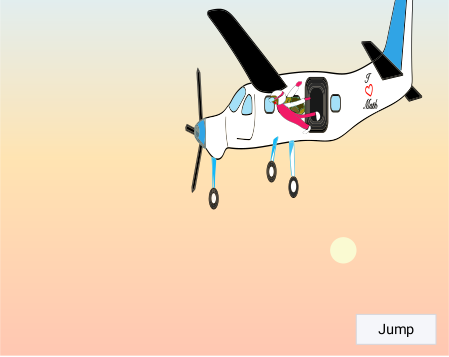 Her height from the ground when she jumps from the plane, measured in feet, is given by the following quadratic equation.
h(t) = - 16 t^2 + 100t + 10 000
Again, h is Emily's height from the floor, while t is the time in seconds since Emily jumped. Using a linear equation, the instructor calculated Emily's height above the ground after her parachute was released.
h(t) = - 16 t + 6700
Her height from the ground when she jumps from the plane, measured in feet, is given by the following quadratic equation.
h(t) = - 16 t^2 + 100t + 10 000
Again, h is Emily's height from the floor, while t is the time in seconds since Emily jumped. Using a linear equation, the instructor calculated Emily's height above the ground after her parachute was released.
h(t) = - 16 t + 6700
Therefore, the height at which Emily released her parachute is about 6404.96 feet.
a After how many seconds does Emily release her parachute? Use substitution to find the answer. Round the time to two decimal places.
{"type":"text","form":{"type":"math","options":{"comparison":"1","nofractofloat":false,"keypad":{"simple":true,"useShortLog":false,"variables":["x"],"constants":["PI"]},"rendered":false},"text":" "},"formTextBefore":"t\u2248","formTextAfter":"seconds","answer":{"text":["18.44"]}}
b At what height does Emily release her parachute? Round the height to two decimal places.
{"type":"text","form":{"type":"math","options":{"comparison":"1","nofractofloat":false,"keypad":{"simple":true,"useShortLog":false,"variables":["x"],"constants":["PI"]},"rendered":false},"text":" "},"formTextBefore":"h\u2248","formTextAfter":"feet","answer":{"text":["6404.96"]}}
Hint
a Which variable is most convenient to isolate?
b Substitute the answer from Part A into either equation.
Solution
a When Emily releases her parachute, both heights have to be equal. Therefore, to find the time is the same as finding the solution of the following nonlinear system.
h = - 16 t^2 +100t + 10 000 & (I) h = - 16 t + 6700 & (II)
Substitute
(I): h= - 16 t + 6700
- 16 t + 6700 = - 16 t^2 +100t + 10 000 h = - 16 t + 6700
SubEqn
(I): LHS-- 16 t + 6700=RHS-- 16 t + 6700
0 = - 16 t^2 +100t + 10 000 - (- 16 t + 6700) h = - 16 t + 6700
SubTerms
(I): Subtract terms
0 = -16t^2 + 116t + 3300 h = - 16 t + 6700
t=- b±sqrt(b^2 - 4ac)/2a
SubstituteValues
Substitute values
t=-116±sqrt(116^2 - 4( -16)( 3300))/2( -16)
CalcPow
Calculate power
t=- 116±sqrt(13 456 - 4(-16)(3300))/2(-16)
Multiply
Multiply
t=- 116±sqrt(13 456 + 211 200)/-32
AddTerms
Add terms
t=- 116±sqrt(224 656)/- 32
| t=- 116±sqrt(224 656)/- 32 | |
|---|---|
| t = -116 + sqrt(224 656)/-32 | t = -116 - sqrt(224 656)/-32 |
| t ≈ -11.17 | t ≈ 18.44 |
The time after Emily jumps has to be positive. Because of this, the only solution that makes sense is the positive one. Therefore, Emily released her parachute about 18.44 seconds after she jumped.
b To find the height at which Emily released her parachute, the value from Part A can be substituted into either equation. In this case, the value will be substituted into Equation (II) because it is linear. Since the value of t is rounded, the equality is substituted with an approximation symbol.
Example
Share
Report error
Planning New Formations
As Emily is on cloud nine after skydiving, she dreams of making a formation with other skydivers, where the skydivers make two intersecting circles.

She then realizes that Instructor Sky Flyer would tell her to solve a nonlinear system.

{"type":"choice","form":{"alts":["(0,1)","(1,0)","(0,3)","(-3,0)"],"noSort":false},"formTextBefore":"","formTextAfter":"","answer":1}
Hint
Isolate a term of one equation to substitute into the other one.
Solution
To find the points of intersection is the same as solving the system. Neither equation of the system is linear, so this is a nonlinear system. The first step to solve this system using substitutions is to find a variable term that can be isolated. In this case, the convenient term to isolate is y^2.
(x+2)^2 + y^2 = 9 & (I) (x-4)^2 + y^2 = 9 & (II)
This term is isolated in Equation (II) to be substituted into Equation (I).
The quadratic equation obtained only depends on x. To solve this equation, first the parenthesis need to be expanded.
This indicates that the circles intersect at x=1. To find the y-coordinate of the intersection points, the value x=1 has to be substituted into either equation. The equation when y^2 was isolated can be used.
Since the only square root of 0 is 0, the only point of intersection is (1,0).
(x+2)^2 + y^2 = 9 & (I) (x-4)^2 + y^2 = 9 & (II)
SubEqn
(II): LHS-(x-4)^2=RHS-(x-4)^2
(x+2)^2 + y^2 = 9 & (I) y^2 = 9 - (x-4)^2 & (II)
Substitute
(I): y^2= 9 - (x-4)^2
(x+2)^2 + 9 - (x-4)^2 = 9 & (I) y^2 = 9 - (x-4)^2 & (II)
(x+2)^2 + 9 - (x-4)^2 = 9
▼
Solve for x
SubEqn
LHS-9=RHS-9
(x+2)^2 - (x-4)^2 = 0
ExpandPosPerfectSquare
(a+b)^2=a^2+2ab+b^2
x^2 + 4x + 4 - (x-4)^2 = 0
ExpandNegPerfectSquare
(a-b)^2=a^2-2ab+b^2
x^2 + 4x + 4 - (x^2-8x + 16) = 0
SubTerms
Subtract terms
12x - 12 = 0
AddEqn
LHS+12=RHS+12
12x = 12
DivEqn
.LHS /12.=.RHS /12.
x = 1
y^2 = 9 - (x-4)^2
Substitute
x= 1
y^2 = 9 - ( 1-4)^2
SubTerms
Subtract terms
y^2 = 9 - (-3 )^2
CalcPow
Calculate power
y^2 = 9 - 9
SubTerms
Subtract terms
y^2 = 0
CalcRoot
Calculate root
y = 0
Closure
Share
Report error
Finding the Intersections with a Circle
In this lesson's challenge, an equation of a circle centered at the origin with a radius of 2sqrt(2) was given. x^2 + y^2 = 8 The challenge was to find the points of intersection of that circle.
{"type":"choice","form":{"alts":["(2.8,0.4) and (-2,-2)","(0.4,2.8) and (0,-2)","(2.8,0) and (-2,0.4)","(-2,2) and (0,2.8)"],"noSort":false},"formTextBefore":"","formTextAfter":"","answer":0}
b Given the parabola y = 12x^2, determine at what points it intersects with the circle. Round the answer to one decimal place if needed.
{"type":"choice","form":{"alts":["(2,2) and (-2,2)","(-2,2) and (0,-2)","(2,0) and (2,-2)","(-2,-2) and (0,2)"],"noSort":false},"formTextBefore":"","formTextAfter":"","answer":0}
Hint
a Consider using substitution.
b Isolate the x^2 terms on both equations.
Solution
a The method used to find the points of intersection of the circle and the line is the same as finding the solution of the nonlinear system made by combining these equations.
x^2 + y^2 = 8 & (I) y = 1/2x - 1 & (II)
Substitute
(I): y= 1/2x - 1
x^2 + ( 1/2x - 1)^2 = 8 y = 1/2x - 1
ExpandNegPerfectSquare
(I): (a-b)^2=a^2-2ab+b^2
x^2 + 1/4x^2 - x + 1 = 8 y = 1/2x - 1
AddTerms
(I): Add terms
5/4x^2 - x + 1 = 8 y = 1/2x - 1
SubTerms
(I): Subtract terms
5/4x^2 - x -7 = 0 y = 1/2x - 1
x=- b±sqrt(b^2 - 4ac)/2a
SubstituteValues
Substitute values
x=- ( -1)±sqrt(( -1)^2 - 4( 54)( -7))/2( 54)
x= 2± 12/5
| x = 2± 12/5 | ||
|---|---|---|
| x = 2+ 12/5 | x = 2- 12/5 | |
| 2.8 | -2 | |
Finally, these values are substituted into Equation (II) to find the values of y of the points of intersection.
| y = 12x - 1 | ||
|---|---|---|
| y = 12( 2.8) - 1 | y = 12( -2) - 1 | |
| 0.4 | -2 | |
The points of intersection are (2.8,0.4) and (-2,-2).
b Finding the points of intersection between the circle and a parabola is achieved by finding the solutions of the nonlinear system.
x^2 + y^2 = 8 & (I) y = 1/2x^2 & (II)
SubEqn
(I): LHS-y^2=RHS-y^2
x^2 = 8 - y^2 y = 1/2x^2
RearrangeEqn
(II): Rearrange equation
x^2 = 8 - y^2 1/2x^2 = y
MultEqn
(II): LHS * 2=RHS* 2
x^2 = 8 - y^2 x^2 = 2y
x^2 = 8 - y^2 x^2 = 2y
SysEqnSub
(I): Subtract (II)
x^2 - x^2 = 8 - y^2 - 2y x^2 = 2y
SubTerms
(I): Subtract terms
0 = 8 - y^2 - 2y x^2 = 2y
RearrangeEqn
(I): Rearrange equation
- y^2 - 2y + 8 = 0 x^2 = 2y
y=- b±sqrt(b^2 - 4ac)/2a
SubstituteValues
Substitute values
y=- ( -2)±sqrt(( -2)^2 - 4( -1)( 8))/2( -1)
CalcPow
Calculate power
y=-(-2)±sqrt(4 - 4(-1)(8))/2(-1)
Multiply
Multiply
y=-(-2)±sqrt(4 +32)/-2
NegNeg
- (- a)=a
y=2±sqrt(4 +32)/-2
AddTerms
Add terms
y=2±sqrt(36)/-2
CalcRoot
Calculate root
y = 2 ± 6/-2
| y = 2 ± 6/-2 | ||
|---|---|---|
| y = 2 + 6/-2 | y = 2 - 6/-2 | |
| -4 | 2 | |
y = 1/2x^2
Substitute
y= 2
2 = 1/2x^2
MultEqn
LHS * 2=RHS* 2
4 = x^2
RearrangeEqn
Rearrange equation
x^2 = 4
CalcRoot
Calculate root
x = ± 2
Solving Systems of Equations Including Quadratics
Exercise 1.1
Solve the nonlinear system by graphing.
y=2x^2-8x-3 & (I) y=x+2 & (II)
Select the solution or solutions to the system of equations.
{"type":"multichoice","form":{"alts":["(-0.5,1.5)","(5,7)","(1.5,-0.5)","(7,4)","(-0.5,5)"],"noSort":false},"formTextBefore":"","formTextAfter":"","answer":[0,1]}
security
report
code
security
report
code
We are asked to solve the nonlinear system by graphing. This means we need to graph both equations in the system and find their points of intersection, which will be the solutions to the system. Let's first graph Equation I.
Equation I
Let's write the quadratic equation in standard form to identify the values of a, b, and c. y=2x^2-8x-3 ⇓ y= 2x^2+( -8)x+( -3) Next, we can determine the axis of symmetry of the parabola. To do so, we will substitute a= 2 and b= -8 into the formula for the axis of a parabola.
The axis of symmetry is the vertical line x=2. Let's graph it on a coordinate plane.
The vertex of the parabola can be determined by evaluating Equation I when x= 2.
This indicates that the vertex of the parabola is at the point (2,-11).
In a quadratic equation in standard form, the value of c indicates the y-intercept. In this case, c= -3. Because the axis of symmetry divides the graph into mirror images, the points (0, -3) and (4, -3) are on the graph of the parabola.
We can now connect these points with a smooth curve to obtain the graph of the parabola.
Equation II
Equation II is a linear equation with slope 1 and y-intecept 2. We can use this information to add the graph of Equation II to our diagram.
Finding the Solutions
We can now examine the graphs of the equations to locate the points of intersection.
Therefore, the solutions to the nonlinear system are (-0.5,1.5) and (5,7).
security
report
code
Use the Substitution Method to solve the nonlinear system of equations.
y=-3x^2+6x+9 & (I) y=6x-3 & (II)
Select the solution or solutions to the system of equations.
{"type":"multichoice","form":{"alts":["(2,9)","(-2,-15)","(-15,-2)","(9,2)","(9,-15)"],"noSort":false},"formTextBefore":"","formTextAfter":"","answer":[0,1]}
security
report
code
security
report
code
We will determine the solutions to the nonlinear system by using the Substitution Method. y=-3x^2+6x+9 & (I) y=6x-3 & (II) We can note that the y-variable is isolated in Equation II. This means we can substitute its value, 6x-3, for y in Equation I.
We have obtained a simple quadratic equation in Equation I. -3x^2+12=0 ⇔ 3x^2=12 This means that we can apply square roots to find the values of x.
We can now substitute the values of x into either equation and simplify to find the corresponding values of y. Let's use Equation II since it is a simpler equation. y=6x-3 We will first substitute x= 2.
We have found that y=9 when x=2. This means that one solution to the system is the point (2,9). Now we will evaluate Equation II when x= -2.
When x=-2, the value of y is -15. This means that (-2,-15) is also a solution to the system. Therefore, the solutions to the system are (2,9) and (-2,-15).
security
report
code
Use the Elimination Method to determine the solution or solutions to the nonlinear system.
y=3x+7.8 & (I) y=5x^2+3x-2 & (II)
{"type":"multichoice","form":{"alts":["(1.4,12)","(-1.4,3.6)","(3.6,-1.4)","(12,1.4)","(12,3.6)"],"noSort":false},"formTextBefore":"","formTextAfter":"","answer":[0,1]}
security
report
code
security
report
code
We will use the Elimination Method to solve the nonlinear system of equations. To do so, one of the variable terms needs to be eliminated by adding or subtracting one equation from the other equation. This means that either the x-terms or the y-terms must cancel each other out. y=3x+7.8 & (I) y=5x^2+3x-2 & (II) Note that if we subtract Equation I from Equation II, we will eliminate the y-terms.
We have written a simple quadratic equation for Equation II. 5x^2-9.8=0 ⇔ 5x^2=9.8 We can find the value or values of x by isolating the x-variable and applying square roots.
We can now use Equation I to find the corresponding y-value for each value of x. Let's first substitute 1.4 for x.
We have found that y=12 when x=1.4. This means that one solution to the system is the point (1.4,12). Now we will substitute -1.4 for x and simplify.
When x=-1.4, the value of y is 3.6. This means that (-1.4,3.6) is also a solution to the equation. Therefore, the solutions to the system are (1.4,12) and (-1.4,3.6).
security
report
code
Determine the values of A and B such that one of the solutions to the nonlinear system is (2,-10).
y=Ax^2+Bx-2 & (I) y=- 53Bx+10 & (II)
{"type":"choice","form":{"alts":["A=-5, B=6","A=6, B=-5","A=2, B=-10","A=-10, B=2"],"noSort":false},"formTextBefore":"","formTextAfter":"","answer":0}
security
report
code
security
report
code
We will begin by substituting the given solution to the nonlinear system, x=2 and y=-10, into the system of equations and simplifying as much as possible.
We can see that our nonlinear system has turned out into a new system of linear equations with only two unknowns, A and B. Furthermore, we only have the B-variable in Equation II. This means we can determine the value of B by solving Equation II.
We can now substitute the value of B back into Equation I to find the value of A.
These values allow the nonlinear system to have (2,-10) as one of its solutions. Let's substitute these values into the original system to write the complete equations.
We have determined the values of A and B that make (2,-10) a solution to the given system of equations. We can use the simplified form of the resulting system to find any other solutions to the system. To do so, we will substitute the value of y from Equation II into Equation I.
We can see that the quadratic equation obtained only depends on x. This equation is already in standard form. ax^2+bx+c=0 ⇓ -5x^2+ 16x+( -12)=0 We can substitute these values into the quadratic formula.
There are two possible values for x. Let's simplify to find them.
| x = -16 ± 4/-10 | |
|---|---|
| x=-16+4/-10 | x=-16-4/-10 |
| x=-12/-10 | x=-20/-10 |
| x=1.2 | x=2 |
We can now substitute these values of x into Equation II to find the solutions to the system. However, we already know that (2,-10) is a solution to the system. This means that we only need to find the value of y when x=1.2. Let's do it!
We now know the two solutions to the system, (1.2,-2) and (2,-10).
security
report
code
Solving Systems of Equations Including Quadratics
Recommended exercises
To get personalized recommended exercises, please login first.
Loading content
≤
>
■2
■▢
e▢
7
8
9
×
÷■1
=
=
√▢
▢√
∫▢▢
4
5
6
+
−
≤
<
log
ln
log▢
1
2
3
()
∣
sin
cos
tan
0
.
π
x
y
Loading content