b The area scale factor between similar figures is a square of the length scale factor between them.
A
a 26
B
b 26units^2
Practice makes perfect
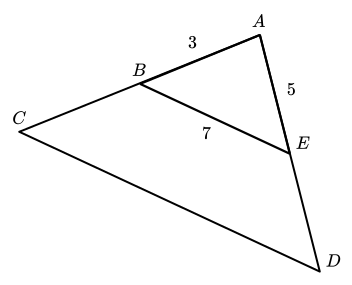
a Consider the given diagram.
We are told that BE is a midsegment of △ ACD. This means that triangles △ ABE and △ ACD are similar with a length scale factor of 2. This also means that the perimeter of △ ACD is twice that of △ ABE.
P_(△ ACD) = 2 P_(△ ABE)
Therefore, we can find the perimeter of △ ACD by first finding the perimeter of △ ABE. Since we are given all the side lengths of △ ABE, we can easily find its perimeter by adding them up.
P_(△ ABE) = 3 + 7 + 5 = 13
Next, let's substitute the found value of P_(△ ABE) into the equation relating it to the value of P_(△ ACD).
b Let's recall that the area scale factor between similar figures is a square of their linear scale factor.
Area scale factor
=
( Length scale factor )^2In Part A we found that the triangles △ ABE and △ ACD are similar with a length scale factor of 2. This means that the area of the bigger one is 2^2 = 4 times larger than the first one.
A_(△ ACD)= 4 A_(△ ABE)
Since we are given that A_(△ ABE) is 6.5units^2, we can substitute this value into equation above and solve the other area.