Draw a vertical segment from the point to the x-axis.
C
c
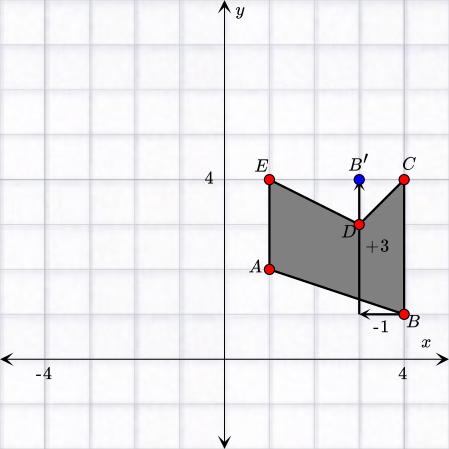
Move the point one unit to the left and three units up.
A
a
(- 1,- 2)
B
b
(4,- 4)
C
c
(3,4)
Practice makes perfect
a
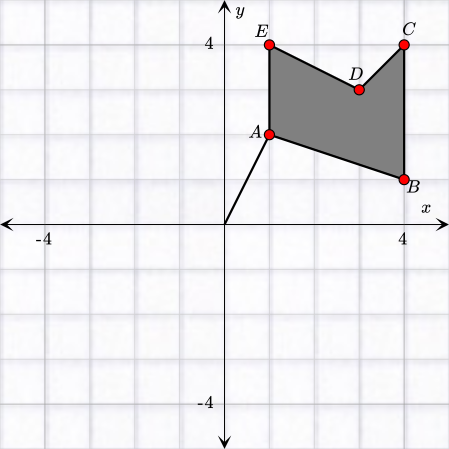
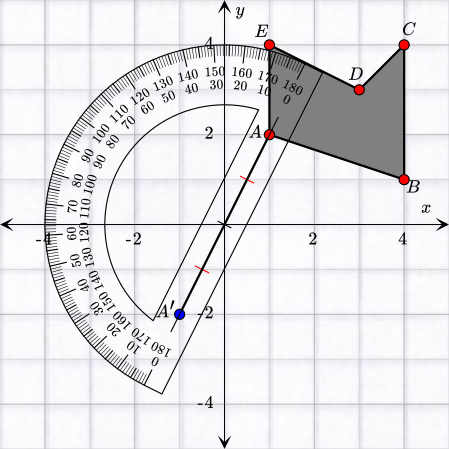
For this purpose, we will only rotate A by 180^(∘) and not the entire shape. To perform the rotation, we will use a protractor. Draw a segment from the point to the origin.
Next, use your protractor to measure a 180^(∘) angle with the drawn segment. Then, extend your segment so that it has the same length as the first.
Observing the diagram, we see that A' has the coordinates (- 1,- 2).
b
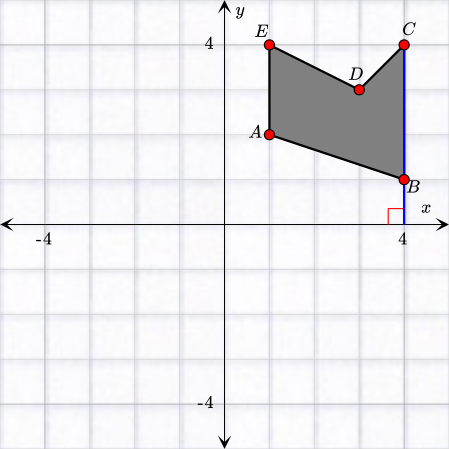
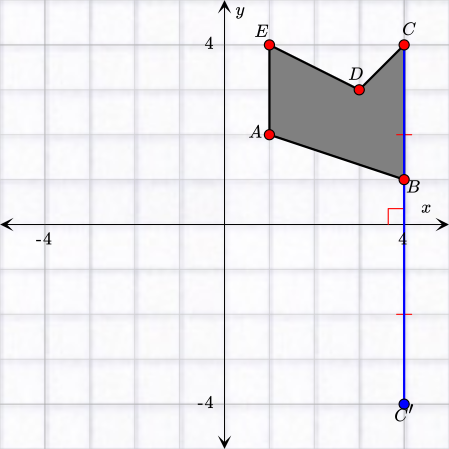
For this purpose, we will only reflect C across the x-axis and not the entire shape. To perform the reflection, draw a vertical segment from the point to the x-axis.
Next, extend your segment to the opposite side of the x-axis until it has the same length as the first.
Observing the diagram, we see that C' has the coordinates (4,- 4).
c
Like in Parts A and B, we will only translate point B by moving it one unit in the negative horizontal direction and three units in the positive vertical direction.
Observing the diagram, we see that B' has the coordinates (3,4).