8. Application of Trigonometric Ratios
Sign In
An error ocurred, try again later!
Chapter 2
8.
Application of Trigonometric Ratios
Trigonometry is not merely a collection of abstract concepts; it permeates our daily experiences. The lesson sheds light on the pivotal role of trigonometry, especially as it relates to right triangles, in real-world contexts. Whether determining distances in navigation, analyzing architectural designs, or decoding the mechanics of objects in motion, the applications of trigonometry are vast and varied. Furthermore, by focusing on right triangles, one gains a deeper appreciation for the foundational relationships that guide various phenomena in our environment. Embracing these principles can lead to a more informed perspective on both the natural and man-made world around us.
Show less Show more expand_more 


Lesson Settings & Tools
| | 10 Theory slides |
| | 9 Exercises - Grade E - A |
| | Each lesson is meant to take 1-2 classroom sessions |
Application of Trigonometric Ratios
Slide of 10
The trigonometry of a right triangle, along with the Pythagorean Theorem, can be used to solve a wide range of real-world problems. In this lesson, some cases will be presented.
Catch-Up and Review
Here are a few recommended readings before getting started with this lesson.
Try your knowledge on these topics.
a Choose the correct values of sine, cosine, and tangent of θ.
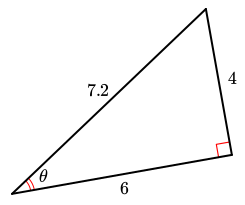
{"type":"pair","form":{"alts":[[{"id":0,"text":"sin\u03b8"},{"id":1,"text":"cos \u03b8"},{"id":2,"text":"tan \u03b8"}],[{"id":0,"text":"4\/7.2"},{"id":1,"text":"6\/7.2"},{"id":2,"text":"4\/6"}]],"lockLeft":false,"lockRight":false},"formTextBefore":"","formTextAfter":"","answer":[[0,1,2],[0,1,2]]}
b Find the measure of acute angle ∠ 1. Round your answer to the closest degree.
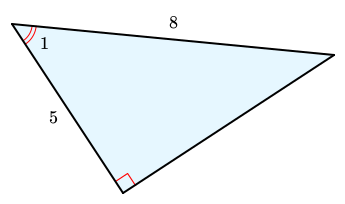
{"type":"text","form":{"type":"math","options":{"comparison":"1","nofractofloat":false,"keypad":{"simple":true,"useShortLog":false,"variables":["x"],"constants":["PI"]},"rendered":false},"text":" "},"formTextBefore":"m∠ 1=","formTextAfter":"^(∘)","answer":{"text":["51"]}}
c Write the given expressions in terms of sine or cosine. Write your answer without the degree symbol.
{"type":"text","form":{"type":"math","options":{"comparison":"1","nofractofloat":false,"keypad":{"simple":false,"useShortLog":false,"variables":["x"],"constants":["PI"]},"rendered":false},"text":" "},"formTextBefore":"sin 34^(∘)=","formTextAfter":null,"answer":{"text":["\\cos(56)"]}}
{"type":"text","form":{"type":"math","options":{"comparison":"1","nofractofloat":false,"keypad":{"simple":false,"useShortLog":false,"variables":["x"],"constants":["PI"]},"rendered":false},"text":" "},"formTextBefore":"cos 51^(∘)=","formTextAfter":null,"answer":{"text":["\\sin(39)"]}}
d Determine the value of x that makes the equation true.
cos 28^(∘)=sin x^(∘)
{"type":"text","form":{"type":"math","options":{"comparison":"1","nofractofloat":false,"keypad":{"simple":true,"useShortLog":false,"variables":["x"],"constants":["PI"]},"rendered":false},"text":" "},"formTextBefore":"x=","formTextAfter":null,"answer":{"text":["62"]}}
Challenge
Share
Report error
Measuring Depths Using Trigonometry
A submarine sailed underwater near a whale that was swimming 9 feet deeper than the submarine. A sonar on that submarine measured the angles of depression to the whale's mouth and tail to be 42^(∘) and 14^(∘), respectively.
How can the sailors use this information to measure the length of the whale?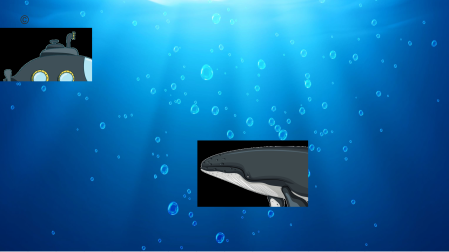
Example
Share
Report error
Measuring Heights Using Trigonometry
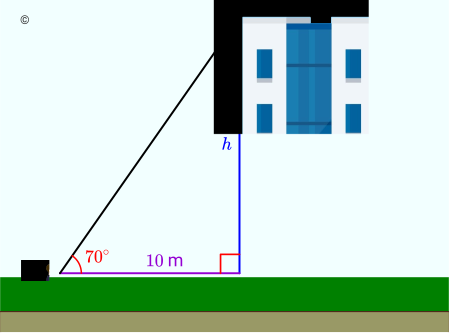
On the way to work, a man started wondering how tall his office building is. Suppose he is standing 10 meters from the building, looking up toward the rooftop at an approximate angle of 70^(∘). What is the height of the building?

External credits: @freepik
{"type":"text","form":{"type":"math","options":{"comparison":"1","nofractofloat":false,"keypad":{"simple":true,"useShortLog":false,"variables":["x"],"constants":["PI"]},"rendered":false},"text":" "},"formTextBefore":"Height=","formTextAfter":"m","answer":{"text":["27.5"]}}
Hint
Draw an angle at which the man is looking at the top of the building. Which trigonometric ratio can be used to find the building's height?
Solution
Start by drawing an angle at which the man is looking at the top of the building. Then identify a right triangle.
External credits: @freepik
tan 70^(∘) = h/10
MultEqn
LHS * 10=RHS* 10
10tan 70^(∘) = h
RearrangeEqn
Rearrange equation
h = 10tan 70^(∘)
UseCalc
Use a calculator
h = 27.474774...
RoundDec
Round to 1 decimal place(s)
h ≈ 27.5
Example
Share
Report error
Measuring Angles Using Trigonometry
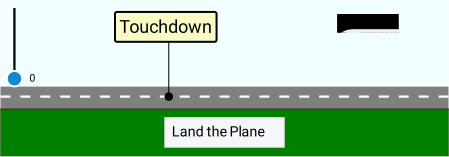
A plane arriving at O'Hare International Airport is 34 meters above the ground and 280 meters from the expected touchdown point on a runway. At what angle is the plane supposed to descend to land successfully? 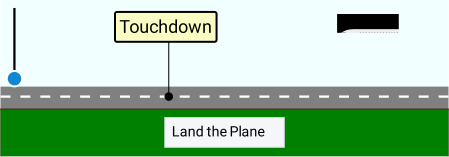 Round the answer to the closest degree.
 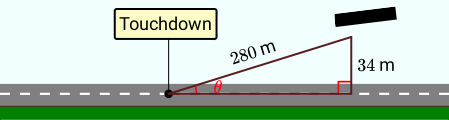 Since the lengths of the opposite side and the hypotenuse are given, the angle of descent can be calculated by using the sine ratio.
sin θ &=Opposite/Hypotenuse & ⇓ sin θ &= 34/280
To solve this equation for θ, the inverse of sine can be used.
Therefore, in order to land successfully, the plane should descend at an angle of 7^(∘).
Since the lengths of the opposite side and the hypotenuse are given, the angle of descent can be calculated by using the sine ratio.
sin θ &=Opposite/Hypotenuse & ⇓ sin θ &= 34/280
To solve this equation for θ, the inverse of sine can be used.
Therefore, in order to land successfully, the plane should descend at an angle of 7^(∘).
{"type":"text","form":{"type":"math","options":{"comparison":"1","nofractofloat":false,"keypad":{"simple":true,"useShortLog":false,"variables":["x"],"constants":["PI"]},"rendered":false},"text":" "},"formTextBefore":"Angle of Descent=","formTextAfter":"^(∘)","answer":{"text":["7"]}}
Hint
Draw a right triangle so that the hypotenuse shows the expected path of the plane's descent. Analyze which side length is given to determine which trigonometric ratio should be used.
Solution
First, draw a right triangle, whose hypotenuse shows the expected path of descent of the plane and label the given distances on the diagram.
sin θ = 34/280
ReduceFrac
a/b=.a /2./.b /2.
sin θ = 17/140
sin^(-1)(LHS) = sin^(-1)(RHS)
θ = sin^(-1) 17/140
UseCalc
Use a calculator
θ = 6.974556...
RoundDec
Round to 1 decimal place(s)
θ ≈ 7^(∘)
Discussion
Share
Report error
Investigating Angles of Elevations and Depressions
In the previous two examples, the angles mentioned can be called the angle of elevation and angle of depression, respectively. To be able to refer to these angles, they should first be properly defined.
Concept
Share
Report error
Angle of Elevation
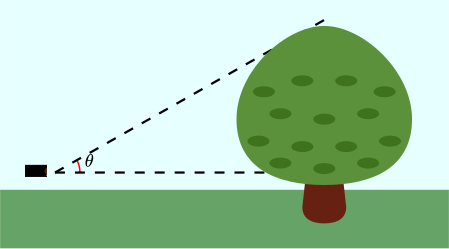
An angle of elevation is defined as an angle between the horizontal plane and oblique line from the observer's eye to some object above. Suppose someone is standing on the ground looking up toward the top of a tree.
Concept
Share
Report error
Angle of Depression
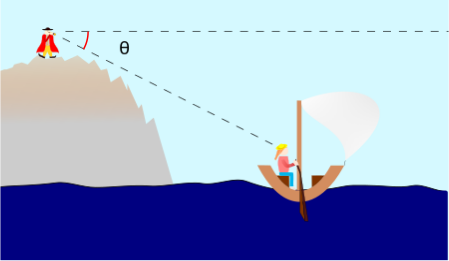
An angle of depression is defined as an angle between the horizontal plane and oblique line from the observer's eye to some object below. Suppose someone is standing on a cliff looking down toward a ship in the ocean below.
Example
Share
Report error
Using Angles of Depressions to Solve Problems
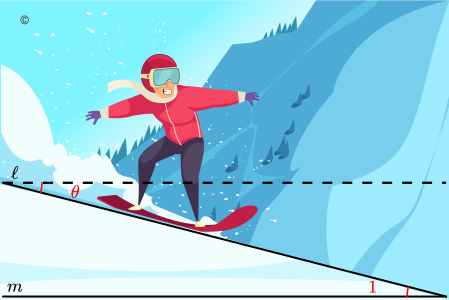
A snowboarder is sliding down a ski hill that is 870 feet long. Its angle of depression is 12^(∘). What is the height of the ski hill?

{"type":"text","form":{"type":"math","options":{"comparison":"1","nofractofloat":false,"keypad":{"simple":true,"useShortLog":false,"variables":["x"],"constants":["PI"]},"rendered":false},"text":" "},"formTextBefore":"Height=","formTextAfter":"ft","answer":{"text":["181"]}}
Hint
Which trigonometric ratio describes the ratio between the height and the length of the ski hill in relation to the angle of depression?
Solution
It is given that the angle of depression of the ski hill is 12^(∘). That angle can be identified on the diagram as ∠ θ. To determine the height of the hill, a line parallel to l can be drawn at the bottom of the hill. By the Alternate Interior Angles Theorem, ∠ θ and ∠ 1 are congruent angles.
External credits: @macrovector
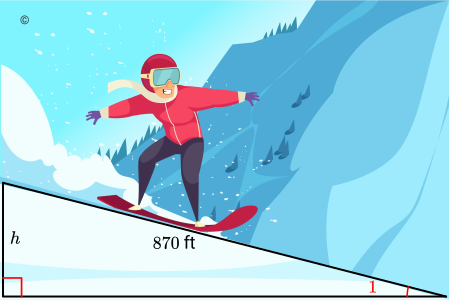
It is also known that the length of the ski hill is 870 feet. Let h represent the height of the hill.
External credits: @macrovector
sin m∠ 1 = h/870
Substitute
m∠ 1= 12^(∘)
sin 12^(∘) = h/870
▼
Solve for h
MultEqn
LHS * 870=RHS* 870
870sin 12^(∘) = h
RearrangeEqn
Rearrange equation
h = 870sin 12^(∘)
UseCalc
Use a calculator
h = 180.883171...
RoundInt
Round to nearest integer
h ≈ 181
Example
Share
Report error
Using Angles of Elevations to Solve Problems
Mark, who plays fútbol for South High School, takes a shot into a 10-foot tall goal post. The ball travels at a 30-degree angle of elevation toward the center of the goal. 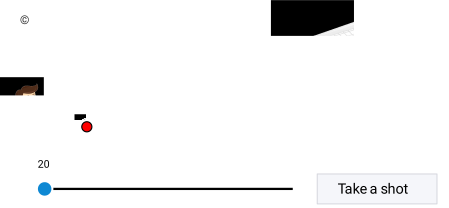 Find the farthest Mark's position from the goal post at which he can still score. Round the answer to the first decimal place.
 Use the Pythagorean Theorem to calculate the distance that the ball travels. Round the answer to the closest integer. 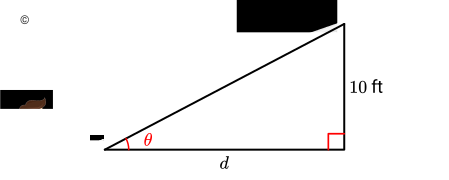 Using the tangent of θ, the distance d can be calculated.
tan θ = 10/d
Substitute θ with 30^(∘) and solve the equation for d.
Therefore, standing 17.3 feet away from the goal post is the farthest position from which Mark can score a goal.
Using the tangent of θ, the distance d can be calculated.
tan θ = 10/d
Substitute θ with 30^(∘) and solve the equation for d.
Therefore, standing 17.3 feet away from the goal post is the farthest position from which Mark can score a goal. 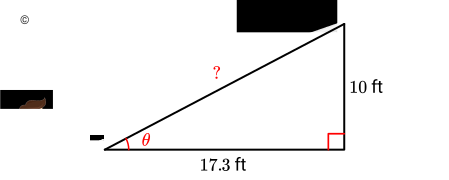 Next, using the Pythagorean Theorem, the distance that the ball travels can be determined. Note that the lengths of the triangle's legs are known, so they can be substituted into the formula.
a^2+b^2=c^2 ⇓ 10^2+17.3^2=c^2
Now, the equation needs to be solved for c.
It was derived that if Mark takes a shot 17.3 feet away from the goal post, the ball will travel approximately 20 feet.
Next, using the Pythagorean Theorem, the distance that the ball travels can be determined. Note that the lengths of the triangle's legs are known, so they can be substituted into the formula.
a^2+b^2=c^2 ⇓ 10^2+17.3^2=c^2
Now, the equation needs to be solved for c.
It was derived that if Mark takes a shot 17.3 feet away from the goal post, the ball will travel approximately 20 feet.
External credits: @macrovector
{"type":"text","form":{"type":"math","options":{"comparison":"1","nofractofloat":false,"keypad":{"simple":true,"useShortLog":false,"variables":["x"],"constants":["PI"]},"rendered":false},"text":" "},"formTextBefore":null,"formTextAfter":"ft","answer":{"text":["17.3"]}}
{"type":"text","form":{"type":"math","options":{"comparison":"1","nofractofloat":false,"keypad":{"simple":true,"useShortLog":false,"variables":["x"],"constants":["PI"]},"rendered":false},"text":" "},"formTextBefore":null,"formTextAfter":"ft","answer":{"text":["20"]}}
Hint
Draw a right triangle formed by the ball and the goal post. Analyze the given side length and angle measures to determine which trigonometric ratio should be used.
Solution
Draw a right triangle based on the position of the ball and the goal post. In order to score, the ball should not rise higher than 10 feet. Therefore, to find the farthest position of Mark from the goal post, let one leg of the triangle be 10 feet long.
External credits: @macrovector
External credits: @macrovector
10^2+17.3^2=c^2
▼
Solve for c
CalcPow
Calculate power
100+299.29=c^2
AddTerms
Add terms
399.29=c^2
RearrangeEqn
Rearrange equation
c^2=399.29
SqrtEqn
sqrt(LHS)=sqrt(RHS)
c=19.982242...
RoundInt
Round to nearest integer
c≈ 20
Example
Share
Report error
Real Life Applications of Trigonometry
A family has a 7-foot tall sliding-glass door leading to the backyard. They want to buy an awning for the door that will be long enough to keep the Sun out when the Sun is at its highest point with an angle of elevation of 75^(∘).
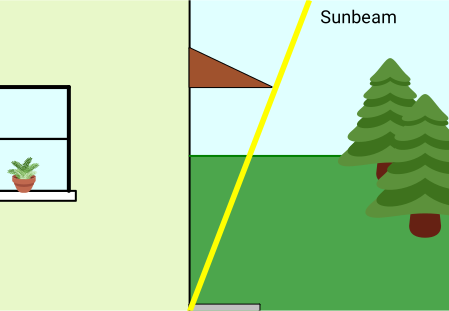
{"type":"text","form":{"type":"math","options":{"comparison":"1","nofractofloat":false,"keypad":{"simple":true,"useShortLog":false,"variables":["x"],"constants":["PI"]},"rendered":false},"text":" "},"formTextBefore":"Length=","formTextAfter":"ft","answer":{"text":["1.9"]}}
Hint
Identify parallel lines and use the corresponding theorem to find the measure of an interior angle of a right triangle. Which trigonometric ratio can be used to find the length of the awning?
Solution
First, note that the concrete entrance way is parallel to the awning, so by the Alternate Interior Angles Theorem, ∠ 1 and the 75-degree angle are congruent angles.
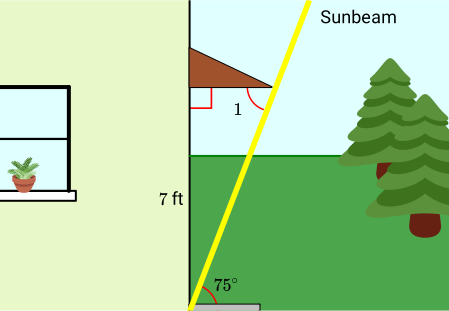
cot 75^(∘) = l/7
MultEqn
LHS * 7=RHS* 7
7cot 75^(∘) = l
RearrangeEqn
Rearrange equation
l = 7cot 75^(∘)
UseCalc
Use a calculator
l = 1.875644...
RoundDec
Round to 1 decimal place(s)
l ≈ 1.9
Example
Share
Report error
Using Trigonometry to Measure Distances on Earth
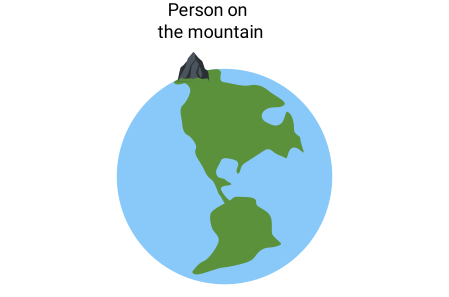
A mountaineer is planning to climb the highest mountain in the US, Denali, located in Alaska. When she reaches the peak, she wonders if she would be able to see the most eastern point of Russia, about 660 miles away from Denali.
{"type":"choice","form":{"alts":["The curvature does block her line of sight.","The curvature does not block her line of sight."],"noSort":false},"formTextBefore":"","formTextAfter":"","answer":0}
{"type":"text","form":{"type":"math","options":{"comparison":"1","nofractofloat":false,"keypad":{"simple":true,"useShortLog":false,"variables":["x"],"constants":["PI"]},"rendered":false},"text":" "},"formTextBefore":"Angle of Depression=","formTextAfter":"^(∘)","answer":{"text":["87"]}}
Hint
Use the Pythagorean Theorem to find the distance from the top of the mountain to the horizon. The angle of depression can be found using one of the trigonometric ratios.
Solution
The exercise will be solved in two steps. First, the distance to the horizon will be calculated to find the answer to the given question. Then, the angle of depression will be determined.
Finding the Distance to the Horizon
Begin by representing the problem with a diagram. The horizon, or the farthest point the person could see, is the point where the line of sight of the mountaineer is tangent to the circle of the Earth. Let point C represent the center of the globe.
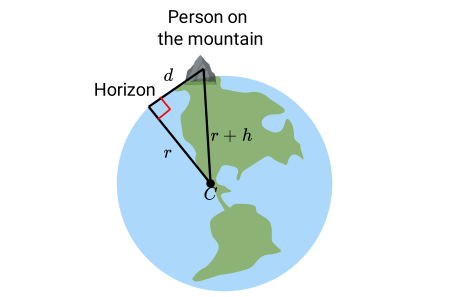
r^2+d^2=(r+h)^2
▼
Solve for d
SubEqn
LHS-r^2=RHS-r^2
d^2=(r+h)^2-r^2
ExpandPosPerfectSquare
(a+b)^2=a^2+2ab+b^2
d^2=r^2+2rh+h^2-r^2
SubTerm
Subtract term
d^2=2rh+h^2
SqrtEqn
sqrt(LHS)=sqrt(RHS)
d=sqrt(2rh+h^2)
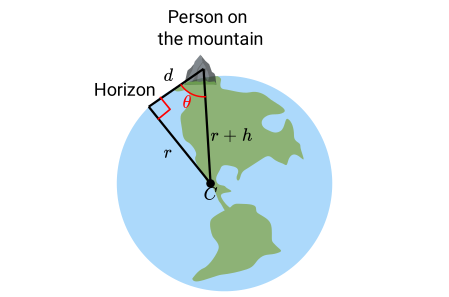
Finding the Angle of Depression
Next, to find the angle of depression from the top of the mountain to the horizon, any of the trigonometric ratios can be used.
Closure
Share
Report error
Measuring the Length of the Whale
Throughout the lesson, different real-life problems have been solved using trigonometric ratios. Through the use of the learned methods, the challenge presented at the beginning can now be solved.
A submarine sailed underwater near a whale that was swimming 9 feet deeper than the submarine. A sonar on that submarine measured the angles of depression to the whale's mouth and tail to be 42^(∘) and 14^(∘), respectively.
How can the sailors use this information to measure the length of the whale?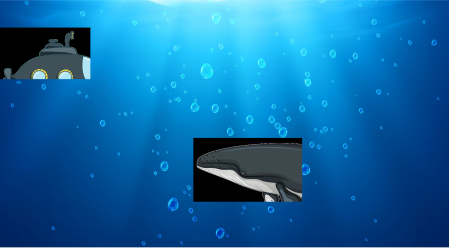
{"type":"text","form":{"type":"math","options":{"comparison":"1","nofractofloat":false,"keypad":{"simple":true,"useShortLog":false,"variables":["x"],"constants":["PI"]},"rendered":false},"text":" "},"formTextBefore":"Length=","formTextAfter":"ft","answer":{"text":["26"]}}
Hint
Use one of the trigonometric ratios to determine the horizontal distance from the submarine to the whale's nose and tale.
Solution
It is given that the angle of depression from the submarine to the whale's front is 42^(∘). Mark this information on the diagram and form a corresponding right triangle.
Using the tangent ratio, the horizontal distance from the submarine to the whale labeled as d_1 can be found.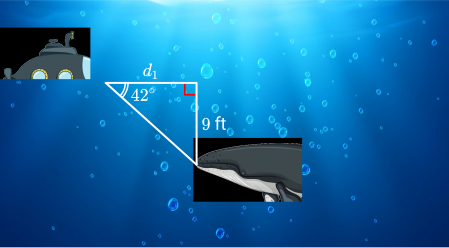
tan 42^(∘) = 9/d_1
d_1≈ 10
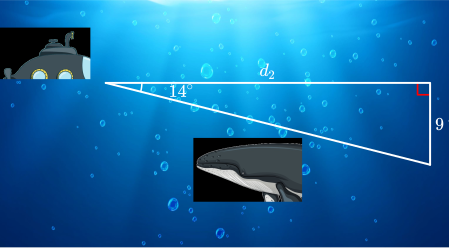
tan 14^(∘) = 9/d_2
d_2≈ 36
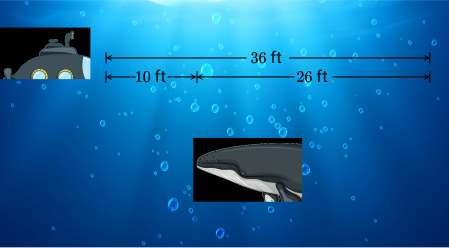
Application of Trigonometric Ratios
Exercise 3.1
Ignacio has just gotten a job as a mountain guide at Mount Hakusan in Japan. Part of the job is knowing interesting facts about the mountain, such as the height of the peak. His very first guest asks him this exact question. Unfortunately, he does not know, and his phone's internet connection is out of service! He does not want to ask anybody either because that feels too embarrassing.

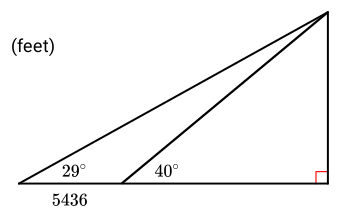
Instead, he decides to measure the angle of elevation from two different locations. This will give him enough information to determine the height of the mountain before the guest becomes weary of his skills as a mountain guide.
{"type":"text","form":{"type":"math","options":{"comparison":"1","nofractofloat":false,"keypad":{"simple":true,"useShortLog":false,"variables":["x"],"constants":["PI"]},"rendered":false},"text":" "},"formTextBefore":null,"formTextAfter":"feet","answer":{"text":["8900"]}}
security
report
code
security
report
code
Let's take a look at the given diagram. We will name the vertices of the triangles with consecutive letters.
Since both △ ACD and △ ACB are right triangles, we can use trigonometric ratios to solve for z. With the given information, we can use the tangent ratio to create two equations forming a system of equations. tan 40^(∘)= zy tan 29^(∘)= z5436+y Let's solve this system of equations using the Substitution Method. Our first step will be to isolate z in the first equation.
Next, we will substitute the value of z into the second equation.
The height of Mount Hakusan is roughly 8900 feet. Phew, that was a close call. We just helped save Ignacio's mountain guiding cred.
security
report
code
Application of Trigonometric Ratios
Recommended exercises
To get personalized recommended exercises, please login first.
Loading content
≤
>
■2
■▢
e▢
7
8
9
×
÷■1
=
=
√▢
▢√
∫▢▢
4
5
6
+
−
≤
<
log
ln
log▢
1
2
3
()
∣
sin
cos
tan
0
.
π
x
y
Loading content