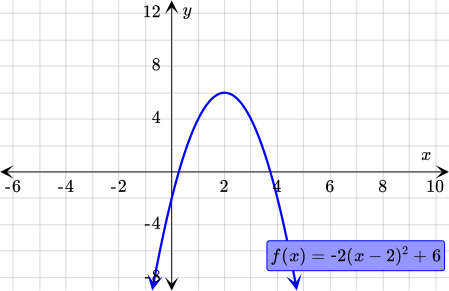
b Start by rewriting the quadratic function in the standard form.
A
aVertex: (2,6) Maximum or minimum point?: Maximum
B
b
Practice makes perfect
a We want to identify the vertex and decide whether it is the maximum or minimum point of the given quadratic function. Note that the formula is already expressed in graphing form, f(x)=a(x-h)^2+k, where a, h, and k are either positive or negative numbers.
f(x)=- 2(x-2)^2+6
It is important to note that we do not need to graph the parabola to identify the desired information. Let's compare the general formula for the graphing form to our equation.
General Formula:f(x)=& a(x- h)^2+k
Equation:f(x)=& - 2(x- 2)^2+6
We can see that a= - 2, h= 2, and k=6.
The vertex of a quadratic function written in graphing form is the point ( h,k). For this exercise, we have h= 2 and k=6. Therefore, the vertex of the given equation is ( 2,6).
Maximum or Minimum Value
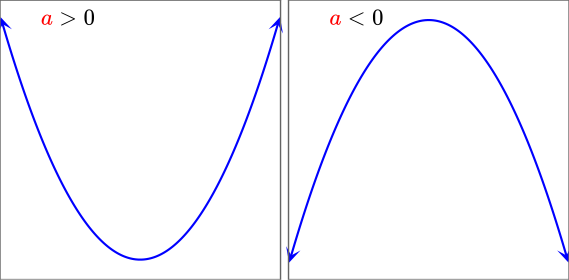
Before we determine if the vertex is the maximum or minimum point recall that if a>0 the parabola opens upwards. Conversely, if a<0 the parabola opens downwards.
In the given function we have a= - 2, which is less than 0. Thus, the parabola opens downwards and we will have a maximum value.
The vertex is always the lowest or the highest point on the graph. Therefore, in this case, the vertex represents the maximum value of the function.
b To draw the graph of the given function we will follow five steps.
Rewrite the quadratic function in standard form and identify the values of a, b, and c.
To draw the graph of the given quadratic function written in standard form, we need to start by identifying the values of a, b, and c.
f(x)=- 2x^2+8x-2
⇕
f(x)=- 2x^2+8x+(- 2)
We can see that a=- 2, b=8, and c=- 2. Now, we will follow five steps to graph the function.
Finding the Axis of Symmetry
The axis of symmetry is a vertical line with equation x=- b2a. Since we already know the values of a and b, we can substitute them into the formula.
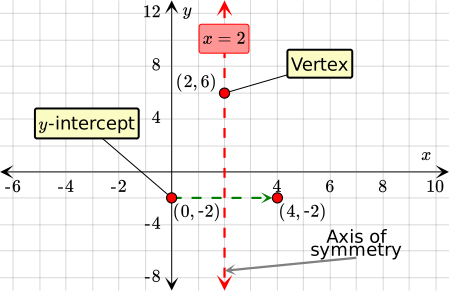
The axis of symmetry of the parabola is the vertical line with equation x=2.
Calculating the Vertex
We can write the expression for the vertex by stating the x- and y-coordinates in terms of a and b.
Vertex: ( - b/2a, f( - b/2a ) )
Note that the formula for the x-coordinate is the same as the formula for the axis of symmetry, which is x=2. Thus, the x-coordinate of the vertex is also 2. To find the y-coordinate we need to substitute 2 for x in the given equation.
We found the y-coordinate, and now we know that the vertex is (2,6).
Identifying the y-intercept and its Reflection
The y-intercept of the graph of a quadratic function written in standard form is given by the value of c. Thus, the point where our graph intercepts the y-axis is (0,- 2). Let's plot this point and its reflection across the axis of symmetry.
Connecting the Points
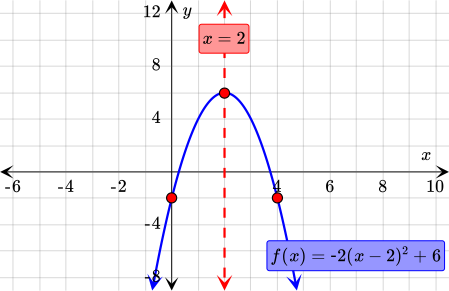
We can now draw the graph of the function. Since a=- 2, which is negative, the parabola will open downwards. Let's connect the three points with a smooth curve.
We found that the vertex is (2,6) and it represents the maximum value of the function. Thus, our results in Part A were correct.