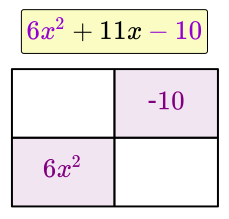
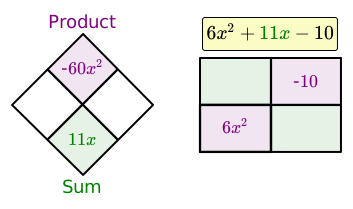
To solve the equation with the Zero Product Property, we want to rewrite the left-hand side in factored form. To do that we can use a generic rectangle and a diamond problem. We know that 6x^2 and -10 go into the lower left and upper right corners of the generic rectangle, respectively.
To fill in the remaining two corners we need two x-terms that have a sum of 11x and a product of -60x^2.
Notice that the product is negative. This means one factor must be positive and the other must be negative.
|c|c|c|r|c|
[-1em]
Product & ax(bx) & ax+bx & Sum & 11x? [0.2em]
[-0.7em]
-60x^2 & - 3x(20x) &- 3x+20x& 17x & * [0.3em]
-60x^2 & -20x(3x) &-20x+3x& -17x & * [0.3em]
-60x^2 & -4x(15x) &-4x+15x& 11x & ✓ [0.3em]
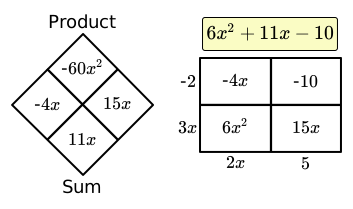
When one factor is -4x and the other is 15x, we have a product of -60x^2 and a sum of 11x. Now we can complete the diamond and generic rectangle.
To factor the left-hand side we add each side of the generic rectangle and multiply the sums.
6x^2+11x-10=0
⇓
(3x-2)(2x+5)=0
To solve the equation, we will use the Zero Product Property.
Zero Product Property:& x= 23 or x=- 52 [1.5em]
Quadratic Formula:& x= 23 or x=- 52
The solutions match, which means we have calculated them correctly in both cases.