Sign In
The two angles are complementary.
Consider the Triangle Angle Sum Theorem.
Consider the Vertical Angles Theorem.
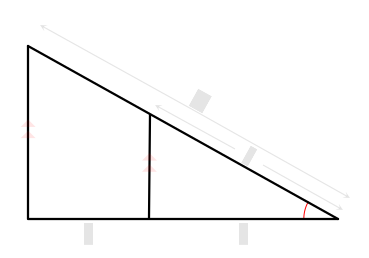
First prove that the triangles are similar.
x=18.4^(∘)
Geometric relationships: See solution.
m=42.25^(∘)
Geometric relationships: See solution.
k=6^(∘)
Geometric relationships: See solution.
x≈ 9.85
Geometric relationships: See solution.
The two angles are complementary because they form a right angle when added. Therefore, we can set the sum of their expressions equal to 90^(∘).
By the Triangle Angle Sum Theorem, we know that the sum of a triangles angles equals 180^(∘).
Remove parentheses
Add and subtract terms
LHS-11^(∘)=RHS-11^(∘)
.LHS /4.=.RHS /4.
The two angles are vertical angles which means they are congruent by the Vertical Angles Theorem.
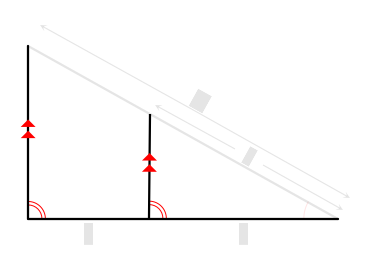
In the diagram, we can make out two triangles. To calculate x, we first have to show that they are similar. This means they have at least two pairs of congruent angles. First, we notice that they share an angle
Since two pairs of angles are congruent, we can claim that the triangles are similar by the AA Similarity condition. Having proved the triangles similar, we can write and solve an equation for x.

LHS * 16=RHS* 16
a/c* b = a* b/c
Use a calculator
Round to 2 decimal place(s)