5. Changes in Dimensions
Sign In
An error ocurred, try again later!
Chapter 11
5.
Changes in Dimensions
When the dimensions of geometric figures change, it impacts their perimeters, areas, and volumes. The Perimeters of Similar Polygons Theorem helps determine how the perimeter of one figure relates to the perimeter of a similar figure. Likewise, the areas of similar figures and the surface areas of similar solids follow proportional relationships based on the scale factor. The volume of similar solids also changes with the cube of the scale factor. Understanding these relationships is essential in geometry, where objects are often resized for various applications in fields like architecture, engineering, and design. By applying these theorems, it becomes easier to solve real-world problems involving the scaling of figures and solids while maintaining accuracy in measurements.
Show less Show more expand_more 


Lesson Settings & Tools
| | 12 Theory slides |
| | 11 Exercises - Grade E - A |
| | Each lesson is meant to take 1-2 classroom sessions |
Changes in Dimensions
Slide of 12
Many people enjoy collecting miniature versions of famous characters or historical structures. These tiny copies are scale models of the originals — in other words, the model and the original figure are similar. This lesson will cover the characteristics of similar figures and explain how to calculate their measurements based on a specific scale.
Catch-Up and Review
Here are a few recommended readings before getting started with this lesson.
Explore
Share
Report error
How Do the Dimensions of Similar Figures Change After a Scale?
Tadeo is interested in making miniature models of various objects. He wants to know more about how the dimensions of similar figures change depending on the scale. Consider the applet below, which displays two similar triangles.
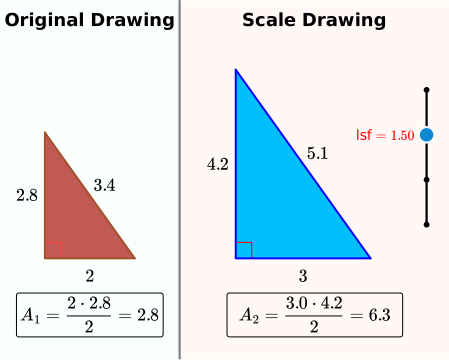 Tadeo changes the length scale factor (lsf) and examines how the area of the blue triangle changes.
- What conclusions could Tadeo draw from the applet?
- How are the scale factor and the ratio between the areas of the triangles related?
Discussion
Share
Report error
Relations Between the Similar Polygons
Two polygons are said to be similar if their corresponding sides are proportional and their corresponding angles are congruent. Because of this, there is a relation between the perimeters of similar polygons.
Rule
Share
Report error
Perimeters of Similar Polygons Theorem
If two polygons are similar, then the ratio of their perimeters is equal to the ratio of their corresponding side lengths.
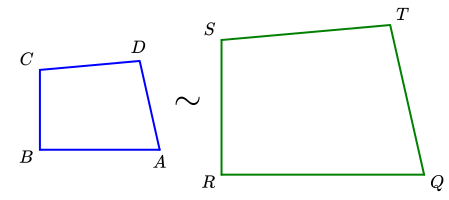
Let P_1 and P_2 be the perimeters of QRST and ABCD, respectively. Let ab be the scale factor between corresponding side lengths. Then, based on the above diagram, the following relation holds true.
ABCD ~ QRST ⇒ P_1/P_2 =a/b
Proof
Let QRST and ABCD be two similar polygons with perimeters P_1 and P_2, respectively. By the definition of similar polygons, corresponding side lengths are proportional, with the scale factor ab as the common ratio.
QR/AB=a/b [0.8em]
RS/BC=a/b [0.8em]
ST/CD=a/b [0.8em]
TQ/DA=a/b ⇔ QR = a/b * AB [0.8em]
RS = a/b * BC [0.8em]
ST = a/b * CD [0.8em]
TQ = a/b * DA
If the equations are added together, the left-hand side of the resulting equation will give the perimeter of QRST. The right-hand side will give the scale factor times the perimeter of ABCD.
Finally, the Perimeters of Similar Polygons Theorem is obtained by dividing both sides by P_2.
QR+RS+ST+TQ=a/b * AB+a/b * BC+a/b * CD+a/b * DA
FactorOut
Factor out a/b
QR+RS+ST+TQ=a/b (AB+BC+CD+DA)
SubstituteII
QR+RS+ST+TQ= P_1, AB+BC+CD+DA= P_2
P_1=a/b * P_2
P_1=a/b * P_2 ⇔ P_1/P_2=a/b
Example
Share
Report error
Making a Miniature Model of a Basketball Court
Tadeo likes playing basketball. He decides to make a miniature model of a basketball court with a length of 32 centimeters.
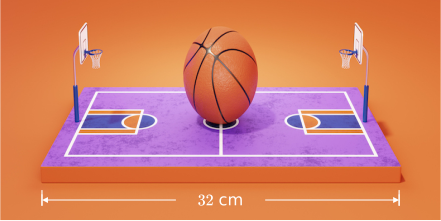
External credits: freepik
A standard basketball court has a length of 28 meters and a width of 15 meters.
a Calculate the scale factor in this model. Write the answer in the simplest fraction form.
{"type":"text","form":{"type":"math","options":{"comparison":"1","nofractofloat":false,"keypad":{"simple":true,"useShortLog":false,"variables":["x"],"constants":["PI"]},"rendered":false},"text":" "},"formTextBefore":null,"formTextAfter":null,"answer":{"text":["2\/175"]}}
{"type":"text","form":{"type":"math","options":{"comparison":"1","nofractofloat":false,"keypad":{"simple":true,"useShortLog":false,"variables":["x"],"constants":["PI"]},"rendered":false},"text":" "},"formTextBefore":"About","formTextAfter":"cm","answer":{"text":["98"]}}
Solution
a The miniature model of the basketball court will be a scale model of a real court, so the model and its original can be thought of as similar polygons. Therefore, their side lengths will be proportional and equal to the scale factor.
Scale factor=Length of model/Actual length
SubstituteValues
Substitute values
Scale factor=32/2800
ReduceFrac
a/b=.a /16./.b /16.
Scale factor=2/175
b To calculate the perimeter of the model, first find the perimeter of the real basketball court.
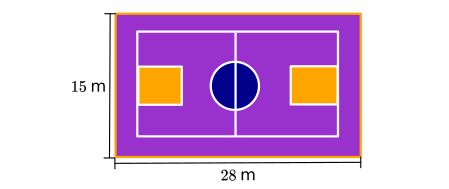
P_1/P_2=Scale factor
SubstituteII
P_2= 86, Scale factor= 2/175
P_1/86= 2/175
MultEqn
LHS * 86=RHS* 86
P_1=2/175 * 86
MoveRightFacToNum
a/c* b = a* b/c
P_1=172/175
CalcQuot
Calculate quotient
P_1=0.982857 ...
RoundDec
Round to 2 decimal place(s)
P_1 ≈ 0.98
Discussion
Share
Report error
Areas of Similar Figures
Like with perimeters, there is a relation between the areas of similar polygons.
If two figures are similar, then the ratio of their areas is equal to the square of the ratio of their corresponding side lengths.
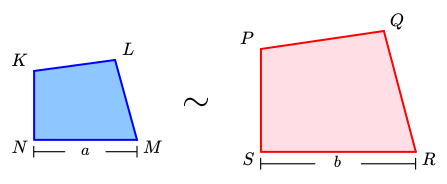
Let KLMN and PQRS be similar figures, and A_1 and A_2 be their respective areas. The length scale factor between corresponding side lengths is ab. Here, the following conditional statement holds true.
KLMN ~ PQRS ⇒ A_1/A_2 = (a/b )^2
Proof
The statement will be proven for similar rectangles, but this proof can be adapted for other similar figures.
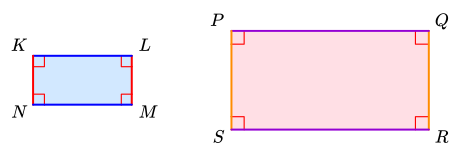
The area of a rectangle is the product of its length and its width.
| Area of KLMN | Area of PQRS |
|---|---|
| A_1 = KL* LM | A_2 = PQ * QR |
A_1 = KL* LM
SubstituteII
KL= PQ * a/b, LM= QR * a/b
A_1 = ( PQ * a/b) ( QR * a/b)
▼
Simplify right-hand side
RemovePar
Remove parentheses
A_1 = PQ * a/b * QR * a/b
CommutativePropMult
Commutative Property of Multiplication
A_1 = a/b * a/b * PQ * QR
ProdToPowTwoFac
a* a=a^2
A_1 = (a/b )^2 * PQ * QR
AssociativePropMult
Associative Property of Multiplication
A_1 = (a/b )^2(PQ * QR)
A_1 = (a/b )^2( PQ* QR)
Substitute
PQ* QR= A_2
A_1 = (a/b )^2 A_2
DivEqn
.LHS /A_2.=.RHS /A_2.
A_1/A_2 = (a/b )^2
Scale Factor & & Area Scale Factor a/b & ⇒ & A_1/A_2 = (a/b )^2
Example
Share
Report error
Making a Miniature Model of a Spectator Stand
Now Tadeo wants to build a miniature spectator stand for his miniature basketball stadium. He plans to use the following stand as a model.
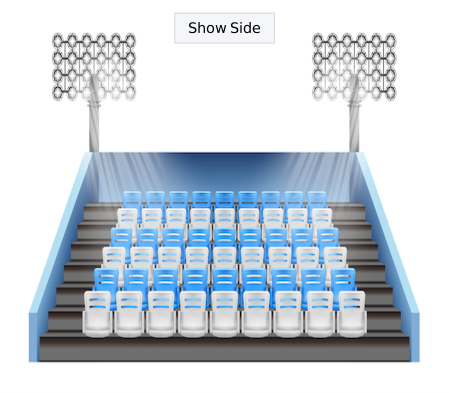 When viewed from the side, the stand looks like a right triangle. Tadeo knows that its hypotenuse is 5 meters long and its height is 3 meters.
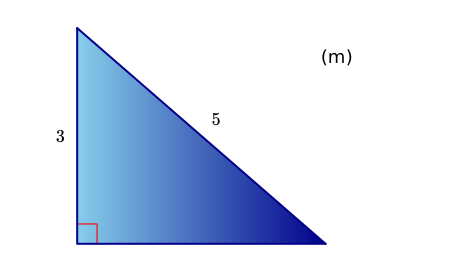 The scale model of the stand and the real stand have to be similar figures, so they have the same ratio between their corresponding side lengths. This ratio is called the scale factor.
Scale factor=Length of model/Actual length
Tadeo wants to create the model with a 12-centimeter height. He knows that the height of the real stand is 3 meters. Before finding the scale factor, both lengths must be in the same units. To achieve this, convert the height of the real stands from meters to centimeters.
3 m * 100 cm/1 m=300 cm
Now the ratio of the height of the model to the corresponding actual height can be calculated.
The scale factor of the model will be 125, or 1:25. This means that the dimensions of the model stand will be 25 times smaller than the dimensions of the real stand.
The scale model of the stand and the real stand have to be similar figures, so they have the same ratio between their corresponding side lengths. This ratio is called the scale factor.
Scale factor=Length of model/Actual length
Tadeo wants to create the model with a 12-centimeter height. He knows that the height of the real stand is 3 meters. Before finding the scale factor, both lengths must be in the same units. To achieve this, convert the height of the real stands from meters to centimeters.
3 m * 100 cm/1 m=300 cm
Now the ratio of the height of the model to the corresponding actual height can be calculated.
The scale factor of the model will be 125, or 1:25. This means that the dimensions of the model stand will be 25 times smaller than the dimensions of the real stand.
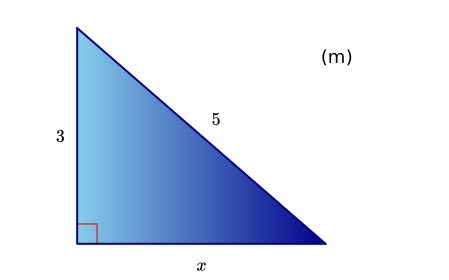 Since it is a right triangle, the Pythagorean theorem can be used to find x.
The base length of the triangular figure is 4 meters. Now, calculate the area of the triangle as half of the product of the base and height.
The area of the triangular side of the real stand is 6 square meters. Recall that if two figures are similar, then the ratio of their areas is equal to the square of the ratio of their corresponding side lengths.
A_1/A_2=(l_1/l_2)^2=k^2
The ratio of the corresponding side lengths is equal to the length scale factor, so in this case, k= 125. The square of this scale factor can be used to find the area of the model's triangular side.
The area of the model's triangular side is 0.0096 square meters. Finally, convert it to square centimeters.
0.0096 m^2 * 10 000 cm^2/1 m^2=96 cm^2
The area of the triangular side of Tadeo's model is 96 square centimeters.
Since it is a right triangle, the Pythagorean theorem can be used to find x.
The base length of the triangular figure is 4 meters. Now, calculate the area of the triangle as half of the product of the base and height.
The area of the triangular side of the real stand is 6 square meters. Recall that if two figures are similar, then the ratio of their areas is equal to the square of the ratio of their corresponding side lengths.
A_1/A_2=(l_1/l_2)^2=k^2
The ratio of the corresponding side lengths is equal to the length scale factor, so in this case, k= 125. The square of this scale factor can be used to find the area of the model's triangular side.
The area of the model's triangular side is 0.0096 square meters. Finally, convert it to square centimeters.
0.0096 m^2 * 10 000 cm^2/1 m^2=96 cm^2
The area of the triangular side of Tadeo's model is 96 square centimeters.
External credits: macrovector
a Tadeo makes his scale model stand with a height of 12 centimeters. Calculate the scale factor in this model. Write the answer in the simplest fraction form.
{"type":"text","form":{"type":"math","options":{"comparison":"1","nofractofloat":false,"keypad":{"simple":true,"useShortLog":false,"variables":["x"],"constants":["PI"]},"rendered":false},"text":" "},"formTextBefore":null,"formTextAfter":null,"answer":{"text":["1\/25"]}}
b Calculate the triangular side area of the miniature spectator stand.
{"type":"text","form":{"type":"math","options":{"comparison":"1","nofractofloat":false,"keypad":{"simple":true,"useShortLog":false,"variables":["x"],"constants":["PI"]},"rendered":false},"text":" "},"formTextBefore":null,"formTextAfter":"cm^2","answer":{"text":["96"]}}
Solution
a The real spectator stand looks like a right triangle from a side perspective.
Scale factor=Length of model/Actual length
SubstituteValues
Substitute values
Scale factor=12/300
ReduceFrac
a/b=.a /12./.b /12.
Scale factor=1/25
b Before calculating the side area of the model spectator stand, calculate the side area of the actual stand. This requires finding the length of the other leg.
x^2+y^2=z^2
SubstituteII
y= 3, z= 5
x^2+( 3)^2=( 5)^2
▼
Solve for x
CalcPow
Calculate power
x^2+9=25
SubEqn
LHS-9=RHS-9
x^2=16
SqrtEqn
sqrt(LHS)=sqrt(RHS)
sqrt(x^2)=sqrt(16)
SqrtPowToNumber
sqrt(a^2)=a
x=sqrt(16)
CalcPow
Calculate power
x=4
A= 1/2bh
SubstituteII
b= 4, h= 3
A= 1/2* 4 * 3
Multiply
Multiply
A= 1/2* 12
MoveRightFacToNumOne
1/b* a = a/b
A=12/2
CalcQuot
Calculate quotient
A=6
A_1/A_2=k^2
SubstituteII
A_2= 6, k= 1/25
A_1/6=( 1/25 )^2
▼
Solve for A_1
PowQuot
(a/b)^m=a^m/b^m
A_1/6=1^2/25^2
CalcPow
Calculate power
A_1/6=1/625
MultEqn
LHS * 6=RHS* 6
A_1=1/625 * 6
MoveRightFacToNumOne
1/b* a = a/b
A_1=6/625
CalcQuot
Calculate quotient
A_1=0.0096
Pop Quiz
Share
Report error
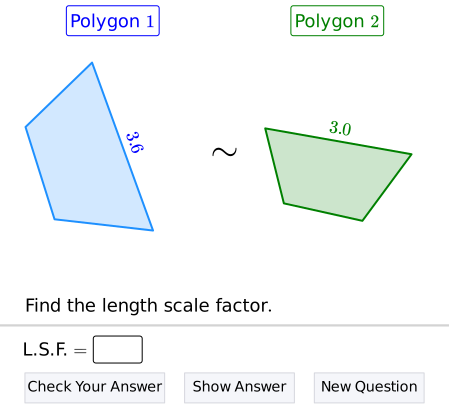
Finding the Length Scale, Perimeter, or Area of Similar Polygons
Consider two similar polygons. Use the given information to find the scale factor, perimeter, or area of either of the polygons. Keep in mind that the given length scale factor corresponds to the ratio of Polygon 2 to Polygon 1. Round the answer to two decimal places if necessary.
Discussion
Share
Report error
Surface Areas of Similar Solids
If two figures are similar, then the ratio of their surface areas is equal to the square of the ratio of their corresponding side lengths.
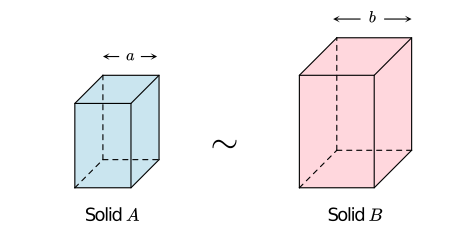
Let Solid A and Solid B be similar solids and SA_1 and SA_2 be their respective surface areas. The length scale factor between corresponding linear measures is ab. Given these characteristics, the following conditional statement holds true.
SolidA ~ SolidB ⇒ SA_1/SA_2 = (a/b)^2
Proof
The statement will be proven for similar rectangular prisms, but this proof can be adapted to prove other similar solids as well. As shown in the diagram, let a_1, a_2, and a_3 be the dimensions of Solid A and b_1, b_2, and b_3 be the dimensions of Solid B.
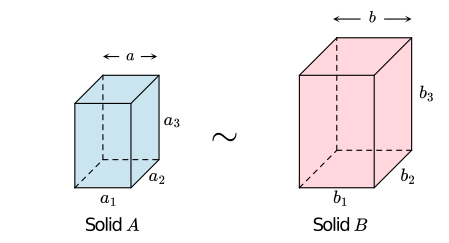
The surface area of a rectangular prism is the sum of the lateral area and the combined areas of the two identical bases. The lateral area of a rectangular prism consists of its four rectangular side areas. Notice that the areas of opposite faces are congruent.
| Surface Area of Solid A | Surface Area of Solid B |
|---|---|
| SA_1 =2( a_1* a_2 + a_1 * a_3+ a_2 * a_3 ) | SA_2 = 2( b_1* b_2 + b_1 * b_3+ b_2 * b_3 ) |
SA_1 = 2(a_1 * a_2 + a_1 * a_3+a_2 * a_3 )
SubstituteExpressions
Substitute expressions
SA_1 = 2 (( b_1 * a/b * b_2 * a/b ) + ( b_1 * a/b * b_3 * a/b) + ( b_2 * a/b * b_3 * a/b ) )
▼
Simplify right-hand side
CommutativePropMult
Commutative Property of Multiplication
SA_1 = 2 ((a/b * a/b * b_1 * b_2 ) + (a/b * a/b * b_1 * b_3 ) + ( a/b * a/b * b_2 * b_3 ) )
RemovePar
Remove parentheses
SA_1 = 2 (a/b * a/b * b_1 * b_2 + a/b * a/b * b_1 * b_3 + a/b * a/b * b_2 * b_3 )
ProdToPowTwoFac
a* a=a^2
SA_1 = 2 ( (a/b )^2 * b_1 * b_2 + (a/b )^2 * b_1 * b_3 + (a/b )^2 * b_2 * b_3 )
FactorOut
Factor out (a/b )^2
SA_1 = (a/b )^2 * 2 ( b_1 * b_2 + b_1 * b_3 + b_2 * b_3 )
SA_1 = (a/b )^2 * 2 ( b_1 * b_2 + b_1 * b_3 + b_2 * b_3 )
Substitute
2 ( b_1 * b_2 + b_1 * b_3 + b_2 * b_3 )= SA_2
SA_1 = (a/b )^2 * SA_2
DivEqn
.LHS /SA_2.=.RHS /SA_2.
SA_1/SA_2 = (a/b )^2
Scale Factor & & Surface Area Scale Factor a/b & ⇒ & SA_1/SA_2 = (a/b )^2
Example
Share
Report error
Designing a Miniature Basketball
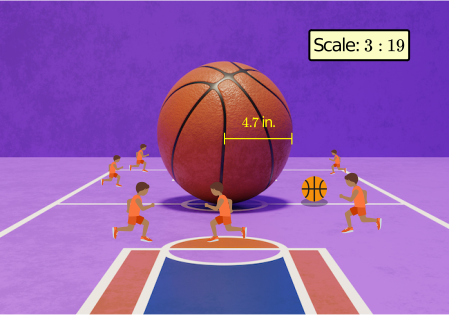
What does a basketball court need if not a basketball? Tadeo turns his attention to designing a miniature basketball for his miniature stadium.
External credits: freepik
He knows that the radius of a real basketball is 4.7 inches.
a If Tadeo determines the length scale factor of the miniature ball to the real ball to be 3:19, what will the surface area of the miniature ball be? Round the answer to the nearest integer.
{"type":"text","form":{"type":"math","options":{"comparison":"1","nofractofloat":false,"keypad":{"simple":true,"useShortLog":false,"variables":["x"],"constants":["PI"]},"rendered":false},"text":" "},"formTextBefore":"About","formTextAfter":"in.^2","answer":{"text":["7"]}}
b Calculate the radius of the miniature ball. Round the answer to two decimal places.
{"type":"text","form":{"type":"math","options":{"comparison":"1","nofractofloat":false,"keypad":{"simple":true,"useShortLog":false,"variables":["x"],"constants":["PI"]},"rendered":false},"text":" "},"formTextBefore":"About","formTextAfter":"in.","answer":{"text":["0.74"]}}
Hint
a Use the formula for the surface area of a sphere. If two figures are similar, then the ratio of their surface areas is equal to the square of the ratio of their corresponding side lengths.
b The ratio of the radius of the model ball to the radius of the actual ball is equal to the length scale factor.
Solution
a Since the model basketball is a scale model of a real one, the real basketball and the model are similar spheres. As such, the ratio of their surface areas is equal to the square of the ratio of their corresponding side lengths, or the scale factor k.
SA_1/SA_2=k^2
SubstituteII
S_2= 88.36π, k= 3/19
SA_1/88.36π=( 3/19 )^2
▼
Solve for SA_1
PowQuot
(a/b)^m=a^m/b^m
SA_1/88.36π=3^2/19^2
CalcPow
Calculate power
SA_1/88.36π=9/361
MultEqn
LHS * 88.36π=RHS* 88.36π
SA_1=9/361 * 88.36π
MoveRightFacToNum
a/c* b = a* b/c
SA_1=9 * 88.36π/361
UseCalc
Use a calculator
SA_1=6.920554 ...
RoundInt
Round to nearest integer
SA_1 ≈ 7
b Once again, use the scale factor to find the radius of the miniature ball. Since the miniature model of the ball and the real ball are similar figures, the ratio between their radii is equal to the scale factor.
r_1/r_2=Scale Factor
SubstituteII
r_2= 4.7, Scale Factor= 3/19
r_1/4.7= 3/19
▼
Solve for r_1
MultEqn
LHS * 4.7=RHS* 4.7
r_1=3/19 * 4.7
MoveRightFacToNum
a/c* b = a* b/c
r_1=3 * 4.7/19
Multiply
Multiply
r_1=14.1/19
CalcQuot
Calculate quotient
r_1=0.742105 ...
RoundDec
Round to 2 decimal place(s)
r_1 ≈ 0.74
Discussion
Share
Report error
Volumes of Similar Solids
As with side lengths and perimeters, there is a relation between the volumes of the similar figures.
If two figures are similar, then the ratio of their volumes is equal to the cube of the ratio of their corresponding side lengths.
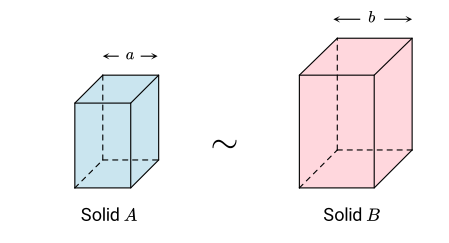
Let Solid A and Solid B be similar solids and V_1 and V_2 be their respective volumes. The length scale factor between corresponding linear measures is ab. Given these characteristics, the following conditional statement holds true.
SolidA ~ SolidB ⇒ V_1/V_2 = (a/b)^3
Proof
The statement will be proven for similar rectangular prisms, but this proof can be adapted to prove other similar solids. As shown in the diagram, let a_1, a_2, and a_3 be the dimensions of Solid A and b_1, b_2, and b_3 be the dimensions of Solid B.
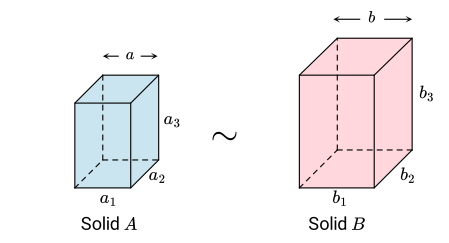
The volume of a rectangular prism is the product of its base area and its height.
| Volume of Solid A | Volume of Solid B |
|---|---|
| V_1 = a_1* a_2 * a_3 | V_2 = b_1 * b_2 * b_3 |
V_1 = a_1 * a_2 * a_3
SubstituteExpressions
Substitute expressions
V_1 = ( b_1 * a/b) ( b_2 * a/b) ( b_3 * a/b)
▼
Simplify right-hand side
RemovePar
Remove parentheses
V_1 = b_1 * a/b * b_2 * a/b * b_3 * a/b
CommutativePropMult
Commutative Property of Multiplication
V_1 = a/b * a/b * a/b * b_1 * b_2 * b_3
ProdToPowThreeFac
a* a* a=a^3
V_1 = (a/b )^3 * b_1 * b_2 * b_3
AssociativePropMult
Associative Property of Multiplication
V_1 = (a/b )^3 (b_1 * b_2 * b_3)
V_1 = (a/b )^3 (b_1 * b_2 * b_3)
Substitute
b_1 * b_2 * b_3= V_2
V_1 = (a/b )^3 V_2
DivEqn
.LHS /V_2.=.RHS /V_2.
V_1/V_2 = (a/b )^3
Scale Factor & & Volume Scale Factor a/b & ⇒ & V_1/V_2 = (a/b )^3
Example
Share
Report error
Designing a Miniature Model of a Stadium
Finally, Tadeo plans to model the exterior of his miniature stadium after his favorite basketball team's stadium.

{"type":"text","form":{"type":"math","options":{"comparison":"1","nofractofloat":false,"keypad":{"simple":true,"useShortLog":false,"variables":["x"],"constants":["PI"]},"rendered":false},"text":" "},"formTextBefore":"About","formTextAfter":"m^3","answer":{"text":["1.13"]}}
Hint
If two figures are similar, then the ratio of their volumes is equal to the cube of the ratio of their corresponding side lengths.
Solution
Since the miniature stadium is a scale model, the actual stadium and the miniature stadium are similar solids. Recall that the ratio of the volumes of similar solids is equal to the cube of the length scale factor k. Note that the scale factor is equal to the ratio of the corresponding side lengths. V_1/V_2=(l_1/l_2)^3=k^3
The length scale factor is k=7:122 and the volume of the real stadium is 6000 cubic meters. Then, the volume of the miniature stadium can be found by substituting V_2=6000 and k=7:122 into the formula and solving for V_1.
The volume of the miniature stadium will be about 1.13 cubic meters.
V_1/V_2=k^3
SubstituteII
V_2= 6000, k= 7/122
V_1/6000=( 7/122 )^3
▼
Solve for V_1
PowQuot
(a/b)^m=a^m/b^m
V_1/6000=343/1 815 848
MultEqn
LHS * 6000=RHS* 6000
V_1=343/1 815 848 * 6000
MoveRightFacToNum
a/c* b = a* b/c
V_1=2 058 000/1 815 848
CalcQuot
Calculate quotient
V_1=1.133354 ...
RoundDec
Round to 2 decimal place(s)
V_1 ≈ 1.13
Closure
Share
Report error
Miniature Basketball Players
Tadeo wants to complete his miniature basketball stadium with the tiny basketball players. As he places his collection of action figures of his favorite team, he thinks about the real heights and weights of the players. For one particular player, the toy figure is 3.1 centimeters tall, while the real life counterpart player is about 2.06 meters tall.

{"type":"choice","form":{"alts":["Yes","No"],"noSort":false},"formTextBefore":"","formTextAfter":"","answer":1}
Hint
What is the length scale factor between the action figure and the human basketball player? Find the basketball player's weight using this equation. Does it make sense for a basketball player to weigh this much?
Solution
Start by determining the length scale factor, the ratio of the given lengths. Both lengths need to have the same units of measure, so remember to convert meters to centimeters using the conversion factor 100 cm1 m.
2.06 m * 100 cm/1 m=206 cm
Now the two centimeter lengths can be used to write the length scale factor k.
k=3.1/206
Tadeo claims that the weights of the action figure and the human player are proportional to the cube of the scale factor k because they are similar solids.
w_1/w_2 = k^3
Calculate the weight of the player using this information. The action figure of player weighs 0.02 pounds, so substitute the weight of the action figure and the scale factor into the equation.
According to these calculations, the human basketball player must weigh about 5869 pounds! 😱 Tadeo knows that even the heaviest NBA player of all time weighed about 375 pounds.
ccc Calculated Weight of Similar Figures && Maximum Actual Weight 5869 & &375
The calculated value does not make sense because the density of an action figure and the density of a person are different. This means that the weights of the action figure and the player are not directly related to the volume scale factor.
Changes in Dimensions
Exercise 1.1
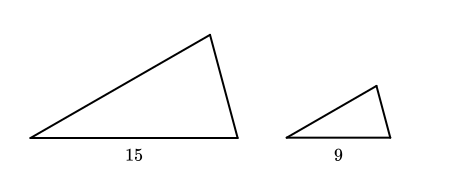
The given pairs of figures are similar. Express the length scale factor between the figures as a fraction in simplest form.
{"type":"text","form":{"type":"math","options":{"comparison":"1","nofractofloat":false,"keypad":{"simple":true,"useShortLog":false,"variables":["x"],"constants":["PI"]},"rendered":false},"text":" "},"formTextBefore":null,"formTextAfter":null,"answer":{"text":["5\/3","3\/5"]}}
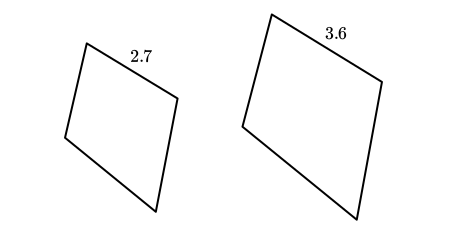
{"type":"text","form":{"type":"math","options":{"comparison":"1","nofractofloat":false,"keypad":{"simple":true,"useShortLog":false,"variables":["x"],"constants":["PI"]},"rendered":false},"text":" "},"formTextBefore":null,"formTextAfter":null,"answer":{"text":["3\/4","4\/3"]}}
security
report
code
security
report
code
We want to find the length scale factor between the given triangles.
Since the triangles are similar, we can express the scale factor as a ratio of the corresponding side lengths. 15/9 Notice that the numerator and denominator of the fraction have common factors. Let's simplify it!
The scale factor 53 refers to the ratio of the side length of the larger triangle to the corresponding side length of the smaller triangle. Alternatively, we can express the scale factor as the ratio of the side length of the smaller triangle to the corresponding side length of the larger triangle. 5/3 or 3/5
We want to find the scale factor between the corresponding side lengths of the given similar quadrilaterals.
We can calculate the scale factor by dividing the side length of the larger quadrilateral by the corresponding side length of the smaller quadrilateral. 2.7/3.6 Let's simplify this fraction.
We can also express this scale factor as its multiplicative inverse to show the scale factor of the bigger figure to the smaller figure. 3/4 or 4/3
security
report
code
The figure will be enlarged by a scale factor of 2.4.
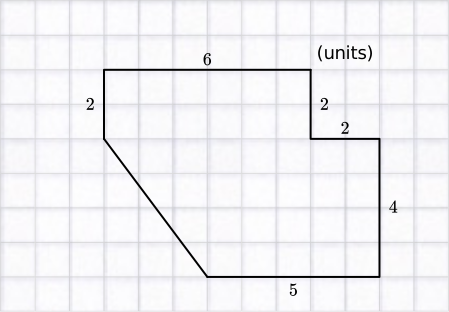
{"type":"text","form":{"type":"math","options":{"comparison":"1","nofractofloat":false,"keypad":{"simple":true,"useShortLog":false,"variables":["x"],"constants":["PI"]},"rendered":false},"text":" "},"formTextBefore":null,"formTextAfter":"units","answer":{"text":["62.4"]}}
security
report
code
security
report
code
Let's start by finding the perimeter of the given figure.
First, we need to find the missing side length. To do so, we can create a right triangle where the missing side length is its hypotenuse.
Next, let's apply the Pythagorean theorem.
The missing diagonal length is 5 units. Now that we know all the side lengths of the figure, we can add up all seven side lengths to find the perimeter of the figure. 5+2+6+2+2+4+5= 26 The perimeter of the figure is 26 units. We know that the figure will be enlarged by a length scale factor of 2.4. This means that each side length will be scaled by a factor of 2.4. Since the figures will be similar, we can consider the Perimeters of Similar Polygons Theorem.
If two polygons are similar, then the ratio of their perimeters is equal to the ratio of their corresponding side lengths.
If we let P_1 represent the perimeter of the given figure and P_2 represent the perimeter of the enlarged figure, then we can write the following proportion using the theorem. P_2/P_1 = k ⇒ P_2 = P_1 * k Let's multiply the perimeter of the figure by the given scale factor to find the perimeter of the enlarged figure. 26 * 2.4= 62.4 The perimeter of the enlarged figure will be 62.4 units.
security
report
code
A smaller copy of a school's 2 foot by 3 foot rectangular flag is being made for the front of the school's homework planner. The dimensions of the copy will be 18 of the school flag. What is the area of the copy? Round the answer to one decimal place.
{"type":"text","form":{"type":"math","options":{"comparison":"1","nofractofloat":false,"keypad":{"simple":true,"useShortLog":false,"variables":["x"],"constants":["PI"]},"rendered":false},"text":" "},"formTextBefore":"About","formTextAfter":"ft^2","answer":{"text":["0.1"]}}
security
report
code
security
report
code
We know that the dimensions of the smaller copy of the flag are 18 those of the original. We want to find the area of the smaller flag. Let's first calculate the area of the original flag. Since the flag is a rectangle, its area is the product of its width and length. Area of The Original Flag 2 * 3=6 The area of the original flag is 6 square feet. Since the flag and its smaller copy are similar figures, the ratio of their areas is equal to square of the ratio of the their corresponding side lengths, or the length scale factor. We are already given this value. Area of the smaller copy/Area of the original flag = ( 1/8)^2 Let's substitute the area of the original flag into the equation and calculate the area of the copy.
The area of the smaller flag is about 0.1 square feet.
security
report
code
Consider the following two similar cans.

{"type":"text","form":{"type":"math","options":{"comparison":"1","nofractofloat":false,"keypad":{"simple":true,"useShortLog":false,"variables":["x"],"constants":["PI"]},"rendered":false},"text":" "},"formTextBefore":null,"formTextAfter":"cm^2","answer":{"text":["1837.5"]}}
security
report
code
security
report
code
We can find the surface area of the larger can by using the surface area of the smaller can and the length scale factor because the cans are similar. The ratio between the surface areas of the figures is equal to square of the ratio of their corresponding side lengths. SA_1/SA_2=(l_1/l_2 )^2 The ratio of the corresponding side lengths is the same as the length scale factor, which for the cans is given as 2:7, or 27. SA_1/SA_2=( 2/7)^2 The surface area of the smaller can is 150 square centimeters. Since the scale factor is less than 1, we will represent the surface area of the smaller can as SA_1 and the larger one as SA_2.
Let's substitute the scale factor and the surface area of the smaller can into the equation and solve it for SA_2.
The surface area of the larger can is 1837.5 square centimeters.
security
report
code
The model of a new apartment building is shown. The architect plans for the actual building to be 150 times the size of the model.

{"type":"text","form":{"type":"math","options":{"comparison":"1","nofractofloat":false,"keypad":{"simple":true,"useShortLog":false,"variables":["x"],"constants":["PI"]},"rendered":false},"text":" "},"formTextBefore":null,"formTextAfter":"m^3","answer":{"text":["7087500"]}}
security
report
code
security
report
code
We want to find the volume of the apartment building given that its dimensions will be 150 times those of the model. In other words, the ratio between a length l_m in the model and its corresponding length l_r in the residence is 1150. l_m/l_r = 1/150 Since the model and the actual building will be similar figures, the ratio of the volumes must be the cube of the ratio of their corresponding side measures, or the scale factor between the figures. V_m/V_a=( 1/150)^3 Let's substitute the volume of the model into the above equation and solve it for V_a.
The volume of the new apartment building will be 7 087 500 cubic meters.
security
report
code
Determine whether the given cylinders are similar.
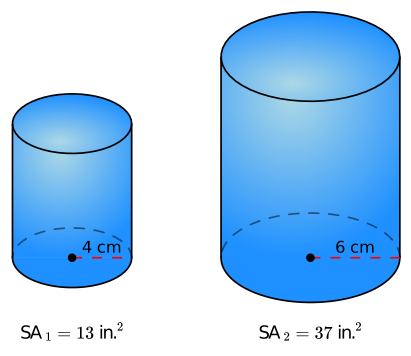
{"type":"choice","form":{"alts":["Yes, they are similar.","No, they are not similar."],"noSort":false},"formTextBefore":"","formTextAfter":"","answer":1}
security
report
code
security
report
code
We want to know if the given cylinders are similar. We are given their radii and surface areas. Recall that if two figures are similar, then the ratio of their surface areas is equal to square of the ratio of their corresponding length measures. SA_1/SA_2= (l_1/l_2 )^2 We know the radii and surface areas of the given cylinders.
| Radius (cm) | Surface Area (in.)^2 | |
|---|---|---|
| Cylinder 1 | r_1 = 4 | SA_1 = 13 |
| Cylinder 2 | r_2 = 6 | SA_2 = 37 |
Let's substitute these values into the equation and see if the equation holds.
As we can see, the ratio of the surface areas is not equal to the square of the ratio of the corresponding side lengths. Therefore, the cylinders are not similar solids.
security
report
code
Assume that two snails have similar shells. The volume of the older snail's shell is 12 cubic centimeters, while the volume of the younger snail's shell is 3 cubic centimeters.
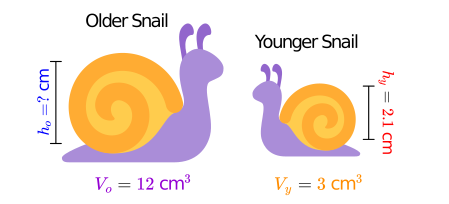
{"type":"text","form":{"type":"math","options":{"comparison":"1","nofractofloat":false,"keypad":{"simple":true,"useShortLog":false,"variables":["x"],"constants":["PI"]},"rendered":false},"text":" "},"formTextBefore":"About","formTextAfter":"cm","answer":{"text":["3.3"]}}
security
report
code
security
report
code
We want to find the height of the older snail's shell. Since the shells are similar, the ratio of their volumes is equal to the cube of the ratio of their corresponding lengths. Let's represent the height and volume of the younger snail as h_y and V_y, and those of the older snail as h_o and V_o, respectively. This gives us the following equation. V_o/V_y=(h_o/h_y)^3 We know that the height of the young snail's shell is 2.1 centimeters and its volume is 3 cubic centimeters. The volume of the older snail's shell is 12 cubic centimeters.
| Height (cm) | Volume (cm^3) | |
|---|---|---|
| Young Snail | 2.1 | 3 |
| Old Snail | h_o | 12 |
We can find the height of the shell of the older snail by substituting the given values into our equation. We can ignore the units because all the measures are given in centimeters. Let's solve for h_o!
The height of the shell of the older snail is about 3.3 centimeters.
security
report
code
Changes in Dimensions
Recommended exercises
To get personalized recommended exercises, please login first.
Loading content
≤
>
■2
■▢
e▢
7
8
9
×
÷■1
=
=
√▢
▢√
∫▢▢
4
5
6
+
−
≤
<
log
ln
log▢
1
2
3
()
∣
sin
cos
tan
0
.
π
x
y
Loading content