1. Using the Distance and Midpoint Formulas in Proofs
Sign In
An error ocurred, try again later!
Chapter 4
1.
Using the Distance and Midpoint Formulas in Proofs
The distance formula and midpoint formula are powerful tools in algebraically proving geometric theorems. The distance formula allows us to calculate the length between two points on a coordinate plane, using their coordinates. By substituting the coordinates into the formula, we can find the distance without the need for measuring tools. The midpoint formula, on the other hand, helps us find the coordinates of the midpoint of a line segment. It enables us to determine the point that divides the segment into two equal halves.
These formulas have various applications in geometry. The distance formula is useful in finding the lengths of line segments or sides of polygons. It is commonly used to prove properties of geometric figures, such as determining whether a quadrilateral is a parallelogram. By calculating the distances between the vertices, we can verify if the opposite sides are congruent and parallel.
The midpoint formula is essential in finding the coordinates of the midpoint of a line segment. It allows us to identify the point that lies exactly in the middle of the segment. This information is valuable when analyzing symmetry, congruence, or dividing a line segment into equal parts.
Both formulas eliminate the need for physical measurement tools like rulers or protractors. They provide an algebraic approach to geometry, offering a more precise and systematic way of proving theorems. By leveraging the distance formula and midpoint formula, we can establish geometric properties and relationships without relying on visual measurements.
In summary, the distance formula and midpoint formula play crucial roles in algebraically proving geometric theorems. They find applications in determining distances, classifying figures, finding midpoints, and proving properties of geometric shapes. These formulas offer an algebraic approach to geometry, enabling us to derive results without relying on physical measurements or visual approximations.
Show less Show more expand_more 


Lesson Settings & Tools
| | 12 Theory slides |
| | 15 Exercises - Grade E - A |
| | Each lesson is meant to take 1-2 classroom sessions |
Using the Distance and Midpoint Formulas in Proofs
Slide of 12
Drawing geometric figures on a coordinate plane allows to prove simple geometric theorems algebraically. In this lesson, several theorems will be proven algebraically.
Catch-Up and Review
Here are a few recommended readings before getting started.
- Coordinate plane
- Basic definitions
- Transformations
- Congruence
- Theorems about parallelograms
- Pythagorean Theorem
- Circles
Try your knowledge on these topics.
a State the coordinates of the points plotted on the plane.
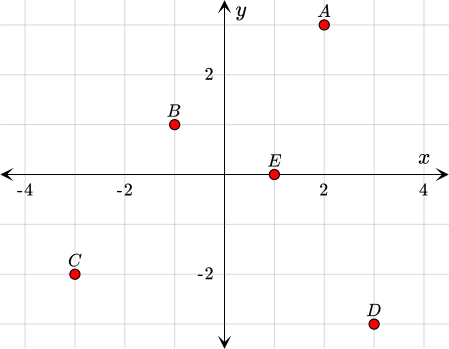
{"type":"text","form":{"type":"point2d","options":{"comparison":"1","nofractofloat":false,"keypad":{"simple":true,"useShortLog":false,"variables":[],"constants":[]},"rendered":false,"decimal":false,"function":false},"text":" "},"formTextBefore":"A=","formTextAfter":null,"answer":{"text1":"2","text2":"3"}}
{"type":"text","form":{"type":"point2d","options":{"comparison":"1","nofractofloat":false,"keypad":{"simple":true,"useShortLog":false,"variables":[],"constants":[]},"rendered":false,"decimal":false,"function":false},"text":" "},"formTextBefore":"B=","formTextAfter":null,"answer":{"text1":"-1","text2":"1"}}
{"type":"text","form":{"type":"point2d","options":{"comparison":"1","nofractofloat":false,"keypad":{"simple":true,"useShortLog":false,"variables":[],"constants":[]},"rendered":false,"decimal":false,"function":false},"text":" "},"formTextBefore":"C=","formTextAfter":null,"answer":{"text1":"-3","text2":"-2"}}
{"type":"text","form":{"type":"point2d","options":{"comparison":"1","nofractofloat":false,"keypad":{"simple":true,"useShortLog":false,"variables":[],"constants":[]},"rendered":false,"decimal":false,"function":false},"text":" "},"formTextBefore":"D=","formTextAfter":null,"answer":{"text1":"3","text2":"-3"}}
{"type":"text","form":{"type":"point2d","options":{"comparison":"1","nofractofloat":false,"keypad":{"simple":true,"useShortLog":false,"variables":[],"constants":[]},"rendered":false,"decimal":false,"function":false},"text":" "},"formTextBefore":"E=","formTextAfter":null,"answer":{"text1":"1","text2":"0"}}
b Match each concept with its corresponding diagram.
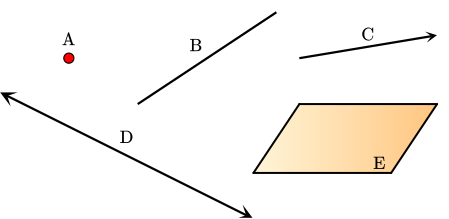
{"type":"pair","form":{"alts":[[{"id":0,"text":"Point"},{"id":1,"text":"Segment"},{"id":2,"text":"Ray"},{"id":3,"text":"Line"},{"id":4,"text":"Plane"}],[{"id":0,"text":"A"},{"id":1,"text":"B"},{"id":2,"text":"C"},{"id":3,"text":"D"},{"id":4,"text":"E"}]],"lockLeft":false,"lockRight":false},"formTextBefore":"","formTextAfter":"","answer":[[0,1,2,3,4],[0,1,2,3,4]]}
c True or false?
A parallelogram has exactly two pairs of parallel sides.
In a parallelogram, adjacent angles are congruent.
The four sides of a parallelogram are congruent.
In a parallelogram, opposite sides and opposite angles are congruent.
The diagonals of a parallelogram bisect each other.
Adjacent angles in a parallelogram are supplementary.
A parallelogram has exactly two pairs of parallel sides.
{"type":"choice","form":{"alts":["True","False"],"noSort":true},"formTextBefore":"","formTextAfter":"","answer":0}
{"type":"choice","form":{"alts":["True","False"],"noSort":true},"formTextBefore":"","formTextAfter":"","answer":1}
{"type":"choice","form":{"alts":["True","False"],"noSort":true},"formTextBefore":"","formTextAfter":"","answer":1}
{"type":"choice","form":{"alts":["True","False"],"noSort":true},"formTextBefore":"","formTextAfter":"","answer":0}
{"type":"choice","form":{"alts":["True","False"],"noSort":true},"formTextBefore":"","formTextAfter":"","answer":0}
{"type":"choice","form":{"alts":["True","False"],"noSort":true},"formTextBefore":"","formTextAfter":"","answer":0}
d Use the Pythagorean Theorem to find the missing side length.
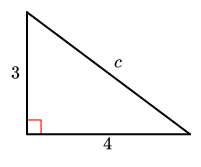
{"type":"text","form":{"type":"math","options":{"comparison":"1","nofractofloat":false,"keypad":{"simple":true,"useShortLog":false,"variables":[],"constants":[]},"rendered":false},"text":" "},"formTextBefore":"c=","formTextAfter":null,"answer":{"text":["5"]}}
Challenge
Share
Report error
Investigating the Properties of a Parallelogram
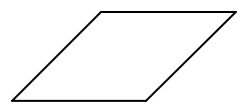
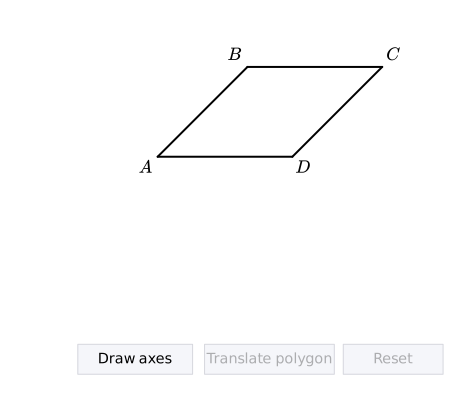
The figure below looks like a parallelogram.
Discussion
Share
Report error
Distance Formula
In certain situations, it is required to find the length of a line segment or a side of a polygon. To find those lengths, it is recommended to calculate the distance between the endpoints of the segment, or between two vertices of a polygon. If those points are plotted on a coordinate plane, the Distance Formula can be used.
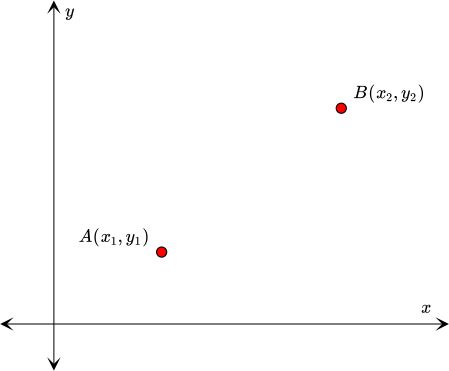
Given two points A(x_1, y_1) and B(x_2, y_2) on a coordinate plane, their distance d is given by the following formula.
d = sqrt((x_2-x_1)^2 + (y_2-y_1)^2)
Proof
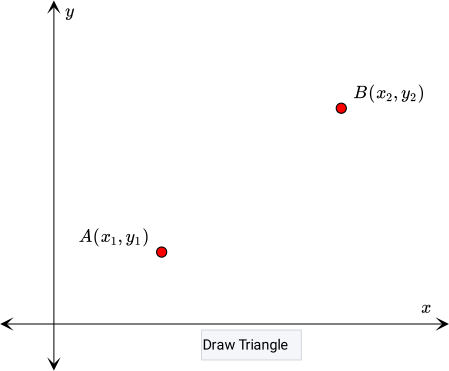
Start by plotting A(x_1,y_1) and B(x_2,y_2) on the coordinate plane. Both points can be arbitrarily plotted in Quadrant I for simplicity. Note that the position of the points in the plane does not affect the proof. Assume that x_2 is greater than x_1 and that y_2 is greater than y_1.
a^2+b^2=c^2
SubstituteII
a= x_2-x_1, b= y_2-y_1
( x_2-x_1)^2+( y_2-y_1)^2=c^2
▼
Solve for c
c=sqrt((x_2-x_1)^2+(y_2-y_1)^2)
Pop Quiz
Share
Report error
Practice Finding the Distance Between Two Coordinate Pairs
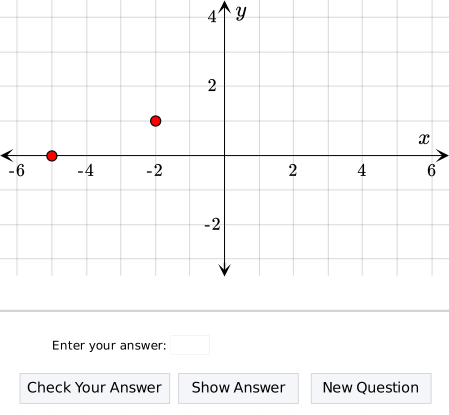
Use the Distance Formula to calculate the distance between the points plotted in the coordinate plane. If needed, round the answer to two decimal places.
Example
Share
Report error
Classifying a Parallelogram Using Its Coordinates
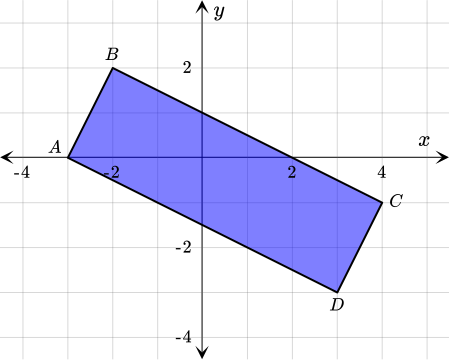
Ramsha and Davontay are learning to make picture frames so they want to determine whether the quadrilateral ABCD shown below is a rectangle.
{"type":"choice","form":{"alts":["Ramsha","Davontay"],"noSort":false},"formTextBefore":"","formTextAfter":"","answer":0}
Hint
Other than just using the Distance Formula, try the Converse of the Pythagorean Theorem to determine whether the angles of the quadrilateral are right angles.
Solution
If the four angles of the quadrilateral are right angles, then ABCD is a rectangle. First, it will be determined whether ∠ B is a right angle. To do so, start by drawing the diagonal AC and considering △ABC.
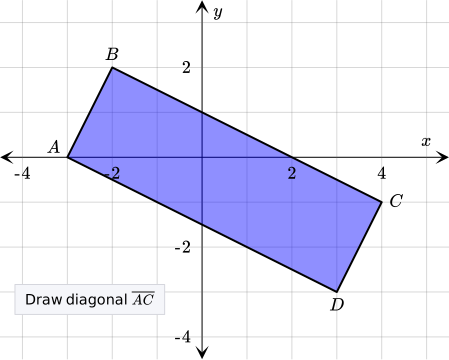 By the Converse of the Pythagorean Theorem, if AC squared is equal to the sum of the squares of AB and BC, then △ ABC is a right triangle. In this case, then ∠ B is a right angle. To find AC, the coordinates of A(- 3,0) and C(4,,- 1) will be substituted into the Distance Formula.
The distance d between A and C, and therefore the length of the diagonal AC, is 5sqrt(2). The same procedure can be used to find AB and BC.
By the Converse of the Pythagorean Theorem, if AC squared is equal to the sum of the squares of AB and BC, then △ ABC is a right triangle. In this case, then ∠ B is a right angle. To find AC, the coordinates of A(- 3,0) and C(4,,- 1) will be substituted into the Distance Formula.
The distance d between A and C, and therefore the length of the diagonal AC, is 5sqrt(2). The same procedure can be used to find AB and BC.
Finally, as previously mentioned, it needs to be seen whether AC squared is equal to the sum of the squares of AB and BC.
Since a true statement was obtained, it can be said that AC^2=AB^2+BC^2. By the Converse of the Pythagorean Theorem, △ABC is a right triangle. Therefore, ∠B is a right angle. 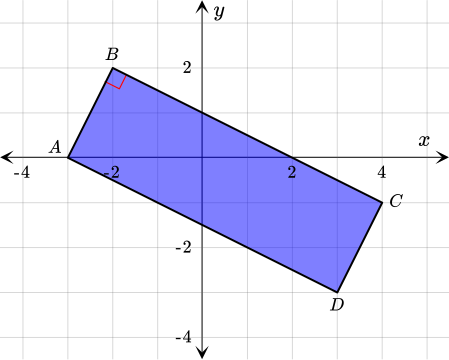
d = sqrt((x_2-x_1)^2 + (y_2-y_1)^2)
SubstitutePoints
Substitute ( - 3,0) & ( 4,- 1)
d=sqrt(( 4-( - 3))^2+( - 1- 0)^2)
d=5sqrt(2)
| d = sqrt((x_2-x_1)^2 + (y_2-y_1)^2) | |||
|---|---|---|---|
| Segment | Points | Substitute | Simplify |
| AC | A( - 3, 0) & C( 4, - 1) | AC= sqrt(( 4-( - 3))^2+( - 1- 0)^2) | AC= 5sqrt(2) |
| AB | A( - 3, 0) & B( - 2, 2) | AB= sqrt(( - 2-( - 3))^2+( 2- 0)^2) | AB= sqrt(5) |
| BC | B( - 2, 2) & C( 4, - 1) | BC= sqrt(( 4-( - 2))^2+( - 1- 2)^2) | BC= 3sqrt(5) |
AC^2? =AB^2+BC^2
SubstituteValues
Substitute values
( 5sqrt(2))^2? =( sqrt(5))^2+( 3sqrt(5))^2
50=50 ✓
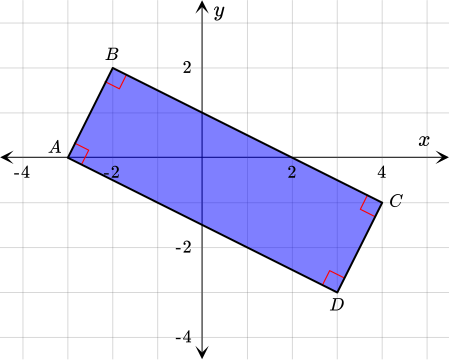
By following the same procedure, it can be shown that ∠ A, ∠ C, and ∠ D are also right angles.
Since each angle of ABCD is a right angle, the quadrilateral is a rectangle. Therefore, Ramsha is correct. She's on her way toward making some nice frames.
Example
Share
Report error
Determining If a Point Is On a Circle's Circumference
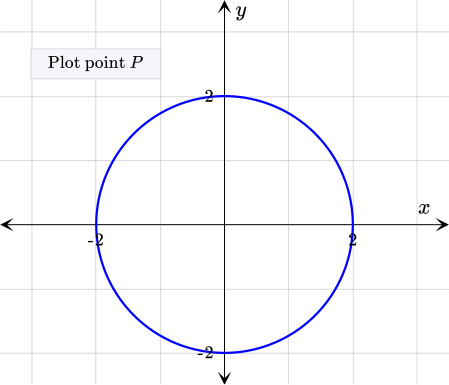
Consider the circle centered at the origin and containing the point Q(0,2).
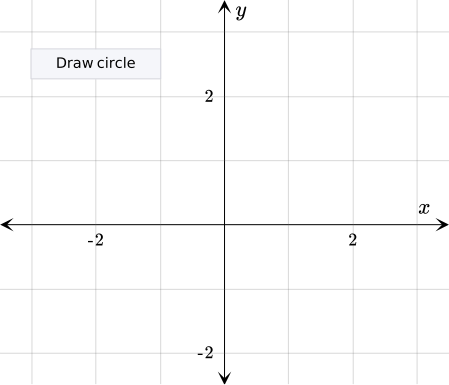 Maya has been asked to determine whether the point P(1,sqrt(3)) lies on the above circle. Use the Distance Formula to help Maya find the answer.
{"type":"choice","form":{"alts":["The point lies on the circle.","The point does not lie on the circle."],"noSort":false},"formTextBefore":"","formTextAfter":"","answer":0}
Hint
Start by finding the radius of the circle.
Solution
The radius of a circle is constant. Therefore, if P(1,sqrt(3)) lies on the circle, then its distance from the origin would also equal the radius of the circle. Point Q(0,2) is given, so the radius can be solved by finding the distance between point Q and the origin, using the Distance Formula.
The distance between the origin and Q(0,2), and therefore the radius of the circle, is 2. Using the Distance Formula one more time, the distance between the origin and P(1,sqrt(3)) will be calculated.
The distance between P(1,sqrt(3)) and the origin is the same as the radius of the circle, 2. Therefore, the point P lies on the circle.
d = sqrt((x_2-x_1)^2 + (y_2-y_1)^2)
SubstitutePoints
Substitute ( 0,0) & ( 0,2)
d=sqrt(( 0- 0)^2+( 2- 0)^2)
d=2
d = sqrt((x_2-x_1)^2 + (y_2-y_1)^2)
SubstitutePoints
Substitute ( 0,0) & ( 1,sqrt(3))
d=sqrt(( 1- 0)^2+( sqrt(3)- 0)^2)
d=2
Discussion
Share
Report error
Definition of a Midpoint
Sometimes the length of a segment is not what is needed. Instead, the coordinates of the point that lies exactly in the middle of a segment are needed.
Concept
Share
Report error
Midpoint
The midpoint of a line segment is the point that divides the segment into two segments of equal length. 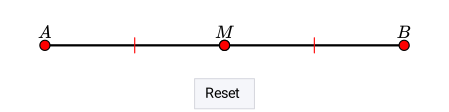 The point M is the midpoint of the segment AB since the distance from A to M is the same as the distance from M to B.
If the points are plotted on a coordinate plane, the Midpoint Formula can be used to find the coordinates of the midpoint.
Rule
Share
Report error
Midpoint Formula
The midpoint M between two points A(x_1, y_1) and B(x_2, y_2) on a coordinate plane can be determined by the following formula.
M(x_1 + x_2/2,y_1 + y_2/2 )
The formula above is called the Midpoint Formula.
Proof
For simplicity, the points A(x_1,y_1) and B(x_2,y_2) will be arbitrarily plotted in Quadrant I. Also, consider the line segment that connects these points. The midpoint M between A and B is the midpoint of this segment. Note that the position of the points in the plane does not affect the proof.
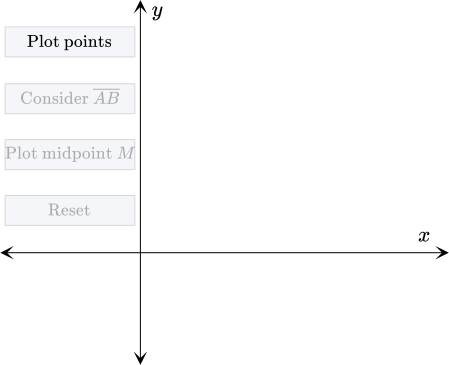 Consider the horizontal distance Δ x and the vertical distance Δ y between A and B. Since M is the midpoint, M splits each distance, Δ x and Δ y, in half. Therefore, the horizontal and vertical distances from each endpoint to the midpoint are Δ x2 and Δ y2. Let x_m and y_m be the coordinates of M.
 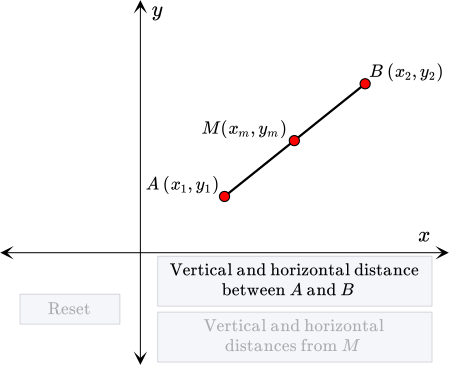 Now, focus on the x-coordinates. The difference between the corresponding x-coordinates gives the horizontal distances between the midpoint and the endpoints. x_m - x_1 and x_2 - x_m
The graph above shows that these distances are both equal to Δ x2. Therefore, by the Transitive Property of Equality, they are equal.
x_m-x_1= Δ x2 x_2-x_m= Δ x2 ⇓ x_m-x_1= x_2-x_m
This equation can be solved to find x_m, the x-coordinate of the midpoint M.
The x-coordinate of M is x_m = x_1+x_22. In the same way, it can be shown that the y-coordinate of M is y_m= y_1+y_22. With this information, the coordinates of M can be expressed in terms of the coordinates of A and B.
Now, focus on the x-coordinates. The difference between the corresponding x-coordinates gives the horizontal distances between the midpoint and the endpoints. x_m - x_1 and x_2 - x_m
The graph above shows that these distances are both equal to Δ x2. Therefore, by the Transitive Property of Equality, they are equal.
x_m-x_1= Δ x2 x_2-x_m= Δ x2 ⇓ x_m-x_1= x_2-x_m
This equation can be solved to find x_m, the x-coordinate of the midpoint M.
The x-coordinate of M is x_m = x_1+x_22. In the same way, it can be shown that the y-coordinate of M is y_m= y_1+y_22. With this information, the coordinates of M can be expressed in terms of the coordinates of A and B.
x_m - x_1 = x_2 - x_m
▼
Solve for x_m
AddEqn
LHS+x_m=RHS+x_m
2x_m - x_1 = x_2
AddEqn
LHS+x_1=RHS+x_1
2x_m = x_2+x_1
CommutativePropAdd
Commutative Property of Addition
2x_m = x_1+x_2
DivEqn
.LHS /2.=.RHS /2.
x_m = x_1+x_2/2
M(x_1 + x_2/2,y_1 + y_2/2 )
Pop Quiz
Share
Report error
Practice Finding Midpoints Using the Midpoint Formula
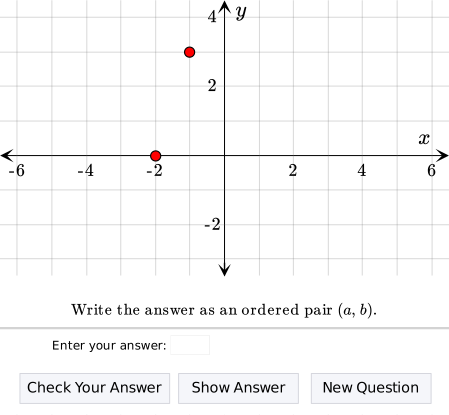
Use the Midpoint Formula to calculate the coordinates of the midpoint M between the points plotted on the coordinate plane.
Example
Share
Report error
Proving the Properties of a Parallelogram
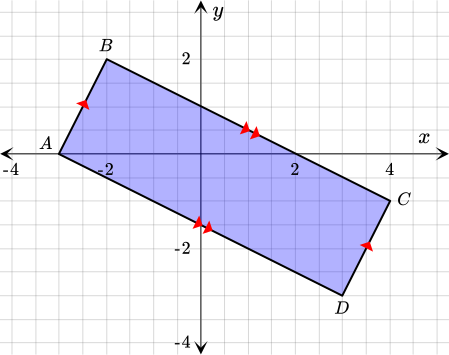
Paulina has joined the bandwagon of making picture frames. She wants to prove that the diagonals of the parallelogram shown below bisect each other.
Answer
See solution.
Hint
Use the Midpoint Formula to show that the diagonals intersect at their midpoint.
Solution
The diagonals bisect each other if and only if they intersect at their midpoint. Start by drawing the diagonals BD and AC. Then, identify the coordinates of their point of intersection.
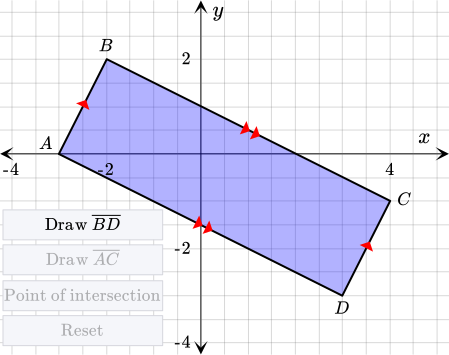 It is seen above that the point of intersection of BD and AC is (0.5,- 0.5). If this point is the midpoint of each diagonal, then the diagonals bisect each other. To prove that (0.5,- 0.5) is the midpoint of BD, the coordinates of the endpoints B(- 2,2) and D(3,- 3) can be substituted into the Midpoint Formula.
The midpoint of the diagonal BD is the point of intersection of the diagonals. By following the same procedure, it can be shown that the midpoint of AC is also (0.5,- 0,5).
It is seen above that the point of intersection of BD and AC is (0.5,- 0.5). If this point is the midpoint of each diagonal, then the diagonals bisect each other. To prove that (0.5,- 0.5) is the midpoint of BD, the coordinates of the endpoints B(- 2,2) and D(3,- 3) can be substituted into the Midpoint Formula.
The midpoint of the diagonal BD is the point of intersection of the diagonals. By following the same procedure, it can be shown that the midpoint of AC is also (0.5,- 0,5).
M(x_1+x_2/2,y_1+y_2/2)
SubstitutePoints
Substitute ( - 2,2) & ( 3,- 3)
M(- 2+ 3/2,2+( - 3)/2)
▼
Evaluate
AddTerms
Add terms
M(1/2,2+(- 3)/2)
AddNeg
a+(- b)=a-b
M(1/2,- 1/2)
MoveNegNumToFrac
Put minus sign in front of fraction
M(1/2,- 1/2)
FracToDiv
a/b=a÷ b
M(0.5,- 0.5) ✓
| M(x_1+x_2/2,y_1+y_2/2) | |||
|---|---|---|---|
| Diagonal | Endpoints | Substitute | Simplify |
| BD | B( - 2, 2) & D( 3, - 3) | M(- 2+ 3/2,2+( - 3)/2) | M(0.5,- 0.5) ✓ |
| AC | A( - 3, 0) & D( 4, - 1) | M(- 3+ 4/2,0+( - 1)/2) | M(0.5,- 0.5) ✓ |
The midpoint of both diagonals is the same as their point of intersection. Therefore, the diagonals bisect each other.
Illustration
Share
Report error
Using Rigid Motions to Prove a Theorem
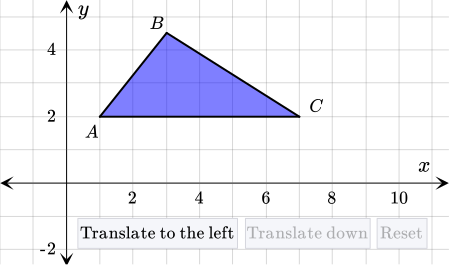
Any figure on a coordinate plane — located at any position — can be transformed through a combination of rigid motions to have a vertex at the origin and a consecutive vertex on the x-axis. By this reasoning, when proving a theorem for a figure with a vertex at the origin and a consecutive vertex on the x-axis, that theorem is valid for any figure with the same shape and size.
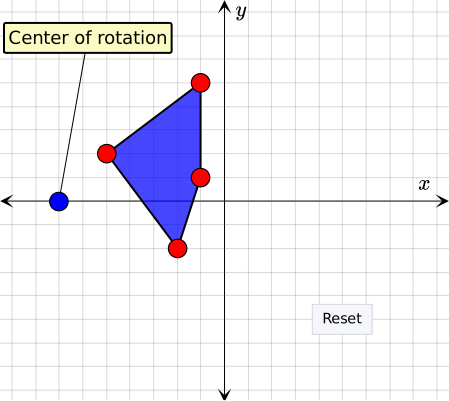 Try to place a vertex of the polygon at the origin and a consecutive vertex on the positive x-axis!
Extra
How to Use the Applet- The polygon can be translated by clicking inside it and dragging it.
- The polygon can be rotated around the center of rotation by clicking and dragging any of its vertices.
- The center of rotation can be moved wherever needed.
Example
Share
Report error
Proving the Triangle Midsegment Theorem by Rigid Motions
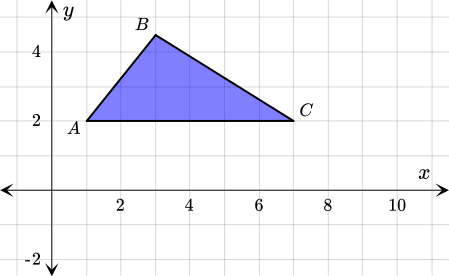
Paulina's best friend is obsessed with triangles. He has requested for Paulina to make him a triangular picture frame. Suppose Paulina can prove the Triangle Midsegment Theorem for the triangle below. She will better understand how to work with triangles and therefore make a better frame!
Answer
See solution.
Solution
Start by recalling the Triangle Midsegment Theorem.
|
Triangle Midsegment Theorem |
|
The segment that connects the midpoints of two sides of a triangle — a midsegment — is parallel to the third side of the triangle and half its length. |
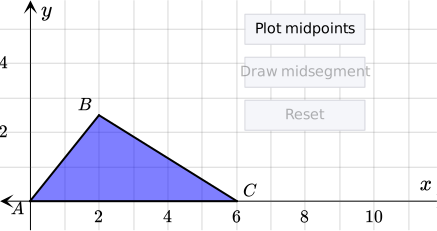
| M(x_1+x_2/2,y_1+y_2/2) | |||
|---|---|---|---|
| Side | Endpoints | Substitute | Simplify |
| AB | A( 0, 0) and B( 2, 2.5) | M_1(0+ 2/2,0+ 2.5/2) | M_1(1, 1.25) |
| BC | B( 2, 2.5) and C( 6, 0) | M_2(2+ 6/2,2.5+ 0/2) | M_2(4, 1.25) |
It can be seen above that both M_1 and M_2 have the same y-coordinate 1.25. This means that M_1M_2 is a horizontal segment. Since AC is on the x-axis, it can be said that it is also a horizontal segment. Therefore, the midsegment is parallel to AC. M_1M_2 ∥ AC Finally, it needs to be proven that M_1M_2 is half AC. To do this, the Distance Formula will be used.
| d = sqrt((x_2-x_1)^2 + (y_2-y_1)^2) | |||
|---|---|---|---|
| Segment | Endpoints | Substitute | Simplify |
| M_1M_2 | M_1( 1, 1.25) and M_2( 4, 1.25) | M_1M_2=sqrt(( 4- 1)^2+( 1.25- 1.25)^2) | M_1M_2= 3 |
| BC | A( 0, 0) and C( 6, 0) | AC=sqrt(( 6- 0)^2+( 0- 0)^2) | AC=6 |
Since 3 is half 6, the length of M_1M_2 is half the length of AC. M_1M_2=1/2AC By following the same procedure, it can be proven that the other two midsegments of △ ABC are parallel and half the length of the third side. The Triangle Midsegment Theorem has been proven. Paulina has just leveled up and her friend will get a great frame!
Closure
Share
Report error
Proving the Properties of a Parallelogram
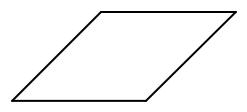
The topics covered in this lesson can now be applied to the challenge. The figure below looks like a parallelogram; without using measuring tools, how can it be proven that the quadrilateral is a parallelogram?
Answer
See solution.
Hint
Place the quadrilateral on a coordinate plane. Then, translate it so that it has a vertex at the origin and a consecutive vertex on the x-axis.
Solution
As advised, the quadrilateral will be placed on a coordinate plane. Then, it will be translated so that a vertex ends up at the origin and a consecutive vertex on the x-axis. For simplicity, the vertices have been labeled.
 It is sufficient to prove that ABCD has one pair of congruent parallel sides to prove that ABCD is a parallelogram. Note that the y-coordinate of B and C is 2. Therefore, BC is parallel to the x-axis. Also, A and D lie on the x-axis, so BC and AD are parallel.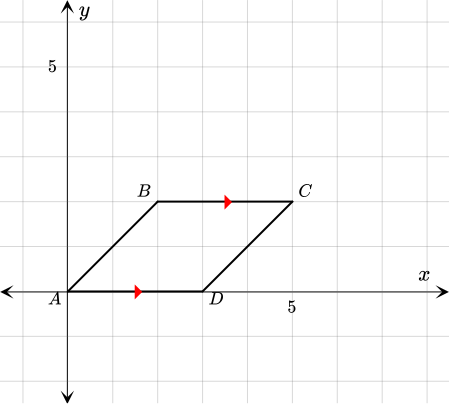
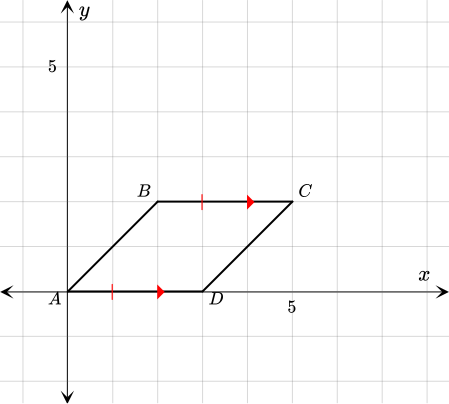
To prove that the sides have the same length, the Distance Formula will be used.
| d = sqrt((x_2-x_1)^2 + (y_2-y_1)^2) | |||
|---|---|---|---|
| Segment | Points | Substitute | Simplify |
| AD | A( 0, 0) & D( 3, 0) | AD= sqrt(( 3- 0)^2+( 0- 0)^2) | AD= 3 |
| BC | B( 2, 2) & C( 5, 2) | BC= sqrt(( 5- 2)^2+( 2- 2)^2) | BC= 3 |
The length of the opposite sides AD and BC is 3. This means that AD and BC are congruent.
The quadrilateral has been proven to have a pair of congruent parallel sides. Therefore, it is a parallelogram.
Using the Distance and Midpoint Formulas in Proofs
Exercise 1.1
Determine the midpoint of the line segment with the following endpoints.
{"type":"text","form":{"type":"point2d","options":{"comparison":"1","nofractofloat":false,"keypad":{"simple":true,"useShortLog":false,"variables":["x"],"constants":["PI"]},"rendered":false,"decimal":false,"function":false},"text":" "},"formTextBefore":"M","formTextAfter":null,"answer":{"text1":"8","text2":"8"}}
{"type":"text","form":{"type":"point2d","options":{"comparison":"1","nofractofloat":false,"keypad":{"simple":true,"useShortLog":false,"variables":["x"],"constants":["PI"]},"rendered":false,"decimal":false,"function":false},"text":" "},"formTextBefore":"M","formTextAfter":null,"answer":{"text1":"8","text2":"6"}}
{"type":"text","form":{"type":"point2d","options":{"comparison":"1","nofractofloat":false,"keypad":{"simple":true,"useShortLog":false,"variables":["x"],"constants":["PI"]},"rendered":false,"decimal":false,"function":false},"text":" "},"formTextBefore":"M","formTextAfter":null,"answer":{"text1":"1","text2":"9"}}
{"type":"text","form":{"type":"point2d","options":{"comparison":"1","nofractofloat":false,"keypad":{"simple":true,"useShortLog":false,"variables":["x"],"constants":["PI"]},"rendered":false,"decimal":false,"function":false},"text":" "},"formTextBefore":"M","formTextAfter":null,"answer":{"text1":"2","text2":"4"}}
security
report
code
security
report
code
We want to find the midpoint of the line segment with the given endpoints. For this purpose, we can use the Midpoint Formula.
The midpoint is at (8,8).
Like in Part A, we want to find the midpoint of the line segment with the given endpoints. To do so, we will substitute the given points into the Midpoint Formula and evaluate.
The midpoint of the line segment is (8,6)
As in previous parts, we will substitute the given points into the Midpoint Formula.
As we can see, the midpoint is (1,9).
Like in previous parts, we should substitute the given endpoints into the Midpoint Formula to determine the midpoint.
The line segment has its midpoint at (2, 4).
security
report
code
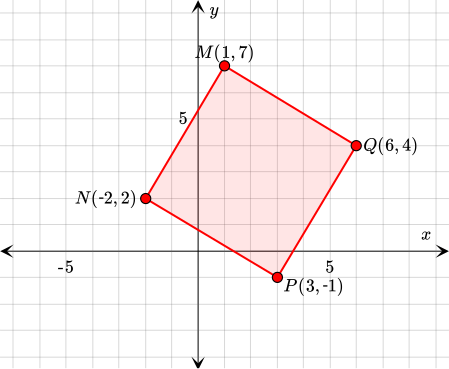
Consider the quadrilateral MNPQ.
{"type":"text","form":{"type":"math","options":{"comparison":"1","nofractofloat":false,"keypad":{"simple":true,"useShortLog":false,"variables":["x"],"constants":["PI"]},"rendered":false},"text":" "},"formTextBefore":"m∠ MNP=","formTextAfter":"^(∘)","answer":{"text":["90"]}}
{"type":"choice","form":{"alts":["Rhombus","Trapezoid","Kite","Square","Rectangle"],"noSort":false},"formTextBefore":"","formTextAfter":"","answer":3}
{"type":"choice","form":{"alts":["MP is longer","NQ is longer","They have the same length"],"noSort":true},"formTextBefore":"","formTextAfter":"","answer":2}
{"type":"text","form":{"type":"point2d","options":{"comparison":"1","nofractofloat":false,"keypad":{"simple":true,"useShortLog":false,"variables":["x"],"constants":["PI"]},"rendered":false,"decimal":true,"function":false},"text":" "},"formTextBefore":"M","formTextAfter":null,"answer":{"text1":"-0.5","text2":"4.5"}}
security
report
code
security
report
code
Let's start by plotting ∠ MNP in the coordinate plane.
To determine the slopes of MN and NP, we will use the Slope Formula.
| Segment | Points | y_2-y_1/x_2-x_1 | m |
|---|---|---|---|
| MN | N(- 2,2), M(1,7) | 7- 2/1-( - 2) | 5/3 |
| NP | N(- 2,2), P(3,- 1) | - 1- 2/3-( - 2) | - 3/5 |
Notice that ∠ MNP looks like a right angle. If this is true, the product of the slopes of MN and NP will equal - 1. m_1* m_2=- 1 Let's substitute our slopes for m_1 and m_2 to find if the equation holds.
As we can see, ∠ MNP is, in fact, a right angle.
Therefore, its measure is 90^(∘).
To label MNPQ correctly, we need investigate the slope of the remaining sides. We also need to find the length of each side of the quadrilateral.
Slopes
From Part A, we already know the slope of MN and NP. Let's find the slope of the remaining two sides.
| Segment | Points | y_2-y_1/x_2-x_1 | m |
|---|---|---|---|
| MQ | M(1,7), Q(6,4) | 4- 7/6- 1 | - 3/5 |
| QP | Q(6,4), P(3,- 1) | - 1- 4/3- 6 | 5/3 |
Notice that opposite sides have the same slope. This means they are parallel sides. Since one angle in MNPQ is right, all angles must be right angles for the sides to be parallel.
Lengths
With the information we have found so far, we know that MNPQ is a rectangle. If all sides have the same length as well, the rectangle is a square. To determine the length of the sides, we can use the Distance Formula.
| Segment | Points | sqrt((x_2-x_1)^2+(y_2-y_1)^2) | d |
|---|---|---|---|
| MN | M(1,7), N(- 2,2) | sqrt(( 1-( - 2))^2+( 7- 2)^2) | sqrt(34) |
| QP | Q(6,4), P(3,- 1) | sqrt(( 6- 3)^2+( 4-( - 1))^2) | sqrt(34) |
| NP | N(- 2,2), P(3,- 1) | sqrt(( - 2- 3)^2+( 2-( - 1))^2) | sqrt(34) |
| MQ | M(1,7), Q(6,4) | sqrt(( 1- 6)^2+( 7- 4)^2) | sqrt(34) |
The four sides all have the same length. Therefore, the quadrilateral is a square.
Let's draw the diagonals.
Notice that each diagonal is the hypotenuse of a right triangle.
Both triangles are isosceles right triangles with congruent legs. Let's recall the Side-Angle-Side Congruence Theorem.
Side-Angle-Side Congruence Theorem |- If two sides and the included angle in a triangle are congruent to corresponding parts in another triangle, then the triangles are congruent.
This means the triangles are congruent. For congruent triangles, corresponding sides have the same length. Therefore, the diagonals have the same length.
To find the midpoint of a segment, we can use the Midpoint Formula.
The midpoint of MN is (- 0.5,4.5).
security
report
code
Determine the distance between the following points. If the answer is a decimal number, then round to two decimal places.
{"type":"text","form":{"type":"math","options":{"comparison":"1","nofractofloat":false,"keypad":{"simple":true,"useShortLog":false,"variables":["x"],"constants":["PI"]},"rendered":false},"text":" "},"formTextBefore":"XY\u2248","formTextAfter":null,"answer":{"text":["11.31"]}}
{"type":"text","form":{"type":"math","options":{"comparison":"1","nofractofloat":false,"keypad":{"simple":true,"useShortLog":false,"variables":["x"],"constants":["PI"]},"rendered":false},"text":" "},"formTextBefore":"MN=","formTextAfter":null,"answer":{"text":["7"]}}
{"type":"text","form":{"type":"math","options":{"comparison":"1","nofractofloat":false,"keypad":{"simple":true,"useShortLog":false,"variables":["x"],"constants":["PI"]},"rendered":false},"text":" "},"formTextBefore":"TR\u2248","formTextAfter":null,"answer":{"text":["9.43"]}}
{"type":"text","form":{"type":"math","options":{"comparison":"1","nofractofloat":false,"keypad":{"simple":true,"useShortLog":false,"variables":["x"],"constants":["PI"]},"rendered":false},"text":" "},"formTextBefore":"SP=","formTextAfter":null,"answer":{"text":["10"]}}
security
report
code
security
report
code
To determine the distance between two points, we can use the Distance Formula. The given points are X(0,0) and Y(8,8).
Between the points X and Y, the distance is about 11.31 units.
Like in Part A, we substitute the points in the Distance Formula and evaluate the right-hand side.
The distance between M and N is 7 units.
Like in previous Parts, we want to use the Distance Formula to calculate the distance between the points.
There is a distance of about 9.43 units between T and R.
As we did in previous Parts, we substitute the given points in the Distance Formula to calculate the distance between them.
As we can see, the distance between S and P is 10 units.
security
report
code
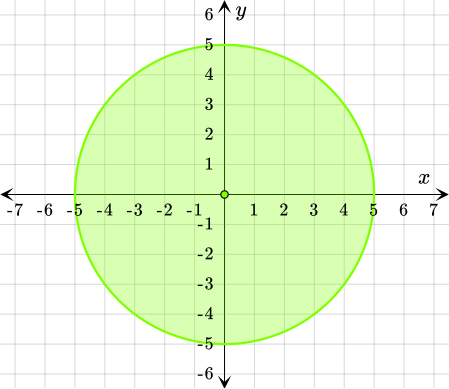
Consider the following circle.
{"type":"multichoice","form":{"alts":["A","B","C","D"],"noSort":true},"formTextBefore":"","formTextAfter":"","answer":[0]}
security
report
code
security
report
code
Examining the coordinate plane, we notice that this is a circle with its center at the origin and a radius of 5.
If a point is on the circumference of the circle, then the distance from the origin to the point should equal 5. With this information, we can determine if the first point is on the circumference by substituting d= 5, and our two points, ( 4,3) and ( 0,0), into the Distance Formula.
The first point is on the circumference of the circle. Let's also test the remaining points. Since we are measuring the distance from the origin, we can replace (y_2-y_1) and (x_2-x_1) by the x- and y-coordinates of each point being tested. clcc B -7pt & 5? =sqrt((3.3)^2+(- 3.5)^2) & -6pt ⇒ -6pt & 5 ≠ 4.8 * [1em] C -7pt & 5? =sqrt((-2.5)^2+(4.2)^2) & -6pt ⇒ -6pt & 5 ≠ 4.9 * [1em] D -7pt & 5? =sqrt(1^2+5^2) & -6pt ⇒ -6pt & 5 ≠ 5.1 * In conclusion, only point A is on the circumference of the circle.
security
report
code
Find the coordinates of the intersection of the diagonals of the parallelogram with the given vertices.
A(-2,5), B(2,5), C(4,0), D(0,0)
{"type":"text","form":{"type":"point2d","options":{"comparison":"1","nofractofloat":false,"keypad":{"simple":true,"useShortLog":false,"variables":["x"],"constants":["PI"]},"rendered":false,"decimal":true,"function":false},"text":" "},"formTextBefore":null,"formTextAfter":null,"answer":{"text1":"1","text2":"\\dfrac{5}{2}"}}
security
report
code
security
report
code
Let's mark the points and draw the parallelogram including its diagonals in a coordinate plane.
According to the Parallelogram Diagonals Theorem, the diagonals of a parallelogram bisect each other. Therefore, to find the diagonal's intersection, we can find the midpoint of either WY or XZ using the Midpoint Formula.
The midpoint of WY is (1, 52) which is the coordinates where the diagonals intersect.
security
report
code
Find the coordinates of the remaining vertex in a parallelogram GDEF with the given vertices.
G(4,0), D(0,2), E(-1,5), F( , )
Determine the coordinates of F.
{"type":"text","form":{"type":"point2d","options":{"comparison":"1","nofractofloat":false,"keypad":{"simple":true,"useShortLog":false,"variables":["x"],"constants":["PI"]},"rendered":false,"decimal":false,"function":false},"text":" "},"formTextBefore":"F","formTextAfter":null,"answer":{"text1":"3","text2":"3"}}
security
report
code
security
report
code
Let's first plot the given vertices D(0,2), E(-1,5), and G(4,0) in a coordinate plane. Notice that the parallelogram is labeled GDEF which means DG and DE makes up two sides in the parallelogram.
Since a parallelogram has two pairs of parallel and congruent sides, we can find F by going the same amount of vertical and horizontal steps from G as we need to go from D to E.
The missing vertex F is at (3,3). Let's draw the parallelogram.
security
report
code
Using the Distance and Midpoint Formulas in Proofs
Recommended exercises
To get personalized recommended exercises, please login first.
Loading content
≤
>
■2
■▢
e▢
7
8
9
×
÷■1
=
=
√▢
▢√
∫▢▢
4
5
6
+
−
≤
<
log
ln
log▢
1
2
3
()
∣
sin
cos
tan
0
.
π
x
y
Loading content