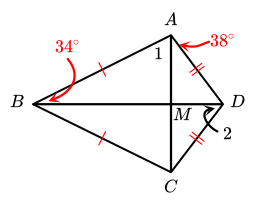
Let's find the measures of the numbered angles one at a time.
Measure of ∠ 1
Before we begin, let's name the vertices of our kite. We will call it quadrilateral ABCD. The point of intersection between the diagonals we will label M.
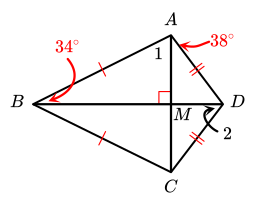
If a quadrilateral is a kite, then its diagonals are perpendicular. Therefore, ∠ AMB is right and its measure is 90.
Let's study △ AMB. By the Triangle Angle-Sum Theorem we know that the measures of the angles add to 180.
34+ m∠ 1+90=180
Let's solve the equation!
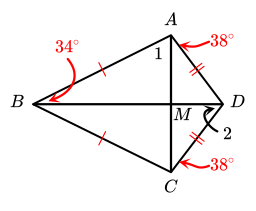
We see that △ ADC is an isosceles triangle. By the Isosceles Triangle Theorem we know that base angles are congruent.
∠ DAM ≅ ∠ DCM
By the definition of congruence their measures are equal. Therefore, we have that m∠ DCM=38.
We can now look at the △ DCM. By the Triangle Angle-Sum Theorem we know that the measures of the angles add to 180.
m∠ DCM+ m∠ CMD+m∠ 2=180
Since ∠ CMD is formed by the diagonals it is right and its measure is 90. By using that and that m∠ DCM=38, we can find the measure of angle 2.