Sign In
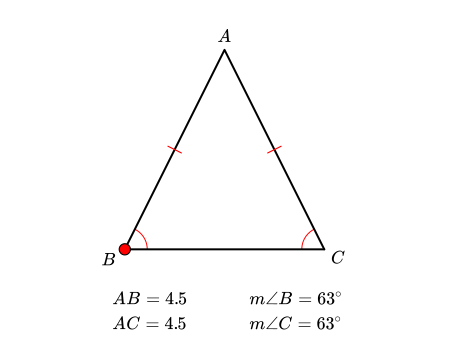
AB≅ AC ⇒ ∠ B≅ ∠ C
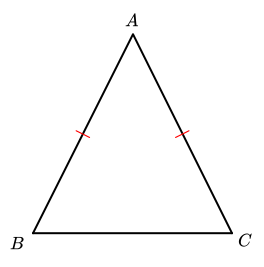
Consider a triangle ABC with two congruent sides, or an isosceles triangle.
| Statement | Reason |
|---|---|
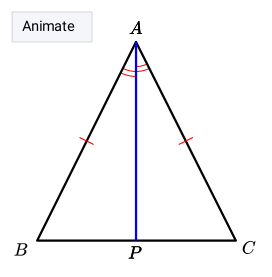
| ∠ BAP ≅ ∠ CAP | Definition of an angle bisector |
| BA ≅ CA | Given |
| AP ≅ AP | Reflexive Property of Congruence |
Therefore, △ BAP and △ CAP have two pairs of corresponding congruent sides and one pair of congruent included angles. By the Side-Angle-Side Congruence Theorem, △ BAP and △ CAP are congruent triangles. △ BAP ≅ △ CAP Corresponding parts of congruent figures are congruent. Therefore, ∠ B and ∠ C are congruent. ∠ B ≅ ∠ C It has been proven that if two sides of a triangle are congruent, then the angles opposite them are congruent.
Consider an isosceles triangle △ ABC.
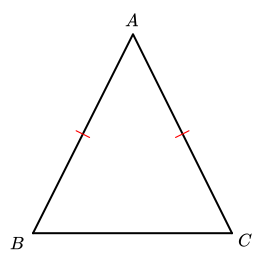
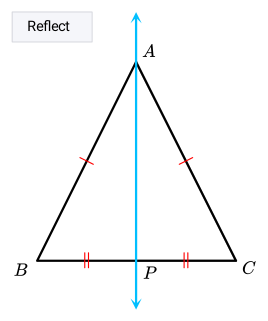
A line passing through A and the midpoint of BC will be drawn. Let P be the midpoint.
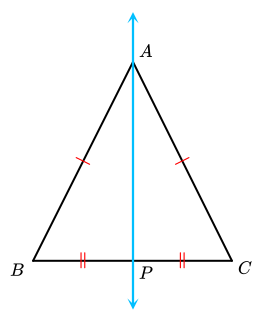
Since BP and PC are congruent, the distance between B and P is equal to the distance between C and P. Therefore, B is the image of C after a reflection across AP. Also, because A lies on AP, a reflection across AP maps A onto itself. The same is true for P.
| Reflection Across AP | |
|---|---|
| Preimage | Image |
| C | B |
| A | A |
| P | P |