Sign In
Start by writing an equation for the area of the rectangular field and calculating the area of the garden.
20ft
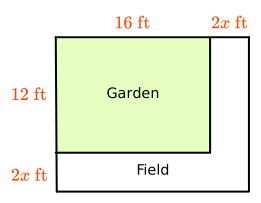
We are told that Joe plants a rectangular garden in the corner of his field, and the area of the garden is 60 % of the area of the field.
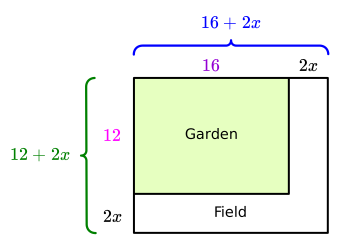
In order to find the longest side of the rectangular field, we will first write an equation representing the area of the field A_F.
l= 16+2x, w= 12+2x
Distribute (16+2x)
Distribute 12
Distribute 2x
Add terms
Commutative Property of Addition
Now, let's find the area of the rectangular garden A_G in the same way.
We know that the area of the garden A_G is 60 % of the area of the field A_F. Using the fact that the fraction form of 60 % is 60100, we can write an equation to represent the relation between A_G and A_F. A_G=60/100A_F We will now substitute A_F= 4x^2+56x+192 and A_G= 192 into this equation, and simplify it as much as possible.
Note that we have a quadratic equation. We will now factor the left-hand side.
Write as a difference
Factor out x
Factor out -2
Factor out x+16
Finally, we will apply the Zero-Product Property.
Use the Zero Product Property
(I): LHS-16=RHS-16
(II): LHS+2=RHS+2
The solutions to the equation are x=-16 and x=2. However, since x represents a length, it should be positive. Therefore, we can find the length of the longest side of the field when x= 2 by substituting 2 into the expression for this side length, 16+2x.

The longest side of the field is 20 feet.