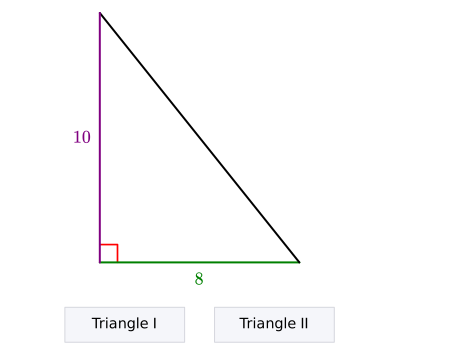
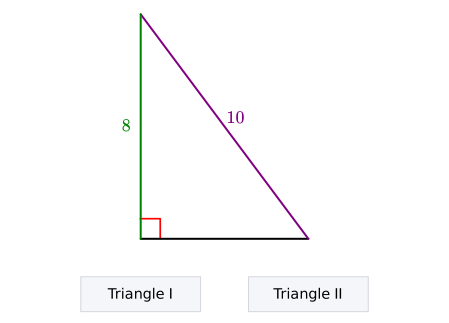
a What if 10 inches is the measure of the hypotenuse and 8 inches is the measure of a leg of the right triangle? What if these are both the measures of the legs of the triangle?
a Let's start by recalling that a right triangle is a triangle that contains a right angle. We are told that two sides of a right triangle measure 10 inches and 8 inches. However, we do not know which sides have these measures. Let's consider two options.
Option 1
One possibility is that 10 inches and 8 inches are the measures of the legs of our right triangle.
Note that it does not matter which leg has which measure. The diagram shows the same triangle in two different positions. In both cases, the measure of the hypotenuse is the same and can be determined by the Pythagorean Theorem.
Option 2
The second possibility is that 10 inches is the measure of the hypotenuse and 8 inches is the measure of a leg of the triangle.
As we can see, it also does not matter which leg has the measure of 8 inches. Each time we get the same triangle, it is just shown in different positions. Keep in mind that we cannot reverse these values and say that the length of the hypotenuse is 8 inches and the length of a leg is 10 inches. The hypotenuse is always the longest side in a right triangle.
Conclusion
We conclude that there are two possible values for the length of the third side.
The length of the third side will be one value if the given lengths are the measures of the legs.
The length of the third side will be another value if the given lengths are the measures of the hypotenuse and either of the legs.
Therefore, there is not enough information to be sure of the length of the third side.
b To calculate the two possible values for the length of the third side, we will use the Pythagorean Theorem.
a^2+b^2=c^2
Here, a and b are the lengths of the legs of a right triangle and c is the length of its hypotenuse. Let's calculate the length of the third side for each option discussed in Part A.
Option 1
In the first option, 8 inches and 10 inches are the lengths of the legs of the triangle. Hence, we can substitute a with 8 and b with 10, and find the value of c. Note that substituting a with 10 and b with 8 would give us the same result.
Therefore, the length of the third side, which in this case is a hypotenuse, is 2sqrt(41) inches.
Option 2
In the second option, 10 inches is the measure of the hypotenuse and 8 inches is the measure of either of its legs. Let's substitute a with 8 and c with 10 and solve the equation for b.