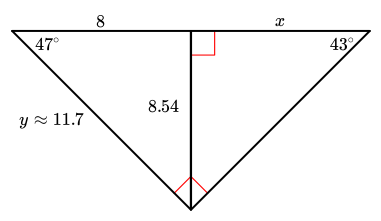
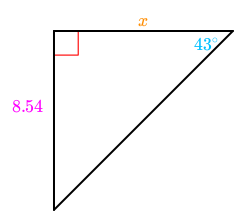
Notice that the given triangle consists of two smaller right triangles. Take a look at them separately.
x≈ 9.2, y≈ 11.7
Practice makes perfect
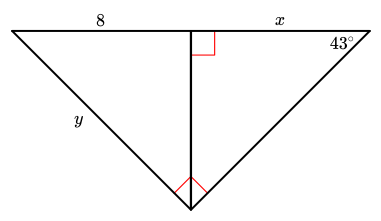
Consider the given triangle.
Notice that the given triangle is a right triangle.
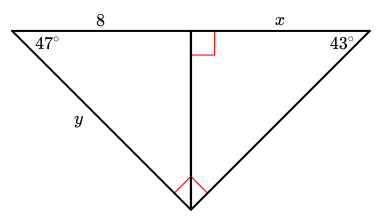
Recall that the acute angles of a right triangle are complementary. Therefore, 43 and the measure of the unknown angle add to 90. We will let the unknown angle be z.
z + 43 = 90 ⇔ z = 47
Let's add the obtained information to the diagram.
We want to find the values of x and y. To do so, we will consider the smaller triangles, which are also right triangles, one at a time.
Finding y
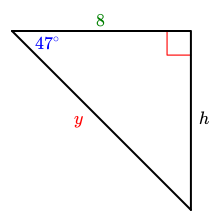
Let's take a look at the first right triangle. We will let unknown side of the triangle be h.
Note that the given side is the side adjacent to the known angle, and the side we want to find is the hypotenuse. Therefore, we will use the cosine ratio.
cos θ = Length of leg adjacent toθ/Length of hypotenuse
In our triangle, we have that θ =47^(∘) and the length of the side adjacent to the known angle is 8. We want to find the length of the hypotenuse.
Let's add the obtained information to the diagram.
Now let's consider the second triangle.
We know the length of the side opposite the given angle and, this time, we want to find the length of the side adjacent to the given angle. Therefore, we will use the tangent ratio.
tan θ = Length of leg opposite toθ/Length of leg adjacent toθ
In our triangle, we have that θ =43^(∘) and the length of the leg opposite to he given angle is about 8.54. We want to find the length of the leg adjacent to the angle.