6. Trigonometric Ratios of Acute Angles
Sign In
An error ocurred, try again later!
Chapter 2
6.
Trigonometric Ratios of Acute Angles
This lesson delves into the relationship between trigonometric ratios and acute angles in right triangles. It explains how these ratios—sine, cosine, and tangent—can be used to find missing side lengths and angles. The text also introduces inverse trigonometric ratios as a tool for solving problems. For example, if you know the length of one side and the hypotenuse, you can find an unknown angle in the triangle. This knowledge is not just theoretical; it has practical applications in various fields like engineering, architecture, and even in everyday scenarios like calculating distances or heights.
Show less Show more expand_more 


Lesson Settings & Tools
| | 17 Theory slides |
| | 10 Exercises - Grade E - A |
| | Each lesson is meant to take 1-2 classroom sessions |
Trigonometric Ratios of Acute Angles
Slide of 17
In this lesson, the concept of similarity will be used to understand that side ratios in right triangles are properties of the angles. This will lead to the definition of trigonometric ratios for acute angles.
Catch-Up and Review
Here are a few recommended readings before getting started.
Try your knowledge on these topics.
a Select all the triangles that are similar to △ ABC.
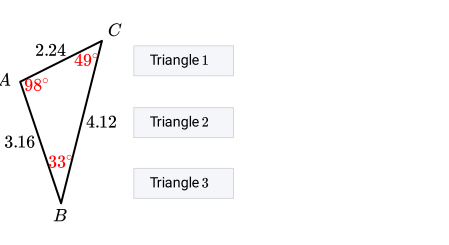
{"type":"multichoice","form":{"alts":["Triangle 1","Triangle 2","Triangle 3"],"noSort":true},"formTextBefore":"","formTextAfter":"","answer":[0,2]}
b Which of the following angles is a right angle?
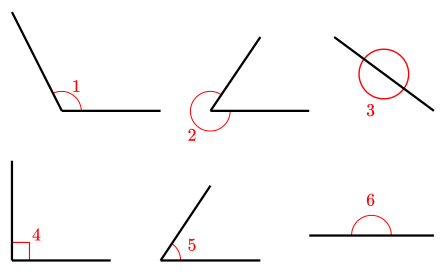
{"type":"choice","form":{"alts":["∠ 1","∠ 2","∠ 3","∠ 4","∠ 5","∠ 6"],"noSort":true},"formTextBefore":"","formTextAfter":"","answer":3}
c Which of the following are right triangles?
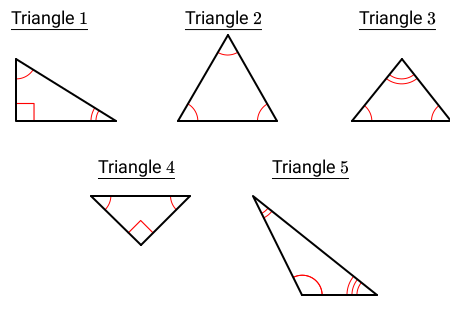
{"type":"multichoice","form":{"alts":["Triangle 1","Triangle 2","Triangle 3","Triangle 4","Triangle 5"],"noSort":true},"formTextBefore":"","formTextAfter":"","answer":[0,3]}
d Find the value of x by using the Pythagorean Theorem.
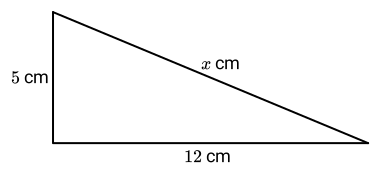
{"type":"text","form":{"type":"math","options":{"comparison":"1","nofractofloat":false,"keypad":{"simple":true,"useShortLog":false,"variables":[],"constants":[]},"rendered":false},"text":" "},"formTextBefore":"x=","formTextAfter":null,"answer":{"text":["13"]}}
Challenge
Share
Report error
Investigating a Side of a Right Triangle
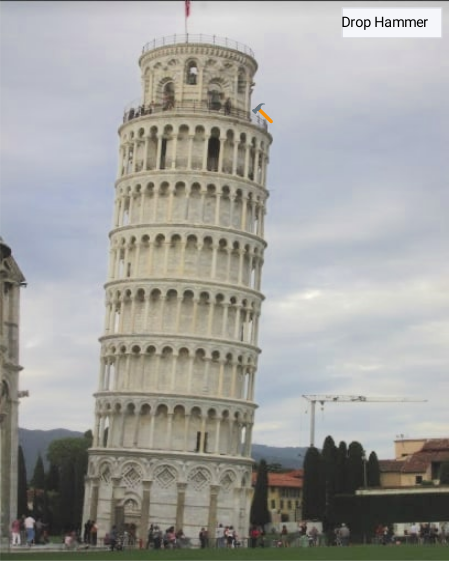
The Leaning Tower of Pisa has a tilt of 4 degrees. Once, a worker maintaining it accidentally dropped a hammer from the top. The hammer landed 3 meters away from the base of the tower. Luckily, it did not hurt anyone!
Explore
Share
Report error
Comparing Ratios of Sides in Similar Right Triangles
Similar triangles have congruent angles and proportional sides. In the following applet, some of the ratios of the side lengths of two similar right triangles are compared. 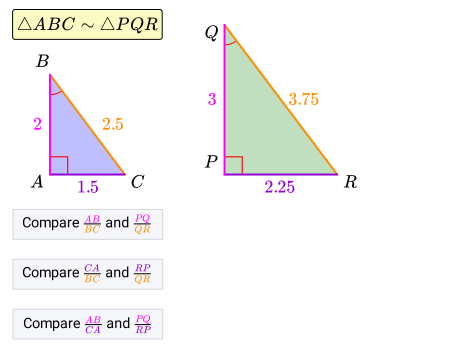 What conclusion can be made about the ratios of the side lengths of two similar triangles?
Discussion
Share
Report error
Analyzing Ratios of Sides in Similar Right Triangles
Because all right angles are congruent, all right triangles have one pair of congruent angles. If they also have one pair of congruent acute angles, then the triangles have two pairs of congruent angles. Therefore, by the Angle-Angle Similarity Theorem, two triangles with one pair of congruent acute angles are similar.
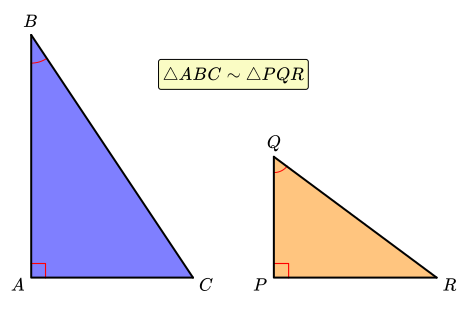
Since corresponding sides of similar polygons are proportional, the ratios between corresponding sides of similar right triangles are the same.
AB/BC&=PQ/QR [1em] AC/BC&=PR/QR [1em] AC/AB&=PR/PQDiscussion
Share
Report error
Trigonometric Ratios
The ratios between side lengths of right triangles depend on the acute angles of the triangle. Some of these ratios receive a special name.
A trigonometric ratio relates two side lengths of a right triangle. Consider the right triangle △ ABC. One of its acute angles has been named θ.
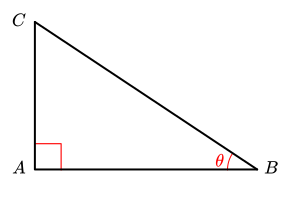
Since it is opposite to the right angle, BC is the hypotenuse of the right triangle. The remaining sides — the legs — can be named relative to the marked angle θ. Because AB is next to ∠ θ, it is called the adjacent side. Conversely, because AC lies across from ∠ θ, it is called the opposite side.
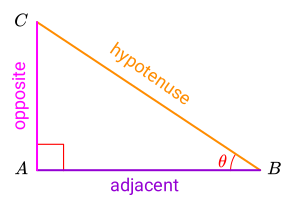
The names of the three main ratios between side lengths are stated in the following table.
| Name | Definition | Notation |
|---|---|---|
| Sine of ∠ θ | Length of opposite side to ∠ θ/Hypotenuse | sin θ=opp/hyp |
| Cosine of ∠ θ | Length of adjacent side to ∠ θ/Hypotenuse | cos θ=adj/hyp |
| Tangent of ∠ θ | Length of opposite side to ∠ θ/Length of adjacent side to ∠ θ | tan θ=opp/adj |
Example
Share
Report error
Understanding Trigonometric Ratios in Right Triangles
Dominika is helping Tadeo understand trigonometric ratios. She drew three right triangles for him to write trigonometric ratios with respect to the acute angle θ. Help Tadeo grasp this topic by selecting the correct answers!
a 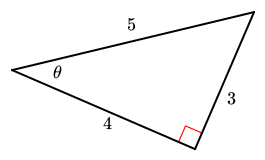
{"type":"choice","form":{"alts":["sin \u03b8=3\/5","sin \u03b8=4\/5","sin \u03b8=3\/4"],"noSort":false},"formTextBefore":"","formTextAfter":"","answer":0}
b 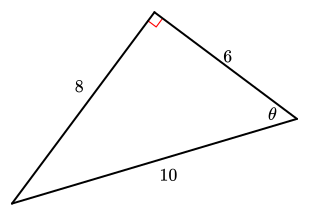
{"type":"choice","form":{"alts":["cos \u03b8=6\/10","cos \u03b8=8\/10","cos \u03b8=8\/6"],"noSort":false},"formTextBefore":"","formTextAfter":"","answer":0}
c 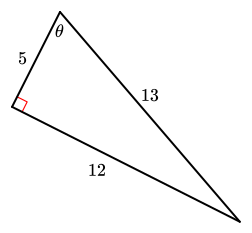
{"type":"choice","form":{"alts":["tan \u03b8=12\/5","tan \u03b8=12\/13","tan \u03b8=5\/13"],"noSort":false},"formTextBefore":"","formTextAfter":"","answer":0}
Hint
a Identify the hypotenuse of the right triangle and the opposite side to ∠ θ.
b Identify the hypotenuse of the right triangle and the adjacent side to ∠ θ.
c Identify the opposite and adjacent sides to ∠ θ.
Solution
a The sine of ∠ θ is defined as the ratio of the length of the side opposite ∠ θ to the hypotenuse of the right triangle. Therefore, Tadeo needs to identify these two sides.
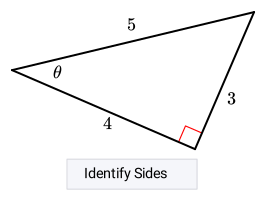 It can be seen above that the hypotenuse of the right triangle is 5 and that the length of the opposite side to ∠ θ is 3. With this information, the sine of ∠ θ can be written. sin θ = 3/5
b The cosine of ∠ θ is the ratio of the length of the adjacent side to ∠ θ to the hypotenuse of the right triangle. Therefore, Tadeo needs to identify these two sides.
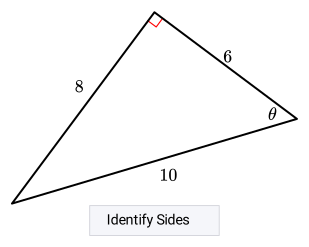 The hypotenuse of the right triangle is 10 and the length of the adjacent side to ∠ θ is 6. With this information, the cosine of ∠ θ can be written. cos θ = 6/10
c The tangent of ∠ θ is the ratio of the length of the side opposite ∠ θ to the length of the side adjacent ∠ θ. Therefore, Tadeo needs to identify these two sides.
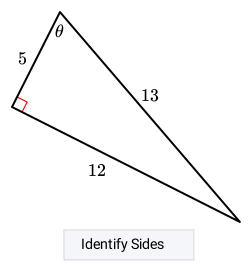 It can be seen above that the lengths of the opposite and adjacent sides to ∠ θ are 12 and 5, respectively. With this information, the tangent of ∠ θ can be written. tan θ = 12/5
Example
Share
Report error
Explaining Trigonometric Ratios in Right Triangles
Despite the awesome explanations Dominika provided, Tadeo still does not get how to find trigonometric ratios. To help his friend, Dominika thought of one more exercise.
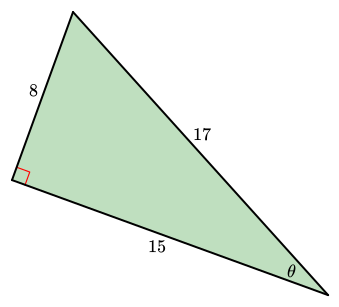
This time, Dominika drew one right triangle and stated its three side lengths. She also labeled one of the triangle's acute angles.
{"type":"text","form":{"type":"math","options":{"comparison":"1","nofractofloat":false,"keypad":{"simple":true,"useShortLog":false,"variables":[],"constants":[]},"rendered":false},"text":" "},"formTextBefore":"sin \u03b8=","formTextAfter":null,"answer":{"text":["\\dfrac{8}{17}","\\frac{8}{17}","8\/17"]}}
{"type":"text","form":{"type":"math","options":{"comparison":"1","nofractofloat":false,"keypad":{"simple":true,"useShortLog":false,"variables":[],"constants":[]},"rendered":false},"text":" "},"formTextBefore":"cos \u03b8=","formTextAfter":null,"answer":{"text":["\\dfrac{15}{17}","\\frac{15}{17}","15\/17"]}}
{"type":"text","form":{"type":"math","options":{"comparison":"1","nofractofloat":false,"keypad":{"simple":true,"useShortLog":false,"variables":[],"constants":[]},"rendered":false},"text":" "},"formTextBefore":"tan \u03b8=","formTextAfter":null,"answer":{"text":["\\dfrac{8}{15}","\\frac{8}{15}","8\/15"]}}
Hint
Start by identifying the hypotenuse of the right triangle. Then identify the opposite and adjacent sides to ∠ θ. Finally, recall the definitions of sine, cosine, and tangent of an acute angle of a right triangle.
Solution
To find the sine, cosine, and tangent of ∠ θ, the hypotenuse of the right triangle needs to be identified. The opposite and adjacent sides to the angle also need to be identified.
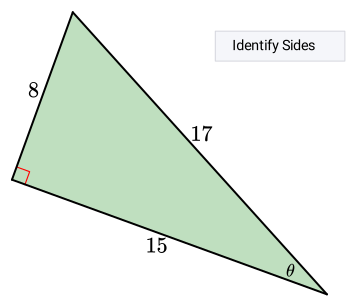 It can be seen above that the hypotenuse is 17, and that the lengths of the opposite and adjacent sides to ∠ θ are 8 and 15, respectively. This information can be substituted into the definitions for sine, cosine, and tangent.
| Definition | Substitute |
|---|---|
| sin θ = Length of oppositeside to∠ θ/Hypotenuse | sin θ = 8/17 |
| cos θ = Length of adjacentside to∠ θ/Hypotenuse | cos θ = 15/17 |
| tan θ = Length of oppositeside to∠ θ/Length of adjacentside to∠ θ | tan θ = 8/15 |
Example
Share
Report error
Using Trigonometric Ratios to Find Side Lengths
Tadeo finally understands the topic! But wait, Dominika wants to level up and has let him know that trigonometric ratios can also be used to find missing side lengths of a right triangle. "Tell me more," Tadeo responds. An acute angle and the hypotenuse of a right triangle are given. To see whether Tadeo masters this topic, Dominika asked him to find the value of x, which is the length of the opposite side to the given angle.
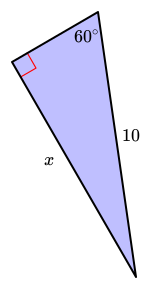
{"type":"text","form":{"type":"math","options":{"comparison":"1","nofractofloat":false,"keypad":{"simple":true,"useShortLog":false,"variables":[],"constants":[]},"rendered":false},"text":" "},"formTextBefore":"x=","formTextAfter":null,"answer":{"text":["8.66"]}}
Hint
Identify the trigonometric ratio that should be used according to the given and desired lengths. Then, with the help of a calculator, set and solve an equation.
Solution
The hypotenuse of the right triangle is given, and the length of the opposite side to the given angle is to be found.
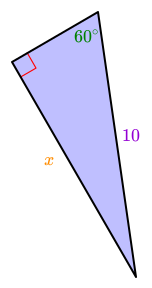
sin 60^(∘)=x/10
▼
Solve for x
MultEqn
LHS * 10=RHS* 10
sin 60^(∘) * 10=x/10 * 10
FracMultDenomToNumber
a/10* 10 = a
sin 60^(∘) * 10=x
Multiply
Multiply
10sin 60^(∘)=x
RearrangeEqn
Rearrange equation
x=10sin 60^(∘)
Degreein the third row.
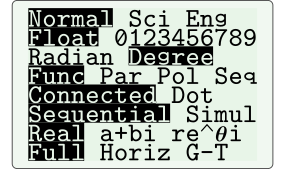
Next the value of sin 60^(∘) can be calculated by pushing SIN followed by the angle measure.
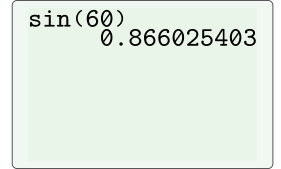
x=10sin 60^(∘)
▼
UseCalc
Use a calculator
x=10(0.866025...)
Multiply
Multiply
x=8.660254...
RoundSigDig
Round to 3 significant digit(s)
x≈ 8.66
Pop Quiz
Share
Report error
Practice Finding Side Lengths Using Trigonometric Ratios
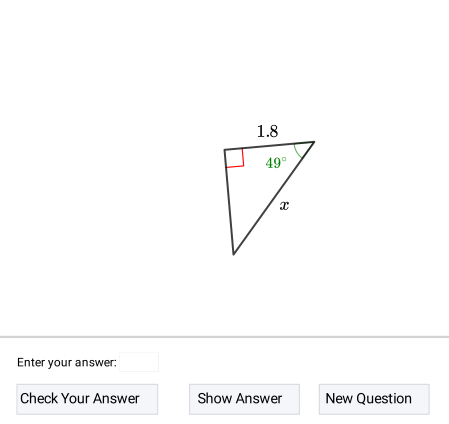
In the right triangles below, one acute angle and one side length are given. By using the corresponding trigonometric ratio, find the length of the side labeled x. Round the answer to one decimal place.
Discussion
Share
Report error
Pythagorean Identities
By using trigonometric ratios, an important property of angles can be derived.
For any angle θ, the following trigonometric identities hold true.
sin^2 θ + cos^2 θ = 1
Proof
For Acute AnglesConsider a right triangle with a hypotenuse of 1.
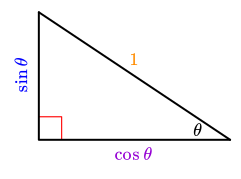
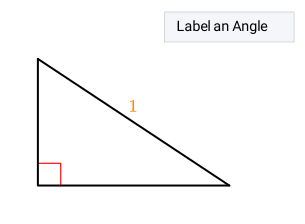 By recalling the sine and cosine ratios, the lengths of the opposite and adjacent sides to ∠ θ can be expressed in terms of the angle.
| Definition | Substitute | Simplify | |
|---|---|---|---|
| sin θ | Length of oppositeside to∠ θ/Hypotenuse | opp/1 | opp |
| cos θ | Length of adjacentside to∠ θ/Hypotenuse | adj/1 | adj |
It can be seen that if the hypotenuse of a right triangle is 1, the sine of an acute angle is equal to the length of its opposite side. Similarly, the cosine of the angle is equal to the length of its adjacent side.
By the Pythagorean Theorem, the sum of the squares of the legs of a right triangle is equal to the square of the hypotenuse. Therefore, for the above triangle, the sum of the squares of sin θ and cos θ is equal to the square of 1.
sin^2 θ+ cos^2 θ&= 1^2 ⇓ & sin^2 θ+cos^2 θ&=1
Example
Share
Report error
Using Trigonometry to Determine the Cosine of an Angle
The property seen before can be used, among other things, to find the sine or cosine ratio of an acute angle in a right triangle.
Kriz and his friends plan to spend Saturday afternoon playing video games. To optimize the space, they decide to tidy up the basement to ensure the console, snacks, and beverages are placed in the form of a right triangle. Kriz decides to set the snacks and the beverages 3 and 5 meters away from the console, respectively.
{"type":"text","form":{"type":"math","options":{"comparison":"1","nofractofloat":false,"keypad":{"simple":true,"useShortLog":false,"variables":[],"constants":[]},"rendered":false},"text":" "},"formTextBefore":"cos \u03b8=","formTextAfter":null,"answer":{"text":["\\dfrac{4}{5}","\\frac{4}{5}","4\/5"]}}
Hint
The hypotenuse of the right triangle is 5 and the measure of the opposite side to ∠ θ is 3. With this information, the sine ratio can be found.
Solution
The hypotenuse of the right triangle is 5 and the measure of the opposite side to ∠ θ is 3. With this information, the sine ratio can be found.
sin θ =Length of opposite side toθ/Hypotenuse ⇓ sin θ = 3/5
This value can be substituted in the equation sin ^2 θ + cos ^2 θ =1.
Note that, when solving the equation for cos θ, only the principal root was considered. The reason is that the cosine of ∠ θ is the ratio between two side lengths, and side lengths are always positive. Therefore, the quotient is also positive.
Explore
Share
Report error
Using Inverse Trigonometric Ratios
Trigonometric ratios can also be used to find missing angles. Consider a right triangle △ ABC where the hypotenuse and a leg are given.
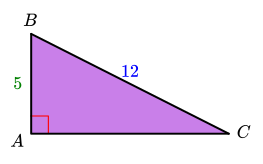
Suppose now that the measure of ∠ C is desired. Note that, apart from the hypotenuse, the side whose length is known is opposite to ∠ C. The trigonometric ratio that relates the hypotenuse and the opposite side to an acute angle in a right triangle is the sine ratio. sin ∠ C=length of oppositeside to ∠ C/hypotenuse ⇓ sin ∠ C=5/12 To find the measure of ∠ C, the inverse of the sine ratio could be used. sin ∠ C=5/12 ⇕ m ∠ C=sin ^(- 1)5/12
Finally, to find the value of sin ^(- 1) 512 and therefore the measure of ∠ C, a calculator will help. In the following example, it will be shown how to use a calculator to find the value of an inverse trigonometric ratio.Example
Share
Report error
Calculating Angles of Right Triangles
Previously, it was said that apart from being useful to find side lengths of a right triangle, trigonometric ratios can also be used to find missing angle measures.
Before playing video games with his friends, Kriz wants to finish his math homework to have a care-free weekend. He wants to find the measure of an acute angle in three different right triangles. By using the corresponding trigonometric ratios, help Kriz find m∠ θ in each triangle. Round the answer to the nearest degree.
a 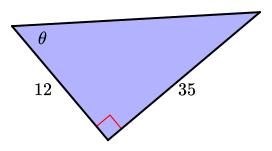
{"type":"text","form":{"type":"math","options":{"comparison":"1","nofractofloat":false,"keypad":{"simple":true,"useShortLog":false,"variables":[],"constants":[]},"rendered":false},"text":" "},"formTextBefore":"m∠ \u03b8 =","formTextAfter":"^(∘)","answer":{"text":["71"]}}
b 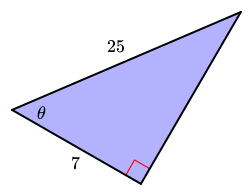
{"type":"text","form":{"type":"math","options":{"comparison":"1","nofractofloat":false,"keypad":{"simple":true,"useShortLog":false,"variables":[],"constants":[]},"rendered":false},"text":" "},"formTextBefore":"m∠ \u03b8 =","formTextAfter":"^(∘)","answer":{"text":["74"]}}
c 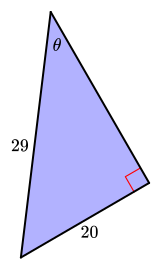
{"type":"text","form":{"type":"math","options":{"comparison":"1","nofractofloat":false,"keypad":{"simple":true,"useShortLog":false,"variables":[],"constants":[]},"rendered":false},"text":" "},"formTextBefore":"m∠ \u03b8 =","formTextAfter":"^(∘)","answer":{"text":["44"]}}
Hint
a The lengths of the adjacent and opposite sides to ∠ θ are 12 and 35, respectively.
b The hypotenuse of the right triangle is 25 and the length of the adjacent side to ∠ θ is 7.
c The hypotenuse of the right triangle is 29 and the length of the opposite side to ∠ θ is 20.
Solution
a In the given diagram, it can be seen that the lengths of the opposite and adjacent sides to ∠ θ are 35 and 12, respectively. The trigonometric ratio that relates these two sides is the tangent ratio.
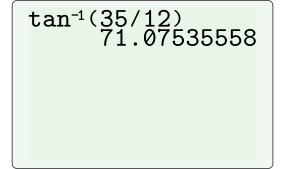 Thereofre, m∠ θ ≈ 71^(∘).
tan θ = length of oppositeside to∠ θ/length of adjacentside to∠ θ ⇓ tan θ = 35/12
To solve this equation, the inverse of the tangent function could be used. tan θ = 35/12 ⇕ m∠ θ =tan ^(- 1) 35/12
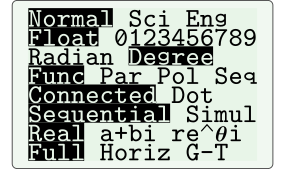
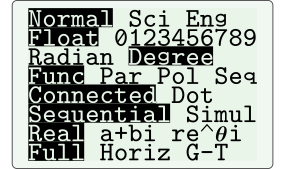
To find the value of tan ^(- 1) 3512, a calculator should to be used. First, the calculator must be set in degree mode. This is done by pushing MODE and selecting Degree
in the third row.
Next the value of tan ^(- 1) 3512, can be calculated by pushing 2ND, followed by TAN, and 35/12.
b In the given diagram, it is shown that the length of the adjacent side to ∠ θ is 7 and that the hypotenuse of the right triangle is 25. The trigonometric ratio that relates these two sides is the cosine ratio.
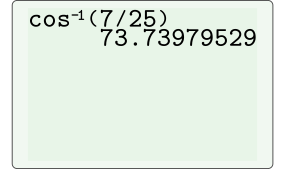 It was found that m∠ θ ≈ 74^(∘).
cos θ = length of adjacentside to∠ θ/hypotenuse ⇓ cos θ = 7/25
To solve this equation, the inverse of the cosine function is needed. cos θ = 7/25 ⇕ m∠ θ =cos ^(- 1) 7/25
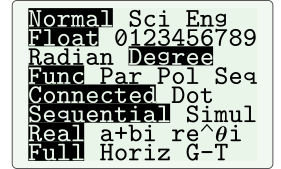
To find the value of cos ^(- 1) 725, a calculator should be used. Just like before, the calculator must be set in degree mode. This is done by pushing MODE and selecting Degree
in the third row.
Next the value of cos ^(- 1) 725, is calculated by pushing 2ND, followed by COS, and 7/25.
c In the diagram, it can be seen that the hypotenuse of the right triangle is 29 and that the length of the opposite side to ∠ θ is 20. The trigonometric ratio that relates these two sides is the sine ratio.
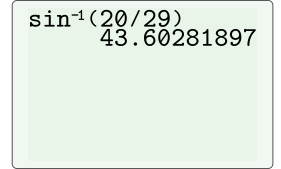 Thereofre, m∠ θ ≈ 44^(∘).
sin θ = length of oppositeside to∠ θ/hypotenuse ⇓ sin θ = 20/29
To solve this equation, the inverse of the sine function can be used. sin θ = 20/29 ⇕ m∠ θ =sin ^(- 1) 20/29
To find the value of sin ^(- 1) 2029, a calculator should be used. Just like in Parts A and B, the calculator must be set in degree mode by pushing MODE and selecting Degree
in the third row.
Next the value of sin ^(- 1) 2029, can be calculated by pushing 2ND, followed by SIN, and 20/29.
Pop Quiz
Share
Report error
Practice Finding Angles Using Trigonometric Ratios
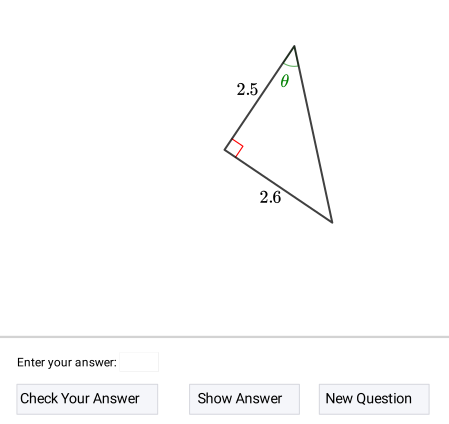
In the following right triangles, two side lengths are given. By using the corresponding trigonometric ratio, find m∠ θ. Round the answer to nearest degree.
Discussion
Share
Report error
Reciprocal Trigonometric Ratios
Apart from the sine, cosine, and tangent ratios, there are three other trigonometric ratios that are worth mentioning.
Consider the right triangle △ ABC.
The so called reciprocal ratios are written in the next table.
| Name | Definition | Notation |
|---|---|---|
| Cosecant of ∠ θ | Hypotenuse/Length of opposite side to ∠ θ | csc θ=hyp/opp |
| Secant of ∠ θ | Hypotenuse/Length of adjacent side to ∠ θ | sec θ=hyp/adj |
| Cotangent of ∠ θ | Length of adjacent side to ∠ θ/Length of opposite side to ∠ θ | cot θ=adj/opp |
These ratios can be defined in terms of sine, cosine, and tangent.
Rule
Share
Report error
Reciprocal Identities
The trigonometric ratios cosecant, secant, and cotangent are reciprocals of sine, cosine, and tangent, respectively.
csc θ=1/sin θ
sec θ=1/cos θ
cot θ=1/tan θ
Proof
Consider a right triangle with the three sides labeled with respect to an acute angle θ.
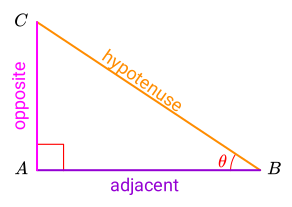
sin θ=opp/hyp
▼
Solve for 1/sin θ
MultEqn
LHS * 1/sin θ=RHS* 1/sin θ
1=opp/hyp (1/sin θ)
MultEqn
LHS * hyp/opp=RHS* hyp/opp
hyp/opp=1/sin θ
RearrangeEqn
Rearrange equation
1/sin θ=hyp/opp
Explore
Share
Report error
Finding Reciprocal Identities
If the sine, cosine, and tangent ratios are known, then their reciprocals cosecant, secant, and cotangent can be calculated without too much effort.
LaShay is really good at her favorite subject, Geometry. She has been appointed by Jefferson High's principal to do some tutoring for some of her classmates after school. To do so, she drew a right triangle. She then asked her peers to find all six trigonometric ratios with respect to the marked angle θ.
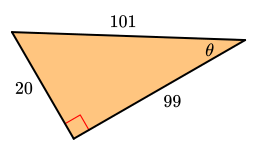
Help LaShay's classmates find the trigonometric ratios!
{"type":"text","form":{"type":"math","options":{"comparison":"0","nofractofloat":false,"keypad":{"simple":true,"useShortLog":false,"variables":[],"constants":[]},"rendered":false},"text":" "},"formTextBefore":"sin \u03b8 =","formTextAfter":null,"answer":{"text":["\\dfrac{20}{101}","\\frac{20}{101}","20\/101"]}}
{"type":"text","form":{"type":"math","options":{"comparison":"0","nofractofloat":false,"keypad":{"simple":true,"useShortLog":false,"variables":[],"constants":[]},"rendered":false},"text":" "},"formTextBefore":"csc \u03b8 =","formTextAfter":null,"answer":{"text":["\\dfrac{101}{20}","\\frac{101}{20}","101\/20"]}}
{"type":"text","form":{"type":"math","options":{"comparison":"0","nofractofloat":false,"keypad":{"simple":true,"useShortLog":false,"variables":[],"constants":[]},"rendered":false},"text":" "},"formTextBefore":"cos \u03b8 =","formTextAfter":null,"answer":{"text":["\\dfrac{99}{101}","\\frac{99}{101}","99\/101"]}}
{"type":"text","form":{"type":"math","options":{"comparison":"1","nofractofloat":false,"keypad":{"simple":true,"useShortLog":false,"variables":[],"constants":[]},"rendered":false},"text":" "},"formTextBefore":"sec \u03b8 =","formTextAfter":null,"answer":{"text":["101\/99","\\dfrac{101}{99}","\\frac{101}{99}"]}}
{"type":"text","form":{"type":"math","options":{"comparison":"0","nofractofloat":false,"keypad":{"simple":true,"useShortLog":false,"variables":[],"constants":[]},"rendered":false},"text":" "},"formTextBefore":"tan \u03b8 =","formTextAfter":null,"answer":{"text":["\\dfrac{20}{99}","\\frac{20}{99}","20\/99"]}}
{"type":"text","form":{"type":"math","options":{"comparison":"0","nofractofloat":false,"keypad":{"simple":true,"useShortLog":false,"variables":[],"constants":[]},"rendered":false},"text":" "},"formTextBefore":"cot \u03b8 =","formTextAfter":null,"answer":{"text":["\\dfrac{99}{20}","\\frac{99}{20}","99\/20"]}}
Hint
Identify the hypotenuse of the right triangle and the opposite and adjacent sides to ∠ θ.
Solution
The hypotenuse of the right triangle and the opposite and adjacent sides to ∠ θ will be identified.
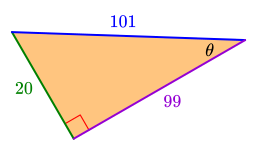
It can be seen that the hypotenuse is 101 and the lengths of the opposite and adjacent sides to ∠ θ are 20 and 99, respectively. With this information, the sine, cosine, and tangent ratios can be found. sin θ &= 20/101 [0.8em] cos θ &= 99/101 [0.8em] tan θ &= 20/99 The reciprocals of the above ratios are the cosecant, secant, and cotangent of ∠ θ. sin θ = 20/101 & ⇒ csc θ = 101/20 [0.9em] cos θ = 99/101 & ⇒ sec θ = 101/99 [0.9em] tan θ = 20/99 & ⇒ cot θ = 99/20
Closure
Share
Report error
Calculating a Side of a Right Triangle
With the topics learned in this lesson, the challenge presented at the onset can now be solved. Previously, it was learned that the Leaning Tower of Pisa has a tilt of 4 degrees. The hammer dropped by the worker landed 3 meters away from the base of the tower.
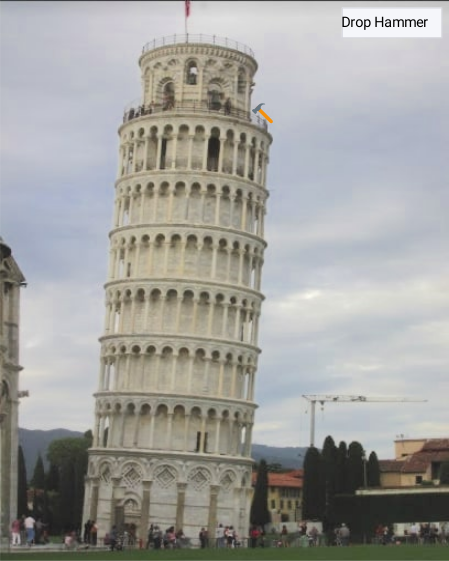 With the given information, the vertical distance traveled by the hammer can be calculated. Write the answer to the nearest tenth.
 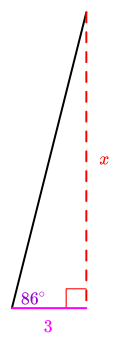 The trigonometric ratio that relates an angle of a right triangle with its opposite and adjacent sides is the tangent ratio.
tan θ = length of opposite side to ∠ θ/length of adjacent side to ∠ θ ⇓ tan 86^(∘)=x/3
This equation can be solved for x, which is the vertical distance traveled by the hammer.
The distance traveled by the hammer is about 42.9 meters.
The trigonometric ratio that relates an angle of a right triangle with its opposite and adjacent sides is the tangent ratio.
tan θ = length of opposite side to ∠ θ/length of adjacent side to ∠ θ ⇓ tan 86^(∘)=x/3
This equation can be solved for x, which is the vertical distance traveled by the hammer.
The distance traveled by the hammer is about 42.9 meters.
{"type":"text","form":{"type":"math","options":{"comparison":"0","nofractofloat":false,"keypad":{"simple":true,"useShortLog":false,"variables":[],"constants":[]},"rendered":false},"text":" "},"formTextBefore":"Vertical distance =","formTextAfter":"meters","answer":{"text":["42.9","42.9 m","42.9 meters","42.9m","42.9meters"]}}
Hint
Draw a right triangle and identify the given information.
Solution
If the tower has a tilt of 4^(∘), then the acute angle formed by the ground and the tower itself is the difference between 90^(∘) and 4^(∘). 90^(∘)- 4^(∘)= 86^(∘) A right triangle can be drawn with an acute angle whose measure is 86^(∘). Furthermore, the length of the adjacent side to this angle is 3 meters, and the length of its opposite side is unknown.
tan 86^(∘)=x/3
▼
Solve for x
MultEqn
LHS * 3=RHS* 3
tan 86^(∘)* 3=x
RearrangeEqn
Rearrange equation
x=tan 86^(∘)* 3
UseCalc
Use a calculator
x=42.901998...
RoundDec
Round to 1 decimal place(s)
x≈ 42.9
Trigonometric Ratios of Acute Angles
Exercise 1.1
Find tan v.
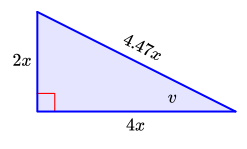
{"type":"text","form":{"type":"math","options":{"comparison":"1","nofractofloat":false,"keypad":{"simple":true,"useShortLog":false,"variables":["x"],"constants":["PI"]},"rendered":false},"text":" "},"formTextBefore":"tan v=","formTextAfter":null,"answer":{"text":["\\dfrac{1}{2}"]}}
Find sin v.
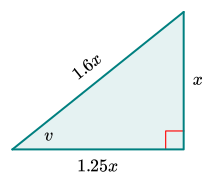
{"type":"text","form":{"type":"math","options":{"comparison":"1","nofractofloat":false,"keypad":{"simple":true,"useShortLog":false,"variables":["x"],"constants":["PI"]},"rendered":false},"text":" "},"formTextBefore":"sin v=","formTextAfter":null,"answer":{"text":["\\dfrac{5}{8}"]}}
Find cos v.
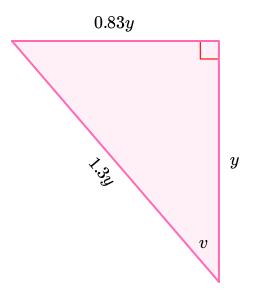
{"type":"text","form":{"type":"math","options":{"comparison":"1","nofractofloat":false,"keypad":{"simple":true,"useShortLog":false,"variables":["x"],"constants":["PI"]},"rendered":false},"text":" "},"formTextBefore":"cos v=","formTextAfter":null,"answer":{"text":["\\dfrac{10}{13}","\\dfrac{1}{1.3}"]}}
security
report
code
security
report
code
The tangent ratio is the ratio of the opposite side to the adjacent side of a non-right angle in a right triangle. tan v = Opposite/Adjacent Let's identify the opposite and adjacent side to v.
Finally, we will simplify this ratio by reducing the fraction on the right-hand side.
The sine ratio is the ratio of the opposite side to the hypotenuse in a right triangle.
sin v = Opposite/Hypotenuse
Let's identify the hypotenuse and opposite side to v in the diagram.
Let's simplify this equation.
The cosine ratio is the ratio of the adjacent side to the hypotenuse in a right triangle.
cos v = Adjacent/Hypotenuse
Let's mark the hypotenuse and adjacent side to v in the triangle.
Let's simplify this equation.
security
report
code
During a hurricane, the flagpole of Magdalena's school snapped. She wants to repair it, so she will do some calculations. The diagram illustrates the situation.
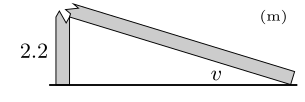
{"type":"text","form":{"type":"math","options":{"comparison":"1","nofractofloat":false,"keypad":{"simple":true,"useShortLog":false,"variables":["x"],"constants":["PI"]},"rendered":false},"text":" "},"formTextBefore":null,"formTextAfter":"m","answer":{"text":["8.1"]}}
security
report
code
security
report
code
From the exercise, we can make out a right triangle where the opposite side of ∠ v is known. Let's label the unknown leg and hypotenuse a and c, respectively.
To determine the height of the flagpole, we can calculate the length of the part that was broken off and add it to the part that is still standing. Since we know tan v=0.4, we will first use the tangent ratio to calculate the length of the unknown leg.
Calculating the Leg
The tangent ratio is the ratio of the opposite side to the adjacent side in a right triangle. tan v = Opposite/Adjacent Let's substitute the legs into the ratio and solve for a.
The leg is 5.5 meters.
Calculating the Hypotenuse
Since we know both legs of the right triangle, we can use the Pythagorean Theorem to determine the hypotenuse.
The hypotenuse is about 5.9 meters.
Lenght of Flagpole
Finally, we can determine the length of the flagpole by adding the broken off part to the part that is still standing. 2.2+5.9=8.1 m Magdalena can take the original height of 8.1 meters into consideration when repairing the flag pole.
security
report
code
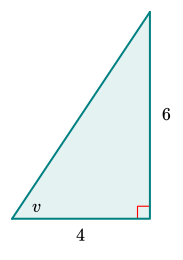
Ignacio wants to determine the measure of ∠ v in the following triangle. He reaches in his backpack for a graphing calculator. Wait a minute; he has lost it!
{"type":"choice","form":{"alts":["Enrique is correct","Ignacio is correct","Both are correct","Neither is correct"],"noSort":true},"formTextBefore":"","formTextAfter":"","answer":0}
security
report
code
security
report
code
In a right triangle where both acute angles are 45^(∘), the legs are congruent.
Conversely, if an angle's opposite side is longer than its adjacent side, the angle becomes greater than 45^(∘). Let's identify the opposite and adjacent side to v in the given triangle.
Now we can analyze the different claims.
Enrique's Claim
Since the opposite side of ∠ v is greater than its adjacent side, ∠ v must be greater than 45^(∘). Therefore, Enrique is correct.
Ignacio's Claim
As for Ignacio's claim that the angle is greater than 55^(∘), we cannot verify the claim without actually calculating it. He may very well be correct, but without the use of inverse trigonometric functions, we cannot know for sure.
security
report
code
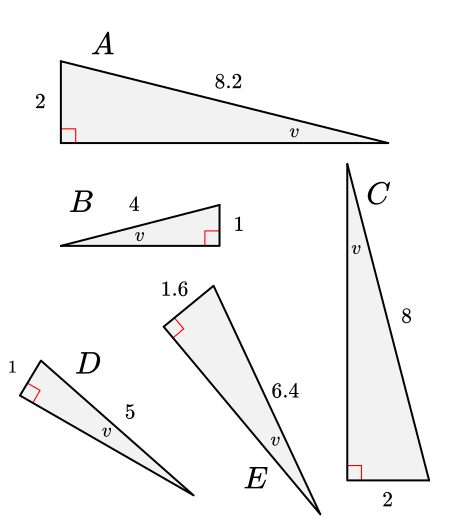
We know that sin v equals 0.25 for a right triangle. Which of the following triangles could this describe?
{"type":"multichoice","form":{"alts":["A","B","C","D","E"],"noSort":true},"formTextBefore":"","formTextAfter":"","answer":[1,2,4]}
security
report
code
security
report
code
The sine ratio is the ratio of the opposite side to the hypotenuse in a right triangle. sin v = Opposite/Hypotenuse Let's identify the hypotenuse and opposite side to angle v for the five triangles.
Having identified the opposite side and hypotenuse to v in each of the five triangles, we can write five different ratios. By calculating them, we can tell which ones that equal 0.25.
| Triangle | Opposite/Hypotenuse | Simplify |
|---|---|---|
| A | 2/8.2 | 0.24 |
| B | 1/4 | 0.25 |
| C | 2/8 | 0.25 |
| D | 1/5 | 0.20 |
| E | 1.6/6.4 | 0.25 |
As we can see, the ratio is 0.25 for B, C, and E. Therefore, the description could be of any of these triangles.
security
report
code
Trigonometric Ratios of Acute Angles
Recommended exercises
To get personalized recommended exercises, please login first.
Loading content
≤
>
■2
■▢
e▢
7
8
9
×
÷■1
=
=
√▢
▢√
∫▢▢
4
5
6
+
−
≤
<
log
ln
log▢
1
2
3
()
∣
sin
cos
tan
0
.
π
x
y
Loading content