5. Joint, Inverse, and Combined Variation
Sign In
An error ocurred, try again later!
Chapter 4
5.
Joint, Inverse, and Combined Variation
Mathematics often presents concepts that showcase relationships between quantities. One such concept is combined variation, where one variable depends on two or more variables, either directly, inversely, or a combination of both. Joint variation, on the other hand, occurs when one variable varies directly with two or more variables. These concepts are illustrated with real-life examples, making them more relatable and easier to grasp. For instance, the number of songs a phone can store can vary inversely with the average size of a song. Similarly, the time it takes for a journey can be inversely proportional to the speed of travel. These variations help in modeling real-world scenarios and solving problems that we encounter daily. By understanding these examples, learners can tackle more complex mathematical challenges with confidence.
Show less Show more expand_more 


Lesson Settings & Tools
| | 13 Theory slides |
| | 10 Exercises - Grade E - A |
| | Each lesson is meant to take 1-2 classroom sessions |
Joint, Inverse, and Combined Variation
Slide of 13
Two or more quantities can have a constant ratio. For example, the circumference of any circle is proportional to its diameter, and its ratio is always equal to a constant, π. In this lesson, equations in two or more variables will be created to represent relationships between quantities and their graphs will be analyzed.
Catch-Up and Review
Here are a few recommended readings before getting started with this lesson.
Challenge
Share
Report error
Number of Phone Calls Per Day Between Two Cities
The average number of phone calls per day between two cities N varies directly with the populations of the cities P_1 and P_2, and inversely with the square of distance d between the two cities.
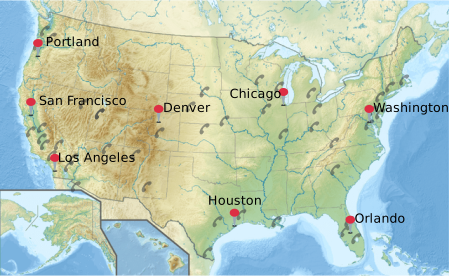
External credits: TUBS
a Which equation models the given situation?
{"type":"choice","form":{"alts":["N = \\dfrac{k d_2} {P_1 P_2}","N = \\dfrac{k P_1 P_2} {d}","N = \\dfrac{k P_1 } {d^2 P_2}","N = \\dfrac{k P_1 P_2} {d^2}"],"noSort":true},"formTextBefore":"","formTextAfter":"","answer":3}
b In 2010, the population of San Francisco was about 806 000, and the population of Portland was about 585 000. The distance between the two cities is about 650 miles. In the given year, the average number of calls between the cities was about 42 000. Use the model determined in Part A to Find the constant k. Round the answer to three decimal places.
{"type":"text","form":{"type":"math","options":{"comparison":"1","nofractofloat":false,"keypad":{"simple":true,"useShortLog":false,"variables":["x"],"constants":["PI"]},"rendered":false},"text":" "},"formTextBefore":"\u2248","formTextAfter":null,"answer":{"text":["0.038"]}}
c In 2010,the average number of daily phone calls between San Francisco and Los Angeles, with a population of about 3 800 000, was about 806 000. Use the model to find the approximate distance between the two cities.
{"type":"text","form":{"type":"math","options":{"comparison":"1","nofractofloat":false,"keypad":{"simple":true,"useShortLog":false,"variables":["x"],"constants":["PI"]},"rendered":false},"text":" "},"formTextBefore":null,"formTextAfter":"miles","answer":{"text":["380"]}}
Discussion
Share
Report error
Joint Variation
A joint variation, also known as joint proportionality, occurs when one variable varies directly with two or more variables. In other words, if a variable varies directly with the product of other variables, it is called joint variation.
z=kxy
Here, the variable z varies jointly with x and y, and k is the constant of variation. Here are some examples of joint variation.
| Examples of Joint Variation | ||
|---|---|---|
| Example | Rule | Comment |
| The area of a rectangle | A=l w | Here, l is the rectangle's length, w its width, and the constant of variation k is 1. |
| The volume of a pyramid | V=1/3l w h | Here, l and w are the length and the width of the base, respectively, while h is the pyramid's height. The constant of variation k is 13. |
Example
Share
Report error
Television Series
Vincenzo and Emily are having a lively chat about television series they love. Emily managed to watch 164 episodes of The Flash in just 50 days! Each episode typically lasts 40 minutes.

{"type":"text","form":{"type":"math","options":{"comparison":"1","nofractofloat":false,"keypad":{"simple":true,"useShortLog":false,"variables":["x"],"constants":["PI"]},"rendered":false},"text":" "},"formTextBefore":"About","formTextAfter":"days","answer":{"text":["9"]}}
Hint
Use the fact that if z varies jointly with x and y, the equation of variation is z=k xy, where k is the constant of variation.
Solution
Begin with recalling that if z varies jointly with x and y, the equation of variation is z=k x y.
z = k* x* y
Here, k is the constant of variation and k≠ 0. In this case, the number of days it takes to watch a show d is jointly proportional to the number of episodes e and the length of the episodes l. This means the equation of the variation can be written as follows.
d = k * e * l
Now, k will be determined by using the given information about the series Emily watched. It is given that it took 50 days to watch 164 episodes that are each about 40 minutes long. Substitute d= 50, e= 164, and l= 40 into the equation and solve for k.
Using k, the time it will take to watch Sherlock can be determined. Recall that it is given that there are 13 episodes and each is 90 minutes long.
It will take Vincenzo about 9 days to watch Sherlock. Time to stock up on snacks!
d = k e l
SubstituteValues
Substitute values
50 = k * 164* 40
▼
Solve for k
Multiply
Multiply
50 = k * 6560
DivEqn
.LHS /6560.=.RHS /6560.
50/6560 = k
ReduceFrac
a/b=.a /10./.b /10.
5/656 = k
RearrangeEqn
Rearrange equation
k = 5/656
d = 5/656 e l
SubstituteValues
Substitute values
d = 5/656 * 13 * 90
▼
Evaluate right-hand side
Multiply
Multiply
d = 5/656 * 1170
MoveRightFacToNum
a/c* b = a* b/c
d = 5850/656
CalcQuot
Calculate quotient
d = 8.917682...
RoundInt
Round to nearest integer
d ≈ 9
Explore
Share
Report error
Recognzing Inverse Variation
Use the applet to investigate the relationship between the width and the length of rectangles.
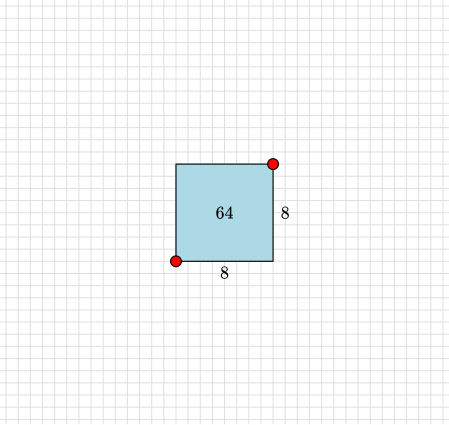 For rectangles with a fixed area, say 64 square units, complete the table.
Draw a scatter plot of the data. Does it make sense to say that the width varies inversely with the length? Explain.
| Width | Length |
|---|---|
| 2 | |
| 4 | |
| 8 | |
| 16 | |
| 32 |
Discussion
Share
Report error
Inverse Variation
An inverse variation, or inverse proportionality, occurs when two non-zero variables have a relationship such that their product is constant. This relationship is often written with one of the variables isolated on the left-hand side.
xy=k or y=k/x
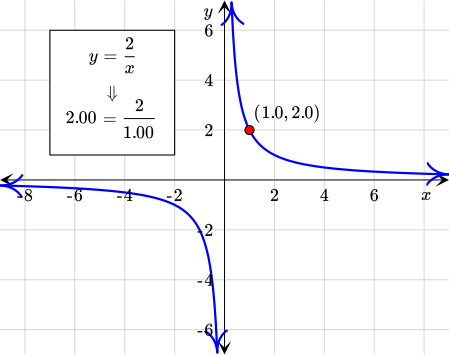
| Examples of Inverse Variation | ||
|---|---|---|
| Example | Rule | Comment |
| The gas pressure in a sealed container if the container's volume is changed, given constant temperature and constant amount of gas. | P=nRT/V | The variables are the pressure P and the volume V. The amount of gas n, temperature T, and universal gas constant R are fixed values. Therefore, the constant of variation is nRT. |
| The time it takes to travel a given distance at various speeds. | t=d/s | The constant of variation is the distance d and the variables are the time t and the speed s. |
Pop Quiz
Share
Report error
Identifying the Type of Variation
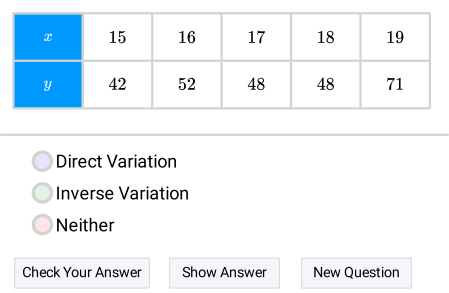
Example
Share
Report error
Number of Songs on Emily's Phone
Emily, tired of watching shows, wants to update the playlist on her phone before starting a family road trip from Portland to San Francisco. The number of songs that can be stored on her phone varies inversely with the average size of a song.

Emily's phone can store 4100 songs when the average size of a song is 4 megabytes (MB).
a How many songs with an average size of 5 megabytes does Emily's phone store?
{"type":"text","form":{"type":"math","options":{"comparison":"1","nofractofloat":false,"keypad":{"simple":true,"useShortLog":false,"variables":["x"],"constants":["PI"]},"rendered":false},"text":" "},"formTextBefore":null,"formTextAfter":"songs","answer":{"text":["3280"]}}
b List the number of songs that will fit on the phone when the average size of a song is 3MB, 4MB, 5MB, and 6MB, respectively. Round the answer to the nearest integer whenever necessary.
{"type":"text","form":{"type":"list","options":{"comparison":"1","nofractofloat":false,"keypad":{"simple":true,"useShortLog":false,"variables":["x"],"constants":["PI"]},"rendered":false,"ordermatters":true,"numinput":4,"listEditable":false,"hideNoSolution":true},"text":" "},"formTextBefore":null,"formTextAfter":null,"answer":{"text":["5466","4100","3280","2733"]}}
Hint
a Begin by finding the constant of variation.
b Use the inverse variation equation to create a table.
Solution
a It is given that the number of songs y that can be stored on Emily's phone varies inversely with the average size x of a song. Recall the form of an inverse variation equation that relates x and y.
y = k/a
SubstituteII
x= 4, y= 4100
4100=k/4
MultEqn
LHS * 4=RHS* 4
16 400=k
RearrangeEqn
Rearrange equation
k=16 400
b In the previous part, the inverse variation equation was found.
y=16 400/x Now a table that shows the number of songs when the average size of a song is 3 MB, 4 MB, 5 MB, and 6 MB can be made.
| Size, x | 16 400/x | Number of Songs, y |
|---|---|---|
| 3 | 16 400/2 | 5466 |
| 4 | 16 400/4 | 4100 |
| 5 | 16 400/5 | 3280 |
| 6 | 16 400/6 | ≈ 2733 |
In the table, as the size gets larger, the number of songs that the phone can store gets smaller. Therefore, the number of songs decreases as the average size increases.
Example
Share
Report error
Emily's Trip to San Francisco
Now that the updated playlist and everything else is ready, Emily's journey from Portland to San Francisco can begin.
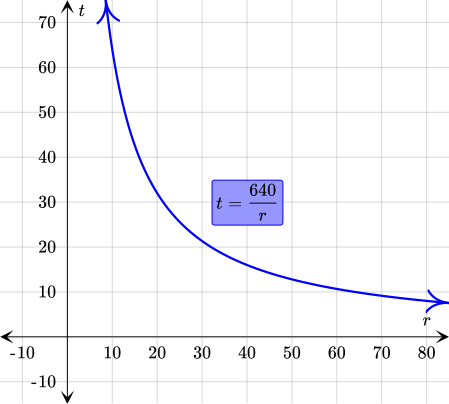
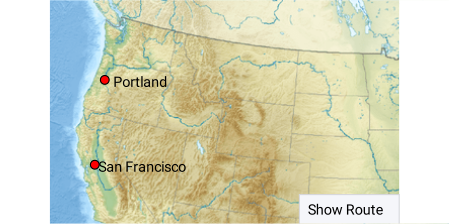 The time it takes to reach San Francisco varies inversely with their average rate of speed.
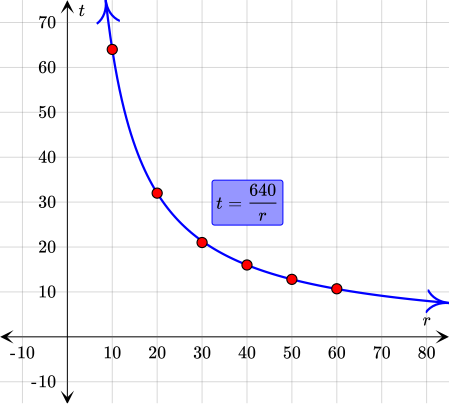 Emily should travel at a minimum speed of 53 miles per hour.
External credits: TUBS
a If Emily lives just outside of the main City of Portland 640 miles from San Francisco by car, write an equation that relates the travel time to the average speed. In addition to the equation, draw its corresponding graph.
Answer
a Example Equation: t=640/r
Example Graph:
b About 53 mph
Hint
a Use the standard equation of the inverse variation, y = kx, where k is the constant of variation.
b Substitute 12 for the time into the equation from Part A and solve for the rate of speed.
Solution
a It is given that the time it takes Emily to reach San Francisco varies inversely with her average rate of speed. Let t be the time and r be the rate of speed. Then, the following equation can be written.
t=k/r Here, k is a constant of variation. It is also given that Emily lives 450 miles away from San Francisco. This is the value of k. Recall that a distance is a product of the time and rate of speed. Thus, the time can be expressed as a quotient of the distance by the rate of speed. d=rt ⇒ t=d/r Comparing this formula with the equation, it is seen that k indeed represents the distance. Therefore, k can be substituted with 640. t=640/r Now make a table of values to graph the equation.
| r | 640/r | t |
|---|---|---|
| 10 | 640/10 | 64 |
| 20 | 640/20 | 32 |
| 30 | 640/30 | ≈ 21 |
| 40 | 640/40 | 16 |
| 50 | 640/50 | 12.8 |
| 60 | 640/60 | ≈ 10.7 |
Ordered pairs (r,t) are the coordinates of the points on the graph. Plot the points and connect them with a smooth curve.
b To determine the minimum average speed that will allow Emily to arrive to San Francisco within 12 hours, substitute 12 for t into the equation from Part A and solve it for r.
t=640/r
Substitute
t= 12
12=640/r
MultEqn
LHS * r=RHS* r
12r= 640
DivEqn
.LHS /12.=.RHS /12.
r= 53.333333 ...
RoundInt
Round to nearest integer
r ≈ 53
Discussion
Share
Report error
Combined Variation
A combined variation, or combined proportionality, occurs when one variable depends on two or more variables, either directly, inversely, or a combination of both. This means that any joint variation is also a combined variation.
z=kx/y
The variable z varies directly with x and inversely with y, and k is the constant of variation. Therefore, this is a combined variation. Here are some examples.
| Examples of Combined Variation | ||
|---|---|---|
| Example | Rule | Comment |
| Newton's Law of Gravitational Force | F=G m_1 m_2/d^2 | The gravitational force F varies directly as the masses of the objects m_1 and m_2, and inversely as the square of the distance d^2 between the objects. The gravitational constant G is the constant of variation. |
| The Ideal Gas Law | P=nRT/V | The pressure P varies directly as the number of moles n and the temperature T, and inversely as the volume V. The universal gas constant R is the constant of variation. |
Example
Share
Report error
Number of T-Shirts Sold
Emily is wandering around a gift shop to buy gifts for some of her friends. Emily overhears a conversation between the shopkeeper and an employee. The shopkeeper says that the number of t-shirts sold is directly proportional to their advertising budget and inversely proportional to the price of each t-shirt.

When $1200 are spent on advertising and the price of each t-shirt is $4.80, the number of t-shirts sold is 6500. How many t-shirts are sold when the advertising budget is $1800 and the price of each t-shirt is $6?
{"type":"text","form":{"type":"math","options":{"comparison":"1","nofractofloat":false,"keypad":{"simple":true,"useShortLog":false,"variables":["x"],"constants":["PI"]},"rendered":false},"text":" "},"formTextBefore":null,"formTextAfter":null,"answer":{"text":["7800"]}}
Hint
Use the equation of the combined variation, z = kxy, where k is the constant of variation.
Solution
When one quantity varies with respect to two or more quantities, this variation can be regarded as a combined variation.
| Combined Variation | Equation Form |
|---|---|
| a varies jointly with b and c. | a=k b c |
| a varies jointly with b and c, and inversely with d. | a=k b c/d |
| a varies directly with b and inversely with the product d c. | a=k b/d c |
N=kb/p
SubstituteValues
Substitute values
6500=k( 1200)/4.80
▼
Solve for k
MultEqn
LHS * 4.80=RHS* 4.80
31 200=k(1200)
DivEqn
.LHS /1200.=.RHS /1200.
31 200/1200=k
CalcQuot
Calculate quotient
26=k
RearrangeEqn
Rearrange equation
k=26
Alternative Solution
The number of t-shirts sold N varies directly with the advertising budget b and inversely with the price of a t-shirt p. Additionally, N=6500 when b=1200 and p=4.80. The goal is to find N when b=1800 and p=6. To find the value of N, write two equations that involve the constant of variation k.
c|c
N_1=kb_1/p_1 & N_2=kb_2/p_2 ⇕ & ⇕ k=N_1p_1/b_1 & k=N_2p_2/b_2
Since k is equal to both x_1z_1y_1 and x_2z_2y_2, by the Transitive Property of Equality these two expressions must be equal. Using this information, a proportion can be written.
N_1p_1/b_1=N_2p_2/b_2
Next, substitute N_1=6500, b_1=1200, p_1=4.8, b_2=1800, and p_2=6 and solve for N_2.
N_1p_1/b_1=N_2p_2/b_2
SubstituteValues
Substitute values
6500( 4.8)/1200=N_2( 6)/1800
▼
Solve for N_2
CrossMult
Cross multiply
6500(4.8)(1800)= N_2(6)(1200)
Multiply
Multiply
56 160 000=N_2(7200)
DivEqn
.LHS /7200.=.RHS /7200.
56 160 000/7200=N_2
CalcQuot
Calculate quotient
7800=N_2
RearrangeEqn
Rearrange equation
N_2=7800
Pop Quiz
Share
Report error
Finding the Value of z
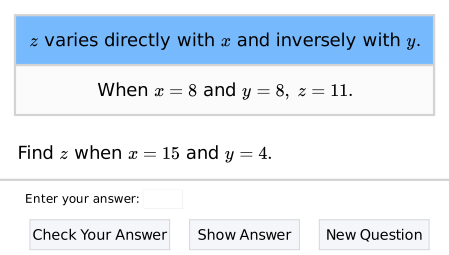
In the applet, various types of variations are shown randomly. Find the value of z by using the given values. If necessary, round the answer to the two decimal places.
Closure
Share
Report error
Number of Phone Calls Per Day Between Two Cities
In this lesson, variation types are explained with real-life examples. Considering those examples, the challenge presented at the beginning of the lesson can be solved with confidence. Recall that the average number of phone calls per day between two cities varies directly with the populations of the cities and inversely with the square of the distance between the two cities.
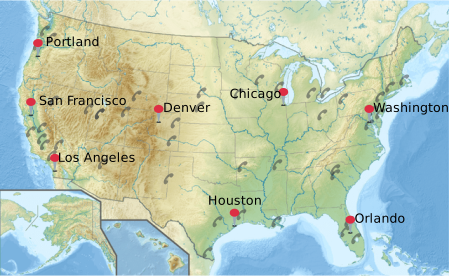
External credits: TUBS
a Which equation models the given situation?
{"type":"choice","form":{"alts":["N = \\dfrac{k d_2} {P_1 P_2}","N = \\dfrac{k P_1 P_2} {d}","N = \\dfrac{k P_1 } {d^2 P_2}","N = \\dfrac{k P_1 P_2} {d^2}"],"noSort":true},"formTextBefore":"","formTextAfter":"","answer":3}
b In 2010, the population of San Francisco was about 806 000 and the population of Portland was about 585 000. The distance between the two cities is roughly 650 miles. In the given year, the average number of calls between the cities was about 42 000. Use the model determined in Part A to Find the constant k. Round the answer to three decimal places.
{"type":"text","form":{"type":"math","options":{"comparison":"1","nofractofloat":false,"keypad":{"simple":true,"useShortLog":false,"variables":["x"],"constants":["PI"]},"rendered":false},"text":" "},"formTextBefore":"\u2248","formTextAfter":null,"answer":{"text":["0.038"]}}
c In 2010,the average number of daily phone calls between San Francisco and Los Angeles, with a population of about 3 800 000, was about 806 000. Use the model to find the approximate distance between the two cities.
{"type":"text","form":{"type":"math","options":{"comparison":"1","nofractofloat":false,"keypad":{"simple":true,"useShortLog":false,"variables":["x"],"constants":["PI"]},"rendered":false},"text":" "},"formTextBefore":null,"formTextAfter":"miles","answer":{"text":["380"]}}
Hint
a Use the equation of the combined variation, z = kxy, where k is the constant of variation.
b Substitute the given values to find the value of k.
c Substitute the given values into the variation equation.
Solution
a Recall the labels of the quantities.
N: & Number of phone calls per day P_1: & Population of one of the cities P_2: & Population of the other city d : & Distance between the cities It is known that N varies directly with P_1 and P_2, and inversely with the square of d. Therefore, N is equal to the product of k, P_1, and P_2 divided by the square of d. N=k P_1 P_2/d^2 Here k is the constant of variation and cannot be 0. This equation models the given variation.
b The value of k can be found by using the given information and the equation written in Part A.
| San Francisco | Portland | |
|---|---|---|
| Population | 806 000 | 585 000 |
| Distance | 650 | |
| Number of Calls | 42 000 | |
N=kP_1 P_2/d^2
SubstituteValues
Substitute values
42 000=k( 806 000)( 585 000)/650^2
▼
Solve for k
Multiply
Multiply
42 000 = k(471 510 000 000)/650^2
CalcPow
Calculate power
42 000 = k(471 510 000 000)/422 500
MovePartNumLeft
a* b/c=a*b/c
42 000 = k * 471 510 000 000/422 500
CalcQuot
Calculate quotient
42 000 = k* 1 116 000
DivEqn
.LHS /1 116 000.=.RHS /1 116 000.
42 000/1 116 000 = k
RearrangeEqn
Rearrange equation
k = 42 000/1 116 000
CalcQuot
Calculate quotient
k = 0.037634 ...
RoundDec
Round to 3 decimal place(s)
k ≈ 0.038
c Using the value of k found in Part B, the equation that models the variation can be expressed.
N= 0.038 P_1 P_2/d^2 For clarity, make a table to organize the given information.
| San Francisco | Los Angeles | |
|---|---|---|
| Population | 806 000 | 3 800 000 |
| Distance | d | |
| Number of Calls | 806 000 | |
N=0.038P_1 P_2/d^2
SubstituteValues
Substitute values
806 000=0.038( 806 000)( 3 800 000)/d^2
▼
Solve for d
Multiply
Multiply
806 000=116 386 400 000/d^2
MultEqn
LHS * d^2=RHS* d^2
d^2(806 000)=116 386 400 000
DivEqn
.LHS /806 000.=.RHS /806 000.
d^2=116 386 400 000/806 000
CalcQuot
Calculate quotient
d^2 = 144 400
SqrtEqn
sqrt(LHS)=sqrt(RHS)
sqrt(d^2) = sqrt(144 400)
sqrt(a^2)=± a
d = ± sqrt(144 400)
CalcRoot
Calculate root
d = ± 380
Joint, Inverse, and Combined Variation
Exercise 1.1
Determine whether x and y show direct variation, inverse variation, or neither.
| x | y |
|---|---|
| 12 | 132 |
| 18 | 198 |
| 23 | 253 |
| 29 | 319 |
| 34 | 374 |
{"type":"choice","form":{"alts":["Direct variation","Inverse variation","Neither"],"noSort":false},"formTextBefore":"","formTextAfter":"","answer":0}
security
report
code
security
report
code
We want to determine whether the relationship between the variables in the given table is a direct variation, an inverse variation, or neither. To do so, we will find the products xy and ratios yx, and check if any of them are constant.
| x | y | xy | y/x |
|---|---|---|---|
| 12 | 132 | 12( 132)=1584 | 132/12=11 ✓ |
| 18 | 198 | 18( 198)=3564 | 198/18=11 ✓ |
| 23 | 253 | 23( 253)=5819 | 253/23=11 ✓ |
| 29 | 319 | 29( 319)=9251 | 319/29=11 ✓ |
| 34 | 374 | 34( 374)=12 716 | 374/34=11 ✓ |
We can see that the ratios are constant. Therefore, x and y show direct variation.
security
report
code
Determine whether x and y show direct variation, inverse variation, or neither.
| x | y |
|---|---|
| 8 | 132 |
| 12 | 136 |
| 16 | 140 |
| 20 | 144 |
| 24 | 148 |
{"type":"choice","form":{"alts":["Direct variation","Inverse variation","Neither"],"noSort":false},"formTextBefore":"","formTextAfter":"","answer":2}
security
report
code
security
report
code
We want to determine whether the relationship between the variables in the given table is a direct variation, an inverse variation, or neither. To do so, we will find the products xy and ratios yx, and check if any of them are constant.
| x | y | xy | y/x |
|---|---|---|---|
| 8 | 132 | 8( 132)=1056 | 132/8=16.5 |
| 12 | 136 | 12( 136)=1632 | 136/12≈ 11.3 |
| 16 | 140 | 16( 140)=2240 | 140/16=8.75 |
| 20 | 144 | 20( 144)=2880 | 144/20=7.2 |
| 24 | 148 | 24( 148)=3552 | 148/24≈ 6.17 |
Neither the products nor the ratios are constant. Therefore, x and y show neither variation.
security
report
code
It is known that y varies directly with x. It is also known that when x=- 2, the value of y is 4.
{"type":"text","form":{"type":"math","options":{"comparison":"1","nofractofloat":false,"keypad":{"simple":true,"useShortLog":false,"variables":["x"],"constants":["PI"]},"rendered":false},"text":" "},"formTextBefore":"k=","formTextAfter":null,"answer":{"text":["-2"]}}
{"type":"text","form":{"type":"math","options":{"comparison":"1","nofractofloat":false,"keypad":{"simple":true,"useShortLog":false,"variables":["x"],"constants":["PI"]},"rendered":false},"text":" "},"formTextBefore":"x=","formTextAfter":null,"answer":{"text":["-3"]}}
security
report
code
security
report
code
Direct variations, which are functions where one variable varies directly with another variable, follow a specific format. y=kx In this form, k is the constant of variation and cannot be 0. By substituting the given values for x and y into this equation, we can determine the value of k. Let's do it!
In Part A, we have found that the constant of variation is k=- 2. With this information, we can write the equation that connects the variables x and y. y= - 2x Using this equation we can find the value of any variable when given the value of the other variable. In this case, we want to find the value of x when y=6.
security
report
code
It is a given that y varies inversely with x.
{"type":"text","form":{"type":"math","options":{"comparison":"1","nofractofloat":false,"keypad":{"simple":false,"useShortLog":false,"variables":["x"],"constants":[]},"rendered":false},"text":" "},"formTextBefore":"y=","formTextAfter":null,"answer":{"text":["\\dfrac{11}{x}","11\/x"]}}
{"type":"text","form":{"type":"math","options":{"comparison":"1","nofractofloat":false,"keypad":{"simple":true,"useShortLog":false,"variables":["x"],"constants":[]},"rendered":false},"text":" "},"formTextBefore":"y=","formTextAfter":null,"answer":{"text":["1.1","11\/10","\\dfrac{11}{10}"]}}
Which of the following graphs is the graph of the function found in Part A?
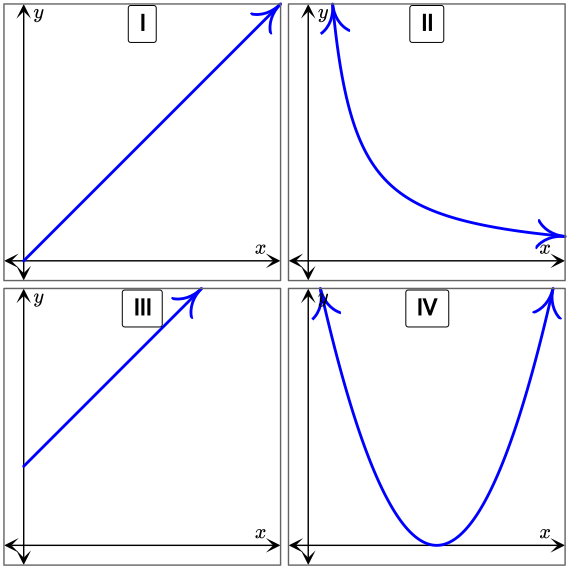
{"type":"choice","form":{"alts":["I","II","III","IV"],"noSort":true},"formTextBefore":"","formTextAfter":"","answer":1}
security
report
code
security
report
code
We are told x and y vary inversely. Knowing this, we want to write a function that models this inverse variation. Let's start by recalling the general form of an inverse variation. y=k/x In this formula, k is the constant of variation and cannot equal 0. To find its value we will substitute x=1 and y=11 into the formula.
Now that we know k=11, we can write the function that models our inverse variation. y=11/x
Now, we want to find the value of y when x=10. To do so, we will substitute 10 for x in the equation we found in Part A, which is y= 11x.
Finally, we want to determine which of the given graphs is the graph of our inverse variation. To do so, we will draw the graph by ourselves and compare it with the choices. To graph the function, we will make a table of values.
| x | 11/x | y=11/x |
|---|---|---|
| 1 | 11/1 | 11 |
| 2 | 11/2 | 5.5 |
| 4 | 11/4 | 2.75 |
| 7 | 11/7 | ≈ 1.57 |
| 9 | 11/9 | ≈ 1.22 |
| 11 | 11/11 | 1 |
Let's now plot and connect the points we obtained in the table with a smooth curve.
This graph corresponds to choice II.
security
report
code
It is a given that y varies jointly as x and z. It is also given that y=- 50 when z is 5 and z is - 10. Find the value of y when x=9 and z=- 3.
{"type":"text","form":{"type":"math","options":{"comparison":"1","nofractofloat":false,"keypad":{"simple":true,"useShortLog":false,"variables":["x"],"constants":["PI"]},"rendered":false},"text":" "},"formTextBefore":"y=","formTextAfter":null,"answer":{"text":["-27"]}}
security
report
code
security
report
code
We know that y varies jointly as x and z. We also know that y=- 50 when z=5 and x=- 10, and want to find the value of y when x=9 and z=- 3. To do so, we will use a proportion that relates the values. y_1/x_1z_1=y_2/x_2z_2 Next, we can substitute y_1= - 50, x_1= - 10, z_1= 5, y_2= y, x_2= 9, and z_2= - 3. Then, we can use cross multiplication to solve for y. Let's do it!
We found that y=- 27 when x=9 and z=- 3.
When one quantity varies with respect to two or more quantities, we have a combined variation. When one quantity varies directly with two or more quantities, we have what is called a joint variation.
| Combined Variation | Equation |
|---|---|
| y varies jointly with x and z | y=k x z |
| y varies jointly with x and z, and inversely with w | y=k x z/w |
| y varies directly with x and inversely with the product w y | y=k x/w y |
Writing the Function that Models the Variation
Here, we are told that y varies jointly with x and with z. y=k x z Here k is the constant of variation, and cannot be 0. To find k we will substitute x= - 10, z= 5, and y= - 50 in the above equation.
Now that we know that k=1, we can write the function that models the variation. y=xz
Finding y when x=9 and z=- 3
To find the value of the variable y when x=9 and z=- 3, we will substitute these values into the equation we have just found.
security
report
code
It is a given that a varies directly as b and inversely as c. Additionally, when b=16 and c=2, the value of a is 4. Find b when a=8 and c=- 3.
{"type":"text","form":{"type":"math","options":{"comparison":"1","nofractofloat":false,"keypad":{"simple":true,"useShortLog":false,"variables":["x"],"constants":["PI"]},"rendered":false},"text":" "},"formTextBefore":"b=","formTextAfter":null,"answer":{"text":["-48"]}}
security
report
code
security
report
code
When one quantity varies with respect to two or more quantities, we have a combined variation. When one quantity varies directly with two or more quantities, we have what is called a joint variation.
| Combined Variation | Equation |
|---|---|
| a varies jointly with b and c. | a=k b c |
| a varies jointly with b and c, and inversely with d. | a=k b c/d |
| a varies directly with b and inversely with the product of d and c. | a=k b/d c |
Writing the Function that Models the Variation
We are told that a varies directly as b and inversely as c. Let's write an equation that represents the situation. a=k b/c Here k is the constant of variation and cannot be 0. To find k we will substitute a= 4, b= 16, and c= 2 in the above equation.
Now that we know that k= 12, we can write the function that models the variation. a=12b/c ⇔ a=b/2c
Finding b When a=8 and c=- 3
To find the value of b when a=8 and c=- 3, we will substitute these values into the equation we have just found.
security
report
code
Joint, Inverse, and Combined Variation
Recommended exercises
To get personalized recommended exercises, please login first.
Loading content
≤
>
■2
■▢
e▢
7
8
9
×
÷■1
=
=
√▢
▢√
∫▢▢
4
5
6
+
−
≤
<
log
ln
log▢
1
2
3
()
∣
sin
cos
tan
0
.
π
x
y
Loading content