Sign In
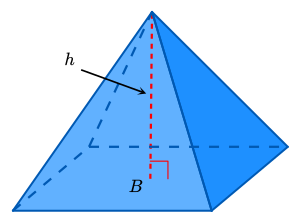
The base area B is the area of the polygon opposite the vertex of the pyramid, and the height h is measured perpendicular to the base.
V=31Bh
Consider a pyramid and a prism that have the same base area and height.
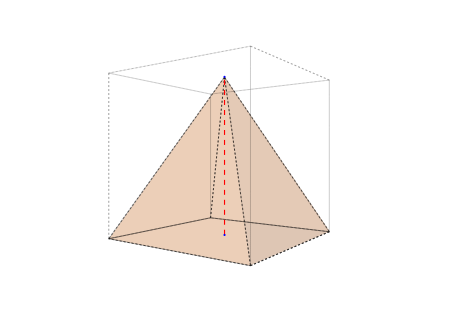
A pyramid can be modeled as a stack of prisms. The sum of the volumes of the small prisms will be greater than the pyramid's volume. However, as the number of prisms increases and they get thinner, the sum will approximate the volume of the pyramid.
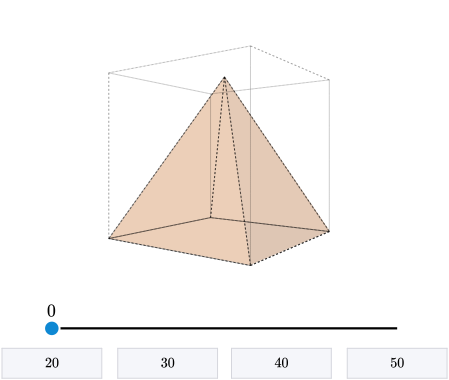
Furthermore, the ratio of the sum of the volumes of each small prism to the volume of the prism will be approximated to 31.
| Number of Layers | Volume of PrismSum of Thin Prisms’ Volumes |
|---|---|
| 4 | ≈0.469 |
| 16 | ≈0.365 |
| 64 | ≈0.341 |
| 256 | ≈0.335 |
| 1024 | ≈0.334 |
| 4096 | ≈0.333 |
| ∞ | 31 |
Therefore, the volume of a pyramid is one third of the prism with the same base area and height.