Direct Variation and Proportional Relationships
Concept

Direct Variation

Direct variation, also known as direct proportionality or proportional relationship, occurs when two variables, x and y, have a relationship that forms a linear function passing through the origin.

y=kx

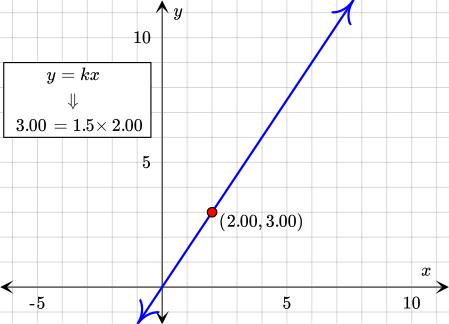
The constant k is the constant of variation. It defines the slope of the line. When k=0, the relationship is not in direct variation. In the example below, the constant of variation is k=1.5.
A line y=1.5x with a point on the line that can be moved
The constant of variation may be any real number except 0. It is worth noting that the quotient of y and x, when x≠0, is the constant of variation. y=kx ⇔ y/x=k Here are some examples.
Examples of Direct Variation
Example Rule Comment
The circumference of a circle. C=π d Here, d is the diameter of the circle and the constant of variation is π.
The mass of an object. m= V Here, is the constant density of the object and V is the volume.
Distance traveled at a constant rate. d=rt The constant of variation r is the rate and t is the time spent traveling.

Direct variation is closely related to other types of variation.

Exercises
Edit Lesson