3. Geometric Proof
Sign In
An error ocurred, try again later!
Chapter 9
3.
Geometric Proof
Geometric proofs are essential for demonstrating the validity of mathematical statements using logical reasoning. This lesson covers key methods such as inductive and deductive reasoning, helping students distinguish between observations and formal logic. It explains how to create conjectures and validate them using direct proofs, theorems, and structured formats like paragraph and two-column proofs. By mastering these techniques, students can develop critical thinking and problem-solving skills applicable in geometry and broader contexts. Understanding geometric proofs enables clear communication of ideas and fosters confidence in tackling complex mathematical problems.
Show less Show more expand_more 


Lesson Settings & Tools
| | 14 Theory slides |
| | 11 Exercises - Grade E - A |
| | Each lesson is meant to take 1-2 classroom sessions |
Geometric Proof
Slide of 14
When police detectives want to solve a crime, they scan the crime scene for clues. They develop possible scenarios based on what they find and then focus on the scenario that seems most likely based on these limited observations. This type of analytical thinking is known as inductive reasoning. Conclusions are drawn from an incomplete picture, so they may be incorrect.

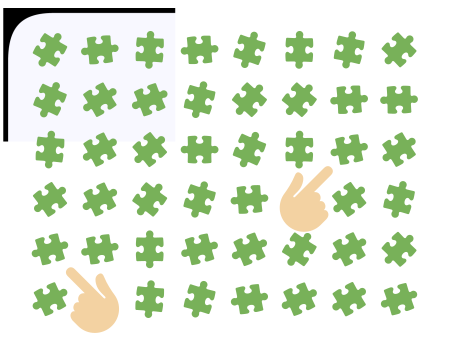
Another type of analytical thinking is deductive reasoning. In deductive reasoning, claims are supported by facts and are connected to consequent facts. Coming to a conclusion is like putting together the pieces of a jigsaw puzzle. Since all of the pieces fit neatly together, conclusions drawn by this type of reasoning tend to be stronger than those drawn by inductive reasoning.
For example, if a house was robbed and there is only one forced door, it is a fact that the thief entered through that door. Interested in knowing more about these types of reasoning? Stay and enjoy!
Catch-Up and Review
Here are a few recommended readings before getting started with this lesson.
Explore
Which Is More Reliable?
Kevin loves movies and television shows where mysteries are solved. When he grows up he would like to be a detective 🕵🏾♂️. He is always helping his friends to clear their doubts. Last week, Dylan and Maya came to him for help.
 In what situation is Kevin's advice based on observations? In what situation is Kevin's advice based on facts? Which of Kevin's tips is more reliable?
Discussion
Looking for Patterns
When not all the information about a particular situation is known, the existing information can be analyzed to look for some kind of pattern. If such a pattern exists, it can lead to some conclusions. This way of thinking is known as inductive reasoning.
Concept
Inductive Reasoning
Inductive reasoning is the process of finding patterns in specific observations and writing a conclusion or conjecture. Since the conjecture is based on observations, it might be false. For example, suppose an observer notices that all the birds around them are white. The observer might inductively reason that all birds in the world are white, which is not true.
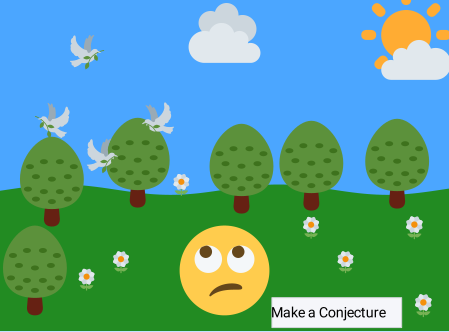 Inductive reasoning is a practical method used in geometry and algebra for recognizing visual and numerical patterns. For instance, use the first three figures in the following diagram to guess the shape and the number of cubes in the fourth figure.
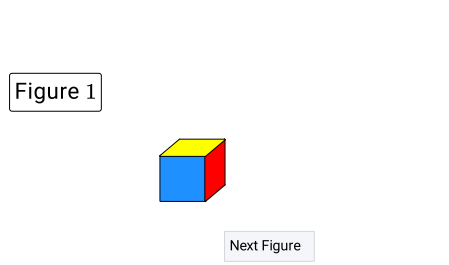 After observing the first three figures, it is reasonable to conclude that the number of cubes increases by 3 from one figure to the next — one on the top, one on the front, and one on the right. Since the figure starts with 1 cube and each step adds 3 cubes, an expression can be written to model the number of cubes in each figure.
1+3n
Here, n represents the number of steps after Figure 1. For example, Figure 2 is one step after Figure 1, so n=1. This expression allows the calculation of the number of cubes in any figure of the pattern. | n | Number of Cubes | |
|---|---|---|
| Figure 1 | 0 | 1+3⋅0=1 |
| Figure 2 | 1 | 1+3⋅1=4 |
| Figure 3 | 2 | 1+3⋅2=7 |
| Figure 4 | 3 | 1+3⋅3=10 |
| Figure 121 | 120 | 1+3⋅120=361 |
Example
The Thief's Pattern
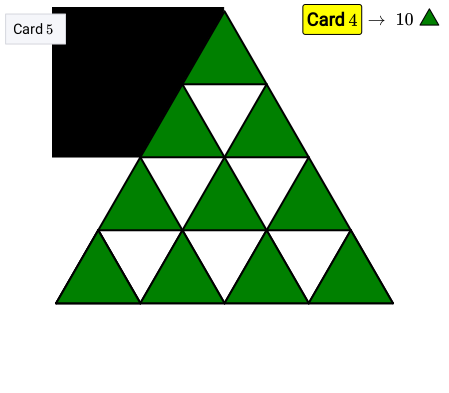
It is Saturday night and Kevin, his parents, and his sister are gathered in the living room watching an action movie. The movie is about a thief who leaves riddles for the police at every crime scene. The police have collected the following cards from the first four robberies.
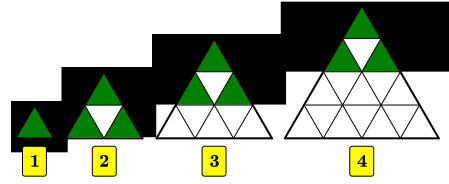
Each card has a riddle written on the back that the police must solve to determine where the next robbery will take place.
a Determine how many green triangles will be on the card that the thief will leave after his next hit.
{"type":"text","form":{"type":"math","options":{"comparison":"1","nofractofloat":false,"keypad":{"simple":true,"useShortLog":false,"variables":[],"constants":[]},"rendered":false},"text":"<span class=\"katex\"><span class=\"katex-html\" aria-hidden=\"true\"><\/span><\/span>"},"formTextBefore":"Number of Green Triangles <span class=\"katex\"><span class=\"katex-html\" aria-hidden=\"true\"><span class=\"base\"><span class=\"strut\" style=\"height:0.36687em;vertical-align:0em;\"><\/span><span class=\"mrel\">=<\/span><\/span><\/span><\/span>","formTextAfter":null,"answer":{"text":["15"]}}
b The thief wrote the following riddle on the back of the fourth card.
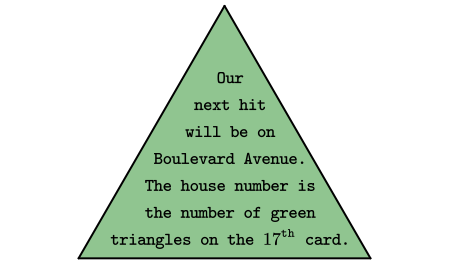
{"type":"text","form":{"type":"math","options":{"comparison":"1","nofractofloat":false,"keypad":{"simple":true,"useShortLog":false,"variables":[],"constants":[]},"rendered":false},"text":"<span class=\"katex\"><span class=\"katex-html\" aria-hidden=\"true\"><\/span><\/span>"},"formTextBefore":"Boulevard Av. House Number:","formTextAfter":null,"answer":{"text":["153"]}}
Hint
a Use inductive reasoning. Start by counting the number of green triangles on each card. Notice that card 2 has two more green triangles than Card 1 and Card 3 has three more green triangles than Card 2.
b Since the seventeenth card is quite far into the pattern, try to find an algebraic expression representing the number of green triangles on each card. Notice that Card 2 has 1+2 green triangles and Card 3 has 1+2+3 green triangles.
Solution
a It is asked to find the number of green triangles on the fifth card. This can be found by observing the first four cards in the pattern — in other words, finding the answer requires using inductive reasoning. Start by counting the number of green triangles in each of the cards.
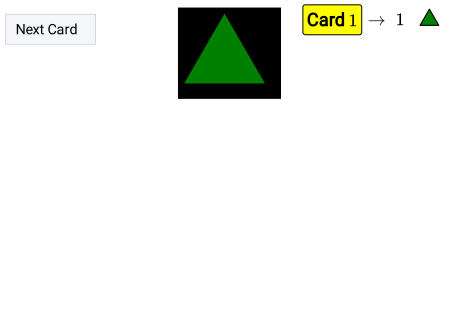
| Card | Green Triangles |
|---|---|
| 1 | 1 |
| 2 | 3 |
| 3 | 6 |
| 4 | 10 |
The next step is trying to find a relation between the numbers in the table. Comparing the rows, the following relations can be written.
- Card 2 has two more triangles than Card 1.
- Card 3 has three more triangles than Card 2.
- Card 4 has four more triangles than Card 3.
b Since the 17th card is quite far into the pattern, it would take a while to draw the diagram for the 17th figure. The police do not have much time to prevent the next robbery. Use the table made in Part A to find an algebraic expression that represents the number of green triangles on each card.
| Card | Green Triangles |
|---|---|
| 1 | 1 |
| 2 | 3 |
| 3 | 6 |
| 4 | 10 |
Card 2 has 3 green triangles, which can be written as 1+2. Similarly, Card 3 has 6 green triangles, which can be written 1+2+3. The same happens with Card 4.
| Card | Green Triangles |
|---|---|
| 1 | 1=1 |
| 2 | 1+2=3 |
| 3 | 1+2+3=6 |
| 4 | 1+2+3+4=10 |
1+2+⋯+17=153
Consequently, Card 17 will have 153 green triangles. With this information, the police now have the complete address of the next robbery! 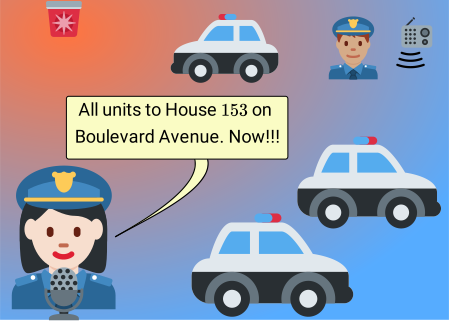
Discussion
Logical Reasoning
Another way of analyzing facts is through deductive reasoning. Unlike inductive reasoning, deductive reasoning does not rely on approximations or guesses. It is a process of logical reasoning through which two or more pieces of information are combined to arrive at a conclusion.
Concept
Deductive Reasoning
Deductive reasoning is the process of reaching logical conclusions from given statements. As long as the given statements are true, the conclusions drawn using deductive reasoning are also true. Consider the following two statements.
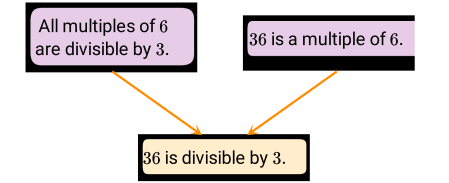 The conclusion is true because the given statements are true. Unlike inductive reasoning, deductive reasoning uses facts, definitions, properties, and the laws of logic to reach a conclusion. The two main laws of logic used to form a conclusion in deductive reasoning are the Law of Detachment and the Law of Syllogism.
Example
An Odd Riddle
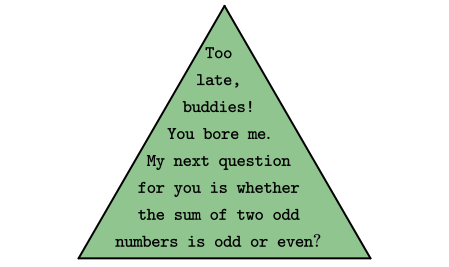
The police arrived at house 153 on Boulevard Avenue too late and the gang got away. At the new crime scene, the police found the fifth card, which had the following riddle.
Answer
See solution.
Hint
Inductive reasoning is the process of finding patterns in specific observations and writing a conclusion. Find the sum of random odd numbers and analyze the results. Deductive reasoning is the process of reaching logical conclusions from given statements. Any odd number can be written as 2n+1, with n an integer number.
Solution
Start by recalling what inductive and deductive reasoning are.
| Definition | |
|---|---|
| Inductive Reasoning | The process of finding patterns in specific observations and writing a conclusion |
| Deductive Reasoning | The process of reaching logical conclusions from given statements |
Keeping the definitions in mind, the answer will be found by applying each reasoning procedure.
Using Inductive Reasoning
The thief's question involves the sum of two odd numbers. Think of two arbitrary odd numbers and calculate their sum.
| Odd Numbers | Sum | |
|---|---|---|
| -21 | -13 | -21+(-13)=-34 |
| -7 | 3 | -7+3=4 |
| 5 | -5 | 5+(-5)=0 |
| 1 | 5 | 1+5=6 |
| 11 | 51 | 11+51=62 |
| 33 | 45 | 33+45=78 |
Take a look at the numbers in the right-hand side column. All of the numbers are even, so it is natural to say that the sum of two odd numbers is always even.
The sum of two odd numbers is an even number.
Note that this conclusion is based on the pattern observed in the table. In other words, there is no 100% certainty that the conclusion is true for any two odd numbers. This is not good news to the detective.
Using Deductive Reasoning
Considering random odd numbers does not qualify as deductive reasoning because this type of reasoning is not based on guesses. Instead, consider two odd numbers written in a general form. Recall that any odd number can be written as 2n+1, where n is an integer number. Let A and B be two different odd numbers.AB=2n+1=2m+1
Since the purpose is to study the sum of two odd numbers, add A and B and simplify as much as possible.
A+B=2n+1+2m+1
CommutativePropAdd
Commutative Property of Addition
A+B=2n+2m+1+1
AddTerms
Add terms
A+B=2n+2m+2
FactorOut
Factor out 2
A+B=2(n+m+1)
A+B=2K
This form matches the general form of even numbers. Therefore, A+B is an even number.
The sum of two odd numbers is an even number.
Conclusion
As shown, both conclusions are the same but were found using different types of reasoning.DeductiveReasoning↘InductiveReasoning↙The sum of two odd numbersis an even number.
However, deductive reasoning is the most formal way to solve the question because it shows that the sum is an even number, no matter what odd numbers are chosen. Understanding this and fed up with being played for a fool by the gang, the detective put all his efforts into catching them and discovered the next target very quickly.
Discussion
Unproven Statements
Mathematicians often make claims after detecting patterns. However, these claims cannot be accepted as fact until they are rigorously verified. The term used to describe this type of claim is conjecture.
Concept
Conjecture
A conjecture is an unproven statement based on observations of a pattern. It is an educated guess that holds true for many supporting cases. A conjecture about the sum of any three consecutive numbers, for example, is shown in the table.
| Sum of Any Three Consecutive Integers | ||
|---|---|---|
| Observation I | Observation II | Observation III |
| 2+3+4=9=3⋅3
|
7+8+9=24=3⋅8
|
13+14+15=42=3⋅14
|
| Conjecture: The sum of any three consecutive integers is three times the second number. | ||
However, it is unknown whether any given conjecture holds true for all cases. It could be false under some circumstances and, therefore, cannot be used to support other claims. A counterexample is enough to prove that a conjecture is false.
Extra
Goldbach's ConjectureOne of the best-known conjectures is Goldbach's Conjecture, named after the German mathematician Christian Goldbach.
|
Goldbach's Conjecture |
|
Every even whole number greater than 2 is the sum of two prime numbers. |
142440=3+11=11+13=17+23
As of 2013, the conjecture has been verified by a computer for all integers less than 4×10¹⁸. In March 2000, it was announced that anyone who could prove Goldbach's Conjecture and whose proof was accepted by other mathematicians would be awarded a one million dollar prize. Although the prize was kept open for two years, nobody claimed it.
Discussion
Justifying a Conjecture Logically
The process of verifying that a conjecture is true is called a proof.
Concept
Proof
In mathematics, a proof is a series of logical steps of reasoning that lead to a conclusion. The reasoning should be strict enough so that the conclusion must be true if the given circumstances it uses are true.
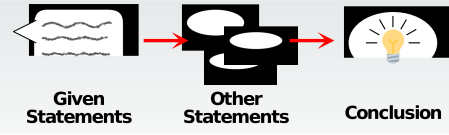
There are several different methods that can be used to construct and visually present a mathematical proof.
| Proof Methods | |
|---|---|
| Visual Styles | Proof Types |
| Paragraph Proof |
Direct Proof |
Method
Direct Proof
A direct proof is a proof that uses the given information and other known facts until the statement is shown to be true. Consider the following statement.
|
If n is an odd number, then n2 is also an odd number. |
1
Understand the Given Statement
expand_more The aim is to prove that given any odd number n, its square n2 is also odd. To better understand the statement some example cases can be worked.
| n | n2 | Is n2 odd? |
|---|---|---|
| 1 | 1 | Yes |
| 3 | 9 | Yes |
| 5 | 25 | Yes |
| 7 | 49 | Yes |
In the above table, the statement was proven to be true for just a few odd numbers, but the goal is to prove that it is true for any odd number.
2
Reach the Conclusion Using Given Information, Known Facts, and Logical Reasoning
expand_more The given information and other known facts should be intertwined using logical reasoning several times. These can be other theorems, definitions, axioms, and so on. This step is repeated several times until a conclusion is reached.
| Statement | Reason |
|---|---|
| n is odd | Given. |
| n=2k+1 | Every odd number is equal to twice an integer plus 1. |
| n2=(2k+1)2 | Raise the equation to the power of 2. |
| n2=4k2+4k+1 | Expand the square. |
| n2=2(2k2+2k)+1 | Factor out 2. |
| n2 is odd | It is written as twice an integer plus 1. |
Discussion
Proven Statements
Once a conjecture is proven, it is no longer called a conjecture but a theorem.
Concept
Theorem
A theorem is a statement which is not self-evident but has been proven to be true using deductive reasoning. Many theorems come in the form of conditional statements — if-then statements that combine a hypothesis and a conclusion.
|
If a triangle has a right angle, then the hypotenuse squared equals the sum of the squares of the legs. |
Discussion
Writing a Proof in a Paragraph
There are various ways of visually presenting the proof of a certain statement. One way is to write all of the statements and reasons in a single paragraph.
Method
Paragraph Proof
A paragraph proof, or informal proof, is a way of presenting a mathematical proof that consists of statements and reasons written as complete sentences in a paragraph. The reasons can be postulates, theorems, or other mathematical reasoning that the reader is assumed to be able to follow without difficulty. For example, consider the following prompt.
|
Let C be a point on AE, B be a point on AC, and D be a point on CE, such that AB≅DE and BC≅CD. Prove that AC≅CE. |
1
Draw a Diagram
expand_more According to the given information, C is a point on AE.

Also, it is given that B is a point on AC and D is a point on CE.

From the last piece of given information, AB is congruent to DE and BC is congruent to CD.

2
Apply the Definition of Congruence
expand_more The given congruence statements imply that the congruent segments have equal lengths.
AB≅DE and BC≅CD⇓AB=DE and BC=CD
3
Use the Segment Addition Postulate
expand_more The Segment Addition Postulate says that the length of a segment is the sum of the lengths of its parts.
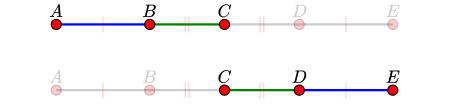
ACCE=AB+BC=CD+DE
These relationships can be visualized on the diagram. 4
Use the Commutative Property of Addition
expand_more The Commutative Property of Addition guarantees that the order of the terms in a sum can be changed.
CE=CD+DE⇓CE=DE+CD
5
Use the Substitution Property of Equality
expand_more List all the four equations written before.
⎩⎪⎪⎪⎪⎪⎨⎪⎪⎪⎪⎪⎧AB=DEBC=CDAC=AB+BCCE=DE+CD(I)(II)(III)(IV)
According to the Substitution Property of Equality, equal values can replace each other in equations. Substitute Equations (I) and (II) into Equation (III).
AC=DE+CD
The right-hand side sum is the same as in Equation (IV). Then, substitute the left-hand side of Equation (IV) into this last equation.
AC=CE
6
Apply the Definition of Congruence
expand_more If two segments have equal lengths, then the segments are congruent.

AC=CE⇓AC≅CE
It is concluded that AC is congruent to CE. Given: Prove: C is a point on AE,B is a point on AC,D is a point on CE,AB≅DE,BC≅CDAC≅CE
Paragraph Proof: According to the definition of congruence, AB=DE and BC=CD. The Segment Addition Postulate states that AC=AB+BC and CE=CD+DE. By the Substitution Property of Equality and the Commutative Property of Addition, it follows that AC=CE. Since segments with equal lengths are congruent, this completes the proof that AC≅CE.Example
The Detective's Hit
When the gang reached their next target, the police were already waiting for them. Finding themselves cornered, the gang split up to escape out to sea. One group flew out to sea in a helicopter. However, due to bad weather, their escape was foiled and the police captured them.
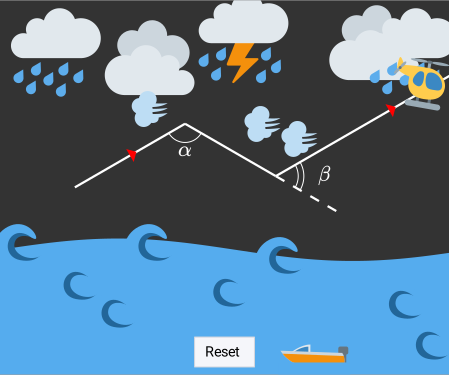 According to the helicopter's radar, the angles α and β of the trajectory are supplementary. Write a paragraph proof that justifies this statement.
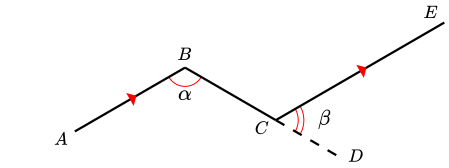
Develop logical conclusions that lead to the desired statement using the given information. For example, the alternate interior angles ABC and BCE are congruent because AB∥CE. 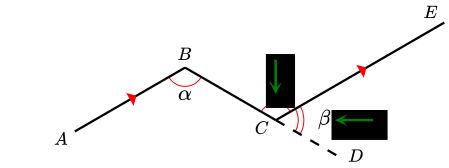 From the definition of supplementary angles, their measures add up to 180∘. Write an equation representing this fact.
Answer
See solution.
Hint
Start by writing the given information and label some points on the trajectory to make it easier to refer to them. The triangular hatch marks indicate that the lines are parallel. When a transversal cuts two parallel lines, the alternate interior angles are congruent. If two angles form a linear pair, their measures add up to 180∘.
Solution
The first step to proving a statement is identifying what information is given and what the final goal is. Labeling some points in the given diagram will make it easier to refer to them throughout the proof. For simplicity, consider only the helicopter's trajectory.
The triangular hatch marks indicate that AB and CE are parallel. This fact is not derived, so it is considered as given information. No more information is given, so continue by identifying what is desired to prove.
| Given | Prove |
|---|---|
| AB∥CE | Angles α and β are supplementary ⇕ α+β=180∘ |
∠ABCα≅∠BCE⇓=m∠BCE
Additionally, the angles BCE and DCE form a linear pair. Therefore, these two angles are supplementary. Angles BCE and DCE are supplementary⇓m∠BCE+β=180∘
Next, substitute α for m∠BCE.
α+β=180∘
The last equation confirms the fact that the angles α and β are supplementary, just as the helicopter's radar said. Finally, condense all the information written above into one paragraph.
Given: Prove: AB∥CEα+β=180∘
Proof: Since AB∥CE, the alternate interior angles ABC and BCE are congruent. Therefore, α=m∠BCE. Also, ∠BCE and ∠DCE form a linear pair, which means they are supplementary. As such, m∠BCE+β=180∘. By the Substitution Property of Equality, α+β=180∘. Consequently, the angles α and β are supplementary.
Discussion
Writing a Proof in a Table
Sometimes, compacting an entire proof into one paragraph results in a very long block of text that might be difficult to follow. A different way of presenting the proof is through a two-column table.
Method
Two-Column Proof
A two-column proof, or formal proof, is a compact way of showing the reasoning behind a mathematical proof. It consists of two columns, one for the statements and one for the reasons. The reasons can be postulates, theorems, or other mathematical reasoning the reader is assumed to be able to follow without difficulty. For example, consider proving the following statement.
|
If M is the midpoint of AB, then AB=2AM. |
1
Write the Given Information
expand_more In the first row, write the given statement in the left-hand side column. This statement is given, not derived, so write given in the right-hand column.
Statements
|
Reasons
|
1. 1. M is the midpoint of AB
|
1. 1. Given
|
If possible, draw a diagram that helps to derive the information that will be written in the table. This diagram will not be included in the table, though.

2
Develop Logical Conclusions
expand_more Starting from what is given, develop logical statements that help to prove the desired statement. Since point M is the midpoint of AB, it divides the segment into two parts of equal length.
MB=AM
Write this equation in the next row in the statements column. Since this equation came from the definition of a midpoint, write that in the reasons column. Statements
|
Reasons
|
1. 1. M is the midpoint of AB
|
1. 1. Given
|
2. 2. MB=AM
|
2. 2. Definition of Midpoint
|
3
Repeat the Step 2 as Many Times as Necessary
expand_more The statements written so far are not enough to reach to the desired conclusion, so continue deriving information and combining it until it points to the desired statement. Remember that postulates, theorems, or other mathematical reasoning can be used.
Statements
|
Reasons
|
1. 1. M is the midpoint of AB
|
1. 1. Given
|
2. 2. MB=AM
|
2. 2. Definition of Midpoint
|
AB=AM+MB
As before, write the equation in the left-hand side and the reason in the right-hand side. Statements
|
Reasons
|
1. 1. M is the midpoint of AB
|
1. 1. Given
|
2. 2. MB=AM
|
2. 2. Definition of Midpoint
|
3. 3. AB=AM+MB
|
3. 3. Segment Addition Postulate
|
Next, use the Substitution Property of Equality to substitute the equation written in the second row into the equation written in the third row.
Statements
|
Reasons
|
1. 1. M is the midpoint of AB
|
1. 1. Given
|
2. 2. MB=AM
|
2. 2. Definition of Midpoint
|
3. 3. AB=AM+MB
|
3. 3. Segment Addition Postulate
|
4. 4. AB=AM+AM
|
4. 4. Substitution Property of Equality
|
The right-hand side of the last equation can be simplified by adding the two terms.
Statements
|
Reasons
|
1. 1. M is the midpoint of AB
|
1. 1. Given
|
2. 2. MB=AM
|
2. 2. Definition of Midpoint
|
3. 3. AB=AM+MB
|
3. 3. Segment Addition Postulate
|
4. 4. AB=AM+AM
|
4. 4. Substitution Property of Equality
|
5. 5. AB=2AM
|
5. 5. Simplify
|
Notice that the last statement is the desired one. Therefore, the proof is done!
Example
Police Chase
It is the climax of the movie. The police are chasing the rest of the gang who had escaped the last crime scene. Suddenly, the Internet connection is lost and the movie stops — right in the middle of the police chase! While waiting for the connection to be restored, Kevin tells his parents that the beams of the police car's light bar make vertical angles.
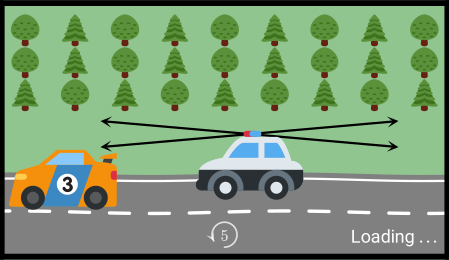 Kevin's sister also mentions that these angles are congruent, something that impressed Kevin. Write a two-column proof to support Kevin's sister's claim.
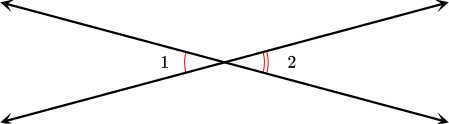 Then, Kevin's sister basically states that if two angles are vertical, then they are congruent. This statement will be proven using a two-column proof. Remember, the first step when writing a proof is to identify the given and desired statements. In this case, they can be written as follows.
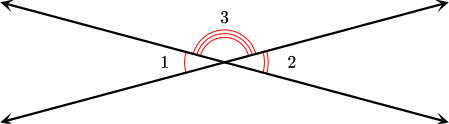 From the diagram, ∠1 and ∠3 form a linear pair, as do ∠2 and ∠3. This means that the sum of the measures of each pair of angles is 180∘. Write two equations representing this information.
Once the connection was restored, the movie continued and the police caught the rest of the gang, recovering all the stolen articles. What a movie, Kevin said!
Answer
See solution.
Hint
Start by identifying the given information and the desired statement. Label two vertical angles and consider an angle that is between them. This angle forms a linear pair with each of the labeled angles. The measures of supplementary angles add up to 180∘.
Solution
Consider a pair of vertical angles, as Kevin talks about this type of angles. A diagram will be very helpful here.
Given: Prove: ∠1 and ∠2 are vertical angles∠1≅∠2
It seems that just because ∠1 and ∠2 are vertical is not enough information to confirm that they are congruent. Some additional information is needed. Let ∠3 be one of the angles between ∠1 and ∠2. {m∠1+m∠3=180∘m∠2+m∠3=180∘
Since both equations are equal to 180∘, by the Substitution Property of Equality, they can be equated.
m∠1+m∠3=m∠2+m∠3
Finally, subtract m∠3 from both sides.
m∠1=m∠2
The last equation is the desired statement, so the proof is done! To finish, summarize all the steps in a two-column table. Statements
|
Reasons
|
1. 1. ∠1 and ∠2 are vertical angles
|
1. 1. Given
|
2. 2. ∠1 and ∠3 form a linear pair ∠2 and ∠3 form a linear pair |
2. 2. From the diagram
|
3. 3. m∠1+m∠3 =180∘ m∠2+m∠3 =180∘ |
3. 3. Definition of linear pair
|
4. 4. m∠1+m∠3= m∠2+m∠3
|
4. 4. Substitution Property of Equality
|
5. 5. m∠1=m∠2
|
5. 5. Subtraction Property of Equality
|
Closure
Other Types of Proofs
How to prove a statement largely depends on the statement itself. Writing direct proofs may not be always easy. For example, consider the following statement.
|
2 is an irrational number. |
Proving this statement using direct proof is not as simple as it may sound. In cases like these, alternative ways of proving statements come into action. The most classic way of proving the above statement is via indirect proof.
| Description | |
|---|---|
| Indirect Proof or Proof by Contradiction | A claim is proven by showing how the opposite conclusion of the claim creates a contradiction. |
The first step in writing an indirect proof for the given statement is to temporarily assume that 2 is not irrational. Based on this new hypothesis, logical conclusions are developed until a contradiction is obtained. Other types of proofs are listed in the table below.
| Description | |
|---|---|
| Proof by Contrapositive | A claim is proven by stating and proving the contrapositive of the claim. |
| Proof by Mathematical Induction | One special case is shown to be true. Next, it is shown that if the statement is true for any special case, then it is also true for some other special case. |
| Coordinate Proof | It is used to prove geometric statements by placing geometric figures in a coordinate plane and assigning variables to the coordinates of points. |
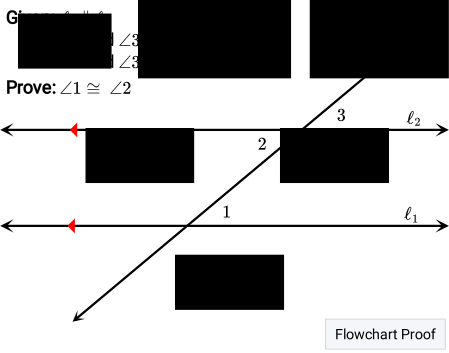
Q.E.D.,which comes from a Latin phrase that means
what was to be shown.
Geometric Proof
Exercise 3.1
Consider the following four figures.

{"type":"text","form":{"type":"math","options":{"comparison":"1","nofractofloat":false,"keypad":{"simple":true,"useShortLog":false,"variables":[],"constants":[]},"rendered":false},"text":"<span class=\"katex\"><span class=\"katex-html\" aria-hidden=\"true\"><\/span><\/span>"},"formTextBefore":"Number of Slices <span class=\"katex\"><span class=\"katex-html\" aria-hidden=\"true\"><span class=\"base\"><span class=\"strut\" style=\"height:0.36687em;vertical-align:0em;\"><\/span><span class=\"mrel\">=<\/span><\/span><\/span><\/span>","formTextAfter":null,"answer":{"text":["64"]}}
security
report
code
security
report
code
Let's analyze the given figures in search of some pattern about the number of slices. We can start by counting the number of slices in each figure.
The number of slices doubles from one figure to the next. If this pattern continues, the fifth figure will have twice as many slices as the fourth figure. In other words, the fifth figure has 2* 16=32 slices. If we apply this reasoning further, the sixth figure will have 2* 32 = 64 slices.
| Figure | Number of Slices |
|---|---|
| Figure 1 | 2 |
| Figure 2 | 4 |
| Figure 3 | 8 |
| Figure 4 | 16 |
| Figure 5 | 32 |
| Figure 6 | 64 |
We have already found the answer, but we could also express the number of slices in a figure regardless of the number of slices in the previous figure. Notice that in the table, the number of slices in a figure is 2 raised to the figure number.
| Figure | Number of Slices |
|---|---|
| Figure 1 | 2^1 = 2 |
| Figure 2 | 2^2 = 4 |
| Figure 3 | 2^3 = 8 |
| Figure 4 | 2^4 = 16 |
| Figure 5 | 2^5 = 32 |
| Figure 6 | 2^6 = 64 |
Recognizing this pattern is really helpful because it allows us to find the number of slices in any figure just by knowing the figure number. For example, Figure 18 would have 2^(18)=262 144 slices!
security
report
code
Consider the following four figures.

Which of the following clocks corresponds to the tenth clock of the pattern?

{"type":"choice","form":{"alts":["Clock <span class=\"katex\"><span class=\"katex-html\" aria-hidden=\"true\"><span class=\"base\"><span class=\"strut\" style=\"height:0.7109375em;vertical-align:0em;\"><\/span><span class=\"mord text\"><span class=\"mord Roboto-Bold textbf\">A<\/span><\/span><\/span><\/span><\/span>","Clock <span class=\"katex\"><span class=\"katex-html\" aria-hidden=\"true\"><span class=\"base\"><span class=\"strut\" style=\"height:0.7109375em;vertical-align:0em;\"><\/span><span class=\"mord text\"><span class=\"mord Roboto-Bold textbf\">B<\/span><\/span><\/span><\/span><\/span>","Clock <span class=\"katex\"><span class=\"katex-html\" aria-hidden=\"true\"><span class=\"base\"><span class=\"strut\" style=\"height:0.73046875em;vertical-align:-0.009765625em;\"><\/span><span class=\"mord text\"><span class=\"mord Roboto-Bold textbf\">C<\/span><\/span><\/span><\/span><\/span>","Clock <span class=\"katex\"><span class=\"katex-html\" aria-hidden=\"true\"><span class=\"base\"><span class=\"strut\" style=\"height:0.7109375em;vertical-align:0em;\"><\/span><span class=\"mord text\"><span class=\"mord Roboto-Bold textbf\">D<\/span><\/span><\/span><\/span><\/span>"],"noSort":true},"formTextBefore":"","formTextAfter":"","answer":1}
security
report
code
security
report
code
Let's take a look at the given four clocks in search of some pattern. We will use inductive reasoning to make a conjecture about the clocks. We can see that in all four clocks, the minute hand is fixed pointing down, which corresponds to 30 minutes.
Therefore, the minute hand of any clock in the pattern will point to 30. In Clock A, the minute hand is not pointing down — it points to 0 minutes. Let's discard Clock A.
The minute hand in the remaining three clocks points to 30, so we need to identify another pattern that allows us to reach the correct answer. Let's check the four original clocks and write down the time they point to.
| Clock | Time |
|---|---|
| 1 | 1:30 |
| 2 | 2:30 |
| 3 | 3:30 |
| 4 | 4:30 |
We can see that the hour hand of each clock points to the clock's number. Continuing with this pattern, the tenth clock should indicate 10:30. With this in mind, we can conclude that the tenth clock is Clock B.
security
report
code
Geometric Proof
Recommended exercises
To get personalized recommended exercises, please login first.
Loading content
≤
>
■2
■▢
e▢
7
8
9
×
÷■1
=
=
√▢
▢√
∫▢▢
4
5
6
+
−
≤
<
log
ln
log▢
1
2
3
()
∣
sin
cos
tan
0
.
π
x
y
Loading content