Method

Indirect Proof

An indirect proof, or proof by contradiction, is a proof method that uses indirect reasoning. Here, all possibilities are considered, and then all except one are proven false. Typically, in an indirect proof, there are two possibilities — a statement and its negation. The negation of the statement is eliminated by contradiction. Consider the following statement.

In a right triangle, the longest side is the hypotenuse.

There are three steps to follow to prove a statement using an indirect proof.

1
Temporarily Assume That the Negation of the Statement Is True
expand_more
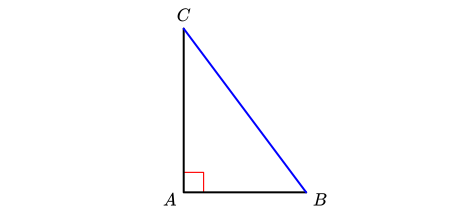
The aim is to prove that the hypotenuse is the longest side of a right triangle. For this case, consider △ABC, where ∠ A is a right angle.

Assume temporarily that the negation of the statement is true.

In a right triangle, the longest side is not its hypotenuse.

2
Use Logical Reasoning Until a Contradiction Is Derived
expand_more
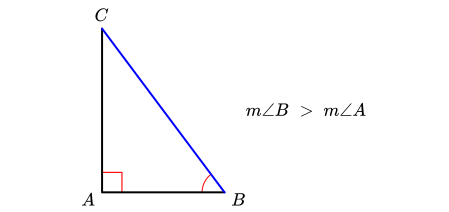
From the assumption, at least one of the legs of the right triangle is larger than the hypotenuse. Let AC be the leg whose length is greater than the length of the hypotenuse BC. Therefore, by the Triangle Longer Side Theorem, the measure of the angle opposite AC is greater than the measure of the angle opposite BC.

Since m∠ A = 90^(∘) and m∠ B is greater than m∠ A, the sum of the measures of these two angles is greater than 180^(∘). m∠ A + m∠ B > 180^(∘) According to the Interior Angles Theorem, the sum of the three interior angles of any triangle is equal to 180^(∘). m∠ A + m∠ B + m∠ C = 180^(∘) For this equation and the previously derived inequality to hold true, m∠ C must be less than 0. This conclusion contradicts the fact that the measures of all interior angles of any polygon are greater than 0.

3
Conclude That the Original Statement Must Be True
expand_more
The contradiction resulted from the assumption that the hypotenuse of a right triangle is not the longest side. Therefore, the assumption — the negation of the original statement — must be false. cc Assumption & c The longest side of a right triangle is not the hypotenuse. & * That indirectly proves that the original statement is true. cc Original Statement & c The longest side of a right triangle is the hypotenuse. & ✓

Extra

What to Assume When Proving a Conditional Statement Using?
Consider a conditional statement. Statement p ⇒ q The first step of a proof by contradiction is assuming the negation of the desired conclusion. Stating the negation of an if-then statement may not make sense, however. For this reason, a statement logically equivalent to the negation of the statement in if-then form can be used. Consider the statement that is formed using a conjunction. Statement & & Equivalent Statement ¬ (p ⇒ q) & & p ∧ ¬ q These statements are logically equivalent because both have the same truth table.

p q p ⇒ q ¬ (p ⇒ q) ¬ q p ∧ ¬ q
T T T F F F
T F F T T T
F T T F F F
F F T F T F

Therefore, assuming that the hypothesis p is true and the conclusion q is false will facilitate the process of deriving a contradiction. rc Conditional Statement: & p ⇒ q Assume: & p and ¬ q


Exercises
Edit Lesson