9. Criteria for Triangle Congruence
Sign In
An error ocurred, try again later!
Chapter 1
9.
Criteria for Triangle Congruence
In geometry, triangles play a pivotal role. Understanding when two triangles are congruent (meaning they have the exact same size and shape) is crucial. The key to this understanding lies in the congruence theorems. These theorems provide criteria that, when met, guarantee that two triangles are congruent. For instance, if you know certain sides or angles of one triangle match those of another, you can confidently state they are congruent. This knowledge is invaluable for architects, engineers, and anyone looking to ensure precision in their designs or constructions.
Show less Show more expand_more 


Lesson Settings & Tools
| | 16 Theory slides |
| | 10 Exercises - Grade E - A |
| | Each lesson is meant to take 1-2 classroom sessions |
Criteria for Triangle Congruence
Slide of 16
Two triangles are congruent if their corresponding sides and angles are congruent. However, there could be cases where not all side lengths or angle measures are known. The good news is that congruence can still be verified depending on which parts are known.
Catch-Up and Review
Here are a few recommended readings before getting started with this lesson.
Explore
Share
Report error
Investigating Congruence of Triangles Given Angles
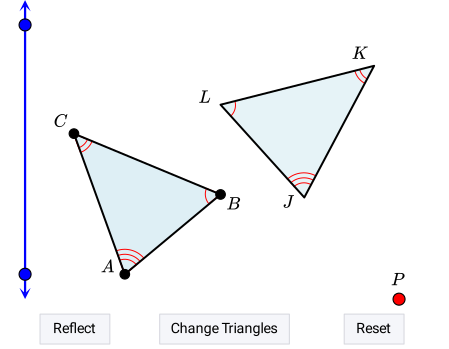
Consider the following statement.
Extra
How to Use the AppletIn the applet, rigid motions can be applied only on △ ABC.
- To translate △ ABC, select its interior region and slide.
- Point P acts as the center of rotation and can be moved by dragging it.
- To rotate △ ABC about P, click on any vertex of △ ABC and drag it.
- The given line acts as a line of reflection which can be moved by dragging it. Similarly, its inclination can be changed by dragging either of its two points.
- To reflect △ ABC across the line of reflection, push the
Reflect
button.
Explore
Share
Report error
Investigating Congruence of Triangles Given Two Sides and the Included Angle
In the previous exploration, it was seen that a pair of triangles can have corresponding congruent angles but not be congruent triangles. Therefore, relying only on the relationship of only angles is not a valid criterion.
Angle-Angle-Angle is not a valid criterion for proving triangle congruence.
Discussion
Share
Report error
Side-Angle-Side Congruence Theorem
The previous exploration suggests that two triangles are congruent whenever they have two pairs of corresponding congruent sides and the corresponding included angles are congruent. In fact, this conclusion is formalized in the Side-Angle-Side Congruence Theorem
If two sides and the included angle of a triangle are congruent to two sides and the included angle of another triangle, then the two triangles are congruent.
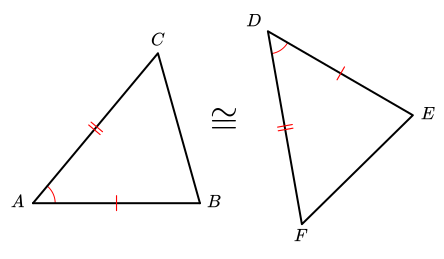
Based on the diagram above, the theorem can be written as follows.
AB ≅ DE ∠ A ≅ ∠ D AC ≅ DF ⇒ △ ABC ≅ △ DEF
Proof
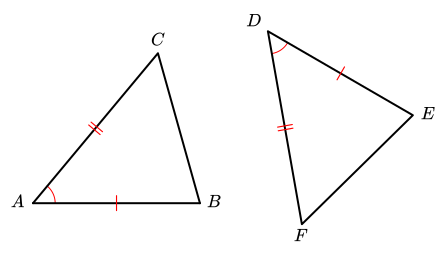
Side-Angle-Side Congruence TheoremThis proof will be developed based on the given diagram, but it is valid for any pair of triangles.
1
Translate △ DEF So That Two Corresponding Vertices Match
expand_more Translate △ DEF so that D is mapped onto A. If this translation maps △ DEF onto △ ABC, the proof is complete.
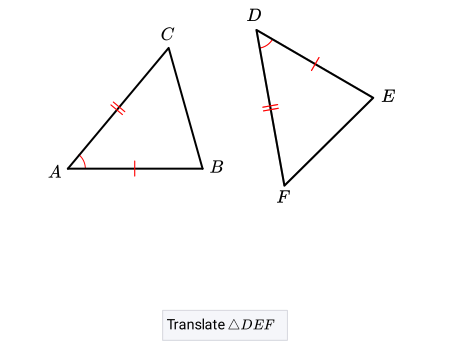 Since the image of the translation does not match △ ABC, at least one more transformation is needed.
2
Rotate △ AE'F' So That Two Corresponding Sides Match
expand_more Rotate △ AE'F' counterclockwise about A so that a pair of corresponding sides match. If the image of this transformation is △ ABC, the proof is complete. Note that this rotation maps E' onto B. Therefore, the rotation maps AE' onto AB.
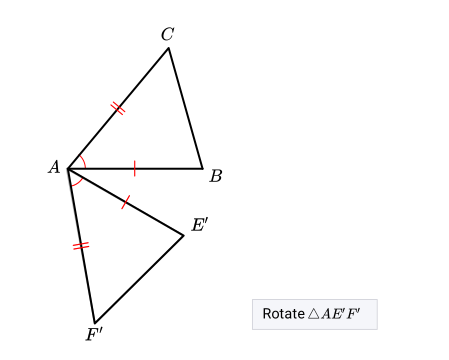 As before, the image does not match △ ABC. Therefore, a third rigid motion is required.
3
Reflect △ ABF'' So That Two More Corresponding Sides Match
expand_more Reflect △ ABF'' across AB. Because reflections preserve angles, AF'' is mapped onto AC. Additionally, it is given that AC=AF''. Therefore, F'' is mapped onto C, which gives that BF'' is mapped onto BC.
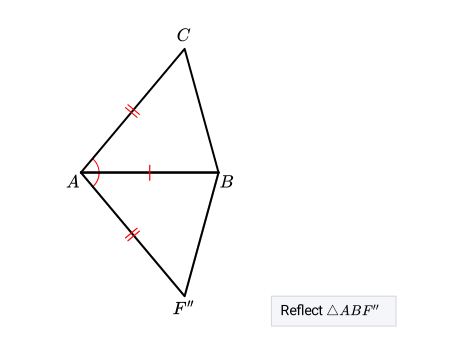 This time the image matches △ ABC.
Example
Share
Report error
Identifying Congruent Triangles
In the following diagram, triangles ADE and BCE are congruent, and ∠ ADC is congruent to ∠ BCD.
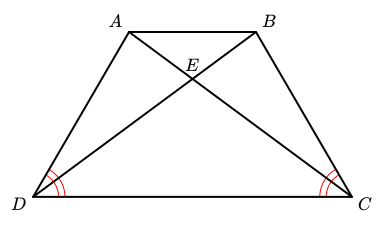
How many more pairs of congruent triangles are there in the diagram? Name each congruent triangle pair.
Answer
There are two more pairs of congruent triangles. △ ADC &≅ △ BCD △ ABD &≅ △ BAC
Hint
Remember, if two triangles are congruent, then their corresponding sides and angles are congruent.
Solution
Start by highlighting the given pair of congruent triangles, △ ADE and △ BCE.
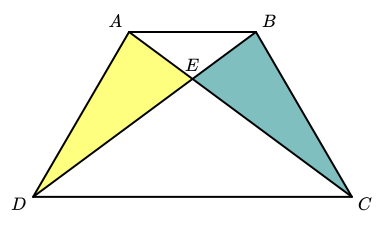
Since these triangles are congruent, their corresponding parts are congruent. This implies that AD is congruent to BC.
First Pair
Because △ ADE and △ BCE are parts of △ ADC and △ BCD respectively, consider triangles ADC and BCD.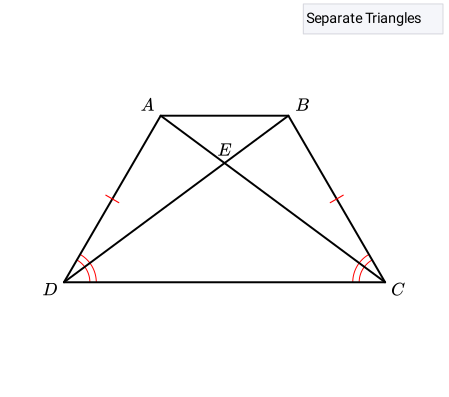
△ ADC ≅ △ BCD
Second Pair
Next, consider triangles ABD and BAC. Because △ ADE and △ BCE are congruent, ∠ ADB and ∠ BCA are congruent. Additionally, since △ ADC and △ BCD are congruent, CA is congruent to DB.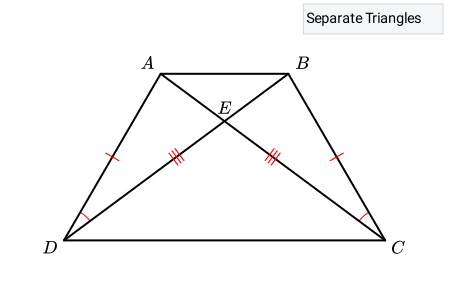
△ ABD ≅ △ BAC
Third Pair
The last two triangles to consider are triangles ABE and DEC. Unlike the first two pairs, these dimensions seem to be quite different. Therefore, it can be concluded that they are not congruent.
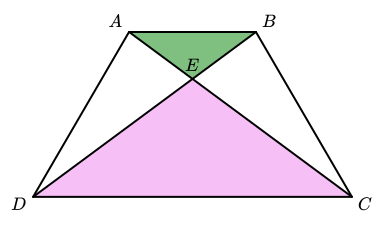
Consequently, in the initial diagram, there are two more pairs of congruent triangles in addition to the given one.
Explore
Share
Report error
Investigating Congruence of Triangles Given Two Angles and the Included Side
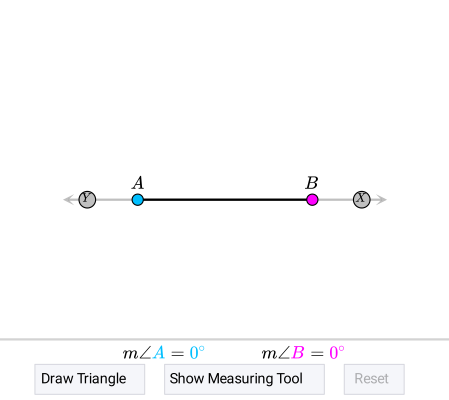
Use segment AB and the rays AX and BY to construct two different triangles, one at a time, in such a way that the following conditions are met.
- The angle formed at A has the same measure in both triangles.
- The angle formed at B has the same measure in both triangles.
Discussion
Share
Report error
Angle-Side-Angle Congruence Theorem
The following statement could be seen in the previous applet. When two triangles have two pairs of corresponding congruent angles, and the included corresponding sides are congruent, the triangles are then congruent. That leads to the second criteria for triangle congruence.
If two angles and the included side of a triangle are congruent to two angles and the included side of another triangle, then the triangles are congruent.
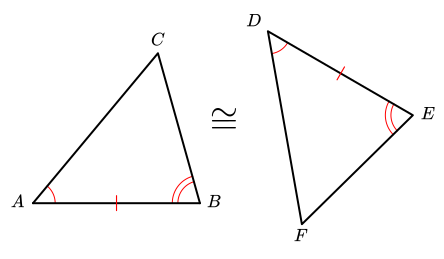
Based on the diagram above, the theorem can be written as follows.
∠ A ≅ ∠ D AB ≅ DE ∠ B ≅ ∠ E ⇒ △ ABC ≅ △ DEF
Proof
Angle-Side-Angle Congruent TheoremThis proof will be developed based on the given diagram, but it is valid for any pair of triangles.
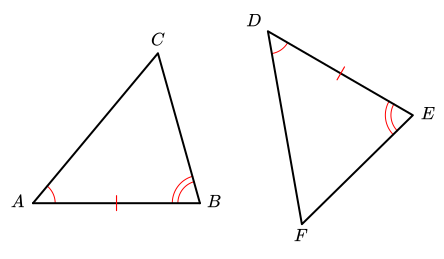
1
Translate △ DEF So That Two Corresponding Vertices Match
expand_more Translate △ DEF so that D is mapped onto A. If this translation maps △ DEF onto △ ABC, the proof is complete.
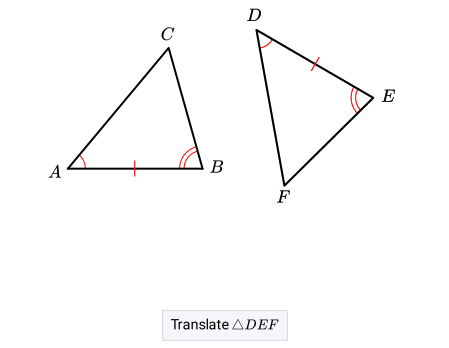 Since the image of the translation does not match △ ABC, at least one more transformation is needed.
2
Rotate △ AE'F' So That Two Corresponding Sides Match
expand_more Rotate △ AE'F' counterclockwise about A so that a pair of corresponding sides match. If the image of this transformation is △ ABC, the proof is complete. Note that this rotation maps E' onto B. Therefore, the rotation maps AE' onto AB.
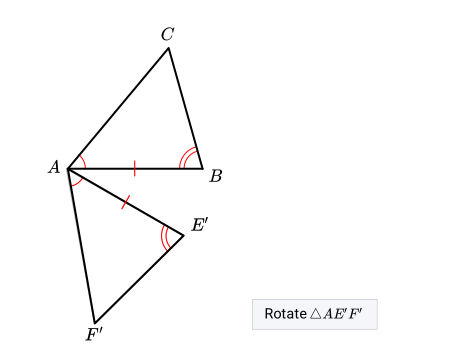 As before, the image does not match △ ABC. Therefore, a third rigid motion is required.
3
Reflect △ ABF'' So That All Corresponding Sides Match
expand_more Reflect △ ABF'' across AB. Because reflections preserve angles, AF'' and BF'' are mapped onto AC and BC, respectively. Then, the point of intersection of the original rays F'' is mapped onto the point of intersection of the image rays C.
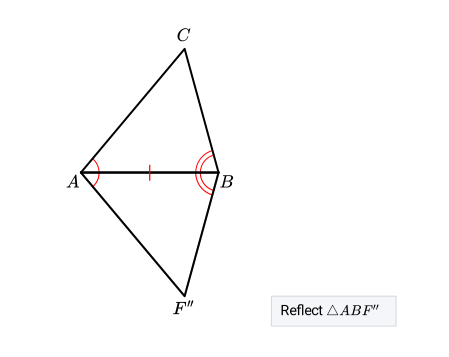 This time the image matches △ ABC.
Example
Share
Report error
Write Equations Based on Congruent Triangles
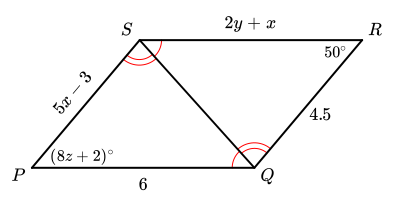
Consider the following diagram.
{"type":"text","form":{"type":"math","options":{"comparison":"1","nofractofloat":false,"keypad":{"simple":true,"useShortLog":false,"variables":[],"constants":[]},"rendered":false},"text":" "},"formTextBefore":null,"formTextAfter":null,"answer":{"text":["9.75"]}}
Hint
Take note that QS is a common side for two triangles. Use the fact that if two triangles are congruent, their corresponding sides and angles are congruent.
Solution
Notice that QS is a common side for triangles PQS and RSQ.
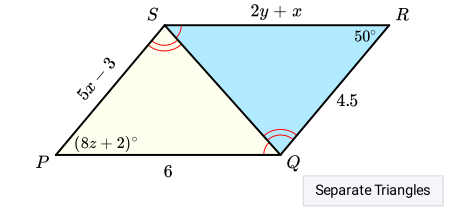 By the Reflexive Property of Congruence, QS is congruent to itself. Additionally, ∠ PQS and ∠ RSQ are congruent, as are ∠ PSQ and ∠ RQS.
cl
∠ PQS ≅ ∠ RSQ & Angle QS ≅ QS & Side ∠ PSQ ≅ ∠ RQS & Angle
Consequently, △ PQS and △ RSQ are congruent because of the Angle-Side-Angle (ASA) Congruence Theorem. Therefore, the corresponding sides and angles are congruent.
△ PQS ≅ △ RSQ ⇒ { ∠ P &≅ ∠ R PQ &≅ RS PS &≅ RQ .
By definition, congruent angles have the same measure, and congruent segments have the same length. Therefore, the congruence statements on the right-hand side support the formation of the following three equations.
8z+2=50 & (I) 6=2y+x & (II) 5x-3=4.5 & (III)
By solving Equation (I), the value of z can be found.
Next, solve Equation (III) to find the value of x.
Then, the value of y can be found by substituting x=1.5 into the Equation (II) and solving the resulting equation for y.
Finally, the required sum can be calculated by substituting the values found for x, y, and z.
By the Reflexive Property of Congruence, QS is congruent to itself. Additionally, ∠ PQS and ∠ RSQ are congruent, as are ∠ PSQ and ∠ RQS.
cl
∠ PQS ≅ ∠ RSQ & Angle QS ≅ QS & Side ∠ PSQ ≅ ∠ RQS & Angle
Consequently, △ PQS and △ RSQ are congruent because of the Angle-Side-Angle (ASA) Congruence Theorem. Therefore, the corresponding sides and angles are congruent.
△ PQS ≅ △ RSQ ⇒ { ∠ P &≅ ∠ R PQ &≅ RS PS &≅ RQ .
By definition, congruent angles have the same measure, and congruent segments have the same length. Therefore, the congruence statements on the right-hand side support the formation of the following three equations.
8z+2=50 & (I) 6=2y+x & (II) 5x-3=4.5 & (III)
By solving Equation (I), the value of z can be found.
Next, solve Equation (III) to find the value of x.
Then, the value of y can be found by substituting x=1.5 into the Equation (II) and solving the resulting equation for y.
Finally, the required sum can be calculated by substituting the values found for x, y, and z.
5x-3=4.5
x = 1.5
6=2y+x
Substitute
x= 1.5
6=2y+ 1.5
▼
Solve for y
SubEqn
LHS-1.5=RHS-1.5
4.5 = 2y
DivEqn
.LHS /2.=.RHS /2.
4.5/2 = y
UseCalc
Use a calculator
2.25 = y
RearrangeEqn
Rearrange equation
y = 2.25
Explore
Share
Report error
Congruence of Triangles Given Three Pairs of Congruent Sides
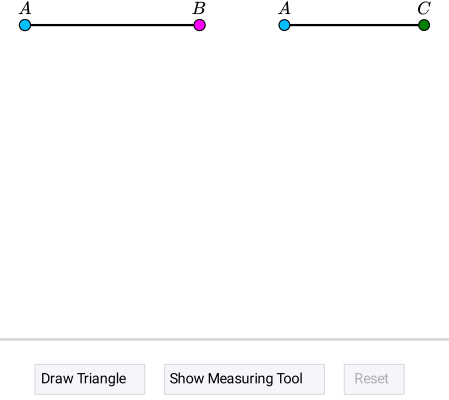
At the beginning of the lesson, it was shown that the Angle-Angle-Angle is not a valid criterion for determining triangle congruence. Next, using the following applet, it will be investigated if the Side-Side-Side is a valid criterion. Use segments AB, AC, and BC to construct two different triangles. Construct the triangles one at a time.
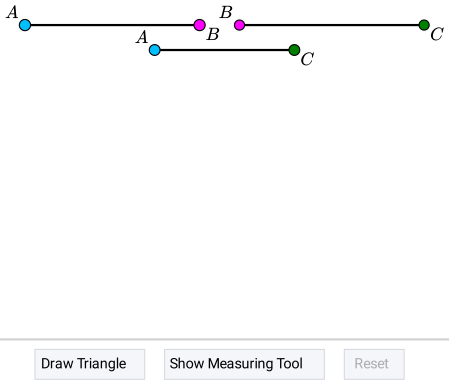 Once the two triangles are drawn, find the angle measures of each triangle. Is there any relationship between the triangles? Repeat the process a couple of times to see if the relationship holds true.
Discussion
Share
Report error
Side-Side-Side Congruence Theorem
As seen in the previous exploration, the Side-Side-Side is a valid criterion for checking triangle congruence.
If the three sides of a triangle are congruent to the three sides of another triangle, then the triangles are congruent.
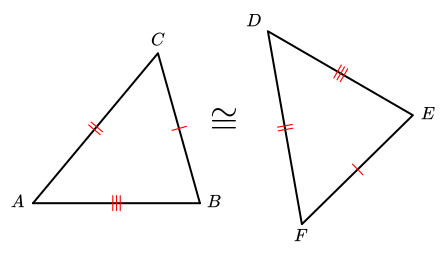
Based on the diagram above, the theorem can be written as follows.
AB ≅ DE BC ≅ EF AC ≅ DF ⇒ △ ABC ≅ △ DEF
Proof
Side-Side-Side Congruence TheoremThis proof will be developed based on the given diagram, but it is valid for any pair of triangles.
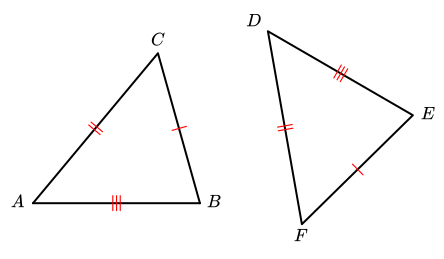
1
Translate △ DEF So That Two Corresponding Vertices Match
expand_more Translate △ DEF so that D is mapped onto A. If this translation maps △ DEF onto △ ABC, the proof is complete.
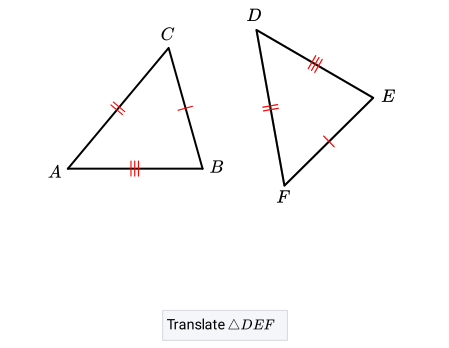 Since the image of the translation does not match △ ABC, at least one more transformation is needed.
2
Rotate △ AE'F' So That Two Corresponding Sides Match
expand_more Rotate △ AE'F' counterclockwise about A so that a pair of corresponding sides matches. If the image of this transformation is △ ABC, the proof is complete. Note that this rotation maps E' onto B. Consequently, AE' is mapped onto AB.
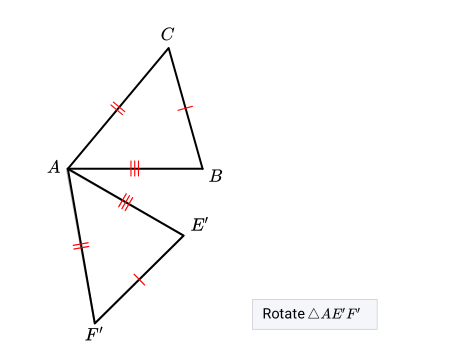 As before, the image does not match △ ABC. Therefore, a third rigid motion is required.
3
Reflect △ ABF'' So That Two More Corresponding Sides Match
expand_more The points C and F'' are on opposite sides of AB. Now, consider CF'. Let G denote the point of intersection between AB and CF''.
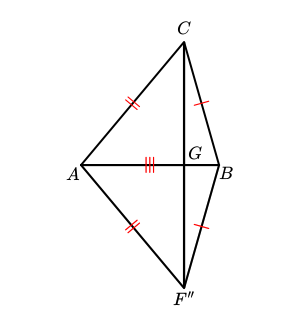
It can be noted that AC = AF'' and BC = BF''. By the Converse Perpendicular Bisector Theorem, AB is a perpendicular bisector of CF''. Points along the perpendicular bisector are equidistant from the endpoints of the segment, so CG = GF''.
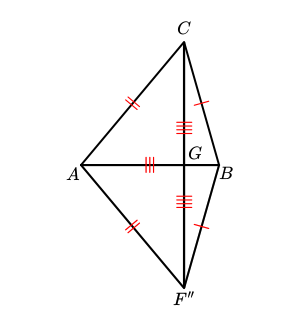
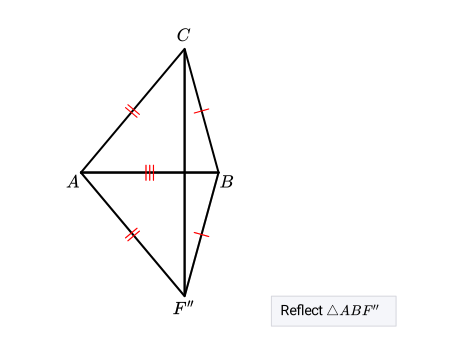
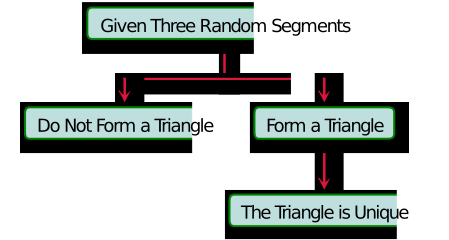
Given three random segments, it is not always possible to construct a triangle. But, when possible, this triangle will be unique. This fact implies that the angle measures of that triangle are also unique.
Example
Share
Report error
Using Triangle Congruence Conditions to Solve Problems
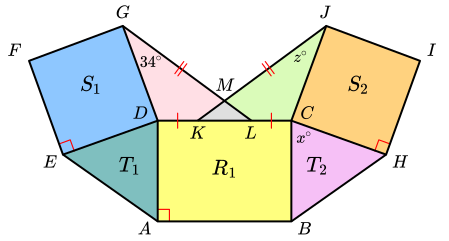
In the following diagram, R_1 is a rectangle, S_1 and S_2 are squares, T_1, T_2, and △ MKL are isosceles triangles, DK is congruent to CL, and GM is congruent to JM.
{"type":"text","form":{"type":"math","options":{"comparison":"1","nofractofloat":false,"keypad":{"simple":true,"useShortLog":false,"variables":[],"constants":[]},"rendered":false},"text":" "},"formTextBefore":null,"formTextAfter":null,"answer":{"text":["70"]}}
Hint
Using the Segment Addition Postulate and the Side-Side-Side (SSS) Congruence Theorem, prove that △ DGL is congruent to △ CJK. Then, find the measure of ∠ JCK. Use the fact that m∠ JCK + m∠ DCB + m∠ JCH + x = 360^(∘).
Solution
To find the value of x, notice that x, m∠ DCB, m∠ JCK, and m∠ JCH add up 360^(∘).
x + m∠ DCB + m∠ JCK + m∠ JCH = 360^(∘)
Since R_1 is a rectangle and S_2 is a square, ∠ DCB and ∠ JCH are right angles. Therefore, these angles have a measure of 90^(∘) each. Also, it is given that m∠ JCK = 3z+8. Use this information to solve for x.
An expression of x was found in terms of z. Therefore, to find the value of x, the value of z should first be known. 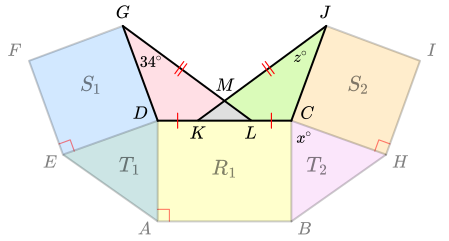 This equation implies that DL and CK are congruent.
Based on the equation just obtained, it can be concluded that GL and JK are congruent.
This equation implies that DL and CK are congruent.
Based on the equation just obtained, it can be concluded that GL and JK are congruent.
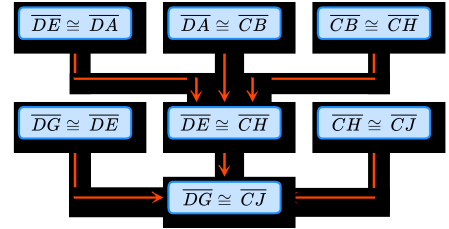
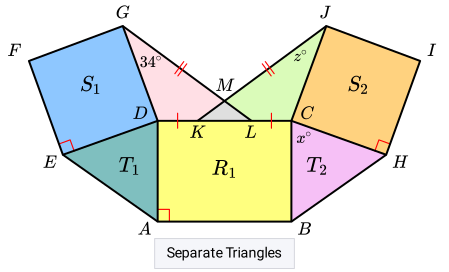 Since corresponding parts of congruent triangles are congruent, it can be concluded that ∠ DGL is congruent to ∠ CJK. Therefore, z=34.
x + m∠ DCB + m∠ JCK + m∠ JCH = 360
SubstituteValues
Substitute values
x + 90 + ( 3z+8) + 90 = 360
x = 172-3z
Finding the Value of z
If △ DGL and △ CJK can be proven to be congruent, that would provide the needed information to find the value of z. Therefore, focus on those two triangles.
Proving that DL ≅ CK
Notice that KL is common to both triangles. By using the Segment Addition Postulate, the following pair of equations can be written. DL=DK+KL & (I) CK=CL+LK & (II) Since DK is congruent to CL, these segments have the same length, that is, DK = CL. Simlarly, KL=LK. By substituting these expressions into Equation (I), a relation between DL and CK will be obtained.DL=DK+KL
▼
Substitute values and simplify
DL=CK
DL ≅ CK
Proving that GL ≅ JK
Once more, the Segment Addition Postulate can be used to rewrite GL and JK. GL = GM+ML & (I) JK = JM+MK & (II) Because △ MKL is isosceles, MK is congruent to ML. Therefore, ML=MK. Keep in mind that it is given that GM and JM are congruent. That means GM=JM. These two expressions can be substituted into Equation (I).GL = GM+ML
▼
Substitute values and simplify
GL = JK
GL ≅ JK
Proving that DG ≅ CJ
Since R_1 is a rectangle, S_1 and S_2 are squares, and T_1 and T_2 are isosceles triangles, the following consequences can be drawn.
| Given | Consequence |
|---|---|
| R_1 is a rectangle | DA≅CB |
| S_1 is a square | DG≅DE |
| S_2 is a square | CH≅CJ |
| T_1 is an isosceles triangle | DE≅DA |
| T_2 is an isosceles triangle | CB≅CH |
Next, organize the information in the right-hand column in a flow chart and use the Transitive Property of Congruence to prove that DG ≅ CJ.
Proving that △ DGL ≅ △ CJK
Previously, the following three congruence statements were obtained. cl DL ≅ CK & Side GL ≅ JK & Side DG ≅ CJ & Side The Side-Side-Side (SSS) Congruence Theorem allows to conclude that △ DGL is congruent to △ CJK.Finding the Value of x
Finally, to find the value of x, substitute z=34 into the equation x = 172-3z. Then solve for x.Explore
Share
Report error
Congruence of Triangles Given Two Angles and a Nonincluded Side
Notice that the ASA criterion requires the congruent sides to be included between the two pairs of corresponding congruent angles. Using the following applet, investigate what happens when the congruent sides are not the included sides.
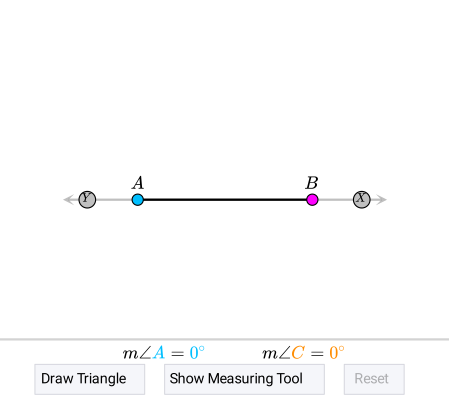
Use segment AB and the rays AX and BY to construct two different triangles, one at a time, in such a way that these conditions are met:
- The angle formed at A has the same measure in both triangles.
- The angle formed at C, the intersection of the rays, has the same measure in both triangles.
Discussion
Share
Report error
Angle-Angle-Side Congruence Theorem
As seen in the previous exploration, the Angle-Angle-Side condition is a valid criterion for triangle congruence.
If two angles and a non-included side of a triangle are congruent to two angles and the corresponding non-included side of another triangle, then the triangles are congruent.
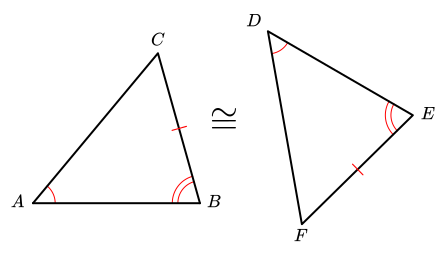
Based on the diagram above, the theorem can be written as follows.
∠A ≅ ∠D ∠B ≅ ∠E BC ≅ EF ⇒ △ ABC ≅ △ DEF
Proof
This proof will be developed based on the given diagram, but it is valid for any pair of triangles.
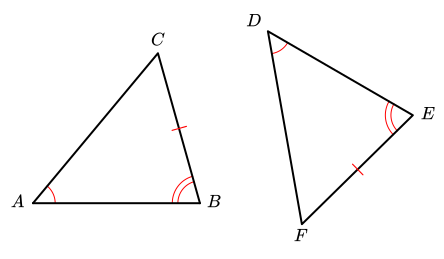
1
Translate △ DEF So That Two Corresponding Vertices Match
expand_more Translate △ DEF so that F is mapped onto C. If this translation maps △ DEF onto △ ABC, the proof is complete.
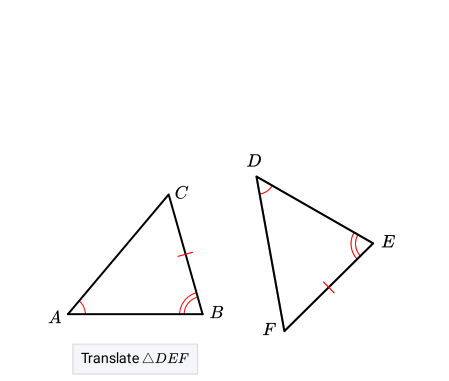 Since the image of the translation does not match △ ABC, at least one more transformation is needed.
2
Rotate △ CD'E' So That Two Corresponding Sides Match
expand_more Rotate △ CD'E' clockwise about C so that a pair of corresponding sides match. If the image of this transformation is △ ABC, the proof is complete. Note that this rotation maps E' onto B. Therefore, the rotation maps CE' onto CB.
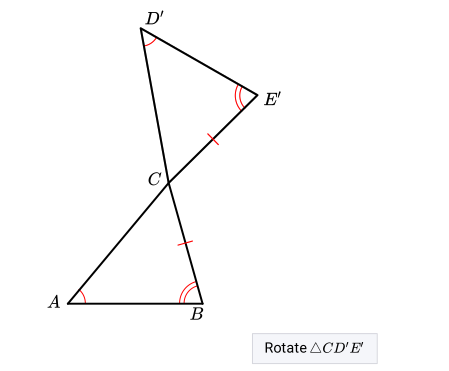 As before, the image does not match △ ABC. Therefore, a third rigid motion is required.
3
Reflect △ ABF'' So That Two More Corresponding Sides Match
expand_more It is given that two angles of △ ABC are congruent to two angles of △ BCD''. Hence, by the Third Angle Theorem, ∠ BCD'' is congruent to ∠ BCA.
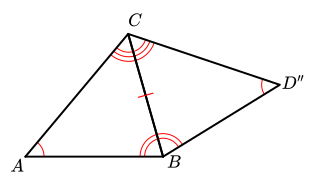
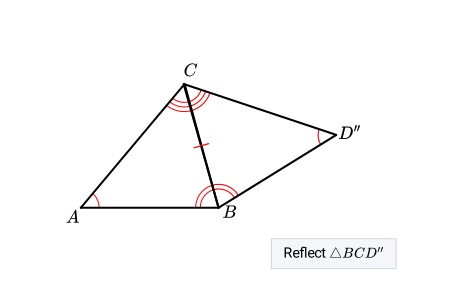
Example
Share
Report error
Proving Congruence in Triangles
Dylan bought a new boomerang to play with his friends next summer. In the drawing printed on the boomerang, ∠ A and ∠ C are congruent, and BF and BE are congruent.
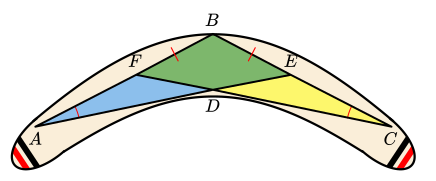
Show that AE is congruent to CF.
Answer
See solution.
Hint
Separate triangles ABE and CBF and notice they have a common angle. Then, use the Angle-Angle-Side (AAS) Congruence Theorem.
Solution
Start by separating △ ABE and △ CBF from the design.
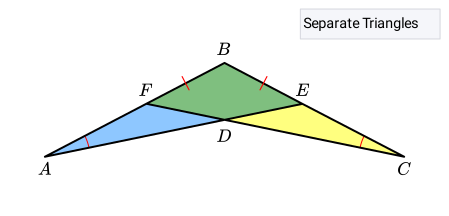 Notice that ∠ B is common to both triangles. By the Reflexive Property of Congruence, ∠ B is congruent to itself. Also, it is given that ∠ A is congruent to ∠ C, and BF is congruent to BE.
cl
∠ A ≅ ∠ C & Angle ∠ B ≅ ∠ B & Angle BF ≅ BE & Side
Applying the Angle-Angle-Side (AAS) Congruence Theorem, it is obtained that △ ABE is congruent to △ CBF. Consequently, their corresponding parts are congruent, which means that AE is congruent to CF.
Notice that ∠ B is common to both triangles. By the Reflexive Property of Congruence, ∠ B is congruent to itself. Also, it is given that ∠ A is congruent to ∠ C, and BF is congruent to BE.
cl
∠ A ≅ ∠ C & Angle ∠ B ≅ ∠ B & Angle BF ≅ BE & Side
Applying the Angle-Angle-Side (AAS) Congruence Theorem, it is obtained that △ ABE is congruent to △ CBF. Consequently, their corresponding parts are congruent, which means that AE is congruent to CF.
Explore
Share
Report error
Investigating Side-Side-Angle
With the help of the following applet, investigate if the Side-Side-Angle is a valid criterion for determining triangle congruence.
Use segments AB and AC to construct two different triangles in such a way that the angle formed at B has the same measure in both triangles.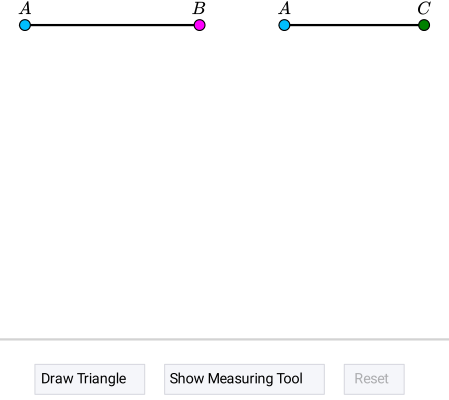
Closure
Share
Report error
Side-Side-Angle Congruence Theorem for Right Triangles
With the previous applet, it can be checked that, in general, the Side-Side-Angle is not a valid criterion to determine triangle congruence. For instance, the following triangles meet the conditions of this criterion, and they are not congruent.
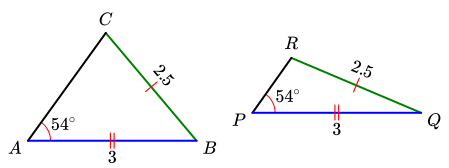
However, this criteria is valid in the particular case that both triangles are right triangles.
Rule
Share
Report error
Hypotenuse Leg Theorem
If the hypotenuse and one leg of a right triangle are congruent to the hypotenuse and one leg of another right triangle, then the two triangles are congruent.
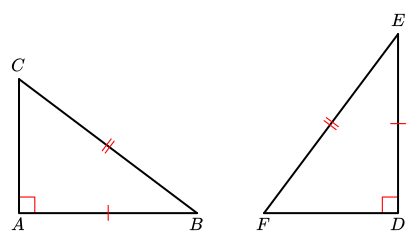
Based on the diagram, the following relations hold true.
{ c m∠A = 90^(∘) m∠D = 90^(∘) AB ≅ DE BC ≅ EF . ⇒ △ ABC ≅ △ DEF
Proof
Consider △ ABC and △ DEF, shown below.
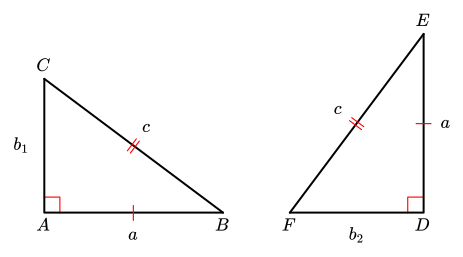
c^2 = a^2 + b_1^2 & (I) c^2 = a^2 + b_2^2 & (II)
Substitute
(II): c^2= a^2+b_1^2
c^2= a^2 + b_1^2 a^2 + b_1^2= a^2 + b_2^2
c^2= a^2 + b_1^2 |b_1| = |b_2|
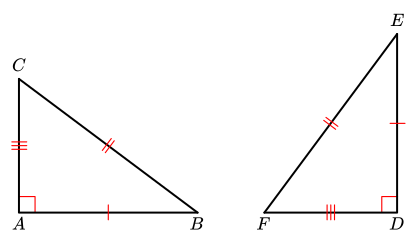
Therefore, by the Side-Side-Side Congruence Theorem the triangles are congruent.
△ ABC ≅ △ DEF
In the following chart, all the criteria for triangle congruence seen in the lesson are listed.
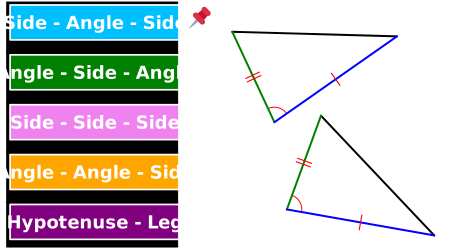
Criteria for Triangle Congruence
Exercise 2.1
Consider the following diagram.
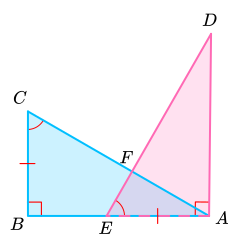
{"type":"multichoice","form":{"alts":["A","B","C","D"],"noSort":true},"formTextBefore":"","formTextAfter":"","answer":[2]}
security
report
code
security
report
code
Let's go through the statements one at a time.
Statement A
From the given information, we only know that BC is congruent to EA. We have no information about BE, which means that we cannot determine if statement A is true or false.
Statement B
Let's only consider △ ABC and △ DAF in the diagram
There is no information about the angles or sides of △ DAF. This means we cannot state that △ ABC and △ DAF are congruent. Therefore, we cannot determine if this statement is true.
Statement C
To evaluate statement C, we will separate the triangles in the statement.
We see that two angles and their included side are congruent. Therefore, we can claim congruence by the ASA Congruence Theorem. Before we can say that the statement is true, we must also make sure that it is written in the correct way. Let's identify corresponding vertices. A &→ D B &→ A C &→ E Since the statement is △ B A C ≅ △ A D E, we can confirm that the statement is true.
Statement D
As we already explained, the stated triangles are congruent. In this statement, however, the vertices are named in an incorrect order. The corresponding parts do not appear in the same order, which means statement D is not true.
security
report
code
Consider the following diagram.
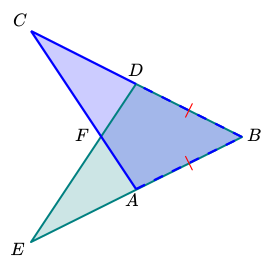
{"type":"choice","form":{"alts":["A","B","C","D"],"noSort":true},"formTextBefore":"","formTextAfter":"","answer":3}
security
report
code
security
report
code
Let's start by separating the triangles. Notice that the triangles share an angle at B. Therefore, by the Reflexive Property of Congruence, we know that ∠ B is congruent to ∠ B.
To prove triangle congruence using the ASA Congruence Theorem, we need to know that two pairs of congruent angles and the corresponding included sides are congruent. From the diagram, we have a pair of congruent sides and a pair of congruent angles. A ∠ B&≅ ∠ B S AB&≅ DB To use the ASA Congruence Theorem, we must also have the second pair of angles that would make AB and BD the included sides.
Therefore, the statement ∠ BDE ≅ ∠ BAC must be true to use the theorem. A& ∠ B≅ ∠ B S& AB≅ DB A& ∠ BDE≅ ∠ BAC This corresponds to option D.
security
report
code
What value of x makes the triangles congruent?
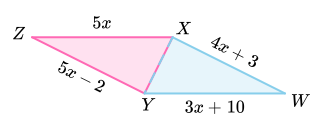
{"type":"text","form":{"type":"math","options":{"comparison":"1","nofractofloat":false,"keypad":{"simple":true,"useShortLog":false,"variables":["x"],"constants":["PI"]},"rendered":false},"text":" "},"formTextBefore":"x=","formTextAfter":null,"answer":{"text":["5"]}}
security
report
code
security
report
code
Examining the diagram, we can see that the two triangles share a side. We know by the Reflexive Property of Congruence that this side is congruent in our triangles.
Notice that it is not clear which of the remaining sides are corresponding. We have two cases.
Let's write the related equations for each of these cases. &Case1 & 5x= 4x+3 & 5x-2= 3x+10 [1em] &Case2 & 5x= 3x+10 & 5x-2= 4x+3 [1em] When we solve these equations, they should give the same solution in order for the triangles to be congruent. Otherwise, the triangles will not be congruent.
Case 1
Let's solve the first equation.
Let's solve the second equation next.
Since the sides are congruent for different values of x, we know that the first case is impossible.
Case 2
We will repeat the procedure for the second case.
Let's solve the second equation as well.
As we can see, each pair of congruent sides will have the same measure when x=5. This means that if x=5, the triangles are congruent.
security
report
code
Heichi claims that △ ABD can be proven congruent to △ CDB using the HL Congruence Theorem.
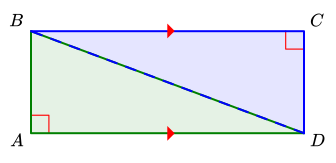
{"type":"choice","form":{"alts":["Yes","No"],"noSort":true},"formTextBefore":"","formTextAfter":"","answer":0}
security
report
code
security
report
code
According to the HL Congruence Theorem, two right triangles are congruent when their hypotenuses and a pair of legs are congruent. From the diagram, we can see that BD is a shared hypotenuse. Therefore, by the Reflexive Property of Congruence, we know that this side is congruent.
However, we also need a pair of congruent legs. Since BC∥ AD and ∠ A and ∠ C are right angles, we know that ABCD is a rectangle. In a rectangle, opposite sides are congruent.
This gives us enough information to use the HL Congruence Theorem to prove that △ ABD is congruent to △ CDB.
security
report
code
Criteria for Triangle Congruence
Recommended exercises
To get personalized recommended exercises, please login first.
Loading content
≤
>
■2
■▢
e▢
7
8
9
×
÷■1
=
=
√▢
▢√
∫▢▢
4
5
6
+
−
≤
<
log
ln
log▢
1
2
3
()
∣
sin
cos
tan
0
.
π
x
y
Loading content