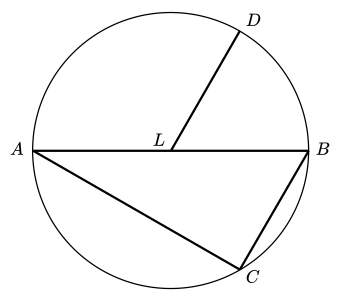
In Part A we found that the length of AB, diameter of L, is 13. Let's find the radius recalling that radius is half the diameter of a circle
13/2 = 6.5
c
Consider the given diagram.
We want to find the measure of ∠ ABC. In Part A we found that △ ABC is a right triangle. Therefore, we can relate the measure of ∠ ABC to the lengths of the sides opposite and adjacent this angle, AC and BC, respectively, using the tangent ratio.
tan ( m∠ ABC ) = AC/BC
Since we are given that AC = 12 and BC = 5, we can substitute these values into equation above and solve it for m∠ ABC.
Therefore, the measure of ∠ ABC is approximately 67.38^(∘).
d
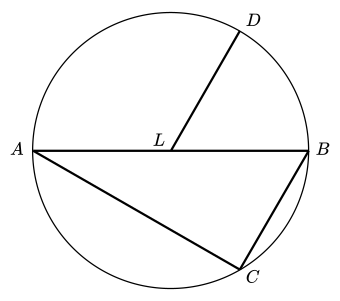
Consider the given diagram.
We want to find the measure of AC. Notice that this is an arc intercepted by the inscribed angle ∠ ABC. Let's recall the Inscribed Angle Theorem.
Inscribed Angle Theorem
The measure of an inscribed angle is half the measure of its intercepted arc.
By this theorem we know that the measure of ∠ ABC is half that of the arc AC.
m ∠ ABC = 1/2 m AC
In Part C we found that m ∠ ABC ≈ 67.38^(∘), so we can substitute this value into equation above to get the approximate value of m AC.