aCongruent triangles are identical. This means they have the same shape and the same size. Similar triangles, on the other hand, only have the same shape, not necessarily the same size.
Are the Triangles Congruent?
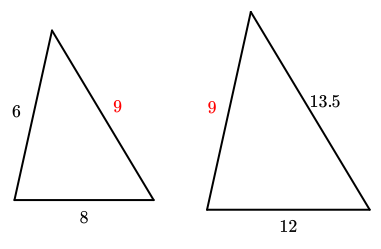
Let's take a look at our pair of triangles.
Congruent triangles have three pairs of congruent corresponding sides. If we carefully examine the diagram, we immediately notice that there is only one pair of congruent sides. Therefore, they cannot be congruent triangles.
Are the Triangles Similar?
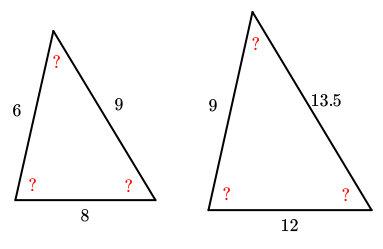
Similar triangles have three pairs of corresponding congruent angles. However, we do not have any information about the angles in either triangle.
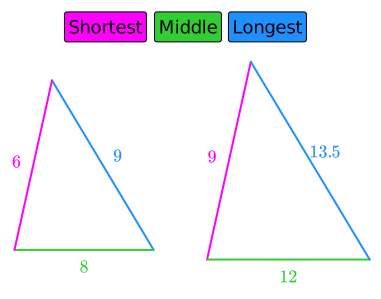
This means that we have to determine if they are similar by analyzing the sides. In similar triangles, the ratio of corresponding sides is constant. Corresponding sides in similar triangles have the same relative length. Let's identify the corresponding sides between the two triangles.
We can determine if the triangles are similar by calculating the ratio of corresponding sides.
cccccc
6/9 & ? = & 8/12 & ? = & 9/13.5 & [1.2em]
& & ⇕ & & & [0.8em]
2/3 & = & 2/3 & = & 2/3 & ✓
As we can see, the triangles are similar by the Side-Side-Side (SSS) Similarity Theorem.
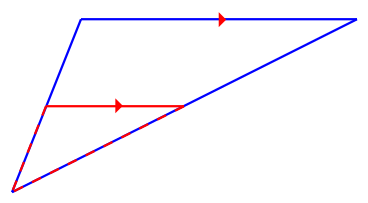
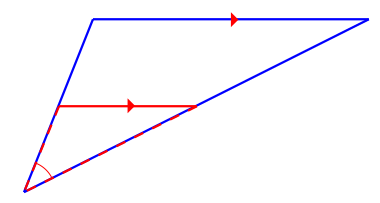
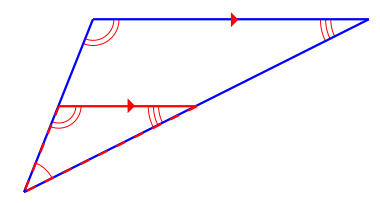
b Let's consider the blue and red triangles in the following diagram.
Are They Congruent?
Notice that one triangle is drawn inside the other. They cannot be congruent, as the triangle on the inside must be smaller than the triangle it is inside of.
Are They Similar?
Since we do not have any information about the triangle's sides, we can only prove similarity by showing that they have at least two pairs of congruent corresponding angles. First, notice that both triangles have one angle in common. By the Reflexive Property of Congruence, we know that this angle is congruent.
Since the triangles have at least two pairs of congruent corresponding angles, we know that the triangles are similar by the Angle-Angle (AA) Similarity Theorem.
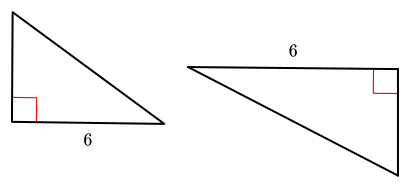
c Here we have two right triangles where one leg length and the right angle are known.
Since the other leg can have any length, this is not enough information to confirm either congruence or similarity.
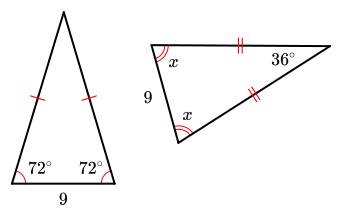
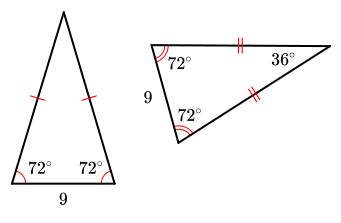
d Notice that the triangles are both isosceles and have congruent bases. According to the Base Angles Theorem, we know that the base angles of the isosceles triangles are congruent. Let's add this information to the diagram.
Using the Triangle Angle Sum Theorem, we can write an equation containing the measure of the base angles that we have labeled x.
m∠ x+m∠ x+36^(∘)=180^(∘)
Let's solve the equation by performing inverse operations until x is isolated.