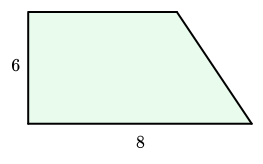
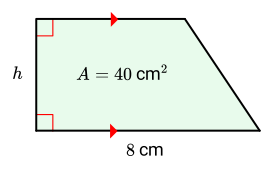
Let's take a look at the figure. We need to give a possible value for h.
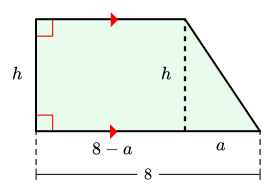
First, we will divide the figure into a right triangle and a rectangle, labeling the base of the triangle a. Since the base of the figure is 8 cm and the base of the triangle is a, the length of the rectangle is the difference between those two values, 8-a.
The area of the figure is a sum of two areas: the area of a rectangle and the area of a triangle. If we combine those two, we will get the total area of the figure.
Area of the Rectangle
Recall that area of a rectangle is its length multiplied by its width. In our case, the length and width are h and 8-a, respectively. Let's substitute those into the formula.
A_R=l w ⇔ A_R = h( 8-a)
We found that h(8-a) represents the area of the rectangle.
Area of the Triangle
Area of a triangle is half the product of its base and height. In the diagram we see that a is the base of the triangle, and h is its corresponding height. We can substitute those values into the formula.
A_T=1/2bh ⇔ A_T = 1/2 a h
Area of the Figure
The area of the whole figure A_F is the sum of both found areas. Let's add them and simplify the right-hand side.
We want to find a possible value of h for which the area of the figure is 40cm^2. To do that, we can substitute 40 for the area of the figure and solve the resulting equation for a.
Now we are free to choose any value of h, as long as a is positive and not more than half of the longer base of the figure, which is 8.
a > 0
a not more than 12(8)=4
Looking at the figure, we can tell that h should probably be less 8. Therefore, let's try a few values that are less than 8 but larger than 0. We can use a calculator for that.
h
16- 80/h
a
4
16- 80/4
- 4
5
16- 80/5
0
6
16- 80/6
2.7
7
16- 80/7
4.57
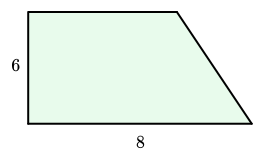
We see that only one of the possible values of h we tested is a viable result. This gives us the following figure.