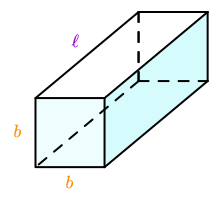
We will begin with finding the area of the base. We see that the base is a square since it is a rectangle with equal sides. To find its area, we will use the formula for the area of a square, where b is the side length.
\begin{gathered}
A_\text{base} = {\color{#FD9000}{b}}^2
\end{gathered}
The four other sides are also identical — each is a rectangle with a length l and a width b. The formula for the area of a rectangle tells us that the area of a rectangle is the length multiplied by the width. In our case, these lengths are l and b, respectively.
\begin{gathered}
A_\text{side} = {\color{#A800DD}{\ell}}{\color{#FD9000}{b}}
\end{gathered}
We can now add add these expressions to write the formula for the surface area S of the prism. Keep in mind there are 2 bases and 4 sides.
\begin{aligned}
S =\ & 2{\color{#009600}{A_\text{base}}} +4 {\color{#FF00FF}{A_\text{side}}} \\
&\Downarrow \\
S =\ & 2{\color{#009600}{b^2}}+4{\color{#FF00FF}{\ell b}}
\end{aligned}
b Let's recall the formula found in Part A. We are asked to choose which length in the formula, b or l, would we rather solve for.
A=2 b^2+ 4 l b
We see that b appears in the formula twice, each time with a different exponent. Solving for b would mean solving a quadratic equation, which is harder than solving linear equations since we need to take a square root. That is why we should choose l.