a Calculate the second and the third term, then find a recursive pattern.
B
b Use a spreadsheet.
C
c Use a spreadsheet.
A
aRecursive Rule: a_1=325, a_n=0.4a_(n-1)+325 for n>1
B
bMaintance level: 541.66 milligrams
C
cMaintance level: 1083.33 milligrams. It doubles when we double the dosage.
Practice makes perfect
a Let a_n denote the amount of the drug in milligrams in the bloodstream after n doses. The first dose is 325 milligrams. This tells us that a_1=325. Next, we will find a recursive equation for the sequence a_n.
Recursive Equation
Just after taking the (n-1)^(th) dose the amount of the drug is a_(n-1). Before the next dose, 60 % of the drug is removed from the bloodstream. Therefore, 40 %=0.4 of the old drug remains. Next, we add 325 milligrams when taking the next dose.
ccccc
c Amount of the drug after the $n^(th)$ dose
&
=0.4 *
&
c Amount of the drug after the $(n-1)^(th)$ dose
&
+
&
New dose
⇓ & & ⇓ & & ⇓
a_n & =0.4 * & a_(n-1) & + & 325
Therefore, we can write a recursive rule: a_1=325, a_n=0.4a_(n-1)+325 for n>1.
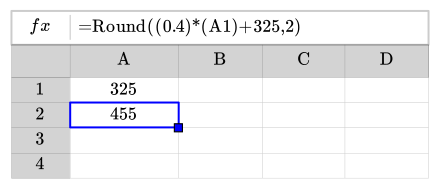
b We are asked to find the maintenance level of the drug, which is the value that a drug level approaches after an extended period of time. To do this we will use a spreadsheet. Let's enter a_1=325 in cell A1 and write =Round((0.4)*(A1)+325,2) in cell A2. When we hit enter, we will get the following.
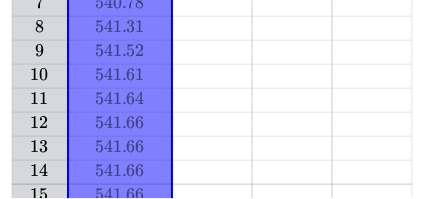
Next, copy cell A2, highlight cells A3 through A30, and paste. Then, note that the numbers stabilize around cell A12.
After cell A11 we will keep getting the same value, 541.66. This tells us that the maintenance level is 541.66.
c We are asked how doubling the dosage affects the maintenance level of the drug. Similar to Part A, we get a recursive rule in this situation.
Recursive Rule:
a_1=650, a_n=0.4a_(n-1)+650forn>1To find the maintenance level of the drug we will use the spreadsheet. Let's enter a_1=650 in cell A1 and write =Round((0.4)*(A1)+650,2) in cell A2. When we hit enter, we will get the following.
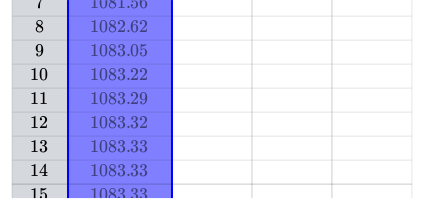
Next, copy cell A2, highlight cells A3 through A30, and paste. Then, note that the numbers stabilize around cell A13.
After cell A12 we will keep getting the same value, 1083.33. This tells us that the maintenance level is 1083.33. The maintenance level of the drug from Part B is 541.66. Since 1083.33541.66≈ 2, the maintenance level doubles when we double the dose.