a Let a_n be balance after the n^(th) payment. We are asked to find the balance after the fourth payment, a_4. To do this, we will find a recursive rule for a_n. Then we will use a spreadsheet.
Recursive Rule
Since the annual interest rate is 11.5 %=0.115, the monthly interest rate is 0.115/12. This tells us that the balance increases by a factor of 1+0.115/12 each month, and then the payment of $ 173.86 is subtracted.
ccccc
c Balance after payment
&
=(1+0.115/12) *
&
c Balance before payment
&
-
&
Payment
⇓ & & ⇓ & & ⇓
a_n & =(1+0.115/12) * & a_(n-1) & - & 173.86
You borrow $10 000. This tells us the balance at the beginning of the first month is $10 000. Therefore, a_0=10 000. Now, we can use a spreadsheet to find the balance after the fourth payment, a_4.
Spreadsheet
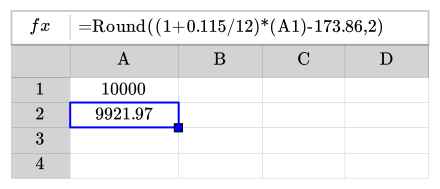
Let's enter a_0=10 000 in cell A1 and write =Round((1+0.115/12)*(A1)-173.86,2) in cell A2. When we hit enter, we will get the following.
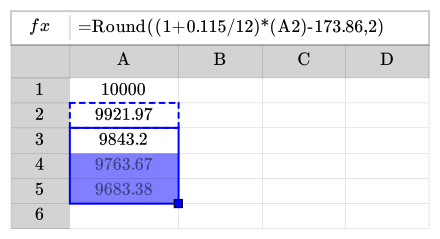
Next, copy cell A2, highlight cells A3 through A5, and paste.
We get 9683.38 in the fifth row. Therefore a_4=9683.38, and this tells us that the balance after the fifth payment is $9683.38.
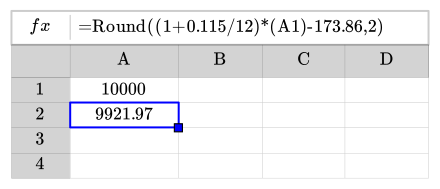
b We are asked to find the balance after the last payment. You borrow the money for 7 years. This tells us that you have 7* 12=84 payments. Again, let's use the spreadsheet. Let's enter a_0=10 000 in cell A1 and write =Round((1+0.115/12)*(A1)-173.86,2) in cell A2. When we hit enter, we will get the following.
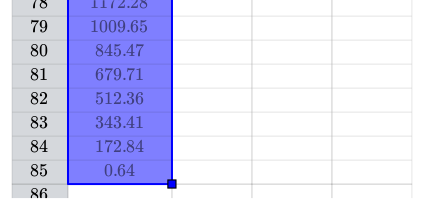
Notice that the balance after the first payment is in cell A2. This tells us that the balance after the n^(th) payment is in the (n+1)^(th) row. Therefore, the balance after the usual 84^(th) payment of $ 173.86 will be in cell A85. Next, in the spreadsheet, copy cell A2, highlight cells A3 through A85, and paste.
The spreadsheet shows that after the usual 84^(th) payment of $ 173.86 the balance is $ 0.64. Therefore, the last payment should be $ 173.86+$ 0.64=$173.48.