{{ tocSubheader }}
{{ 'ml-label-loading-course' | message }}
An error ocurred, try again later!
Chapter {{ article.chapter.number }}
{{ article.number }}.
{{ article.displayTitle }}
{{ article.intro.summary }}
Show less Show more expand_more Lesson Settings & Tools
| | {{ 'ml-lesson-number-slides' | message : article.intro.bblockCount }} |
| | {{ 'ml-lesson-number-exercises' | message : article.intro.exerciseCount }} |
| | {{ 'ml-lesson-time-estimation' | message }} |
When a quantity changes in a repetitive and specific manner, it exhibits a pattern. This behavior often happens in everyday life. Consider bacteria; they multiply over a particular period of time while following a specific pattern. Here, the bacteria is shown doubling. 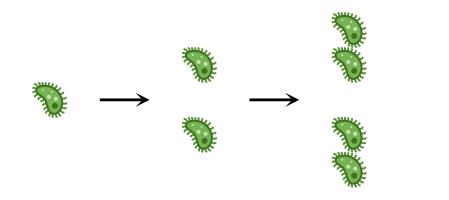
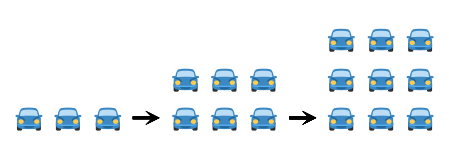
Patterns are also very common in the process of making things. Consider a car factory that bases its production of cars following a specific pattern. In their case, they have planned for the number of cars they produce to increase by the same amount each month.
Patterns like the given scenarios can be modeled using sequences. This lesson demonstrates these sequences and explores a special type called an arithmetic sequence.
Catch-Up and Review
Here are a few recommended readings before getting started with this lesson.
Challenge
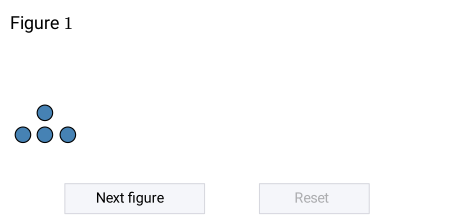
How Many Circles Are in Each Figure?
Discussion
Defining Sequences
A sequence is an ordered list of objects or elements called terms. The terms are often represented using a variable labeled with indices that specify the positions of the terms in the sequence.
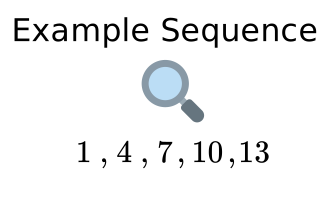 Depending on the number of terms, a sequence can be finite or infinite. Since it is not possible to list all the elements in an infinite sequence, it is common to place three dots after a few terms. These three dots indicate that the sequence continues indefinitely based on a specific pattern.
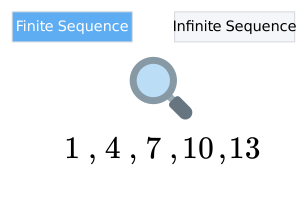 The values of the terms of a sequence can repeat.
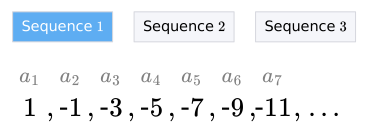
Sequence With Repeating Termsa1-1,a20,a31,a40,a5-1,a60,a71,…
Sequences can have all sorts of patterns. The examples below use the same starting term but result in different sequences due to the differences in the patterns. Note that it is common to use letters like an, bn, cn, and so on to represent distinct sequences. Discussion
A Special Type of Sequences: Arithmetic Sequences
An arithmetic sequence is a sequence that has a constant difference between consecutive terms — that is, the difference between the first and the second term is the same as the difference between the second and the third term, and so on. This difference is called the common difference and is usually denoted with d. For example, consider the sequence of all even positive integers 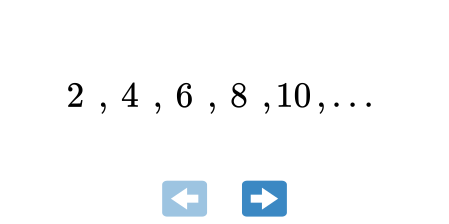 For this sequence, the common difference is d=2. It is important to note that the common difference can take on negative values as well. Consider the following arithmetic sequence where the values decrease.
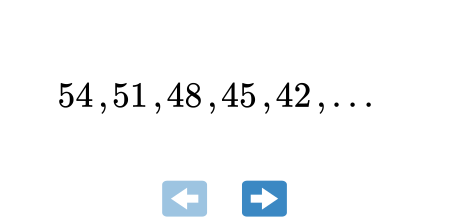 This is an arithmetic sequence with a common difference of -3.
Pop Quiz
Identifying Arithmetic Sequences
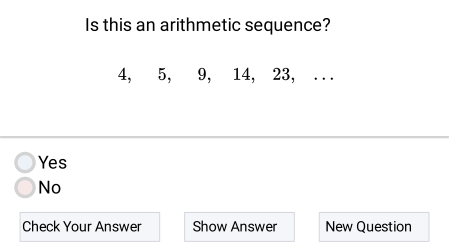
The following applet shows the firsts five terms of an infinite sequence. Analyze them carefully and determine whether or not the sequence is arithmetic.
Discussion
Explicit Rule of an Arithmetic Sequence
Every arithmetic sequence can be described by a linear function that is defined for the set of counting numbers. This function, referred to as the explicit rule of an arithmetic sequence, follows a specific general format.
an=a1+(n−1)d
Proof
Justification Based on InductionEvery arithmetic sequence has a common difference d. Therefore, it is possible to obtain every term of the sequence by adding the common difference to the first term a1 an appropriate number of times.
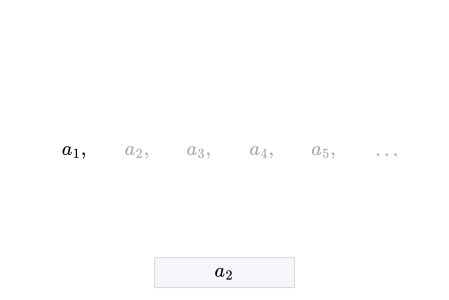 Tables can help in identifying the pattern and writing a general expression.
| n | an | Rewrite |
|---|---|---|
| 1 | a1 | a1+0⋅d |
| 2 | a2 | a1+1⋅d |
| 3 | a3 | a1+2⋅d |
| 4 | a4 | a1+3⋅d |
| 5 | a5 | a1+4⋅d |
The coefficient of the common difference is always 1 less than the value of the position n. This makes it possible to write an explicit rule like the following formula.
an=a1+(n−1)d
Proof
Proof by Using the Point-Slope Form of a LineA sequence can be thought of as a set of coordinate pairs where the first coordinate is the position n and the second coordinate is the term value an. 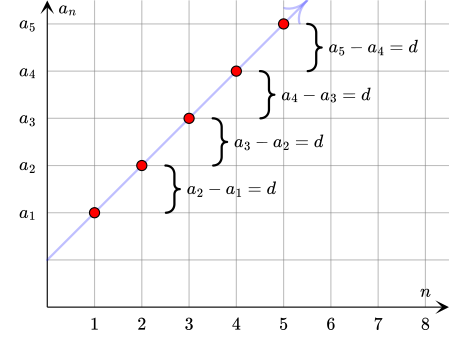 Therefore, the explicit rule for the sequence can be written by substituting the coordinate pair (1,a1) into the point-slope form of a line.
(1,a1), (2,a2), (3,a3), …
As the position increases by 1, the value of the term increases, or decreases, by a constant. Therefore, the rate of change between two consecutive coordinate pairs is constant and equal to d. That means an arithmetic sequence is a linear function with a slope d. Point-Slope Formy−y1=m(x−x1)Explicit Rulean−a1=d(n−1)
Finally, the explicit rule can be rewritten to the form given at the beginning of this proof.
an−a1=d(n−1)⇕an=a1+(n−1)d
Example
Counting the Number of Seats in a Movie Theater
Davontay goes to a cinema to see a new movie about a kid who runs like the wind. Waiting for the movie to start, he notices something very interesting about the theater itself.
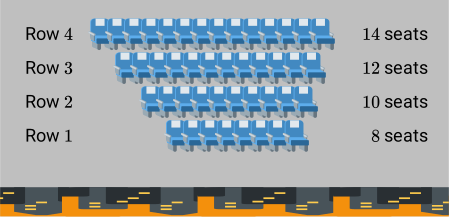
a The theater has its seats organized in such a way that as the number of rows increase, the number of seats increase by a fixed amount. The first four rows have 8, 10, 12, and 14 seats, respectively.
{"type":"choice","form":{"alts":["<span class=\"katex\"><span class=\"katex-html\" aria-hidden=\"true\"><span class=\"base\"><span class=\"strut\" style=\"height:0.58056em;vertical-align:-0.15em;\"><\/span><span class=\"mord\"><span class=\"mord mathdefault\">a<\/span><span class=\"msupsub\"><span class=\"vlist-t vlist-t2\"><span class=\"vlist-r\"><span class=\"vlist\" style=\"height:0.151392em;\"><span style=\"top:-2.5500000000000003em;margin-left:0em;margin-right:0.05em;\"><span class=\"pstrut\" style=\"height:2.7em;\"><\/span><span class=\"sizing reset-size6 size3 mtight\"><span class=\"mord mathdefault mtight\">n<\/span><\/span><\/span><\/span><span class=\"vlist-s\">\u200b<\/span><\/span><span class=\"vlist-r\"><span class=\"vlist\" style=\"height:0.15em;\"><span><\/span><\/span><\/span><\/span><\/span><\/span><span class=\"mspace\" style=\"margin-right:0.2777777777777778em;\"><\/span><span class=\"mrel\">=<\/span><span class=\"mspace\" style=\"margin-right:0.2777777777777778em;\"><\/span><\/span><span class=\"base\"><span class=\"strut\" style=\"height:0.72777em;vertical-align:-0.08333em;\"><\/span><span class=\"mord\">2<\/span><span class=\"mspace\" style=\"margin-right:0.2222222222222222em;\"><\/span><span class=\"mbin\">+<\/span><span class=\"mspace\" style=\"margin-right:0.2222222222222222em;\"><\/span><\/span><span class=\"base\"><span class=\"strut\" style=\"height:1em;vertical-align:-0.25em;\"><\/span><span class=\"mopen\">(<\/span><span class=\"mord mathdefault\">n<\/span><span class=\"mspace\" style=\"margin-right:0.2222222222222222em;\"><\/span><span class=\"mbin\">\u2212<\/span><span class=\"mspace\" style=\"margin-right:0.2222222222222222em;\"><\/span><\/span><span class=\"base\"><span class=\"strut\" style=\"height:1em;vertical-align:-0.25em;\"><\/span><span class=\"mord\">1<\/span><span class=\"mclose\">)<\/span><span class=\"mord\">8<\/span><\/span><\/span><\/span>","<span class=\"katex\"><span class=\"katex-html\" aria-hidden=\"true\"><span class=\"base\"><span class=\"strut\" style=\"height:0.58056em;vertical-align:-0.15em;\"><\/span><span class=\"mord\"><span class=\"mord mathdefault\">a<\/span><span class=\"msupsub\"><span class=\"vlist-t vlist-t2\"><span class=\"vlist-r\"><span class=\"vlist\" style=\"height:0.151392em;\"><span style=\"top:-2.5500000000000003em;margin-left:0em;margin-right:0.05em;\"><span class=\"pstrut\" style=\"height:2.7em;\"><\/span><span class=\"sizing reset-size6 size3 mtight\"><span class=\"mord mathdefault mtight\">n<\/span><\/span><\/span><\/span><span class=\"vlist-s\">\u200b<\/span><\/span><span class=\"vlist-r\"><span class=\"vlist\" style=\"height:0.15em;\"><span><\/span><\/span><\/span><\/span><\/span><\/span><span class=\"mspace\" style=\"margin-right:0.2777777777777778em;\"><\/span><span class=\"mrel\">=<\/span><span class=\"mspace\" style=\"margin-right:0.2777777777777778em;\"><\/span><\/span><span class=\"base\"><span class=\"strut\" style=\"height:0.72777em;vertical-align:-0.08333em;\"><\/span><span class=\"mord\">8<\/span><span class=\"mspace\" style=\"margin-right:0.2222222222222222em;\"><\/span><span class=\"mbin\">+<\/span><span class=\"mspace\" style=\"margin-right:0.2222222222222222em;\"><\/span><\/span><span class=\"base\"><span class=\"strut\" style=\"height:1em;vertical-align:-0.25em;\"><\/span><span class=\"mopen\">(<\/span><span class=\"mord mathdefault\">n<\/span><span class=\"mspace\" style=\"margin-right:0.2222222222222222em;\"><\/span><span class=\"mbin\">\u2212<\/span><span class=\"mspace\" style=\"margin-right:0.2222222222222222em;\"><\/span><\/span><span class=\"base\"><span class=\"strut\" style=\"height:1em;vertical-align:-0.25em;\"><\/span><span class=\"mord\">1<\/span><span class=\"mclose\">)<\/span><span class=\"mord\">2<\/span><\/span><\/span><\/span>","<span class=\"katex\"><span class=\"katex-html\" aria-hidden=\"true\"><span class=\"base\"><span class=\"strut\" style=\"height:0.58056em;vertical-align:-0.15em;\"><\/span><span class=\"mord\"><span class=\"mord mathdefault\">a<\/span><span class=\"msupsub\"><span class=\"vlist-t vlist-t2\"><span class=\"vlist-r\"><span class=\"vlist\" style=\"height:0.151392em;\"><span style=\"top:-2.5500000000000003em;margin-left:0em;margin-right:0.05em;\"><span class=\"pstrut\" style=\"height:2.7em;\"><\/span><span class=\"sizing reset-size6 size3 mtight\"><span class=\"mord mathdefault mtight\">n<\/span><\/span><\/span><\/span><span class=\"vlist-s\">\u200b<\/span><\/span><span class=\"vlist-r\"><span class=\"vlist\" style=\"height:0.15em;\"><span><\/span><\/span><\/span><\/span><\/span><\/span><span class=\"mspace\" style=\"margin-right:0.2777777777777778em;\"><\/span><span class=\"mrel\">=<\/span><span class=\"mspace\" style=\"margin-right:0.2777777777777778em;\"><\/span><\/span><span class=\"base\"><span class=\"strut\" style=\"height:0.72777em;vertical-align:-0.08333em;\"><\/span><span class=\"mord\">1<\/span><span class=\"mord\">4<\/span><span class=\"mspace\" style=\"margin-right:0.2222222222222222em;\"><\/span><span class=\"mbin\">+<\/span><span class=\"mspace\" style=\"margin-right:0.2222222222222222em;\"><\/span><\/span><span class=\"base\"><span class=\"strut\" style=\"height:1em;vertical-align:-0.25em;\"><\/span><span class=\"mopen\">(<\/span><span class=\"mord mathdefault\">n<\/span><span class=\"mspace\" style=\"margin-right:0.2222222222222222em;\"><\/span><span class=\"mbin\">\u2212<\/span><span class=\"mspace\" style=\"margin-right:0.2222222222222222em;\"><\/span><\/span><span class=\"base\"><span class=\"strut\" style=\"height:1em;vertical-align:-0.25em;\"><\/span><span class=\"mord\">1<\/span><span class=\"mclose\">)<\/span><span class=\"mord\">2<\/span><\/span><\/span><\/span>","<span class=\"katex\"><span class=\"katex-html\" aria-hidden=\"true\"><span class=\"base\"><span class=\"strut\" style=\"height:0.58056em;vertical-align:-0.15em;\"><\/span><span class=\"mord\"><span class=\"mord mathdefault\">a<\/span><span class=\"msupsub\"><span class=\"vlist-t vlist-t2\"><span class=\"vlist-r\"><span class=\"vlist\" style=\"height:0.151392em;\"><span style=\"top:-2.5500000000000003em;margin-left:0em;margin-right:0.05em;\"><span class=\"pstrut\" style=\"height:2.7em;\"><\/span><span class=\"sizing reset-size6 size3 mtight\"><span class=\"mord mathdefault mtight\">n<\/span><\/span><\/span><\/span><span class=\"vlist-s\">\u200b<\/span><\/span><span class=\"vlist-r\"><span class=\"vlist\" style=\"height:0.15em;\"><span><\/span><\/span><\/span><\/span><\/span><\/span><span class=\"mspace\" style=\"margin-right:0.2777777777777778em;\"><\/span><span class=\"mrel\">=<\/span><span class=\"mspace\" style=\"margin-right:0.2777777777777778em;\"><\/span><\/span><span class=\"base\"><span class=\"strut\" style=\"height:0.72777em;vertical-align:-0.08333em;\"><\/span><span class=\"mord\">1<\/span><span class=\"mord\">4<\/span><span class=\"mspace\" style=\"margin-right:0.2222222222222222em;\"><\/span><span class=\"mbin\">\u2212<\/span><span class=\"mspace\" style=\"margin-right:0.2222222222222222em;\"><\/span><\/span><span class=\"base\"><span class=\"strut\" style=\"height:1em;vertical-align:-0.25em;\"><\/span><span class=\"mopen\">(<\/span><span class=\"mord mathdefault\">n<\/span><span class=\"mspace\" style=\"margin-right:0.2222222222222222em;\"><\/span><span class=\"mbin\">\u2212<\/span><span class=\"mspace\" style=\"margin-right:0.2222222222222222em;\"><\/span><\/span><span class=\"base\"><span class=\"strut\" style=\"height:1em;vertical-align:-0.25em;\"><\/span><span class=\"mord\">1<\/span><span class=\"mclose\">)<\/span><span class=\"mord\">2<\/span><\/span><\/span><\/span>"],"noSort":false},"formTextBefore":"","formTextAfter":"","answer":1}
b Predict how many seats there are in the 8th row?
{"type":"text","form":{"type":"math","options":{"comparison":"1","nofractofloat":false,"keypad":{"simple":true,"useShortLog":false,"variables":["x"],"constants":["PI"]},"rendered":false},"text":"<span class=\"katex\"><span class=\"katex-html\" aria-hidden=\"true\"><\/span><\/span>"},"formTextBefore":null,"formTextAfter":"seats","answer":{"text":["22"]}}
c If the theater were to be expanded to fit 50 rows, how many seats would be in the 50th row?
{"type":"text","form":{"type":"math","options":{"comparison":"1","nofractofloat":false,"keypad":{"simple":true,"useShortLog":false,"variables":["x"],"constants":["PI"]},"rendered":false},"text":"<span class=\"katex\"><span class=\"katex-html\" aria-hidden=\"true\"><\/span><\/span>"},"formTextBefore":null,"formTextAfter":"seats","answer":{"text":["106"]}}
Hint
a The general form of an explicit rule of an arithmetic sequence is an=a1+(n−1)d.
b In the explicit rule describing the situation, an represents the number of seats in the nth row.
c In the explicit rule the row number is represented by the term position n.
Solution
a The increment in the number of seats from row to row is constant. Therefore, this situation can be modeled using an arithmetic sequence. Let the term position n represent the row number and the term value an the corresponding number of seats. The constant increase in number of seats is the common difference of the sequence.
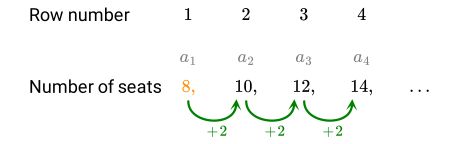
an=a1+(n−1)d
By substituting the corresponding values, the explicit rule can be found.
an=8+(n−1)2
b The number of seats in the 8th row can be found by using the expression found in Part A and substituting in n=8.
Therefore, there are 22 seats in the 8th row.
an=8+(n−1)2
▼
Substitute 8 for n and evaluate
a8=22
c Similarly as in Part B, the number of seats in the 50th row can be found by evaluating the explicit formula for n=50.
an=8+(n−1)2
▼
Substitute 50 for n and evaluate
Substitute
n=50
a50=8+(50−1)2
SubTerm
Subtract term
a50=8+(49)2
Multiply
Multiply
a50=8+98
AddTerms
Add terms
a50=106
Example
Calculating the Total Distance Ran and Making Predictions
Davontay, inspired by a movie about running, downloaded an app that keeps track of his total running distance. It even predicts his running goals. He went for a long run on his first day using it and has followed that same route ever since. One day, he opened the app, but the free trial period was over, and his data was locked!

a After careful thought, Davontay realizes that since he always runs the same path, the total distance must have increased by the same amount each day. This means that he can model the situation using an arithmetic sequence! Determine his missing running data and find an explicit rule to model this situation.
{"type":"choice","form":{"alts":["<span class=\"katex\"><span class=\"katex-html\" aria-hidden=\"true\"><span class=\"base\"><span class=\"strut\" style=\"height:0.58056em;vertical-align:-0.15em;\"><\/span><span class=\"mord\"><span class=\"mord mathdefault\">a<\/span><span class=\"msupsub\"><span class=\"vlist-t vlist-t2\"><span class=\"vlist-r\"><span class=\"vlist\" style=\"height:0.151392em;\"><span style=\"top:-2.5500000000000003em;margin-left:0em;margin-right:0.05em;\"><span class=\"pstrut\" style=\"height:2.7em;\"><\/span><span class=\"sizing reset-size6 size3 mtight\"><span class=\"mord mathdefault mtight\">n<\/span><\/span><\/span><\/span><span class=\"vlist-s\">\u200b<\/span><\/span><span class=\"vlist-r\"><span class=\"vlist\" style=\"height:0.15em;\"><span><\/span><\/span><\/span><\/span><\/span><\/span><span class=\"mspace\" style=\"margin-right:0.2777777777777778em;\"><\/span><span class=\"mrel\">=<\/span><span class=\"mspace\" style=\"margin-right:0.2777777777777778em;\"><\/span><\/span><span class=\"base\"><span class=\"strut\" style=\"height:0.72777em;vertical-align:-0.08333em;\"><\/span><span class=\"mord\">5<\/span><span class=\"mspace\" style=\"margin-right:0.2222222222222222em;\"><\/span><span class=\"mbin\">+<\/span><span class=\"mspace\" style=\"margin-right:0.2222222222222222em;\"><\/span><\/span><span class=\"base\"><span class=\"strut\" style=\"height:1em;vertical-align:-0.25em;\"><\/span><span class=\"mopen\">(<\/span><span class=\"mord mathdefault\">n<\/span><span class=\"mspace\" style=\"margin-right:0.2222222222222222em;\"><\/span><span class=\"mbin\">\u2212<\/span><span class=\"mspace\" style=\"margin-right:0.2222222222222222em;\"><\/span><\/span><span class=\"base\"><span class=\"strut\" style=\"height:1em;vertical-align:-0.25em;\"><\/span><span class=\"mord\">1<\/span><span class=\"mclose\">)<\/span><span class=\"mord\">2<\/span><span class=\"mord\">.<\/span><span class=\"mord\">5<\/span><\/span><\/span><\/span>","<span class=\"katex\"><span class=\"katex-html\" aria-hidden=\"true\"><span class=\"base\"><span class=\"strut\" style=\"height:0.58056em;vertical-align:-0.15em;\"><\/span><span class=\"mord\"><span class=\"mord mathdefault\">a<\/span><span class=\"msupsub\"><span class=\"vlist-t vlist-t2\"><span class=\"vlist-r\"><span class=\"vlist\" style=\"height:0.151392em;\"><span style=\"top:-2.5500000000000003em;margin-left:0em;margin-right:0.05em;\"><span class=\"pstrut\" style=\"height:2.7em;\"><\/span><span class=\"sizing reset-size6 size3 mtight\"><span class=\"mord mathdefault mtight\">n<\/span><\/span><\/span><\/span><span class=\"vlist-s\">\u200b<\/span><\/span><span class=\"vlist-r\"><span class=\"vlist\" style=\"height:0.15em;\"><span><\/span><\/span><\/span><\/span><\/span><\/span><span class=\"mspace\" style=\"margin-right:0.2777777777777778em;\"><\/span><span class=\"mrel\">=<\/span><span class=\"mspace\" style=\"margin-right:0.2777777777777778em;\"><\/span><\/span><span class=\"base\"><span class=\"strut\" style=\"height:0.72777em;vertical-align:-0.08333em;\"><\/span><span class=\"mord\">1<\/span><span class=\"mord\">6<\/span><span class=\"mspace\" style=\"margin-right:0.2222222222222222em;\"><\/span><span class=\"mbin\">+<\/span><span class=\"mspace\" style=\"margin-right:0.2222222222222222em;\"><\/span><\/span><span class=\"base\"><span class=\"strut\" style=\"height:1em;vertical-align:-0.25em;\"><\/span><span class=\"mopen\">(<\/span><span class=\"mord mathdefault\">n<\/span><span class=\"mspace\" style=\"margin-right:0.2222222222222222em;\"><\/span><span class=\"mbin\">\u2212<\/span><span class=\"mspace\" style=\"margin-right:0.2222222222222222em;\"><\/span><\/span><span class=\"base\"><span class=\"strut\" style=\"height:1em;vertical-align:-0.25em;\"><\/span><span class=\"mord\">1<\/span><span class=\"mclose\">)<\/span><span class=\"mord\">2<\/span><\/span><\/span><\/span>","<span class=\"katex\"><span class=\"katex-html\" aria-hidden=\"true\"><span class=\"base\"><span class=\"strut\" style=\"height:0.58056em;vertical-align:-0.15em;\"><\/span><span class=\"mord\"><span class=\"mord mathdefault\">a<\/span><span class=\"msupsub\"><span class=\"vlist-t vlist-t2\"><span class=\"vlist-r\"><span class=\"vlist\" style=\"height:0.151392em;\"><span style=\"top:-2.5500000000000003em;margin-left:0em;margin-right:0.05em;\"><span class=\"pstrut\" style=\"height:2.7em;\"><\/span><span class=\"sizing reset-size6 size3 mtight\"><span class=\"mord mathdefault mtight\">n<\/span><\/span><\/span><\/span><span class=\"vlist-s\">\u200b<\/span><\/span><span class=\"vlist-r\"><span class=\"vlist\" style=\"height:0.15em;\"><span><\/span><\/span><\/span><\/span><\/span><\/span><span class=\"mspace\" style=\"margin-right:0.2777777777777778em;\"><\/span><span class=\"mrel\">=<\/span><span class=\"mspace\" style=\"margin-right:0.2777777777777778em;\"><\/span><\/span><span class=\"base\"><span class=\"strut\" style=\"height:0.72777em;vertical-align:-0.08333em;\"><\/span><span class=\"mord\">1<\/span><span class=\"mord\">3<\/span><span class=\"mspace\" style=\"margin-right:0.2222222222222222em;\"><\/span><span class=\"mbin\">+<\/span><span class=\"mspace\" style=\"margin-right:0.2222222222222222em;\"><\/span><\/span><span class=\"base\"><span class=\"strut\" style=\"height:1em;vertical-align:-0.25em;\"><\/span><span class=\"mopen\">(<\/span><span class=\"mord mathdefault\">n<\/span><span class=\"mspace\" style=\"margin-right:0.2222222222222222em;\"><\/span><span class=\"mbin\">\u2212<\/span><span class=\"mspace\" style=\"margin-right:0.2222222222222222em;\"><\/span><\/span><span class=\"base\"><span class=\"strut\" style=\"height:1em;vertical-align:-0.25em;\"><\/span><span class=\"mord\">1<\/span><span class=\"mclose\">)<\/span><span class=\"mord\">2<\/span><\/span><\/span><\/span>","<span class=\"katex\"><span class=\"katex-html\" aria-hidden=\"true\"><span class=\"base\"><span class=\"strut\" style=\"height:0.58056em;vertical-align:-0.15em;\"><\/span><span class=\"mord\"><span class=\"mord mathdefault\">a<\/span><span class=\"msupsub\"><span class=\"vlist-t vlist-t2\"><span class=\"vlist-r\"><span class=\"vlist\" style=\"height:0.151392em;\"><span style=\"top:-2.5500000000000003em;margin-left:0em;margin-right:0.05em;\"><span class=\"pstrut\" style=\"height:2.7em;\"><\/span><span class=\"sizing reset-size6 size3 mtight\"><span class=\"mord mathdefault mtight\">n<\/span><\/span><\/span><\/span><span class=\"vlist-s\">\u200b<\/span><\/span><span class=\"vlist-r\"><span class=\"vlist\" style=\"height:0.15em;\"><span><\/span><\/span><\/span><\/span><\/span><\/span><span class=\"mspace\" style=\"margin-right:0.2777777777777778em;\"><\/span><span class=\"mrel\">=<\/span><span class=\"mspace\" style=\"margin-right:0.2777777777777778em;\"><\/span><\/span><span class=\"base\"><span class=\"strut\" style=\"height:0.72777em;vertical-align:-0.08333em;\"><\/span><span class=\"mord\">4<\/span><span class=\"mspace\" style=\"margin-right:0.2222222222222222em;\"><\/span><span class=\"mbin\">+<\/span><span class=\"mspace\" style=\"margin-right:0.2222222222222222em;\"><\/span><\/span><span class=\"base\"><span class=\"strut\" style=\"height:1em;vertical-align:-0.25em;\"><\/span><span class=\"mopen\">(<\/span><span class=\"mord mathdefault\">n<\/span><span class=\"mspace\" style=\"margin-right:0.2222222222222222em;\"><\/span><span class=\"mbin\">\u2212<\/span><span class=\"mspace\" style=\"margin-right:0.2222222222222222em;\"><\/span><\/span><span class=\"base\"><span class=\"strut\" style=\"height:1em;vertical-align:-0.25em;\"><\/span><span class=\"mord\">1<\/span><span class=\"mclose\">)<\/span><span class=\"mord\">3<\/span><span class=\"mord\">.<\/span><span class=\"mord\">5<\/span><\/span><\/span><\/span>"],"noSort":false},"formTextBefore":"","formTextAfter":"","answer":0}
b Davontay has a personal goal of running 150 kilometers in total. If he keeps running the same path every day, how many days will he need to reach his goal?
{"type":"text","form":{"type":"math","options":{"comparison":"1","nofractofloat":false,"keypad":{"simple":true,"useShortLog":false,"variables":["x"],"constants":["PI"]},"rendered":false},"text":"<span class=\"katex\"><span class=\"katex-html\" aria-hidden=\"true\"><\/span><\/span>"},"formTextBefore":null,"formTextAfter":"days","answer":{"text":["59"]}}
Hint
a The total distance accumulated increases by a constant amount each day. That is the common difference of the arithmetic sequence.
b Use the explicit rule found in Part A and let an be 150 kilometers. This way, the corresponding n-value represents the number of the day in which that distance will be reached.
Solution
a Since the same distance was added every day to the data, the total distance reported each day should increase by a constant amount d. This will be the common difference of the arithmetic sequence. The day number will be represented by the term's position, and the total distance represented by the term's value.
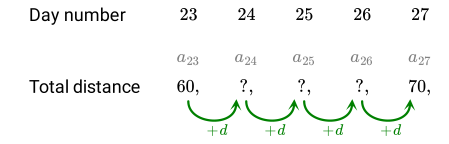
10=4d ⇔ d=2.5
Recall the explicit rule of an arithmetic sequence.
an=a1+(n−1)d
The common difference found earlier can now be substituted into the formula.
an=a1+(n−1)2.5
Next, find a1. This can be done by evaluating the explicit rule in place of one of the known terms. As a demonstration, since it is given that a23=60, the rule can be evaluated at n=23 and solved for a1.
an=a1+(n−1)2.5
Substitute
n=23
a23=a1+(23−1)2.5
Substitute
a23=60
60=a1+(23−1)2.5
▼
Solve for a1
SubTerm
Subtract term
60=a1+(22)2.5
Multiply
Multiply
60=a1+55
SubEqn
LHS−55=RHS−55
5=a1
RearrangeEqn
Rearrange equation
a1=5
an=5+(n−1)2.5
b It is required to determine the numbers of day that Davontay will reach 150 kilometers in total. That can be done by using the explicit formula found in Part A.
an=5+(n−1)2.5
By substituting 150 for an an equation for n will be obtained. The solution to the equation is the number of the day that corresponds to this distance. an=5+(n−1)2.5
Substitute
an=150
150=5+(n−1)2.5
▼
Solve for n
SubEqn
LHS−5=RHS−5
145=(n−1)2.5
DivEqn
LHS/2.5=RHS/2.5
58=n−1
AddEqn
LHS+1=RHS+1
59=n
RearrangeEqn
Rearrange equation
n=59
Pop Quiz
Determining the Explicit Rule of an Arithmetic Sequence
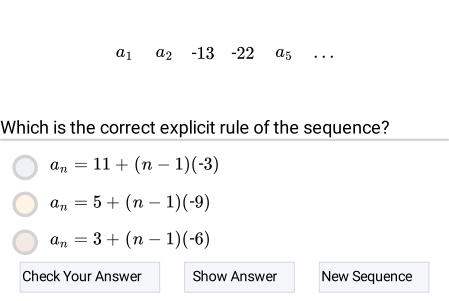
The following applet shows two of the first five terms of an infinite arithmetic sequence. Analyze the sequence carefully and determine which of the three options is the correct explicit rule of the sequence.
Pop Quiz
Finding the nth Term of an Arithmetic Sequence
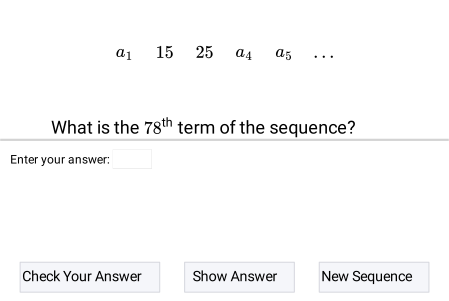
The following applet shows the first five terms of an infinite arithmetic sequence. Determine the explicit rule of the sequence and use it to find the indicated term.
Discussion
Describing Arithmetic Sequences Using a Recursive Rule
It has been shown how an explicit rule describes an arithmetic sequence. This representation uses a formula that receives the term position as the input and returns the term's value as the output. However, an arithmetic sequence can also be described by using a recursive rule.
Concept
Recursive Rule of an Arithmetic Sequence
A recursive rule of an arithmetic sequence is a pair comprised of a recursive equation telling how the term an is related to its preceding term an−1 and the initial term of the sequence a1.
a1,an=an−1+d
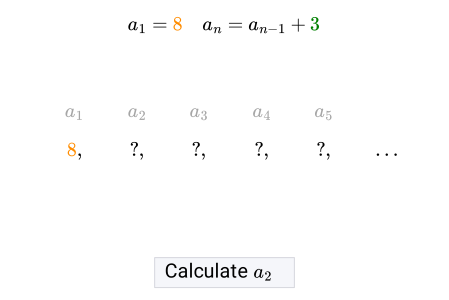
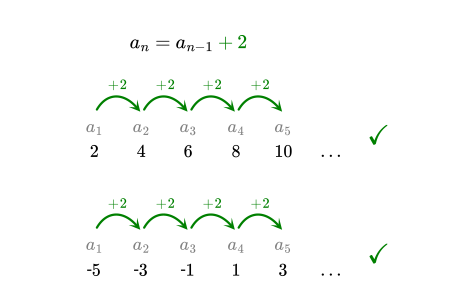
Now it will be explained, step by step, how to write the recursive rule for an arithmetic sequence and how to use it to find an unknown term's value.
Method
Writing a Recursive Rule for an Arithmetic Sequence
The recursive rule of an arithmetic sequence gives the first term of the sequence and a recursive equation.
a1,an=an−1+d
a15,a28,a311,a414,…
To write the recursive rule there are three steps to follow.
1
Find the Common Difference
expand_more The first step is to find the common difference d. To do this, calculate the difference between any two consecutive terms.
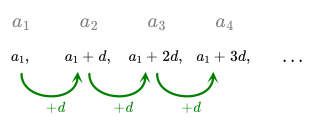 Since each term increases by d, a2 is equal to a1+d and a4 is equal to a1+3d.
a15,a28,a311,a414,…11−8=3 ⇒ d=3
What to Do When No Consecutive Terms Are Known?
If the sequence was known to be arithmetic but no consecutive terms were known, the common difference could still be found. In general, it is enough to know two terms of the arithmetic sequence and their positions. For example, consider that only a2 and a4 were known.a1?,a28,a3?,a414,…
Recall the general form of an arithmetic sequence. a4=a1+3d a2=a1+3d ⇒ 14=a1+3d⇒ 48=a1+3d
By subtracting the corresponding sides of the resulting equations, a single equation, which can be solved for d, is obtained.
14−8=a1+3d−(a1+d)
6=2d
▼
Solve for d
d=3
2
Identify the First Term of the Sequence
expand_more To completely define an arithmetic sequence the first term should also be determined. Note that the recursive equation alone would describe any arithmetic sequence with common difference d=3. From the sequence it can be seen that a1=5.
a15,a28,a311,a414,…
What to Do When a1 Is Not Known?
Reconsider the case where only a2 and a4 are known. Two equations were obtained.1418=a1+3d=a1+d
Since it is now known that d=3, this value can be substituted in any of the equations to find a1. This will be illustrated using the latter equation.
8=a1+3 ⇒ a1=5
3
Write the Equation Rule
expand_more Finally, by putting together the previous results and substituting the common difference and the first term value, the recursive rule for the sequence can be written.
a1,an=an−1+d⇓a1=5,an=an−1+3
Example
Using Recursive Rules to Describe Patterns
Davontay finds himself looking at his phone app too often when running. He has an idea! He will make patterns using heavy rocks at each kilometer mark along his running route so he does not have to check his phone to know what point his on the run.
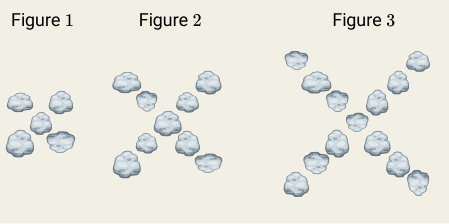
Davontay wants to make a fourth figure following the same pattern. Before setting out to collect more heavy rocks, he wants to model the pattern to save time and energy.
a Show that the situation can be modeled by using an arithmetic sequence and find a recursive rule for it.
b Calculate the number of rocks needed for the next figure.
Answer
a Proof: See solution.
Recursive Rule: a1=5, an=an−1+4
Recursive Rule: a1=5, an=an−1+4
b a4=17
Hint
a Recall that a sequence is arithmetic if it has a common difference.
b Note that the value of the term an is the number of rocks needed for the figure n. Evaluate the recursive rule found in Part A for the appropriate n-value.
Solution
a First, it will be shown that the described situation can be modeled using a sequence. Let an be the number of rocks used for the n-th figure.
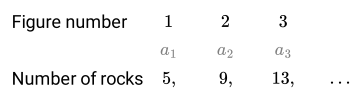
Now, to prove that the sequence obtained this way is arithmetic, the difference between consecutive terms will be calculated.
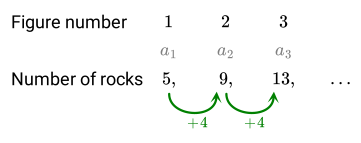
a1,an=an−1+d
In this equation, d represents the common difference of the sequence which was already found to be d=4. This value will now be substituted into the general recursive equation.
an=an−1+d⇓an=an−1+4
To finish writing the recursive rule, it is needed to specify the first term of the sequence a1. This can be identified in the previous diagram. 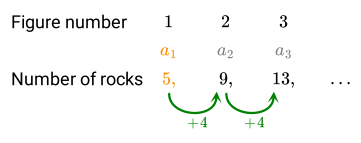
a1=8,an=an−1+4
b The value of the next term a4 is the number of rocks needed for the next figure. To find this term's value, the recursive equation will be evaluated at n=4.
an=an−1+4
▼
Substitute values and evaluate
a4=17
Example
Using Recursive and Explicit Rules to Predict Total Savings
Davontay is celebrating the completion of reaching his running goal. His family and friends throw him a party. They play a raffle game and he wins $50! He decides not to spend this money, instead, he will save it and put it in a piggy bank.

a1=50,an=an−1+5
In this expression, an represents the total savings after the nth week. a Use the recursive formula to find the savings after each of the first four weeks.
b Davontay wants to know how much money he will save after one year, that is 52 weeks. There is one catch, he does not want to use the recursive formula more than 50 times! Help Davontay find the corresponding explicit rule and the savings after one year.
c Thinking bigger picture, Davontay is now thinking about opening a bank account to save his money. A bank agent suggests for him to deposit the money in an account set to the following explicit rule.
an=100+(n−1)10
In this equation an represents the total savings after the nth week. Davontay would prefer to have a recursive rule since he thinks that it makes the weekly savings calculation easier. Help Davontay find the corresponding recursive rule. Answer
a Savings After Week 1: $50
Savings After Week 2: $55
Savings After Week 3: $60
b Savings After One Year: $305
c Recursive Rule: a1=100, an=an−1+10
Hint
a Note that the initial amount of $50 represents the savings after week 1. The savings after week 2, 3, and 4 can be found by evaluating the recursive rule at n=2, n=3, and n=4, respectively.
b Identify the relevant values from the recursive rule provided. Recall that the general form of a recursive rule is a1, an=an−1+d, where d is the common difference, n the position of the term and an the nth term's value.
c Identify the relevant values from the recursive rule provided. Recall that the general form of a recursive rule is a1, an=an−1+d, where d is the common difference, n the position of the term and an the nth term's value.
Solution
a Remember, it is already understood that a1=50, which means that the savings after the first week is $50. Now, in order to find the savings for the second week, the recursive rule will be used for n=2.
an=an−1+5
▼
Substitute values and evaluate
a2=55
| a1=50,an=an−1+5 | ||
|---|---|---|
| Position | Substitute | Simplify |
| n=1 | a1=50 | a1=50 |
| n=2 | a2=a1+5⇓a2=50+5
|
a2=55 |
| n=3 | a3=a2+5⇓a3=55+5
|
a3=60 |
| n=4 | a4=a3+5⇓a4=60+5
|
a4=65 |
b The given recursive rule can compared with the general form of a recursive rule. This helps to identify the first term a1 and the common difference d, which are needed to write the explicit rule.
General Recursive Rulea1,an=an−1+dGiven Recursive Rulea1=50,an=an−1+5
It is now understood that a1=50 and d=5. Next, use the general form of an explicit rule and substitute the previously identified values.
an=a1+(n−1)d⇓an=50+(n−1)5
Finally to find the value after a years worth of savings — 52 weeks — the explicit rule will be evaluated using n=52.
an=50+(n−1)5
▼
Substitute n for 52 and evaluate
Substitute
n=52
a52=50+(52−1)5
SubTerm
Subtract term
a52=50+(51)5
Multiply
Multiply
a52=50+255
AddTerms
Add terms
a52=305
c To help Davontay find the corresponding recursive rule, identify the first term a1 and the common difference d from the explicit rule given by the bank agent. This can be done by using the general form of an explicit rule.
General Explicit Rulean=a1+(n−1)dGiven Explicit Rulean=100+(n−1)10
As seen, a1=100 and d=10. Next, recall the general form of a recursive rule and substitute the values for a1 and d.
a1,an=an−1+d⇓a1=100,an=an−1+10
Pop Quiz
Relating Recursive and Explicit Rules of Arithmetic Sequences
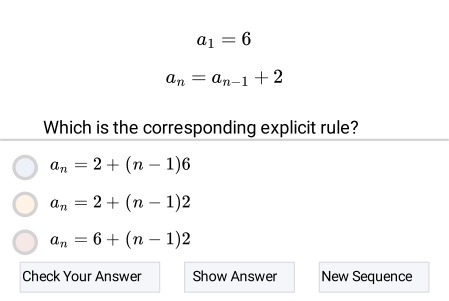
Find the corresponding explicit rule for the recursive rule shown.
Discussion
Arithmetic Sequences and Linear Functions
It was previously shown that the terms' values of an arithmetic sequence change by a constant amount. Because of that consistent change, every arithmetic sequence has an associated linear relationship where the common difference is the slope of its associated line. To illustrate this, consider the following arithmetic sequence.
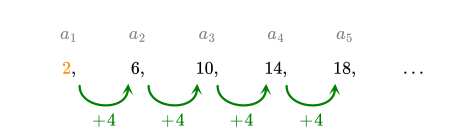
an=a1+(n−1)d↓an=2+(n−1)4
This rule can be simplified by distributing and subtracting 4, in that order.
The sequence can be represented graphically using this expression. Treat the terms position n as the independent variable, and treat the terms value an as the dependent one. See how the graph of a sequence compares to that of the linear function f(x)=4x−2. Note how the common difference of the sequence relates to the slope of the line.
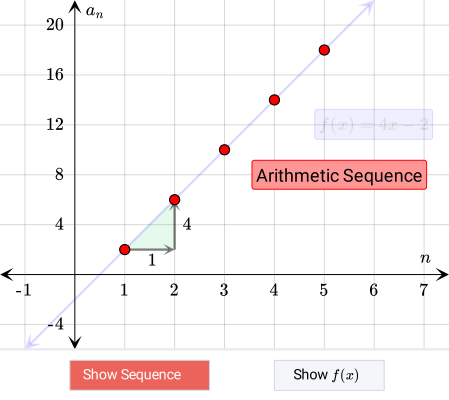
an=a1+(n−1)d⇕an=dn+(a1−d)
f(x)=mx+b
The only difference is that an arithmetic sequence has a domain and range which are discrete. In other words, the variables n and an can only have specific values. For this reason, their graphs are a series of isolated points, not a solid line.Closure
Modeling a Pattern Using an Arithmetic Sequence
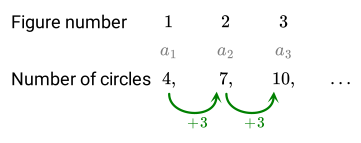
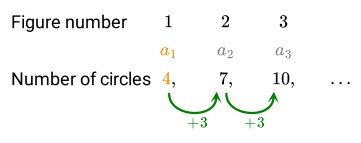
Now that sequences have been introduced and understood, the pattern presented at the beginning of the lesson can be modeled using a sequence. Then, the number of circles for Figure 20 can be calculated. Interact with the applet once more, predicting the next figure. 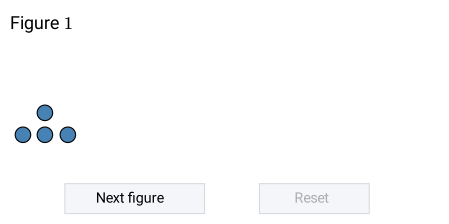 How many circles will Figure 20 have?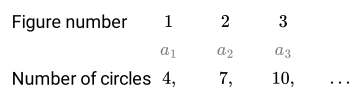
{"type":"text","form":{"type":"math","options":{"comparison":"1","nofractofloat":false,"keypad":{"simple":true,"useShortLog":false,"variables":["x"],"constants":["PI"]},"rendered":false},"text":"<span class=\"katex\"><span class=\"katex-html\" aria-hidden=\"true\"><\/span><\/span>"},"formTextBefore":null,"formTextAfter":"circles","answer":{"text":["61"]}}
Hint
The pattern shown can be modeled by an arithmetic sequence. Find the explicit rule of the sequence.
Solution
The pattern in the applet can be modeled using a sequence where the values of theterms are the number of circles and the positions of the terms are the figure numbers.
Since the number of circles used increases by a constant amount, this sequence is arithmetic.
To find the number of circles appearing in Figure 20, find the explicit rule for this arithmetic sequence. The explicit rule of an arithmetic sequence has the following general form.
an=a1+(n−1)d
In this equation, a1 is the first term of the sequence and d is the common difference. Both can be identified from the previous diagram.
The initial term a1=4 and d=3. These values can be substituted in the general explicit rule form.
an=a1+(n−1)d⇓an=4+(n−1)3
Finally, to find the number of circles in Figure 20, the explicit rule will be evaluated at n=20.
an=4+(n−1)3
▼
Substitute n for 20 and evaluate
Substitute
n=20
a20=4+(20−1)3
SubTerm
Subtract term
a20=4+(19)3
Multiply
Multiply
a20=4+57
AddTerms
Add terms
a20=61
Figure 20 will have 61 circles.
Loading content