{{ tocSubheader }}
{{ 'ml-label-loading-course' | message }}
An error ocurred, try again later!
Chapter {{ article.chapter.number }}
{{ article.number }}.
{{ article.displayTitle }}
{{ article.intro.summary }}
Show less Show more expand_more Lesson Settings & Tools
| | {{ 'ml-lesson-number-slides' | message : article.intro.bblockCount }} |
| | {{ 'ml-lesson-number-exercises' | message : article.intro.exerciseCount }} |
| | {{ 'ml-lesson-time-estimation' | message }} |
Expanding binomials can be difficult if the exponent is large. Considering that there is a formula for the square of a binomial, it might be possible to find similar expressions for greater exponents. This lesson aims to show an array of numbers that can be used to expand binomials.
Catch-Up and Review
Here are a few recommended readings before getting started with this lesson.
Explore
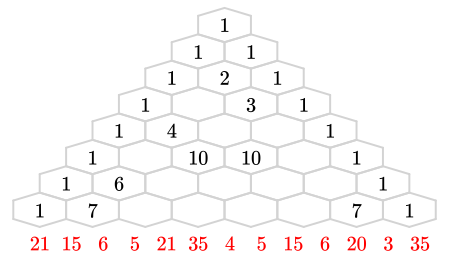
Recognizing Patterns
Example
Difference of Squares
Two good friends, Diego and Maya, like to challenge each other on math related topics. One summer afternoon, Diego came up with an interesting problem.
Answer
See solution.
Hint
Let n be an arbitrary integer. Find the difference of the squares of n and its consecutive integer.
Remember that the division of an even number by two always result on an integer.
Solution
To prove that the difference of the squares of any two consecutive integers is odd, let n be an integer number. The second of the consecutive integers is obtained by adding 1 to n. Therefore, the consecutive integer to n is n+1. Each number will be squared.
To determine whether this difference is an odd number, the expression 2n+1 can be divided by 2. If the result is not an integer, the difference is odd.
Since n is an integer number and 21 is not, the number n+21 is not an integer. This means that the number 2n+1 is odd for any integer n. Therefore, the difference of the squares of any two consecutive integers odd.
Numbersn and n+1Squares of the Numbersn2 and (n+1)2
Next, the difference of the squared numbers can be calculated. For simplicity the smaller integer is subtracted from the larger, but it should be noted that either way works.
(n+1)2−n2
▼
Simplify
ExpandPosPerfectSquare
(a+b)2=a2+2ab+b2
n2+2n(1)+12−n2
IdPropMult
Identity Property of Multiplication
n2+2n+12−n2
BaseOne
1a=1
n2+2n+1−n2
SubTerm
Subtract term
2n+1
22n+1
▼
Simplify
WriteSumFrac
Write as a sum of fractions
22n+21
MovePartNumRight
ca⋅b=ca⋅b
22n+21
QuotOne
aa=1
1n+21
IdPropMult
Identity Property of Multiplication
n+21
Example
Difference of Cubes
After solving Diego's challenge, Maya now creates one for Diego. She asks him to prove that the difference of the cubes of any two consecutive integers is also an odd number.

Answer
See solution.
Hint
To prove this statement, consider an even number 2n, where n is any integer. Its consecutive number is 2n+1 and its previous number is 2n−1. Consider the difference of the cubes of 2n+1 and n, and the difference of n and 2n−1.
Solution
Any even number can be written as 2n, where n is an integer. Consider the cube of this number.
There are two possible situations. The consecutive numbers can be 2n and 2n+1, or 2n−1 and 2n. These two situations will be considered one at a time.
This expression will be examined closely to determine if it is an integer or not. Each term will be examined individually, gradually building the expression of 212n2−6n+1.
Just like in the previous case, the expression that represents the difference will be divided by 2 to determine if the result is even.
Similar to the previous case, 6n2+3n is an integer. Because of the 21, the sum 6n2+3n+21 is not an integer. Therefore, the difference of the cubes is odd. Now that the two cases are considered, the statement has been proved.
(2n)3=8n3
Now, when considering two consecutive integers, one is even and the other is odd. The odd number can be before or after 2n. These cases can be expressed by subtracting 1 from or adding 1 to 2n, respectively. Number Before n: Number After n: 2n−12n+1
Recall the formula for the cube of a binomial.
(a±b)3=a3±3a2b+3ab2±b3
By using this formula, the cubes of 2n−1 and 2n+1 can be found. These formulas are obtained by substituting 2n for a and 1 for b.
(a±b)3=a3±3a2b+3ab2±b3
SubstituteII
a=2n, b=1
(2n±1)3=(2n)3±3(2n)2(1)+3(2n)(1)2±(1)3
(2n±1)3=8n3±12n2+6n±1
2n and 2n−1
If the consecutive integers are 2n and 2n−1, then their cubes are 8n3 and 8n3−12n2+6n−1, respectively. Next, find their difference. For the result to be positive, the cube of 2n−1 is subtracted from the cube of 2n. Now, divide this expression by 2. An even number is always divisible by two. Therefore, if dividing the above expression by 2 results in an integer, the expression represents an even number.212n2−6n+1
▼
Simplify
WriteSumFrac
Write as a sum of fractions
212n2−26n+21
MovePartNumRight
ca⋅b=ca⋅b
212n2−26n+21
CalcQuot
Calculate quotient
6n2−3n+21
| Expression | Is it an Integer? | Reason |
|---|---|---|
| n | Yes | It is defined this way. |
| n2 | Yes | Closure Property of Multiplication |
| 6n2 | Yes | Closure Property of Multiplication |
| 3n | Yes | Closure Property of Multiplication |
| 6n2−3n | Yes | Closure Property of Subtraction |
| 6n2−3n+21 | No | 21 is not an integer |
Since dividing 12n2−6n+1 by 2 did not result in an integer number, the expression 12n2−6n+1, which is the difference of the cubes of 2n and 2n−1, is odd.
2n+1 and 2n
If the consecutive integers are 2n+1 and 2n, then their cubes are 8n3+12n2+6n+1 and 8n3, respectively. Their difference can be calculated.(8n3+12n2+6n+1)−8n3
12n2+6n+1
212n2+6n+1
▼
Simplify
WriteSumFrac
Write as a sum of fractions
212n2+26n+21
MovePartNumRight
ca⋅b=ca⋅b
212n2+26n+21
CalcQuot
Calculate quotient
6n2+3n+21
Example
Square of the Sum of Two Consecutive Integers
Diego, engulfed by Maya's last challenge, asks if she could create another one for him. This time, Maya asks Diego to prove that the square of the sum of two consecutive integers is odd.

Answer
See solution.
Hint
Let n and n+1 be two consecutive integers. Find their sum, calculate its square, and prove that the obtained result is odd.
Remember that the division of an even number by two always result on an integer.
Solution
Let n and n+1 be two consecutive integer numbers. To prove the given statement, the numbers first must be added.
An even number is always divisible by 2. This means that, if dividing the above expression by 2 results in an integer, the expression represents an even number. Otherwise, it represents an odd number.
Since n is an integer, the expression 2n2+2n also represents an integer. Adding a non-integer to an integer results in a non-integer. Therefore, the expression 2n2+2n+21 is not an integer. This means that 4n2+4n+1 is an odd number, proving the statement.
n+(n+1)=2n+1
The sum resulted in a binomial. Then, the square of the sum is the square of a binomial.
(2n+1)2
ExpandPosPerfectSquare
(a+b)2=a2+2ab+b2
(2n)2+2(2n)(1)+12
ProdPowII
ambm=(ab)m
4n2+2(2n)(1)+12
BaseOne
1a=1
4n2+2(2n)(1)+1
Multiply
Multiply
4n2+4n+1
24n2+4n+1
WriteSumFrac
Write as a sum of fractions
24n2+24n+21
MovePartNumRight
ca⋅b=ca⋅b
24n2+24n+21
CalcQuot
Calculate quotient
2n2+2n+21
Discussion
Pascal's Triangle and the Binomial Theorem
The Pascal's triangle is a triangular representation of the coefficients in the expansion of a binomial expression. In other words, it contains the coefficients that result when expanding the expression (a+b)n, with n=0,1,2,…
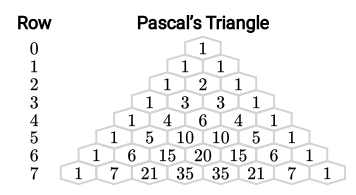
The rows are numbered from top to bottom starting with 0. The number in each cell equals the sum of the numbers in the two neighboring cells above.
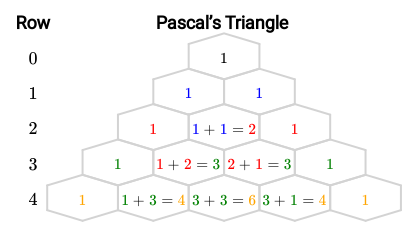
The numbers in the Pascal's Triangle have an interesting application. Consider the following binomial expansions.
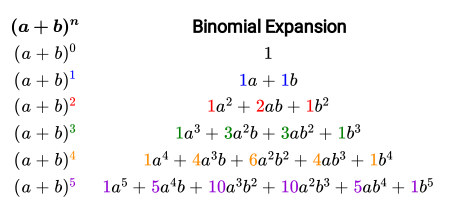
Looking at the coefficients of the binomial expansions, it can be noted that every number of a row in the Pascal's Triangle is the same as the coefficients of a binomial expansion.
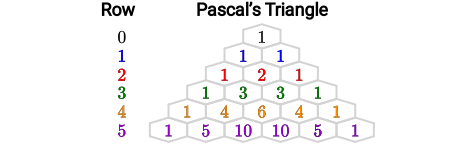
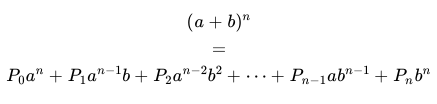
This is expressed in the Binomial Theorem.
Binomial Theorem
Consider a binomial raised to the power of n, where n is a positive integer. Let a and b be real numbers. Expanding the binomial (a+b)n results in the following expression.
Example
The Volume of a Room
Maya, feeling like she challenged Diego well, remembers that her mom asked her to measure her room for new wallpaper. She has to take a phone call, so she asks Diego if he can take the measurements. The room is in the shape of a cube. Diego hands over the measurements to her — he wrote them as a challenge!

{"type":"text","form":{"type":"math","options":{"comparison":"1","nofractofloat":false,"keypad":{"simple":false,"useShortLog":false,"variables":["x"],"constants":[]},"rendered":false},"text":"<span class=\"katex\"><span class=\"katex-html\" aria-hidden=\"true\"><\/span><\/span>"},"formTextBefore":"<span class=\"katex\"><span class=\"katex-html\" aria-hidden=\"true\"><span class=\"base\"><span class=\"strut\" style=\"height:0.68333em;vertical-align:0em;\"><\/span><span class=\"mord mathdefault\" style=\"margin-right:0.22222em;\">V<\/span><span class=\"mspace\" style=\"margin-right:0.2777777777777778em;\"><\/span><span class=\"mrel\">=<\/span><\/span><\/span><\/span>","formTextAfter":null,"answer":{"text":["x^6-18x^5+135x^4-540x^3+1215x^2-1458x+729"]}}
Hint
Use the Binomial Theorem to expand the binomial.
Solution
The room has the shape of a room with side length (x−3)2. To find its volume, it is necessary to use the formula for the volume of a cube.
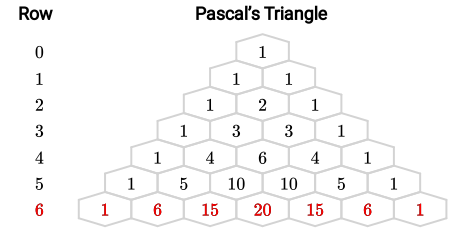 Each number in the sixth row corresponds to a coefficient of the binomial expansion, considering that the result is written in standard form.
V=s3
In this formula, V is the volume of the cube and s its side length. Substituting (x−3)2 for s gives the formula for the volume of the room.
Instead of multiplying the binomial by itself 6 times, the Binomial Theorem can be used to expand the binomial. This theorem indicates that the coefficients of a binomial to the sixth power coincide with the numbers in the sixth row of Pascal's Triangle. V=1x6+6x5(-3)+15x4(-3)2+20x3(-3)3+15x2(-3)4+6x(-3)5+1(-3)6
▼
Simplify right-hand side
IdPropMult
Identity Property of Multiplication
V=x6+6x5(-3)+15x4(-3)2+20x3(-3)3+15x2(-3)4+6x(-3)5+(-3)6
CalcPow
Calculate power
V=x6+6x5(-3)+15x4(9)+20x3(-27)+15x2(81)+6x(-243)+(729)
Multiply
Multiply
V=x6−18x5+135x4−540x3+1215x2−1458x+729
Example
Finding a Certain Coefficient
It's Diego's birthday, and without fail, Maya has gotten him a cool present. Diego is so excited to open it, but there is a problem. The gift has a lock that asks for a combination that he does not have!

{"type":"text","form":{"type":"math","options":{"comparison":"1","nofractofloat":false,"keypad":{"simple":false,"useShortLog":false,"variables":["f","w"],"constants":[]},"rendered":false},"text":"<span class=\"katex\"><span class=\"katex-html\" aria-hidden=\"true\"><\/span><\/span>"},"formTextBefore":null,"formTextAfter":null,"answer":{"text":["126f^5w^4"]}}
Hint
Consider the Binomial Theorem.
Solution
The Binomial Theorem indicates that the coefficients in the expansion of (f+w)9 coincide with the numbers in the ninth row of Pascal's Triangle.
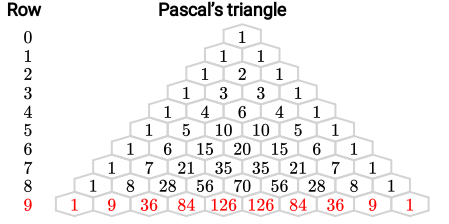
The fifth term in the expansion of the binomial raised to the ninth power matches the fifth number in the ninth row of Pascal's Triangle.
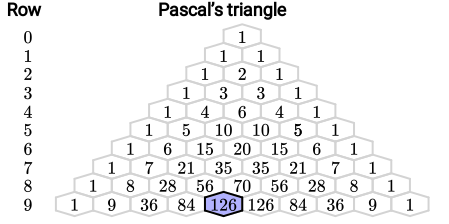
The terms of the polynomial are counted starting from the term f9w0, this being the first one. The variables for each consecutive term are obtained by subtracting one from the exponent of f9 and adding one to the exponent of w. The coefficients are the same as the numbers in the ninth row of Pascal's Triangle.
| nth term | |||
|---|---|---|---|
| Number of Term | Coefficient | Variables | Value of Term |
| 1 | 1 | f9w0 | f9 |
| 2 | 9 | f8w1 | 9f8w |
| 3 | 36 | f7w2 | 36f7w2 |
| 4 | 84 | f6w3 | 84f6w3 |
| 5 | 126 | f5w4 | 126f5w4 |
| 6 | 126 | f4w5 | 126f4w5 |
| 7 | 84 | f3w6 | 84f3w6 |
| 8 | 36 | f2w7 | 36f2w7 |
| 9 | 9 | f1w8 | 9fw8 |
| 10 | 1 | f0w9 | w9 |
Therefore, the fifth term is 126f5w4.
Closure
Using the Binomial Theorem to Solve a Problem
To finish this lesson, a more complex exercise will be solved using the Binomial Theorem. Consider the following expression.
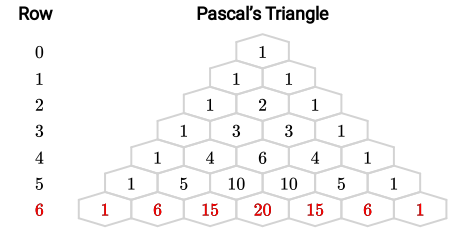
It is given that the coefficients of the x5- and the x3-terms are the same. Therefore, 2916a must be equal to 4320a3. This can be written as an equation which can be solved for a.
Therefore, the possible values for a are 20330 and -20330.
(2a+3x)6
It is known that the coefficient in the x3-term in the expansion of the above expression is the same as the coefficient in the x5-term. Find the possible values of a. Write the exact answer in its simplest form, with no radicals in denominators. {"type":"text","form":{"type":"roots","options":{"comparison":"1","nofractofloat":false,"keypad":{"simple":false,"useShortLog":false,"variables":[],"constants":[]},"rendered":false,"hideNoSolution":false,"variable":"a"},"text":"<span class=\"katex\"><span class=\"katex-html\" aria-hidden=\"true\"><\/span><\/span>"},"formTextBefore":null,"formTextAfter":null,"answer":{"texts":["\\dfrac{3\\sqrt{30}}{20}","-\\dfrac{3\\sqrt{30}}{20}"]}}
Hint
Use the Binomial Theorem to find the coefficients of every term.
Solution
The Binomial Theorem indicates that the coefficients in the expansion of (2a+3x)6 are the numbers in the sixth row of Pascal's Triangle.
Now the terms for x5 and x3 have to be identified. To identify these terms, every term of the binomial expansion is determined using the Binomial Theorem.
| Number of Term | Coefficient | Variables | Value of Term |
|---|---|---|---|
| 1 | 1 | (2a)6(3x)0 | 64a6 |
| 2 | 6 | (2a)5(3x)1 | 576a5x |
| 3 | 15 | (2a)4(3x)2 | 2160a4x2 |
| 4 | 20 | (2a)3(3x)3 | 4320a3x3 |
| 5 | 15 | (2a)2(3x)4 | 4860a2x4 |
| 6 | 6 | (2a)1(3x)5 | 2916ax5 |
| 7 | 1 | (2a)0(3x)6 | 729x6 |
2916a=4320a3
▼
Solve for a
DivEqn
LHS/108a=RHS/108a
108a2916a=108a4320a3
WriteProdFrac
Write as a product of fractions
1082916⋅aa=1084320⋅aa3
CalcQuot
Calculate quotient
27⋅aa=40⋅aa3
QuotOne
aa=1
27(1)=40⋅aa3
IdPropMult
Identity Property of Multiplication
27=40⋅aa3
aam=am−1
27=40a2
DivEqn
LHS/40=RHS/40
4027=a2
RearrangeEqn
Rearrange equation
a2=4027
SqrtEqn
LHS=RHS
a2=4027
a2=±a
a=±4027
▼
Simplify right-hand side
SplitIntoFactors
Split into factors
a=±4(10)9(3)
SqrtQuot
ba=ba
a=±4(10)9(3)
SqrtProd
a⋅b=a⋅b
a=±21033
ExpandFrac
ba=b⋅10a⋅10
a=±210⋅1033⋅10
ProdSqrt
a⋅b=a⋅b
a=±2100330
CalcRoot
Calculate root
a=±2(10)330
Multiply
Multiply
a=±20330
Loading content