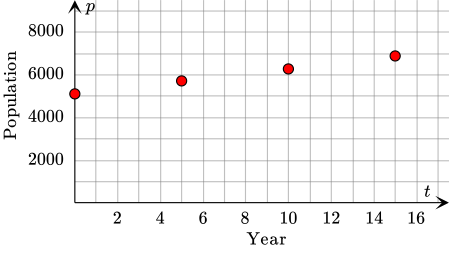
a Does the graph seem to curve or follow a straight edge?
B
b What is the change in population every 5 years?
C
c Recall that the slope-intercept form of a line is p=mt+b. Find the values of m and b.
D
d What t corresponds to the year 2050, if t=0 corresponds to the year 2020?
E
e Subtract the function representing the population of the smaller town from the function representing the population of the bigger town.
A
aGraph:
Model: Linear
B
b See solution.
C
c p=120t+5100
D
d 8700
E
e 70t+3800
Practice makes perfect
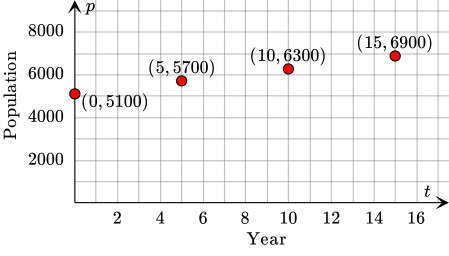
a A graph of the data can suggest a type of function to use. By looking at it we can eliminate possibilities and find the appropriate type of function quicker. Let's graph the given data!
The graph does not seem to curve. Therefore, it may be modeled by a linear function.
b Note that the numbers of the years have a common difference of 5. Now we will check the data for a constant first difference.
Year, t
Population, p
First Differences
0
5100
5
5700
+600 ↩
10
6300
+600 ↩
15
6900
+600 ↩
The first differences of the p-values are all 600, so a linear model fits the data. This supports our answer from Part A. In respect to time from one data point to another, a common difference of 600 means that the population increases by 600 every 5 years.
c From Part B we know that a linear function best models the given data.
p=mt+b
To write an equation to model the data we have to determine the slope m and the y-intercept b. Recall that the point (0,b) is where the graph of a linear function crosses the y-axis. Since the pair (0,5100) is included in the data set, b=5100.
p=mt+5100
In order to determine the value of m we will use the Slope Formula and the points ( 0,5100) and ( 5,5700).
We have that m=120. Let's finish writing the equation to model the data!
p=120t+5100
d To predict the town's population in 2050 using the function from Part C, we have to determine what value of t corresponds to the year 2050. Since t=0 corresponds to the year 2020, t=30 corresponds to the year 2050. Let's substitute t=30 into the equation from Part C!
e We are asked to find an expression that can be used to find the difference in population of the two towns. From Part C we know what function models the population of the first town.
p=120t+5100We are also given the function that represents the population of the second town.
s=50t+1300
In both cases t=0 corresponds to the year 2020. Let's subtract the function s representing the population of the smaller town from the function p representing the population of the bigger town.