What does it mean when the ratios of the y-values in the data set are almost equal?
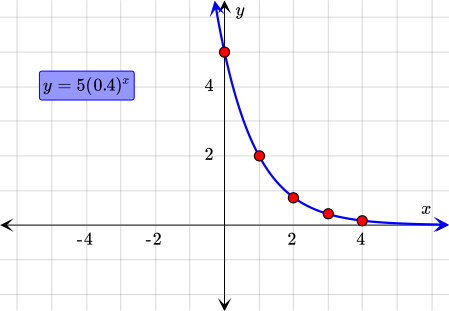
Model: Exponential Equation: y=5(0.4)^x
Practice makes perfect
We will start by determining the type of function that best models the data. Then we will be able to write an exact equation that models the data.
Finding a Model
We want to determine the most appropriate model for the given data set. Note that the x-values have a common difference of 1. Therefore, we can check if the y-values have a common difference, a common ratio, or constant second differences. It will tell us which model is most appropriate for the data set.
Sometimes data does not fall exactly into the models listed above. In this case we have to round our results and see when they are the closest to being constant. First let's check our data set for a common first difference!
x
y
First differences
0
5
1
2
-3 ↩
2
0.79
-1.21 ↩
3
0.32
-0.47 ↩
4
0.128
-0.192 ↩
As we can see, the differences between the consecutive y-values are far from being constant. Therefore, we will check for a common ratio next.
x
y
Ratio
0
5
1
2
2/5=0.4
2
0.79
0.79/2=0.395
3
0.32
0.32/0.79=0.405...
4
0.128
0.128/0.32=0.4
The ratios between the consecutive y-values are all approximately 0.4, so an exponential model fits the data.
Writing an Equation
We know that an exponential function best models the given data.
y=a* b^x
To write an equation to model the data, we have to determine the values of a and b. Recall that (0,a) is the y-intercept of the exponential function. Since the pair (0,5) is included in the data set, a=5.
y=5* b^x
In order to determine the value of b we will use one (x,y) pair from the data set, other than (0,5), to write an equation. Let's use ( 1, 2).
We have that b= 0.4. Note that the value of b is equal to the approximation of the common ratio! We could have used that information instead of solving the equation. Let's finish writing the equation to model the data!
y=5* 0.4^x ⇔ y=5(0.4)^x
Below we have included a graph that shows how the equation models the given data.