1. Multiplying and Dividing Rational Expressions
Sign In
An error ocurred, try again later!
Chapter 4
1.
Multiplying and Dividing Rational Expressions
This lesson delves into the realm of rational expressions, specifically focusing on their multiplication and division. Rational expressions, essentially fractions where both the numerator and denominator are polynomials, have specific rules for operations. When multiplying, it's akin to multiplying fractions: numerators with numerators and denominators with denominators. Before performing these operations, it's beneficial to factor the expressions to simplify the process. Dividing rational expressions, on the other hand, involves multiplying by the reciprocal of the divisor. The lesson emphasizes the importance of understanding restrictions, as certain values can render a rational expression undefined. Through examples and detailed explanations, learners are equipped with the knowledge to handle these algebraic expressions effectively.
Show less Show more expand_more 


Lesson Settings & Tools
| | 12 Theory slides |
| | 10 Exercises - Grade E - A |
| | Each lesson is meant to take 1-2 classroom sessions |
Multiplying and Dividing Rational Expressions
Slide of 12
As with rational numbers, it is possible to write two polynomial expressions as a ratio, so long as the divisor is not zero. This lesson will explore various aspects of this type of algebraic expression, including how mathematical operations such as multiplication and division can be applied to it.
Catch-Up and Review
Here are a few recommended readings before getting started with this lesson.
Challenge
Share
Report error
Combined Fuel Efficiency
The distance that a vehicle can travel per one gallon of fuel is measured as its mile per gallon (mpg) fuel economy. Each car has two fuel economy numbers, one measuring its efficiency for city driving and the other for highway driving. The combined fuel economy C for x mpg in the city and y mpg on the highway is computed by the following formula. C = 1/12( 1x + 1y )
a If a car travels 28 miles per gallon in the city and 36 mpg on the highway, what is the combined fuel economy for the car?
{"type":"text","form":{"type":"math","options":{"comparison":"1","nofractofloat":false,"keypad":{"simple":true,"useShortLog":false,"variables":[],"constants":[]},"rendered":false},"text":" "},"formTextBefore":null,"formTextAfter":"mpg","answer":{"text":["31.5","\\dfrac{504}{16}","\\dfrac{63}{2}"]}}
b Let x be the city fuel economy for a new car model. If the highway fuel economy in terms of x is 10xx-20, write a simplified expression for the combined fuel economy for such a car.
{"type":"text","form":{"type":"math","options":{"comparison":"1","nofractofloat":false,"keypad":{"simple":false,"useShortLog":false,"variables":["x"],"constants":[]},"rendered":false},"text":" "},"formTextBefore":"C=","formTextAfter":null,"answer":{"text":["\\dfrac{20x}{x-10}"]}}
Discussion
Share
Report error
Rational Expression
A rational expression is a fraction where both the numerator and the denominator are polynomials.
p(x)/q(x)
Here, p(x) and q(x) are polynomials and q(x)≠ 0. The expression below is an example of a rational expression. x^2-7/x^3+5x A rational expression is said to be written in its simplest form if the numerator and denominator have no common factors.
| Rational Expressions | |
|---|---|
| Not in Simplest Form | In Simplest Form |
| xy/x(x-3)(y+2) | x-1/x+1 |
| x^4+x^2/x^2+1 | x^3+7/x^2-x-6 |
Notice that for some of the expressions shown in the table, there are some x-values that make the denominator 0. For example, the denominator of x-1x+1 is 0 when x=- 1. Any value of a variable for which a rational expression is undefined is called an excluded value.
| Expression | Restriction | Excluded Value(s) |
|---|---|---|
| x-1/x+1 | x+1≠ 0 | x ≠ - 1 |
| x^3+7/x^2-x-6 | x^2-x-6≠ 0 | x≠ - 2 and x≠ 3 |
| xy/x(x-3)(y+2) | x(x-3)(y+2)≠ 0 | x≠0, x ≠ 3, and y ≠ - 2 |
| x^4+x^2/x^2+1 | There is no real number that makes x^2+1 zero | None |
Simplifying a rational expression can remove some of the excluded values that appear in the original expression. A rational expression and its simplified form must have the same domain in order for them to be equivalent expressions. This means that the excluded values that are no longer visible in the simplified expression must still be declared.
| Equivalent Expressions | |
|---|---|
| Rational Expression | Simplified Form |
| x-3/(x+2)(x-3), x≠ - 2, 3 | 1/x+2,x≠ - 2, 3 |
| x^2+2x+1/x^2-1, x≠ - 1, 1 | x+1/x-1,x≠ - 1,1 |
| x^3-2x^2+x/x^2,x≠ 0 | x^2-2x+1/x, x≠ 0 |
Pop Quiz
Share
Report error
Determining Values That Make a Rational Expression Undefined
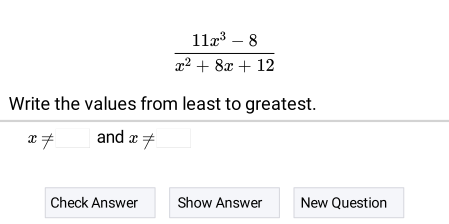
A rational expression is undefined when its denominator is 0. The values that make the denominator of a rational expression equal to 0 are called excluded values because they are excluded from its domain. Determine the excluded values for the indicated rational expressions.
Discussion
Share
Report error
Simplifying Rational Expressions
A rational expression is written in simplest form if the numerator and denominator have no factors in common. Rational expressions that are not in simplest form can be simplified by canceling out the common factors. There are many various methods of factoring polynomials to find any common factors. Consider an example expression.
x^2 - 6x + 9/9x - x^3
Rational expressions can be simplified in three steps.
1
Factor the Numerator and the Denominator
expand_more Check first if either the numerator or the denominator — or both — can be factored by the greatest common factor. In this example, the factor x is in both terms of the denominator.
Determine if it is possible to factor either the numerator or the denominator by using a difference of squares. Look for an expression in the form a^2 - b^2, which can be factored as (a + b)(a - b). In the example, (9 - x)^2 can be factored using this rule.
See if either the numerator or the denominator is a perfect square trinomial. Look for an expression in the form a^2 ± 2ab + b^2, which can be factored as (a ± b)^2. Here, the numerator is a perfect square trinomial.
In some cases, a negative sign can be factored out for one expression to have the same form as another factor. Here, the factor 3 - x in the denominator is almost identical to the factor x - 3 in the numerator.
Now both the numerator and denominator are completely factored.
x^2 - 6x + 9/9x - x^3
SplitIntoFactors
Split into factors
x^2 - 6x + 9/x * 9 - x* x^2
FactorOut
Factor out x
x^2 - 6x + 9/x (9 - x^2 )
x^2 - 6x + 9/x(9 - x^2 )
WritePow
Write as a power
x^2 - 6x + 9/x (3^2 - x^2 )
FacDiffSquares
a^2-b^2=(a+b)(a-b)
x^2 - 6x + 9/x (3 + x)(3 - x)
x^2 - 6x + 9/x (3 + x)(3 - x)
SplitIntoFactors
Split into factors
x^2 - 2x(3) + 9/x (3 + x)(3 - x)
WritePow
Write as a power
x^2 - 2* x * 3 + 3^2/x (3 + x)(3 - x)
FacNegPerfectSquare
a^2-2ab+b^2=(a-b)^2
(x - 3)^2/x (3 + x)(3 - x)
(x - 3)^2/x (3 + x)(3 - x)
CommutativePropMult
Commutative Property of Multiplication
(x - 3)^2/(3 - x)x(3 + x)
FactorOutNegSignSwap
a-b=-(b-a)
(x - 3)^2/- (x - 3)x(3 + x)
2
List Restricted Values
expand_more Before simplifying the common factors, check if there are any restrictions on x. (x - 3)^2/- (x - 3)x(3 + x) Note that the expression is undefined when x=- 3, x=0, or x=3.
3
Cancel Out Common Factors
expand_more In this expression, (x-3) is the common factor of the numerator and the denominator and can be eliminated.
The rational expression is now written in its simplest form. In order for the given expression and the simplified expression to be equivalent, the domain of the simplified expression should be restricted by excluding x=3.
x - 3/- x (3 + x), x ≠ 3
Since the restriction x≠ 3 cannot be seen from the simplified expression, it should be written. The other restrictions are evident from the simplified expression.
Example
Share
Report error
Finding the Domain of Rational Expressions
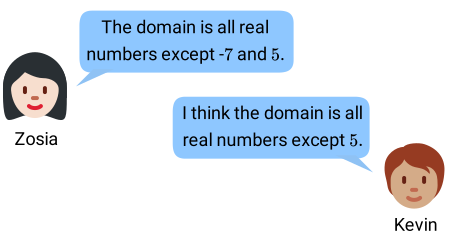
Kevin and Zosia are asked to find the values that make the following rational expression undefined. x^2+12x+35/x^2+2x-35 They disagree about the domain of the rational expression.
{"type":"choice","form":{"alts":["Kevin","Zosia"],"noSort":false},"formTextBefore":"","formTextAfter":"","answer":1}
Hint
A rational expression is undefined for values that make its denominator zero. Therefore, those values should be excluded from the domain.
Solution
A rational expression is undefined when the denominator equals 0. x^2+12x+35/x^2+2x-35
To find the domain of the rational expression, the expression in the denominator is set equal to 0.
x^2+2x-35=0
To solve the resulting equation for x, start by factoring the expression on the left-hand side.
Now the Zero Product Property will be applied to find all excluded values.
The values x=- 7 and x=5 make the denominator equal to 0. As a result, they make the rational expression undefined. Therefore, Zosia is correct in saying that the domain is all real numbers except - 7 and 5. Kevin may have simplified the expression before identifying the excluded values. This is a common mistake!
Note that x=5 is the value that makes the denominator of the simplified expression equal to 0. However, Kevin should have noted that - 7 makes the original expression undefined. Since the original and simplified expressions are equivalent, both should have the same domain.
x^2+2x-35=0
(x+7)(x-5)=0
(x+7)(x-5)=0
▼
Solve using the Zero Product Property
ZeroProdProp
Use the Zero Product Property
lcx+7=0 & (I) x-5=0 & (II)
SubEqn
(I): LHS-7=RHS-7
lx=-7 x-5=0
AddEqn
(II): LHS+5=RHS+5
lx=-7 x=5
x^2+12x+35/(x+7)(x-5)
(x+7)(x+5)/(x+7)(x-5)
▼
Simplify
(x+5)/(x-5)
Discussion
Share
Report error
Multiplying and Dividing Rational Expressions
Operations with rational numbers and rational expressions are similar.
Multiplying Rational Expressions
Multiplying rational expressions works the same way as multiplying fractions. The numerators and denominators are multiplied separately.
P(x)/Q(x) * H(x)/G(x)=P(x)* H(x)/Q(x)* G(x)
1
Factor Each Numerator and Denominator
expand_more Before multiplying, it is helpful to factor the numerators and denominators, if possible. Start with the first rational expression.
Now the numerator and denominator of the second expression will be factored.
x^2+9x+18/x^2-11+30
(x+3)(x+6)/x^2-11x+30
(x+3)(x+6)/(x-5)(x-6)
2
Multiply the Numerators and Multiply the Denominators
expand_more Now that both expressions have been factored, the numerators and denominators can be multiplied.
The product is undefined when x=- 6, x=5, and when x=6.
(x+3)(x-5)/7(x+6) * (x+3)(x+6)/(x-5)(x-6)
MultFrac
Multiply fractions
(x+3)(x-5)(x+3)(x+6)/7(x+6)(x-5)(x-6)
4
Cancel Out Common Factors
expand_more Note that (x−5) and (x+6) are common factors of the numerator and denominator. Finally, the product is simplified by canceling out common factors.
Considering the denominator of the simplified expression and any other denominator used, the values x=- 6, x=5, and x=6 must be excluded from the domain of the simplified expression. In this expression it is clear that x=6 makes the denominator 0. Therefore, the fact that x≠ 6 will not be expressed.
(x+3)^2/7(x-6), x ≠ - 6, x ≠ 5
(x+3)(x-5)(x+3)(x+6)/7(x+6)(x-5)(x-6)
CancelCommonFac
Cancel out common factors
(x+3)(x-5) (x+3) (x+6)/7(x+6)(x-5)(x-6)
SimpQuot
Simplify quotient
(x+3)(x+3)/7(x-6)
ProdToPowTwoFac
a* a=a^2
(x+3)^2/7(x-6)
Dividing Rational Expressions
Dividing two rational expressions is the same as multiplying the first expression by the reciprocal of the second expression.
P(x)/Q(x) ÷ H(x)/G(x) = P(x)/Q(x) * G(x)/H(x)
1
Rewrite the Division as the Product of the Dividend and the Reciprocal of the Divisor
expand_more To divide a rational expression by another rational expression, multiply the first expression by the reciprocal of the second. 5-x/x^2+3x ÷ x^2-25/x^2+10x+21 [0.5em] ⇕ [0.6em] 5-x/x^2+3x * x^2+10x+21/x^2-25 Once the quotient is expressed as a product, the remaining steps are the same as those for multiplying rational expressions.
2
Factor Each Numerator and Denominator
expand_more Factor the numerators and the denominators, if possible. The first expression will be factored first.
Now the numerator and the denominator of the second expression will be factored.
x^2+10x+21/x^2-25
(x+3)(x+7)/x^2-25
▼
Factor the denominator
(x+3)(x+7)/(x+5)(x-5)
3
Multiply the Numerators and Multiply the Denominators
expand_more Next, the numerators and denominators can be multiplied. 5-x/x(x+3) * (x+3)(x+7)/(x+5)(x-5) [0.5em] ⇕ [0.6em] (5-x)(x+3)(x+7)/x(x+3)(x+5)(x-5) This product is undefined when x= - 5, x=- 3, x=0, and x=5. Also, the values that make the divisor's denominator in the original quotient expression equal 0 should be excluded. These values are x=- 7 and x=- 3. Excluded Values - 7, - 5, - 3, 0, 5
4
Cancel Out Common Factors
expand_more Finally, the product is simplified by canceling out common factors.
Considering the denominator of the simplified expression and any other denominator used in this process, the values x=- 7, x=- 5, x=- 3, x=0, and x=5 must be excluded from the domain of the expression. The simplified expression shows that x=0 and x=- 5 must be excluded, so these values are not mentioned.
- x-7/x(x+5), x ≠ - 7, x ≠ - 3, x ≠ 5
(5-x)(x+3)(x+7)/x(x+3)(x+5)(x-5)
FactorOut
Factor out - 1
- 1(x-5)(x+3)(x+7)/x(x+3)(x+5)(x-5)
CancelCommonFac
Cancel out common factors
- 1 (x-5) (x+3)(x+7)/x(x+3)(x+5)(x-5)
SimpQuot
Simplify quotient
- 1(x+7)/x(x+5)
Distr
Distribute - 1
- x-7/x(x+5)
Example
Share
Report error
Representing Areas with Rational Expressions
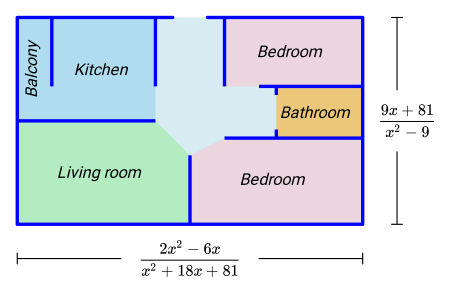
Ramsha drew the plan of her house and labeled the sides, measured in meters, as shown.
a Write a simplified rational expression for the area of the house.
{"type":"text","form":{"type":"math","options":{"comparison":"1","nofractofloat":false,"keypad":{"simple":false,"useShortLog":false,"variables":["x"],"constants":[]},"rendered":false},"text":" "},"formTextBefore":null,"formTextAfter":"m^2","answer":{"text":["\\dfrac{18x}{(x+9)(x+3)}","\\dfrac{18x}{x^2+12x+27}"]}}
b State any restrictions on x.
{"type":"text","form":{"type":"list","options":{"comparison":"1","nofractofloat":false,"keypad":{"simple":true,"useShortLog":false,"variables":[],"constants":[]},"rendered":false,"ordermatters":false,"numinput":3,"listEditable":true,"hideNoSolution":true},"text":" "},"formTextBefore":"x≠","formTextAfter":null,"answer":{"text":["-9","-3","3"]}}
Hint
a Start by factoring the numerator and the denominator of each rational expression.
b The denominator of a rational expression cannot be zero.
Solution
a Start by considering the formula for the area of a rectangle.
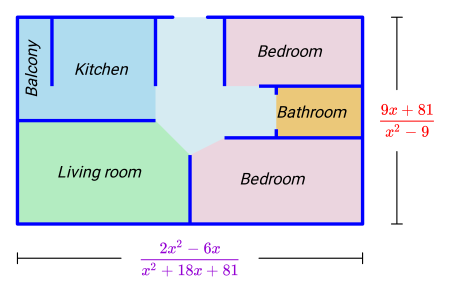
A= l w According to the diagram, the length l of the house is represented by 2x^2-6xx^2+18x+81 and the width w by 9x+81x^2-9.
A=l w
SubstituteII
l= 2x^2-6x/x^2+18x+81, w= 9x+81/x^2-9
A= 2x^2-6x/x^2+18x+81* 9x+81/x^2-9
▼
Factor the first expression
FactorOut
Factor out 2x
A=2x(x-3)/x^2+18x+81* 9x+81/x^2-9
SplitIntoFactors
Split into factors
A=2x(x-3)/x^2+2(9)x+81* 9x+81/x^2-9
CommutativePropMult
Commutative Property of Multiplication
A=2x(x-3)/x^2+2x(9)+81* 9x+81/x^2-9
WritePow
Write as a power
A=2x(x-3)/x^2+2x(9)+9^2* 9x+81/x^2-9
FacPosPerfectSquare
a^2+2ab+b^2=(a+b)^2
A=2x(x-3)/(x+9)^2* 9x+81/x^2-9
▼
Factor second expression
FactorOut
Factor out 9
A=2x(x-3)/(x+9)^2* 9(x+9)/x^2-9
WritePow
Write as a power
A=2x(x-3)/(x+9)^2* 9(x+9)/x^2-3^2
FacDiffSquares
a^2-b^2=(a+b)(a-b)
A=2x(x-3)/(x+9)^2* 9(x+9)/(x+3)(x-3)
2x(x-3)/(x+9)^2 * 9(x+9)/(x+3)(x-3)
▼
Simplify
MultFrac
Multiply fractions
2x(x-3)* 9(x+9)/(x+9)^2* (x+3)(x-3)
PowToProdTwoFac
a^2=a* a
2x(x-3)* 9(x+9)/(x+9)(x+9)* (x+3)(x-3)
CancelCommonFac
Cancel out common factors
2x(x-3) * 9(x+9)/(x+9)(x+9) * (x+3)(x-3)
SimpQuot
Simplify quotient
2x* 9/(x+9)* (x+3)
Multiply
Multiply
18x/(x+9)(x+3)
b To identify the restrictions, the denominator of the simplified expression and any other denominator used in this process will be analyzed. For simplicity, their factored forms will be used.
| Denominator | Restrictions on the Denominator | Restrictions on the Variable |
|---|---|---|
| (x+9)^2 | (x+9)^2≠ 0 | x≠ - 9 |
| (x+3)(x-3) | x+3≠ 0 and x-3≠ 0 | x≠ -3 and x≠ 3 |
| (x+9)(x+3) | x+9≠ 0 and x+3≠ 0 | x≠ -9 and x≠ -3 |
There are three unique restrictions on the variable x. x≠ - 9, x≠ - 3, x≠ 3
Example
Share
Report error
Determining the Type With the Best Efficiency Ratio
Companies aim to produce packaging using the lowest possible amount of material. They produce their packages in such a way that the ratio of the surface area S of a package to its volume V is as small as possible. Efficiency Ratio: S/V A company is designing two different types of packages. The table shows the expressions for their surface areas and volumes.
| Surface Area, S | Volume, V | |
|---|---|---|
| Type I | x^3-x^2/4x^4+12x^3 | x^2-2x+1/x^3+3x^2 |
| Type II | 2x^2-9x-18/4x^2-28x+24 | 2x^2+x-3 |
a Find the efficiency ratio of each type.
{"type":"text","form":{"type":"math","options":{"comparison":"1","nofractofloat":false,"keypad":{"simple":false,"useShortLog":false,"variables":["x"],"constants":[]},"rendered":false},"text":" "},"formTextBefore":"<b>Type I:<\/b>","formTextAfter":null,"answer":{"text":["\\dfrac{x}{4(x-1)}","\\dfrac{x}{4x-4}"]}}
{"type":"text","form":{"type":"math","options":{"comparison":"1","nofractofloat":false,"keypad":{"simple":false,"useShortLog":false,"variables":["x"],"constants":[]},"rendered":false},"text":" "},"formTextBefore":"<b>Type II:<\/b>","formTextAfter":null,"answer":{"text":["\\dfrac{1}{4(x-1)^2}","\\dfrac{1}{(2x-2)^2}","\\dfrac{1}{4x^2-8x+4}"]}}
b Which type is more efficient when x=2?
{"type":"choice","form":{"alts":["Type I","Type II","Both are equally efficient."],"noSort":true},"formTextBefore":"","formTextAfter":"","answer":1}
Hint
a Start by factoring each denominator and numerator, if possible. Recall that all denominators must be different than 0.
b Substitute the given value for x into each rational expression found in Part A. The smaller the ratio, the more efficient the packaging.
Solution
a To find the efficiency ratios, the ratio of the surface area to the volume will be found for each packaging type. First, the efficiency ratio of Type I will be calculated.
x^3-x^2/4x^4+12x^3
FactorOut
Factor out x^2
x^2(x-1)/4x^4+12x^3
FactorOut
Factor out 4x^3
x^2(x-1)/4x^3(x+3)
x^3+3x^2/x^2-2x+1
FactorOut
Factor out x^2
x^2(x+3)/x^2-2x+1
▼
Factor denominator
IdPropMult
Identity Property of Multiplication
x^2(x+3)/x^2-2x(1)+1
WritePow
Write as a power
x^2(x+3)/x^2-2x(1)+1^2
ExpandNegPerfectSquare
(a-b)^2=a^2-2ab+b^2
x^2(x+3)/(x-1)^2
x^2(x-1)/4x^3(x+3)* x^2(x+3)/(x-1)^2
MultFrac
Multiply fractions
x^2(x-1)x^2(x+3)/4x^3(x+3)(x-1)^2
▼
Simplify
Write power as a product
x^2(x-1)x * x(x+3)/4x^2 * x(x+3)(x-1)(x-1)
CancelCommonFac
Cancel out common factors
x^2 (x-1) x * x(x+3)/4x^2 * x(x+3) (x-1)(x-1)
SimpQuot
Simplify quotient
x/4 (x-1)
| Multiplying Rational Expressions | |
|---|---|
| Product | 2x^2-9x-18/4x^2-28x+24 * 1/2x^2+x-3 |
| Factor | (2x+3)(x-6)/4(x-1)(x-6) * 1/(2x+3)(x-1) |
| Multiply | (2x+3)(x-6)/4(x-1)(x-6)(2x+3)(x-1) |
| Cancel Out Common Factors | (2x+3)(x-6)/4(x-1)(x-6)(2x+3)(x-1) |
| Simplify | 1/4(x-1)^2 |
The efficiency ratio of Type II is 14(x-1)^2
b In Part A, the efficiency ratio of each type was found. Now, these ratios will be evaluated for x=2.
| Type I | Type II | |
|---|---|---|
| Efficiency Ratio | x/4(x-1) | 1/4(x-1)^2 |
| Substitute | 2/4( 2-1) | 1/4( 2-1)^2 |
| Evaluate | 1/2 | 1/4 |
Recall that the smaller the ratio, the more efficient the packaging. Therefore, Type II is more efficient because 14 < 12.
Discussion
Share
Report error
Complex Fractions
A complex fraction is a rational expression where the numerator, denominator, or both, contain a rational expression.
p(x)r(x)/q(x)m(x)
Here, p(x), r(x), q(x), and m(x) are polynomials. A complex fraction can be simplified by rewriting it as a quotient and then dividing the rational expressions. p(x)r(x)/q(x)m(x) ⇔ p(x)/r(x) ÷ q(x)/m(x) As an example of a complex fraction, consider the following division of rational expressions.
x^2-2x+4x^2-y^2/x-yx+y ⇔ x^2-2x+4/x^2-y^2 ÷ x-y/x+yExample
Share
Report error
Surface Area to Volume Ratio of Penguins
Animals adapt to their environment. As a result of adaptations, the surface area and volume of animals vary depending on where they live. For example, penguins have a lower surface area to volume ratio to conserve their body heat.

External credits: @macrovector
{"type":"text","form":{"type":"math","options":{"comparison":"1","nofractofloat":false,"keypad":{"simple":false,"useShortLog":false,"variables":["r","h"],"constants":[]},"rendered":false},"text":" "},"formTextBefore":null,"formTextAfter":null,"answer":{"text":["\\dfrac{2(r+h)}{rh}","\\dfrac{2r+2h}{rh}"]}}
Hint
Start by rewriting the complex fraction as a division expression and then divide the rational expressions.
Solution
The ratio of the surface area S of a penguin to its volume V needs to be simplified.
2π r^3 +2π r^2h3r-6/π r^4h-2π r^3 h3r^2-12r+12
This complex fraction can be rewritten as a division expression.
2π r^3 +2π r^2h/3r-6 ÷ π r^4h-2π r^3 h/3r^2-12r+12
Dividing two rational expressions is the same as multiplying the first expression by the reciprocal of the second expression.
2π r^3 +2π r^2h/3r-6 ÷ π r^4h-2π r^3 h/3r^2-12r+12 [0.6em] ⇕ [0.6em]
2π r^3 +2π r^2h/3r-6 * 3r^2-12r+12/π r^4h-2π r^3 h
Now the multiplication can be performed. To do so, begin by factoring the numerators and denominators of each expression, if possible. The first expression will be factored first.
Now the second rational expression will be factored.
Next, the numerators and denominators are multiplied and the common factors are eliminated.
2π r^3 +2π r^2h/3r-6
FactorOut
Factor out 2π r^2
2π r^2(r +h)/3r-6
FactorOut
Factor out 3
2π r^2(r +h)/3(r-2)
3r^2-12r+12/π r^4h-2π r^3 h
▼
Factor the numerator
FactorOut
Factor out 3
3(r^2-4r+4)/π r^4h-2π r^3 h
SplitIntoFactors
Split into factors
3(r^2-2(2)r+4)/π r^4h-2π r^3 h
CommutativePropMult
Commutative Property of Multiplication
3(r^2-2r(2)+4)/π r^4h-2π r^3 h
WritePow
Write as a power
3(r^2-2r(2)+2^2)/π r^4h-2π r^3 h
ExpandNegPerfectSquare
(a-b)^2=a^2-2ab+b^2
3(r-2)^2/π r^4h-2π r^3 h
FactorOut
Factor out π r^2h
3(r-2)^2/π r^3h(r-2)
2π r^2(r +h)/3(r-2)* 3(r-2)^2/π r^3h(r-2)
MultFrac
Multiply fractions
2π r^2(r +h)3(r-2)^2/3(r-2) π r^3h(r-2)
▼
Simplify
Write power as a product
2π r^2(r +h) 3(r-2) (r-2)/3(r-2) π r^2 r h(r-2)
CancelCommonFac
Cancel out common factors
2π r^2(r +h) 3(r-2) (r-2)/3(r-2) π r^2 r h(r-2)
SimpQuot
Simplify quotient
2(r+h)/rh
Closure
Share
Report error
Finding Combined Fuel Efficiency of a New Car Model
With the methods seen in the lesson, the challenge given at the beginning can finally be solved. Recall the combined fuel economy formula. C = 1/12 ( 1x+ 1y ) In the formula, x represents miles per gallon (mpg) in the city and y represents miles per gallon on the highway.
a If a car travels 28 mpg in the city and 36 mpg on the highway, what is the combined fuel economy for the car?
{"type":"text","form":{"type":"math","options":{"comparison":"1","nofractofloat":false,"keypad":{"simple":true,"useShortLog":false,"variables":[],"constants":[]},"rendered":false},"text":" "},"formTextBefore":null,"formTextAfter":"mpg","answer":{"text":["31.5","\\dfrac{504}{16}","\\dfrac{63}{2}"]}}
b Let x be the city fuel economy for a new car model. If the highway fuel economy, in terms of x, is 10xx-20, write a simplified expression for the combined fuel economy for such a car.
{"type":"text","form":{"type":"math","options":{"comparison":"1","nofractofloat":false,"keypad":{"simple":false,"useShortLog":false,"variables":["x"],"constants":[]},"rendered":false},"text":" "},"formTextBefore":"C=","formTextAfter":null,"answer":{"text":["\\dfrac{20x}{x-10}"]}}
Hint
a Substitute the given values and evaluate the formula.
b Substitute the given expression for y and simplify it. When 1 is divided by a rational expression, the result is the reciprocal of the the rational expression.
Solution
a A car travels at 28 mpg in the city and 36 mpg on the highway. The combined fuel economy can be found by substituting these values into the given formula.
C = 1/12 ( 1x+ 1y )
SubstituteII
x= 28, y= 36
C = 1/12 ( 1 28+ 1 36 )
▼
Simplify denominator
ExpandFrac
a/b=a * 9/b * 9
C = 1/12 ( 9252+ 136 )
ExpandFrac
a/b=a * 7/b * 7
C = 1/12 ( 9252 + 7252 )
AddFrac
Add fractions
C = 1/12 ( 16252 )
MultFrac
Multiply fractions
C = 1/16504
DivOneByFracD
1/a/b= b/a
C = 504/16
CalcQuot
Calculate quotient
C = 31.5
b In this case, the rational expression 10xx-20 will be substituted for y.
C = 1/12 ( 1x + 1 10xx-20 )
▼
Simplify denominator
DivOneByFracSL
.1 /a/b.=b/a
C = 1/12 ( 1x + x-2010x )
ExpandFrac
a/b=a * 10/b * 10
C = 1/12 ( 1010x + x-2010x )
AddFrac
Add fractions
C = 1/12 ( x-1010x )
MultFrac
Multiply fractions
C = 1/x-1020x
DivOneByFracSL
.1 /a/b.=b/a
C= 20x/x-10
Multiplying and Dividing Rational Expressions
Exercise 1.1
Simplify the rational expression.
{"type":"text","form":{"type":"math","options":{"comparison":"1","nofractofloat":false,"keypad":{"simple":false,"useShortLog":false,"variables":["x"],"constants":[]},"rendered":false},"text":" "},"formTextBefore":null,"formTextAfter":null,"answer":{"text":["\\dfrac{6x^2}{3x-4}"]}}
{"type":"text","form":{"type":"math","options":{"comparison":"1","nofractofloat":false,"keypad":{"simple":false,"useShortLog":false,"variables":["x"],"constants":[]},"rendered":false},"text":" "},"formTextBefore":null,"formTextAfter":null,"answer":{"text":["\\dfrac{9x-1}{3x}"]}}
security
report
code
security
report
code
We want to simplify the given rational expression. To do so, we will factor the numerator and denominator as much as possible. Then, we will cancel out any common factors. Let's do it!
We simplified the given expression.
Let's factor the numerator and denominator as much as possible. If they have any common factors, we will cancel them out.
We have simplified the expression.
security
report
code
Find the product of the rational expressions.
{"type":"text","form":{"type":"math","options":{"comparison":"1","nofractofloat":false,"keypad":{"simple":false,"useShortLog":false,"variables":["x","y"],"constants":[]},"rendered":false},"text":" "},"formTextBefore":null,"formTextAfter":null,"answer":{"text":["\\dfrac{9y^2}{5x^2}"]}}
{"type":"text","form":{"type":"math","options":{"comparison":"1","nofractofloat":false,"keypad":{"simple":false,"useShortLog":false,"variables":["x","y"],"constants":[]},"rendered":false},"text":" "},"formTextBefore":null,"formTextAfter":null,"answer":{"text":["\\dfrac{1}{6x^2y}"]}}
security
report
code
security
report
code
We want to multiply the rational expressions. 6x^2y^3/x^3 * 3x^2y/10x^3y^2 We multiply numerator by numerator and denominator by denominator. Then, we can cancel out any common factors.
In a similar fashion, we will multiply the given rational expressions. 6xy^3/x^6 * x^4/36xy^4 Let's do it!
security
report
code
Find the quotient of the rational expressions.
{"type":"text","form":{"type":"math","options":{"comparison":"1","nofractofloat":false,"keypad":{"simple":false,"useShortLog":false,"variables":["x","y"],"constants":[]},"rendered":false},"text":" "},"formTextBefore":null,"formTextAfter":null,"answer":{"text":["-\\dfrac{5(x+y)}{4}","\\dfrac{-5(x+y)}{4}","\\dfrac{-5x-5y}{4}","-\\dfrac{5x+5y}{4}","\\dfrac{5x+5y}{-4}"]}}
{"type":"text","form":{"type":"math","options":{"comparison":"1","nofractofloat":false,"keypad":{"simple":false,"useShortLog":false,"variables":["x"],"constants":["PI"]},"rendered":false},"text":" "},"formTextBefore":null,"formTextAfter":null,"answer":{"text":["\\dfrac{5}{2}"]}}
security
report
code
security
report
code
We want to divide the rational expressions. 7x+7y/y-x÷ 28/5x-5y We will begin by rewriting the division as a product. To be more specific, we will multiply 7x+7yy-x by the reciprocal of 285x-5y. 7x+7y/y-x * 5x-5y/28 The remaining steps are the same as those for multiplying rational expressions. We can factor the numerators and denominators of each expression and cancel out any common factors. Let's start with the first expression.
Now, let's factor the second expression.
Finally, we can multiply the expressions and cancel out any common factors.
Even if the order of the steps we follow in dividing rational expressions changes, the result will not change. 5x/2x-10÷ x^2+6x/x^2+x-30 We can begin by factoring the numerators and denominators of each expression. Since the numerator of the first expression is already factored, we will factor only the denominator.
Now, let's factor the second expression.
We can now multiply the first expression by the reciprocal of the second expression. 5x/2(x-5) ÷ x(x+6)/(x-5)(x+6) ⇕ 5x/2(x-5) * (x-5)(x+6)/x(x+6) Finally, we cancel out any common factors.
security
report
code
{"type":"text","form":{"type":"math","options":{"comparison":"1","nofractofloat":false,"keypad":{"simple":false,"useShortLog":false,"variables":["x"],"constants":[]},"rendered":false},"text":" "},"formTextBefore":null,"formTextAfter":null,"answer":{"text":["\\dfrac{2(3x^2+5)}{x-5}","\\dfrac{6x^2+10}{x-5}"]}}
{"type":"text","form":{"type":"list","options":{"comparison":"1","nofractofloat":false,"keypad":{"simple":false,"useShortLog":false,"variables":[],"constants":[]},"rendered":false,"ordermatters":false,"numinput":3,"listEditable":true,"hideNoSolution":true},"text":" "},"formTextBefore":"x≠","formTextAfter":null,"answer":{"text":["5","\\sqrt{\\dfrac{5}{3}}","-\\sqrt{\\dfrac{5}{3}}"]}}
security
report
code
security
report
code
We want to simplify the given rational expression. To do so, we will factor the numerator and denominator as much as possible. Then, we will cancel out any common factors.
The expression cannot be factored any further.
We will identify the restrictions on the variable from the denominator of the simplified expression and from any other denominator used. For simplicity, we will use their factored forms.
| Denominator | Restrictions on the Denominator | Restrictions on the Variable |
|---|---|---|
| (x-5)(3x^2-5) | x-5 ≠ 0 and 3x^2-5 ≠ 0 | x≠ 5 and x = ± sqrt(5/3) |
| x-5 | x-5≠ 0 | x≠ 5 |
We see that there are three unique restrictions on the variable x. x ≠ - sqrt(5/3), x ≠ sqrt(5/3), x ≠ 5
security
report
code
Which of the expressions does not belong with the other three?
A. & x^2-x/x^2+2x-3 [1.1em]
B. & x-1/x^2-1 * x^2+4x+3/x [1.1em]
C. & x^2+2x-15/x^2-9 ÷ x+5/x [1.1em]
D. & 13y-3/x+33xy-3x
{"type":"choice","form":{"alts":["A","B","C","D"],"noSort":true},"formTextBefore":"","formTextAfter":"","answer":1}
security
report
code
security
report
code
A simplified rational expression will not have any common factors in the numerator and denominator. Let's try to look for any common factors in the given rational expressions one at a time.
Option A
Let's factor the numerator and denominator.
Option B
In option B, we are given a multiplication of two rational expressions. Let's factor the numerators and denominators of each expression before multiplying the rational expressions.
Now we can multiply and simplify common factors.
Option C
We need to find the quotient of the rational expressions. Since the divisor is fully factored, we only need to factor the dividend.
Recall that dividing by a rational expression is the same as multiplying by the reciprocal of the rational expression. The reciprocal of x+5x is xx+5.
Option D
Finally, we will simplify the given complex fraction.
Conclusion
After simplifying and performing operations, we see that only option B is simplified to a different expression. Therefore, the answer is option B.
| Given | Simplified Form | |
|---|---|---|
| Option A | x^2-x/x^2+2x-3 | x/x+3 |
| Option B | x-1/x^2-1 * x^2+4x+3/x | x+3/x |
| Option C | x^2+2x-15/x^2-9 ÷ x+5/x | x/x+3 |
| Option D | 13y-3/x+33xy-3x | x/x+3 |
security
report
code
Multiplying and Dividing Rational Expressions
Recommended exercises
To get personalized recommended exercises, please login first.
Loading content
≤
>
■2
■▢
e▢
7
8
9
×
÷■1
=
=
√▢
▢√
∫▢▢
4
5
6
+
−
≤
<
log
ln
log▢
1
2
3
()
∣
sin
cos
tan
0
.
π
x
y
Loading content