a Congruent sides are sides with the same measure.
B
b Measure the needed sides and angles in each pair of triangles and complete the table.
C
c Analyze the relationship between the measure of the angles and the length of the sides opposite to them.
A
a
B
b
Triangle Pair
BC
m∠ A
EF
m∠ D
1
5.7
76^(∘)
3.3
41^(∘)
2
3
49^(∘)
6
113^(∘)
3
4.2
73^(∘)
5
90^(∘)
C
c The angle opposite to the longer of the two non-congruent sides is greater than the angle opposite the shorter of the two non-congruent sides.
Practice makes perfect
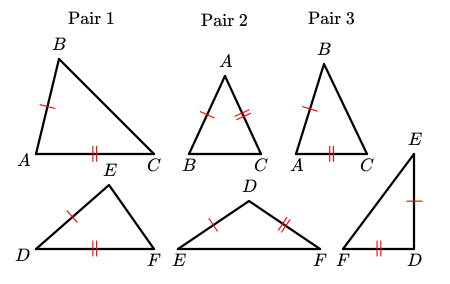
a Let's start with drawing three pairs of triangles that have two congruent sides and one pair of sides that is not congruent.
As we can see, in each pair of the triangles AB is congruent to DE, and AC is congruent to DF.
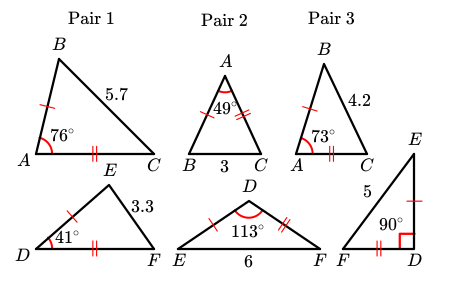
b First we will measure sides AB and EF, and angles ∠ A and ∠ D in each triangle pair.
Next, we can use these measures to complete the table.
Triangle Pair
BC
m∠ A
EF
m∠ D
1
5.7
76^(∘)
3.3
41^(∘)
2
3
49^(∘)
6
113^(∘)
3
4.2
73^(∘)
5
90^(∘)
c Analyzing the table, we notice that the angle opposite to the longer of the two non-congruent sides is greater than the angle opposite the shorter of the two non-congruent sides. This is the conjecture we can make about two triangles with two congruent sides.