Let's remember the definition of invariant points.
Invariant points are points on a figure that do not change their location under a transformation.
Now, a dilation with a scale factor 1 maps an image onto itself. This means that all vertices of ABCD remain in place.
This is how we know that the points are always maintained under the dilation with a scale factor of 1.
b
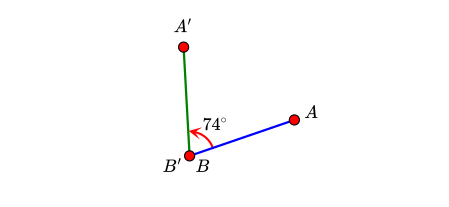
The center of rotation is a fixed point around which a figure is rotated. Since B is the center of the rotation, the image of B is B itself. We can see a 74^(∘) rotation of a sample segment AB in the diagram below.
We see that the invariant point B is always maintained under the rotation.
c
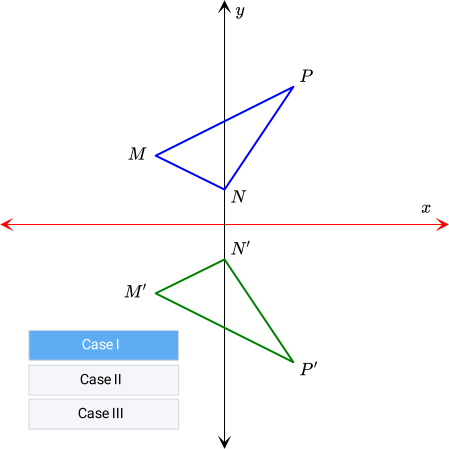
Let's consider the position of △ MNP with respect to the x-axis.
If none of vertices of △ MNP are on the x-axis, then no points can remain invariant under the reflection.
If a vertex, or a point on △ MNP, is also on the x-axis, then that one point will remain invariant under the reflection.
If two vertices are on the x-axis, then these two vertices will remain invariant under the reflection.
Let's examine the example for each case.
Therefore, the invariant points are sometimes maintained under the reflection.
d
In a translation all points are translated along a vector. Therefore, each point of PQRS is translated along ⟨ 7,3 ⟩.
(x,y) → (x+7,y+3)
Because every point (x,y) is translated 7 units right and 4 units up, no point will map onto itself. As a result, the points are never maintained under the translation.
e
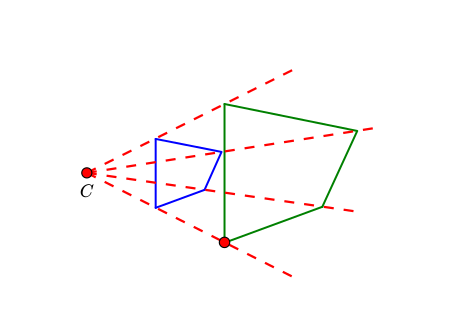
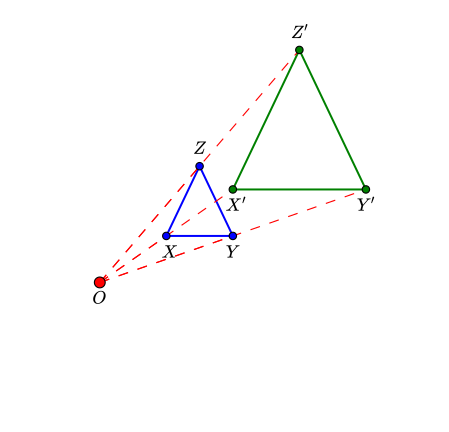
The graph below shows the dilation of △ XYZ centered at O with a scale factor of 2. We can change the location of center of dilation to see if there are any invariant points of the dilation.
Looking at the graph, we can make the following conclusions.
If none of points of △ XYZ are located at the origin O, then no points can remain invariant under the dilation.
If O is one of the vertices of △ XYZ, then it will remain invariant under the dilation.
As a result, the points are sometimes maintained under the reflection.