The surface area of a prism can be found using the formula below.
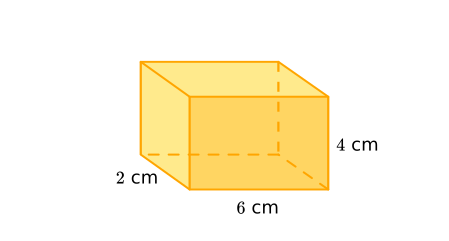
S= Ph + 2BIn the formula, P is the perimeter of the base, B is the area of the base and h is the height of the prism. Here the base is 2 cm wide and 6 cm long. We can use these values to calculate the perimeter and area of the base.
P & = 2( 2)+ 2 ( 6) =16
B & = ( 2)( 6)=12
Now, let's substitute P= 16, B= 12, and h= 4 into the formula for the surface area of a prism.
To find the volume of the prism, we multiply the area of the base B by the height h.
V= Bh
We know that B= 12 and h= 4. Let's substitute these values into the formula and simplify.
Our goal is to find the surface area and the volume of the prism after a dilation with a scale factor of 2. See that this type of a dilation makes each dimension twice as long. Let's find the dimensions of the image.
Preimage
Image
2
2(2)=4
6
2(6)=12
4
2(4)=8
The base of the image is 4 cm wide and 12 cm long.
P & = 2( 4)+ 2(12) =32
B & = ( 4)(12)=48
Let's substitute P = 32, B= 48, and h= 8 into the formulas for the surface area and the volume of a prism and simplify.
Surface Area (cm^2)
Volume (cm^3)
Formula
S = Ph +2B
V=Bh
Substitution
S = ( 32)( 8) +2( 48)
V=( 48)( 8)
Calculation
S=352
V=384
c
This time we want to find the surface area and the volume of the prism after a dilation with a scale factor of 12. Let's find the dimensions of the image.
Preimage
Image
2
1/2(2)=1
6
1/2(6)=3
4
1/2(4)=2
The base of the image is 1 cm wide and 3 cm long. Let's find the perimeter and area of the base.
P & = 2( 1)+ 2( 3) =8
B & = ( 1)( 3)=3
We can now substitute P = 8, B= 3, and h= 2 into the formulas for the surface area and the volume of a prism.
Surface Area (cm^2)
Volume, (cm^3)
Formula
S = Ph +2B
V=Bh
Substitution
S = ( 8)( 2) +2( 3)
V=( 3)( 2)
Calculation
S=22
V=6
d
We want to compare the perimeters and areas of the image and preimage in each dilation. We will start by comparing the surface areas of the preimage, Image B, and Image C.
Comparing Surface Areas
Let's make a table showing the surface areas and volumes of the given prism and the two images.
Preimage
Image B
Image C
Surface Area
88 cm^2
352 cm^2
22 cm^2
Volume
48 cm^3
384 cm^3
6 cm^3
We see that a dilation with a scale factor of 2 makes the surface area 4 times more. Also, a dilation with a scale factor of 12 makes the surface area 14 of what it used to be.
Preimage
Image B
Image C
Surface Area
88 cm^2
352 cm^2= 4( 88 cm^2)
22 cm^2=1/4( 88 cm^2)
Volume
48 cm^3
384 cm^3
6 cm^3
Comparing Volumes
Now we can compare the volumes.
Preimage
Image B
Image C
Surface Area
88 cm^2
352 cm^2
22 cm^2
Volume
48 cm^3
384 cm^3=8( 48 cm^3)
6 cm^3=1/8( 48 cm^3)
A dilation with a scale factor of 2 makes the volume 8 times more. A dilation with a scale factor of 12 makes the volume 18 of what it used to be.
e
We want to decide on the effect that a dilation by a scale factor r has on the surface area and volume of a prism. For that let's remember the table from Part D.
Preimage
Image B
Image C
Surface Area
88 cm^2
352 cm^2= 4(88 cm^2)
22 cm^2=1/4(88 cm^2)
Volume
48 cm^3
384 cm^3=8(48 cm^3)
6 cm^3=1/8(48 cm^3)
See that with a dilation of 2 the surface area was multiplied by 4=2^2, and the volume was multiplied by 8=2^3. With a dilation of 12 the surface area was multiplied by 14=( 12)^2, and the volume was multiplied by 18=( 12)^3.
Preimage
Image B
Image C
Surface Area
88 cm^2
352 cm^2= 2^2(88 cm^2)
22 cm^2=(1/2)^2(88 cm^2)
Volume
48 cm^3
384 cm^3=2^3(48 cm^3)
6 cm^3=(1/2)^3(48 cm^3)
We can conclude that if r is the scale factor of a dilation of a prism, the surface area of the preimage would be multiplied by r^2 and the volume of the preimage would be multiplied by r^3.