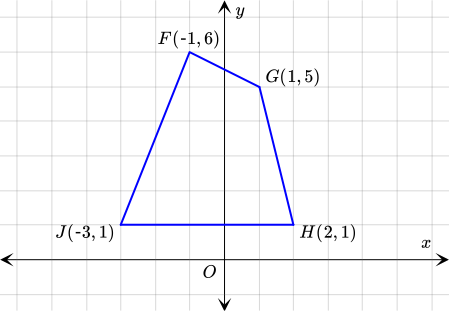
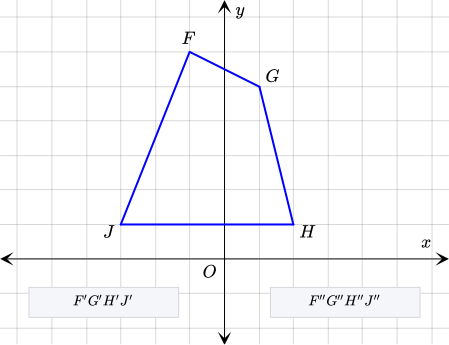
Start by identifying the coordinates of the vertices. Then, to dilate the figure, multiply the x- and y- coordinates of each vertex by the scale factor.
B
b
To reflect a point in the y-axis, multiply its x-coordinate of it by - 1.
C
c
Compare the graph of the final images in Parts A and B.
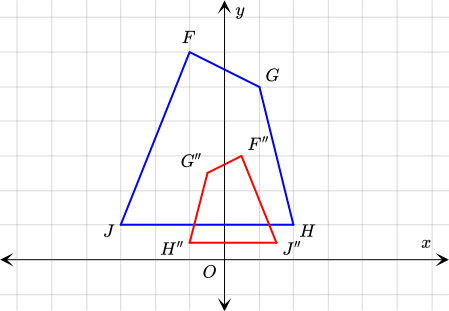
Now we are going to dilate FGHJ by a scale factor of 12, or 0.5, centered at the origin. To do so, we multiply the x- and y-coordinates of each vertex by the scale factor and simplify.
lcl
(x,y) & → & (0.5x, 0.5y) [0.6em] [-0.6em]
F(- 1,6) & → & F'(- 0.5,3) [0.5em]
G(1,5) & → & G'(0.5,2.5) [0.5em]
H(2,1) & → & H'(1,0.5) [0.5em]
J(- 3,1) & → & J'(- 1.5,0.5) [0.5em]
Now, we want to reflect this image in the y-axis. For that we will reflect the vertices of the image in the y-axis. Multiplying the x-coordinate of each point by - 1 will give us the coordinates of the reflected points.
lcl
(x,y) & → & (- x, y) [0.6em] [-0.6em]
F'(- 0.5,3) & → & F''(0.5,3) [0.5em]
G'(0.5,2.5) & → & G''(- 0.5,2.5) [0.5em]
H'(1,0.5) & → & H''(- 1,0.5) [0.5em]
J'(- 1.5,0.5) & → & J''(1.5,0.5) [0.5em]
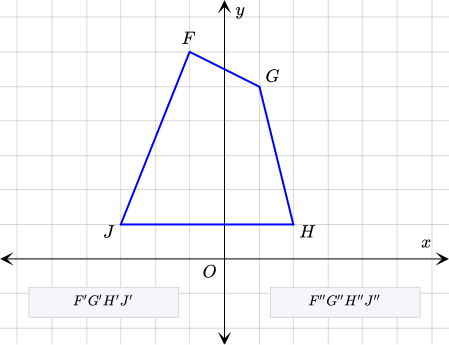
Let's plot the points and then connect them to draw the two images.
b
This time we should complete the steps from Part A in reverse order. Here is what we are going to do.
We will first reflect FGHJ in the y-axis.
Next we will dilate the reflected image by a scale factor of 12 centered at the origin.Let's go! Here are the vertices of both images.
lclcl
(x,y) & → & (- x, y) & → & (0.5x, 0.5y) [0.6em] [-0.6em]
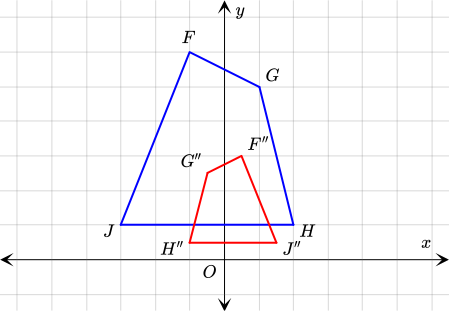
F(- 1,6) & → & F'(1,6) & → & F''(0.5,3) [0.5em]
G(1,5) & → & G'(- 1,5) & → & G''(- 0.5,2.5) [0.5em]
H(2,1) & → & H'(- 2,1) & → & H''(- 1,0.5) [0.5em]
J(- 3,1) & → & J'(3,1) & → & J''(1.5,0.5)
Let's plot the points and draw the images of FGHJ.
c
If we compare the final images from Parts A and B, we will see that the results are the same figure. Therefore, the order of the transformations does not affect the final image.
d
We want to decide following statement is always, sometimes, or never true.
The order of a composition of a dilation and a reflection affects the final image.
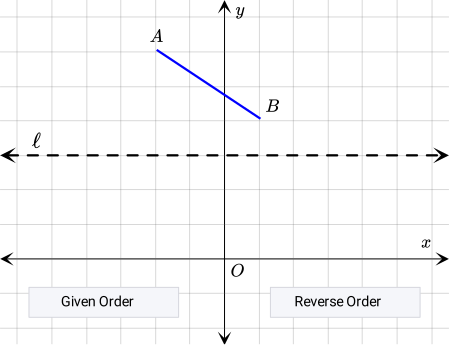
In Part C we found that the order in which we dilated and reflected polygon FGHJ did not affect the final image. Now, consider the image of AB under the composition of two transformations.
A reflection in line l
A dilation with the scale factor 0.5 and centered at the origin
Graph below shows the images of the transformations performed in different orders.
As we can see, the final images are not the same. This is why the statement is only sometimes true.
Extra
Let's take a look at the statement one more time. We know that it is sometimes true.
The order of a composition of a dilation and a reflection affects the final image.
See that the order of operations matters only when the line of reflection does not pass through the origin. If the line does pass through (0,0), we can perform the operations in any order and the result will always be the same.