4. Equations
+ Customize lesson
0
0
Sign In
This lesson delves into the complexities of equations, emphasizing the importance of variables, solutions to an equation, and mathematical modeling. It aims to simplify these mathematical tools by connecting them to real-life situations. For instance, equations can be used to calculate costs in group activities or to determine physical characteristics like height and weight. By making these connections, the guide helps both students and professionals understand how to apply equations in practical, everyday contexts.
| Student Learning Objectives: |
|---|
|
| | 10 Theory slides |
| | 8 Exercises - Grade E - A |
| | Each lesson is meant to take 1-2 classroom sessions |
Tadeo and his little brother Dylan are in an elevator. Dylan randomly presses buttons on the panel.

The elevator goes 3 floors up and then 7 floors down before arriving at the ground floor, or Floor 1. Which floor were Tadeo and his brother on when they got on the elevator?
A solution of an equation is a value that makes the equation true. It satisfies the equation when it is substituted for the variable of the equation. Consider the following equation. x+1=4 The solution of the equation is x=3 because 3 is the only value of x that makes the equation true.
For the other values that are not solutions, the right-hand side of the solution is not equal to the left-hand side. This is shown by anot equalsign ≠. Consider the result of substituting x=1 into the equation. Some equations are have no solution. For example, x=x+1 can never be true because a number cannot equal more than one of itself. x=x+1 * Equations can have multiple or even infinitely many solutions. x+x=2x This equation will be true for all values of x since the expressions on the left- and right-hand sides are equivalent expressions.
A restaurant has four different combos meals.

Suppose two customers order the same combo. The price of their combo satisfies the equation 2x+8=22. Which combo did they choose?
Now suppose they order different combos. The prices of the combos they choose satisfy the equation x^2-15x=-54. Select the combos they chose.
Substitute the given prices into the equation. Which combo makes the equation true?
Substitute the given prices into the equation. Which combos make the equation true?
To find which combo the two customers chose, we substitute each combo price into the equation and check whether it satisfies the equation. Let's start with the price of Combo I, which is $ 7.
Since x=7 makes the equation true, it is a solution to the equation. Now let's check the remaining prices by substituting them into the equation and simplifying to see if the equation has any more solutions.
| Menu | Menu Price ($) | Substitution into 2x+8=22 | Check |
|---|---|---|---|
| Combo I | 7 | 2( 7)+8? =22 | 22 = 22 ✓ |
| Combo II | 9 | 2( 9)+8? =22 | 26 ≠ 22 * |
| Combo III | 5 | 2( 5)+8? =22 | 18 ≠ 22 * |
| Combo IV | 6 | 2( 6)+8? =22 | 20 ≠ 22 * |
Only the price of Combo I satisfies the equation, so they ordered Combo I.
To find which combos they chose, we proceed in a similar way to Part A. We substitute each price and check if it satisfies the equation. Let's start by substituting the price of Combo I.
x= 7
Calculate power
Multiply
Subtract terms
Since x=7 does not satisfy the given equation, it is not a solution. Neither customer ordered Combo I. Now let's check the remaining prices.
| Menu | Menu Price | Substitution into x^2-15x=-54 | Check |
|---|---|---|---|
| Combo I | 7 | ( 7)^2-15( 7)? =-54 49-105? =-54 | -56 ≠ -54 * |
| Combo II | 9 | ( 9)^2-15( 9)? =-54 81-135 ? =-54 | -54 = -54 ✓ |
| Combo III | 5 | ( 5)^2-15( 5)? =-54 25-75 ? =-54 | -50 ≠ -54 * |
| Combo IV | 6 | ( 6)^2-15( 6)? =-54 36-90 ? =-54 | -54 = -54 ✓ |
We found that x = 9 and x = 6 are solutions to the equation. Since they ordered different combos, one customer ordered Combo II, and the other ordered Combo IV.
Write an equation for each situation.
A bookshelf is 12 centimeters taller than a cabinet. The bookshelf is 168 centimeters tall. Write an equation to find the height of the cabinet.
A smaller box weighs three-fourths as much as the larger box. The larger box weighs 52 kilograms. Write an equation to find the weight of the smaller box.
The difference between the ages of an oak tree and a maple tree is 3 years. The oak tree is older and is 16 years old. Write an equation to find the age of the maple tree.
The bookshelf is 12 centimeters taller than the cabinet. This involves adding some numbers.
Three-fourths of a number is the same as the product of 34 and that number.
Difference
indicates subtraction.
To write the equation for the situation, let's start by writing it in words. Then, we can look at smaller phrases and write them as algebraic expressions.

The word is represents an equals sign, which means that the expressions to the left and right of this word are equal. We also know that the bookshelf's height is 168 centimeters.

Next, more than stands for addition. We can also use a variable x to represent the height of the cabinet.

Saying that the height of the cabinet is 12 centimeters less than the bookshelf's height is another way of saying the same thing. Here, less than stands for subtraction. x=168-12 Both equations can be used to find the height of the cabinet.
Three-fourths of a number means the product of 34 and that number. With this in mind, let's write the sentence as an equation using x for the weight of the smaller box.

We can also write the fraction 34 as 75100 or 0.75. This means that, for example, the equation x=0.75 * 52 also represents the given sentence.
Here, the word difference
stands for subtraction. Let's use x for the age of the maple tree and translate the words into an equation.

Another way to state the situation is to say that the oak tree is 3 years older than the maple tree. Then, its age is the maple tree's age plus 3. x+3=16 Both equations can be used to find the age of the maple tree. A situation can be represented by more than one equation. We can rewrite an equation in different ways by rearranging its terms.
Dylan and Tadeo visit a game store.

Dylan purchases 7 new premium trading cards. After this purchase, he has 25 premium cards. How many premium cards did Dylan have before he bought the new ones?
After buying 3 used games for $ 15, Tadeo is left with $ 32 in his wallet. How much money did he have before he bought the games?
The number of cards Dylan had before going into the store is 7 less than 25.
Tadeo started with $15 more than the $32 he has left after buying the games.
Dylan bought 7 new cards and now has 25 cards in total. This means that the number of cards he had before was 7 fewer than 25. Let's write an equation using n for the number of cards Dylan had before buying more.
n= 25- 7 Now we simplify the equation to find how many cards he had.
The solution to the equation is n=18. This means that Dylan had 18 premium cards before buying more.
The amount of money Tadeo started with is the total of the $ 15 he spent on the games and the $ 32 he had left after the purchase. Let's use m to represent the amount of money he started with and write an equation for this situation.
m= 32+ 15 Now we can simplify the equation.
We found that Tadeo had $ 47 before buying the games.
Mark and Kevin are selling their old toy cars at a secondhand store.

The store pays them $ 36 for 12 cars. If each car is worth the same amount, how much do they get for one car?
How many cars do the boys need to sell to earn $54?
To find the amount paid for one car, divide $36 by 12.
Use the amount from Part A. Write a division equation to represent the situation.
The store paid the boys the same amount for each toy car. This means we can find x, the amount they got for one car, by dividing the total of $ 36 they received by the 12 cars they sold.
x = 36/12 Now we can simplify the equation.
The solution to the equation is x=3, so the shop paid the boys $ 3 for each toy car sold.
In Part A, we found that the store pays $ 3 for each car. To find the number of cars, y, they need to sell to get $ 54, we divide 54 by the 3 price per car.
54/3= y Next, we calculate the quotient to simplify the equation and find the value of y. 54/3=18 ⇒ y=18 The boys need to sell 18 toy cars.
At the beginning of the lesson, Dylan randomly pressed some elevator buttons.

The elevator went 3 floors up and then 7 floors down before arriving at the ground floor, or Floor 1. Which floor were Tadeo and his brother on when they got on the elevator?
undotheir trip.

After going 3 floors up and then 7 floors down, they ended up on Floor 1. To reverse their trip, they would go 7 floors up from Floor 1 and then 3 floors down, arriving at Floor x. We can use this information to write an equation. x = 1 + 7 - 3 Now we can simplify this equation to find the floor the boys were on when they got on the elevator.
The solution to the equation is x=5. This means that the boys got on the elevator on Floor 5.
Magdalena added 23 new contacts to her contacts list. She now has a total of 95 contacts.

How many contacts did Magdalena have in her contacts list before she updated it?
We know that Magdalena updated her phone and added 23 new contacts to her contacts list. Now she has 95 contacts. Let c represent the number of contacts Magdalena had in her phone before the update. c ⇒ Number of contacts at the start Let's represent this situation by making a diagram.
Notice that the number of contacts before she updated the list is 23 less than the current number of contacts. This means that we can use subtraction to find the value of c. c=95-23 Let's now simplify this equation.
We found that the solution to the equation is c=72. This means that Magdalena had 72 contacts in her phone before the update.
The outside temperature dropped 18^(∘)F from Saturday morning to Sunday evening. It was 32^(∘) F on Sunday evening.
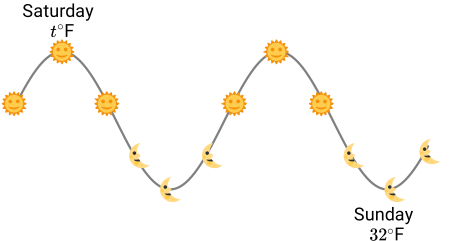
Find the outside temperature t on Saturday morning.
We are told that the outside temperature on Saturday morning was t ^(∘) F and over the next day, it decreases to 32 ^(∘) F. t ^(∘) F&⇒ Saturday Morning Temperature 32^(∘) F&⇒ Sunday Evening Temperature This means that the temperature on Saturday morning is 18^(∘) F more than the temperature on Sunday evening. This means that if we add 18^(∘) F to the temperature on Sunday evening, we can find the temperature on Saturday morning t. t=32^(∘) F+18 ^(∘) F We wrote an equation for t. Let's simplify it!
We found that the solution to the equation is t=50^(∘) F. This means that the temperature outside is 50^(∘) F on Saturday morning.
Paulina uses some cards to play a homemade game. The goal of the game is to be the first to get rid of all their cards. Paulina has 54 cards in her deck.
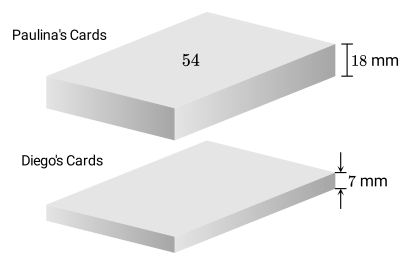
According to the given thickness of the decks, find the number of cards that Diego has in his deck.
Paulina has a deck of 54 cards and is 18 millimeters thick. We know that Diego's deck is 7 millimeters thick, and we want to find how many cards he has. 54 cards ⇒ 18 mm ? cards ⇒ 7 mm Note that each card has the same thickness. This means that if we divide the thickness of the deck by the number of cards in the deck, we can find the thickness of one card. Let x represent the thickness of each card. x=18/54 Next, we will simplify this equation.
Each card is 13 millimeter thick. Now that we know the thickness of each card, we can calculate the number of cards in Diego's deck by dividing the thickness of Diego's deck by the thickness of each card. Let y be the number of cards in Diego's deck. y=7/13 Let's calculate the right-hand side of the equation.
We found that Diego has 21 cards in his deck.

