4. Equations
Sign In
An error ocurred, try again later!
Chapter 5
4.
Equations
This lesson delves into the complexities of equations, emphasizing the importance of variables, solutions to an equation, and mathematical modeling. It aims to simplify these mathematical tools by connecting them to real-life situations. For instance, equations can be used to calculate costs in group activities or to determine physical characteristics like height and weight. By making these connections, the guide helps both students and professionals understand how to apply equations in practical, everyday contexts.
Show less Show more expand_more 


Lesson Settings & Tools
| | 10 Theory slides |
| | 8 Exercises - Grade E - A |
| | Each lesson is meant to take 1-2 classroom sessions |
Equations
Slide of 10
Problems or situations in daily life can often be represented by algebraic expressions. When an expression is set equal to another expression or number, it is called as equation. This lesson will be an introduction to equations and how to use them to model real-life situations.
Catch-Up and Review
Here are a few recommended readings before getting started with this lesson.
Challenge
Share
Report error
Finding the Correct Floor
Tadeo and his little brother Dylan decide to go out together. They get in the elevator and Dylan randomly presses buttons on the panel until Tadeo stops him.

External credits: Icongeek26
The elevator went 3 floors up and then 7 floors down before arriving at the ground floor, or Floor 1. Which floor were Tadeo and his brother on when they got in the elevator?
{"type":"text","form":{"type":"math","options":{"comparison":"1","nofractofloat":false,"keypad":{"simple":true,"useShortLog":false,"variables":["x"],"constants":["PI"]},"rendered":false},"text":" "},"formTextBefore":"Floor","formTextAfter":null,"answer":{"text":["5"]}}
Discussion
Share
Report error
Equation
An equation is a type of mathematical relation that indicates that two quantities are equal. Equations often contain one or more unknowns values called variables. Some examples are shown below.
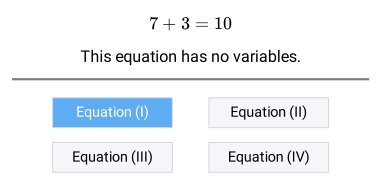 Solving an equation with a variable means to find the value or values of each variable that make the equation true.
Discussion
Share
Report error
Solution of an Equation
A solution of an equation is a value that makes the equation true. It satisfies the equation when it is substituted for the variable of the equation. Consider the following equation.
x+1=4
The equation has the solution x=3 because 3 is the only value of x that makes the equation true. This means that the the right and left-hand sides of the equation are equal to each other when this solution is substituted for the variable.
For the other values that are not solutions, the right-hand side of the solution is not equal to the left-hand side. This is shown by a
not equalsign ≠. Consider the result of substituting x=1 into the equation. Some equations are impossible to solve. Consider the following example. x=x+1 Notice that it is impossible to get a number itself after adding 1 to that number. This means that this equation has no solution. Conversely, it is possible for an equation to have more than one solution. An equation can also have infinitely many solutions, which means that all values satisfy the equation. x+x=2x This equation will be true for all values of x since the expressions on the left-hand side and right-hand side are equivalent expressions.
Extra
Replacement SetSometimes the solution set of an equation can be obtained from a replacement set, which is a list of possible solutions. The values from the replacement set are substituted into the equation and then checked to confirm whether they satisfy the equation or not. Consider the following equation and its replacement set. Equation: & x-5=3 Replacement Set: & {5,6,7,8} In the following table, each value is substituted into the equation and the equation is evaluated.
| Value of x | Substitute | Are both sides equal? |
|---|---|---|
| 5 | 5-5 ? = 3 | 0 ≠ 3 * |
| 6 | 6-5 ? = 3 | 1 ≠ 3 * |
| 7 | 7-5 ? = 3 | 2 ≠ 3 * |
| 8 | 8-5 ? = 3 | 3 = 3 ✓ |
As shown in the table, the only solution of the equation is 3.
Example
Share
Report error
Deciding What to Order
Tadeo and his brother Dylan are very hungry and decide to go to one of the restaurants at the city center. There are four different kinds of combos on the menu.
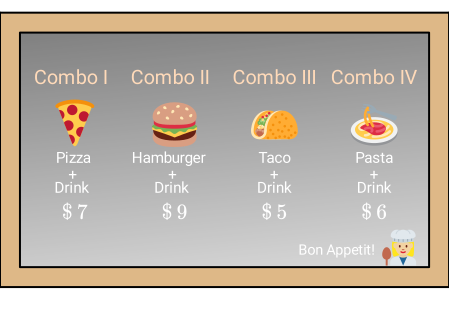
a Suppose they order the same combo. The price of their combo satisfies the equation 2x+8=22. Which combo did they choose?
{"type":"choice","form":{"alts":["Combo I","Combo II","Combo III","Combo IV"],"noSort":true},"formTextBefore":"","formTextAfter":"","answer":0}
b Now suppose they order different combos. Both combo prices satisfy the equation x^2-15x=-54. Select the combos they choose.
{"type":"multichoice","form":{"alts":["Combo I","Combo II","Combo III","Combo IV"],"noSort":true},"formTextBefore":"","formTextAfter":"","answer":[1,3]}
Hint
a Substitute the given combo prices into the equation.
b Substitute the given combo prices into the equation.
Solution
a Consider the given equation again.
| Menu | Menu Price | Substitution into 2x+8=22 | Check |
|---|---|---|---|
| Combo I | 7 | 2( 7)+8? =22 | 22 = 22 ✓ |
| Combo II | 9 | 2( 9)+8? =22 | 26 ≠ 22 * |
| Combo III | 5 | 2( 5)+8? =22 | 18 ≠ 22 * |
| Combo IV | 6 | 2( 6)+8? =22 | 20 ≠ 22 * |
As shown in the table, the other prices do not satisfy the equation. This means that Tadeo and his brother both ordered Combo I.
b Since the brothers ordered different combos this time, there is a different equation to consider. Even though the equation might look intimidating, the solution process is the same — substitute the values into the equation to see if they produce a true statement. Two or more combo prices will satisfy this given equation.
x^2-54x=15
Substitute
x= 7
( 7)^2-15( 7) ? =-54
CalcPow
Calculate power
49-15(7)? =-54
Multiply
Multiply
49-105? =-54
SubTerms
Subtract terms
-56 ≠ -54
| Menu | Menu Price | Substitution into x^2-15x=-54 | Check |
|---|---|---|---|
| Combo I | 7 | ( 7)^2-15( 7)? =-54 49-105? =-54 | -56 ≠ -54 * |
| Combo II | 9 | ( 9)^2-15( 9)? =-54 81-135 ? =-54 | -54 = -54 ✓ |
| Combo III | 5 | ( 5)^2-15( 5)? =-54 25-75 ? =-54 | -50 ≠ -54 * |
| Combo IV | 6 | ( 6)^2-15( 6)? =-54 36-90 ? =-54 | -54 = -54 ✓ |
According to the table, the equation has two solutions, x=9 and x=6. This means that one of the brothers ordered Combo II and the other one ordered Combo IV. Bon appetit!
Pop Quiz
Share
Report error
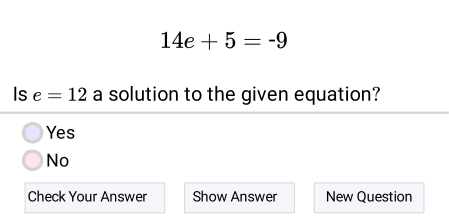
Checking Solutions
Example
Share
Report error
Writing Equations
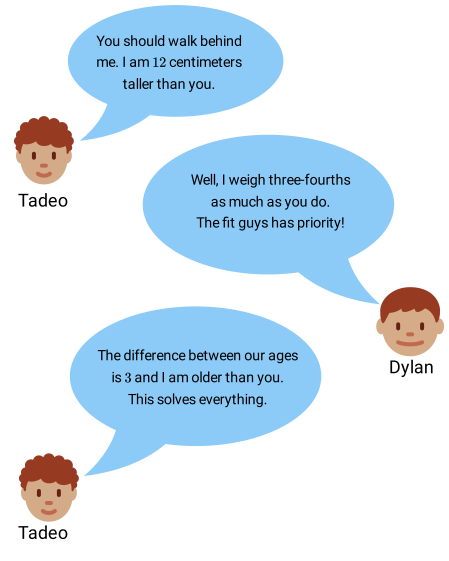
After having lunch, Tadeo and his brother Dylan walk around the city center. They start to discuss their physical characteristics.
a If Tadeo is 168 centimeters tall, write an equation to find the height of his brother.
{"type":"text","form":{"type":"math","options":{"comparison":"1","nofractofloat":false,"keypad":{"simple":false,"useShortLog":false,"variables":["x"],"constants":[]},"rendered":false},"text":" "},"formTextBefore":null,"formTextAfter":null,"answer":{"text":["168=x+12","x=168-12","x=156","x+12=168","168-12=x","156=x"]}}
b If Tadeo is 52 kilograms, write an equation to find the weight of his brother.
{"type":"text","form":{"type":"math","options":{"comparison":"1","nofractofloat":false,"keypad":{"simple":false,"useShortLog":false,"variables":["x"],"constants":[]},"rendered":false},"text":" "},"formTextBefore":null,"formTextAfter":null,"answer":{"text":["x=0.75 \\times 52","0.75 \\times 52=x","4x=3\\times 52","3\\times 52=4x","x=3\/4 \\times 52","3\/4 \times 52 = x","x=39","39=x","4x=156","156=4x"]}}
c If Tadeo is 16 years old, write an equation to find his brother's age.
{"type":"text","form":{"type":"math","options":{"comparison":"1","nofractofloat":false,"keypad":{"simple":false,"useShortLog":false,"variables":["x"],"constants":[]},"rendered":false},"text":" "},"formTextBefore":null,"formTextAfter":null,"answer":{"text":["16-x=3","x=16-3","x=13","13=x","16-3=x","x+3=16"]}}
Hint
a Tadeo is is 12 centimeters taller than Dylan is. This involves adding some numbers.
b Three-fourths of a number is the same as the product of 34 and that number.
c
Differencemeans subtraction.
Solution
a Consider the conversation between Tadeo and his brother. Tadeo says that he is 12 centimeters taller than Dylan is. This means that Tadeo's height is 12 centimeters more than his brother's height. In order to write an equation that represents this situation, carefully examine the sentence again.
Tadeo's height is 12cm more than Dylan's height.
The word is
represents an equals sign, which means that the expressions to the left and right sides of this word are equal to each other. Tadeo is 168 centimeters tall, so write this number on the left-hand side of the equation in place of Tadeo's height.
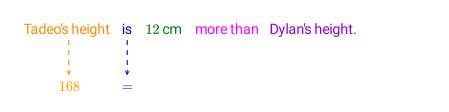
Next, more than indicates the addition of numbers. Let x be the variable that represents Dylan's height to write an expression for the right-hand side of the equation.
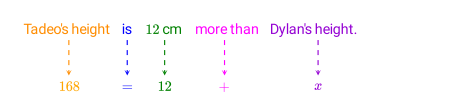
There may be other ways to write this equation. Saying that Dylan's height is 12 centimeters less than Tadeo's height has the same meaning. Here, less than refers to subtraction. Consider how to rewrite the equation as a subtraction expression. x=168-12 Both of the equations can be used to find Dylan's height.
b Once again, start by considering Dylan's claim. Note that three-fourths of a number means the product of 34 and that number. With this in mind, write the sentence as an equation. Let x be Dylan's weight.
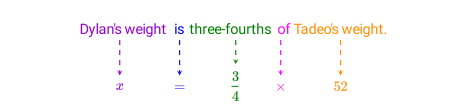
Dylan's weight can be found by using the translated equation. x=3/4 * 52 Note that there are other possible ways to write the fraction 34. 3/4=75/100=0.75 This means that the equation x=0.75 * 52 also represents the given sentence.
c This time, an equation that represents the sentence, "The difference between Tadeo's and Dylan's ages is 3." must be found. Tadeo says that he is older than Dylan, and Tadeo is 16 years old. The word
differencemeans subtraction. Let x be the Dylan's age.
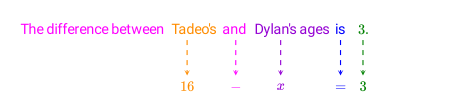
This situation can also be represented by other equations. If Tadeo is 3 years older than Dylan, we know that his age is Dylan's age plus 3. This means that the equation can be written using addition as well. x+3=16 Both equations can be used to find Dylan's age. Also, keep in mind that there is not only one way to represent a situation by an equation. Equations can be rewritten as several different equations by rearranging the terms of the equation.
Example
Share
Report error
Buying Games
Dylan and Tadeo like playing collectible card games and video games. They stop at a game store and see what is new.

a Dylan decides to purchase 7 individual cards. After this purchase, he has 25 cards. How many cards did Dylan have before he bought the new ones?
{"type":"text","form":{"type":"math","options":{"comparison":"1","nofractofloat":false,"keypad":{"simple":true,"useShortLog":false,"variables":["x"],"constants":["PI"]},"rendered":false},"text":" "},"formTextBefore":null,"formTextAfter":"cards","answer":{"text":["18"]}}
b While Dylan is passionate about collectible card games, Tadeo prefers video games. After buying three new games for $ 15, Tadeo is left with $ 32 in his wallet. How much did he have in his wallet before he bought the games?
{"type":"text","form":{"type":"math","options":{"comparison":"1","nofractofloat":false,"keypad":{"simple":true,"useShortLog":false,"variables":["x"],"constants":["PI"]},"rendered":false},"text":" "},"formTextBefore":"$","formTextAfter":null,"answer":{"text":["47"]}}
Hint
a The number of cards Dylan has before before going to the store is 7 less than 25.
<listcircle icon="b">Tadeo started with $15 more than the 2 he has left after buying the games.
Solution
a Let n represent the number of cards that Dylan has before buying more. After buying 7 cards at the shop, he now has 25 cards. This means that the number of cards he had before going to the store is 7 less than 25. This information can be written as an equation.
b Tadeo has a certain amount of money in his wallet before going to the store. After he spends $15, he is left with $ 32. This means that the initial amount is $ 15 more than the money left after buying the new games.
Example
Share
Report error
Selling Old Toys
Dylan and Tadeo have lots of old toy cars from their childhood. They decide to sell their old cars in a secondhand shop. They hope that other children will play with their old cars!

a The store gives them $ 36 for 12 cars. What is the cost of a single car if the shop pays the same amount for each car?
{"type":"text","form":{"type":"math","options":{"comparison":"1","nofractofloat":false,"keypad":{"simple":true,"useShortLog":false,"variables":["x"],"constants":["PI"]},"rendered":false},"text":" "},"formTextBefore":"$","formTextAfter":null,"answer":{"text":["3"]}}
b How many cars would the boys need to sell in order to earn $54 in total?
{"type":"text","form":{"type":"math","options":{"comparison":"1","nofractofloat":false,"keypad":{"simple":true,"useShortLog":false,"variables":["x"],"constants":["PI"]},"rendered":false},"text":" "},"formTextBefore":null,"formTextAfter":"cars","answer":{"text":["18"]}}
Hint
a The boys received 12 times the amount of money paid per car to get $36.
b Use the cost of a single car that was found in Part A. Write a division equation to represent the situation.
Solution
a The boys sold 12 toy cars to the secondhand shop and received $36.

b This time the boys want to know how many cars they would need to sell in order to earn $ 54. Remember that they will be paid $ 3 for each car. Draw a diagram to represent this situation.
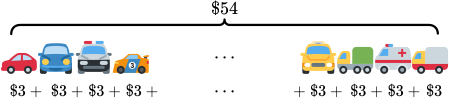
Consider how to split $ 54 in groups of $ 3. This will require division — in other words, divide the total amount that will be earned by the price of a single car to find the number of cars sold. Let y be the number of cars. 54/3=y Now calculate the quotient to find the value of y. 54/3=18 ⇒ y=18 This means that they need to sell 18 toy cars to get $ 54. Keep in mind that the scenarios from Part A and Part B can be solved by using other methods. These solutions are just examples of one way of how to find the required information.
Closure
Share
Report error
Finding the Correct Floor
At the beginning of the lesson, Tadeo and his brother got into an elevator to go out together. Dylan randomly pressed the elevator buttons until Tadeo stopped him.

External credits: Icongeek26
{"type":"text","form":{"type":"math","options":{"comparison":"1","nofractofloat":false,"keypad":{"simple":true,"useShortLog":false,"variables":["x"],"constants":["PI"]},"rendered":false},"text":" "},"formTextBefore":"Floor","formTextAfter":null,"answer":{"text":["5"]}}
Hint
The ground floor is represented as Floor 1. The boys went 7 floors down before getting off the elevator.
Solution
After the boys got in the elevator, it first went up 3 floors, then down 7 floors. Start by drawing a diagram to represent this situation.
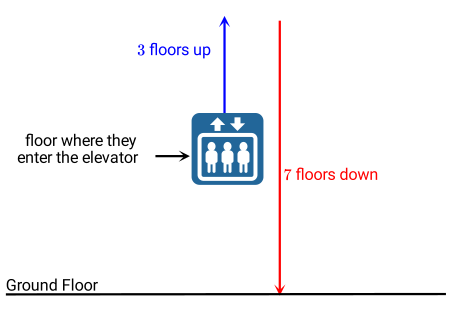
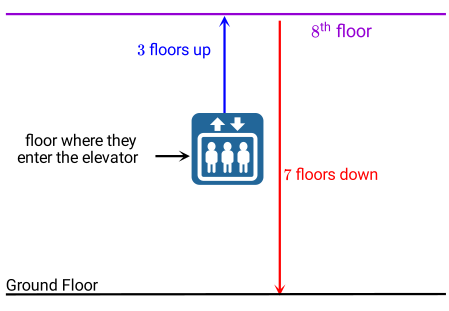
Keep in mind that the ground floor is represented as Floor 1. Since the boys went 7 floors down before getting off the elevator, they must be at the 1+7=8^\text{th} floor after going 3 floors up.
Equations
Exercise 1.1
Write the given sentence as an equation.
{"type":"text","form":{"type":"math","options":{"comparison":"1","nofractofloat":false,"keypad":{"simple":false,"useShortLog":false,"variables":["b"],"constants":[]},"rendered":false},"text":" "},"formTextBefore":null,"formTextAfter":null,"answer":{"text":["b-5=9","9=b-5","b=14"]}}
{"type":"text","form":{"type":"math","options":{"comparison":"1","nofractofloat":false,"keypad":{"simple":false,"useShortLog":false,"variables":["y"],"constants":[]},"rendered":false},"text":" "},"formTextBefore":null,"formTextAfter":null,"answer":{"text":["y+6=13","y=7","13=y+6"]}}
security
report
code
security
report
code
When writing words as equations, we look for keywords such as is
or equals
to find the placement of the equals sign.
5 less than a number b equals 9.
↓
=
Another keyword in our sentence is less than,
which indicates subtraction.
5 less than a number b equals 9.
⇓ ↓
- =
Now let's rewrite the other terms 5, the number b, and 9 to complete our equation.
The equation b-5=9 represents the given sentence.
Let's start by examining the given sentence again. Note that the word sum
means addition.
The sum of a number y and 3 is 13.
⇓
+
Next, we place the equals sign where the keyword is
stands.
The sum of a number y and 6 is 13.
⇓ ⇓
+ =
Finally write the terms y, 6, and 13 to complete the equation.
The equation y+6=13 represents the given word sentence.
security
report
code
Consider the following equation.
x-7=31
Choose the sentence that does not represent this equation.
{"type":"choice","form":{"alts":["7 subtracted from a number is 31.","A number decreased by 7 is 31.","A number minus 7 is the same as 31.","A number is 7 less than 31.","31 equals the difference between a number and 7."],"noSort":true},"formTextBefore":"","formTextAfter":"","answer":3}
security
report
code
security
report
code
We will decide which option does not represent the given equation. Let's start by examining the given options.
| Sentences |
|---|
| 7 subtracted from a number is 31. |
| A number decreased by 7 is 31. |
| A number minus 7 is the same as 31. |
| A number is 7 less than 31. |
| 31 equals the difference between a number and 7. |
Let's write each sentence as an equation and check whether it matches the given equation. When writing sentences as equations, we look for keywords such as is
or equals
to find the placement of the equals sign. There are also some other keywords to decide the place of the operational signs. In this case, we want to use subtraction, so let's look for keywords that indicate subtraction.
difference
less than
subtracted from
decreased by
Since all of the options use the variable x, we will also use x to indicate a number
. With this in mind, let's write one of the options as an equation.
We can write the other sentences as equations by following the same steps.
| Sentences | Equation |
|---|---|
| 7 subtracted from a number is 31. | x - 7 = 31 |
| A number decreased by 7 is 31. | x - 7 = 31 |
| A number minus 7 is the same as 31. | x - 7 = 31 |
| A number is 7 less than 31. | x = 31 - 7 |
| 31 equals the difference between a number and 7. | 31 = x - 7 |
As we can see from the table, the sentence A number is 7 less than 31.
needs to be represented with a different equation.
x=31-7
is not the same as
x-7=31
security
report
code
A group of 6 friends are planning to have a fun day together. They will choose one out of three different activities. The equations in the table represent the number of people x who can participate in each activity for $18.
| Activity | Cost ($ ) |
|---|---|
| Balloon Ride | 3x-42=18 |
| Amusement Park | 5x-22=18 |
| Zoo Trip | 2x+6=18 |
{"type":"choice","form":{"alts":["Balloon Ride","Amusement Park","Zoo Trip"],"noSort":false},"formTextBefore":"","formTextAfter":"","answer":2}
security
report
code
security
report
code
We are asked to determine which activity the friends should choose if they want to spend exactly $18 and all do the same activity. There are 6 people in the friends group, so let's substitute x=6 into each equation and see which of them produce true statements. Let's start with the equation for the balloon ride.
Notice that x=6 is not a solution to this equation, so the 6 friends cannot join a balloon ride for $18. Let's apply the same thought process and substitute x=6 into the equations for the amusement park and zoo trip.
| Activity | Cost ($) | Substitute x=6 | Multiply | Add or Subtract | Is x=6 a Solution? |
|---|---|---|---|---|---|
| Balloon Ride | 3x-42=18 | 3( 6)-42? =18 | 18-42? =18 | -24=18 * | No |
| Amusement Park | 5x-22=18 | 5( 6)-22? =18 | 30-22? =18 | 8 ≠ 18 * | No |
| Zoo Trip | 2x+6=18 | 2( 6)+6? =18 | 12+6? =18 | 18=18 ✓ | Yes |
We found that x=6 is a solution to the equation that represents the cost of the zoo trip. This means that if the friends want to spend exactly $18 and all do something together, they should choose the zoo trip.
security
report
code
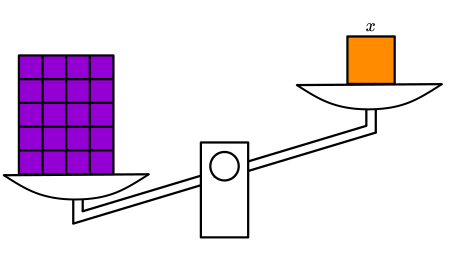
A scale balances with four violet blocks on one side and one orange x-block on the other side. This situation is represented by the following equation. 4=x Heichi places 16 more violet blocks to the left side. The scale is now unbalanced.
{"type":"text","form":{"type":"math","options":{"comparison":"1","nofractofloat":false,"keypad":{"simple":true,"useShortLog":false,"variables":[],"constants":[]},"rendered":false},"text":" "},"formTextBefore":null,"formTextAfter":null,"answer":{"text":["5"]}}
security
report
code
security
report
code
We know that the following scale is balanced when four violet blocks are on the left side and one orange x-block on the right side.
We want to find a number that balances the scale again when multiplied by x.
Let's keep adding 4 violet blocks to the left side and 1 orange x-block to the other side until we get 20 violet blocks. This method will keep the scale balanced!
As we can see, if there are 20 violet blocks on the left side of the scale, we need 5 orange x-blocks to keep the scale balanced. This means that we need to multiply the x-blocks by 5. Now we can complete the given equation. 20=5* x
security
report
code
Equations
Recommended exercises
To get personalized recommended exercises, please login first.
Loading content
≤
>
■2
■▢
e▢
7
8
9
×
÷■1
=
=
√▢
▢√
∫▢▢
4
5
6
+
−
≤
<
log
ln
log▢
1
2
3
()
∣
sin
cos
tan
0
.
π
x
y
Loading content