a Note that the corresponding white triangles are similar as well.
B
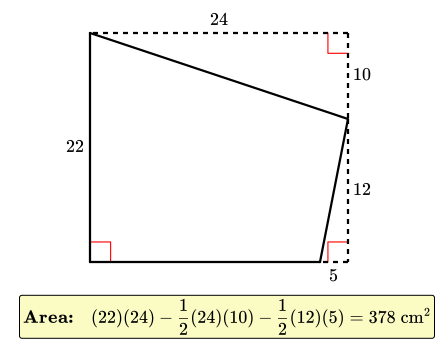
b You can find the area by subtracting the area of the white triangles from the rectangle.
A
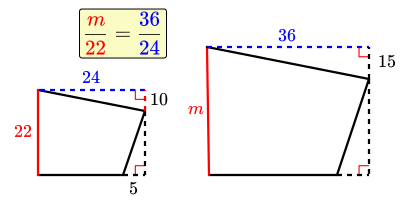
a n=36
m=33
B
bArea Small Shape: 378 cm^2
Area Large Shape: 850.5 cm^2 Perimeter Small Shape: 80cm Perimeter Large Shape: 120 cm
Practice makes perfect
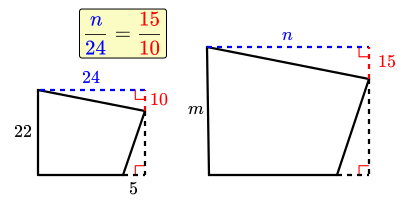
a Given that the two shapes are similar, the rectangles are also similar. This means that the two pairs of right triangles we can make out in the figure are similar as well. With this, we can write an equation for n.
b Let's find the area of the shapes one at the time.
Area Small Shape
By calculating the area of the rectangle with a width and length of 22 and 24 cm, and then subtract the area of the two right triangles that are not part of the shaded figure, we can calculate the shaded figure's area.
Area Large Shape
We can find the area of the larger shape by using the same method as for the smaller shape. However, the ratio of the areas of similar figures will always be the square of the ratio of two corresponding sides.
A_(large)/A_(small)=(33/22)^2
Let's substitute the area of the small shape into this equation and solve for A_(large).
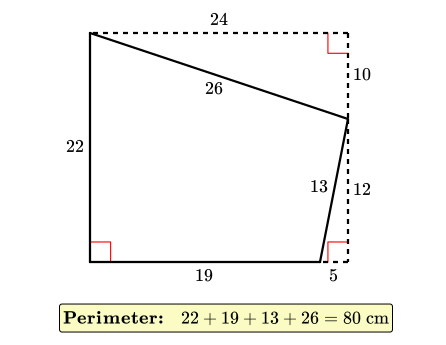
To find the perimeter, we have to determine the unknown sides. The smaller of the right triangles has two legs of 5 and 12. This fits the description of a 5-12-13 triangle which means the hypotenuse is 13 units. In the larger triangle, the lengths of the two legs are both multiples of 2. If we divide both of these sides by this factor we notice that this is a dilated 5-12-13 triangle. It's hypotenuse is therefore 2(13)=26 cm. Now we can find the perimeter.
Perimeter Large Shape
We can find the perimeter of the larger shape by using the same method as for the smaller shape. However, the common ratio of the perimeters between similar figures, will always be the ratio of two of their corresponding sides.
P_(large)/P_(small)=33/22
Let's substitute the area of the small shape into this equation and solve for P_(large).