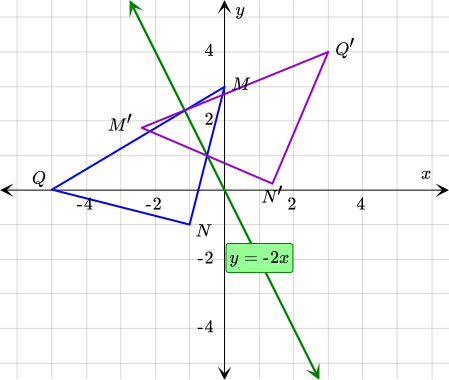
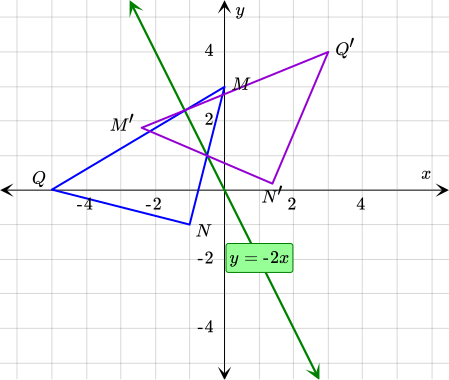
The vertices of △ MQN will fall on lines that are perpendicular to y=- 2x.
Practice makes perfect
To reflect the figure in y=- 2x, we first have to find the perpendicular slope to - 2. Because slopes of perpendicular lines are opposite reciprocals, we know that all perpendicular lines to y=- 2x will have the following format.
y=1/2x+b
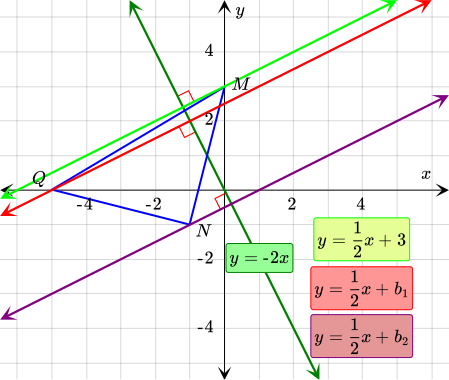
Therefore, any point on the image will be on a line that goes through the corresponding point on the preimage and with a slope of 12. Let's show this in a diagram using three different lines, one for each vertex.
To reflect the vertices of △ MQN, we must know the equation of all these lines. From the diagram, we can see that the uppermost line intercepts the y-axis at (0,3) to it has the following equation.
y=1/2x+3
To find the remaining two lines, we substitute the coordinates of the vertices, in their respective equation and solve for the y-intercept.
Red Line:& 0=1/2(- 5)+b_1 ⇔ b_1=2.5 [0.8em]
Purple Line:& - 1=1/2(- 1)+b_2 ⇔ b_2=- 0.5
Corresponding vertices on the image and preimage form a segment whose perpendicular bisector is the line of reflection. This means each lines point of intersection with y=- 2x will be the midpoint of these segments. Since we know the equations of each line, we can find the x-coordinate of this midpoint by equating them with y=- 2x.
Lime Line:& - 2x=1/2x+3 ⇔ x=- 1.2 [0.8em]
Red Line:& - 2x=1/2x+2.5 ⇔ x=- 1 [0.8em]
Purple Line:& - 2x=1/2x-0.5 ⇔ x= 0.2
Having found the x-coordinate where the three lines intersect with the line of reflection, we have to solve for the corresponding y-coordinate as well.
Lime Line:& y=1/2(- 1.2)+3 ⇔ y= 2.4 [0.8em]
Red Line:& y=1/2(- 1)+2.5 ⇔ y= 2 [0.8em]
Purple Line:& y=1/2* 0.2-0.5 ⇔ y= - 0.4
When we know each line's intersection point with y=- 2x, we can use the Midpoint Formula to find the coordinates of the image vertices.
Finding M'
We are looking for (x_(M'),y_(M')). By substituting the midpoint and the coordinates for M on the preimage into the midpoint-formula, we can solve for these coordinates.