Remember, a glide reflection is always a translation followed by a reflection.
Glide reflection:
Translation: (x,y) → (x+12,y)
Reflection: in the x-axis
Practice makes perfect
In example 4, the glide reflection from △ ABC to △ A''B''C'' consisted of the following translation and reflection:
Translation:& (x,y) → (x-12,y)
Reflection:& in the $x-$axis
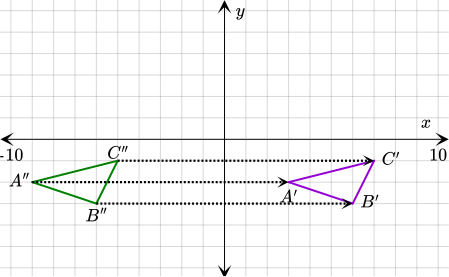
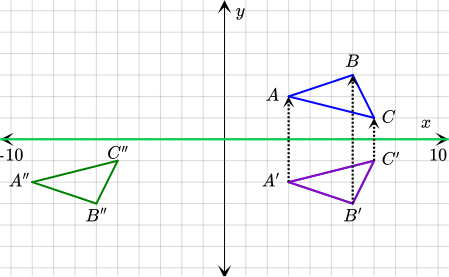
To perform a glide reflection moving △ A''B''C'' to △ ABC we have to undo these transformations. Note that a glide reflection is always a translation followed by a reflection. Therefore, our first transformation has to be a translation. To get the x-coordinates of the vertices on △ A''B''C'' to line up, we have to translate it 12 units horizontally in the positive direction.
Translation:& (x,y) → (x+12,y)
Let's perform this translation.
Next, we have to reflect △ A'B'C' in the x-axis. We can do that by moving all of the vertices of △ A'B'C' to the opposite side of the x-axis so that the distance from the vertices to the x-axis is the same.
Therefore, the glide reflections that describes moving △ A''B''C'' to △ ABC is
Translation:& (x,y) → (x+12,y)
Reflection:& in the $x-$axis