2. Angles and Transversals
Sign In
An error ocurred, try again later!
Chapter 9
2.
Angles and Transversals
This lesson explains the relationships between various types of angles formed by a transversal cutting through two lines. It covers concepts like alternate interior angles, same-side interior angles, and corresponding angles, helping learners understand their geometric properties and how they apply to real-world problems.
Show less Show more expand_more 


Lesson Settings & Tools
| | 16 Theory slides |
| | 13 Exercises - Grade E - A |
| | Each lesson is meant to take 1-2 classroom sessions |
Angles and Transversals
Slide of 16
Consider when three lines are drawn. Eight angles are formed when two or fewer of those lines are parallel. The angles formed at one intersection point are related to the angles formed at the other. In the given diagram, there are no parallel lines.
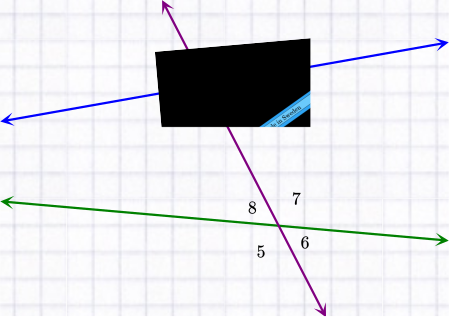
This lesson will focus on finding relations between these eight angles under the condition that two lines are parallel.
Catch-Up and Review
Here is a recommended reading before getting started with this lesson.
Challenge
Share
Report error
Fixing the Fence
It is a Friday afternoon. Dylan just arrive at home 🏠 from school 🏫. He begins the weekend by mending the fence in his backyard. It broke last night because of extremely strong wind 💨.
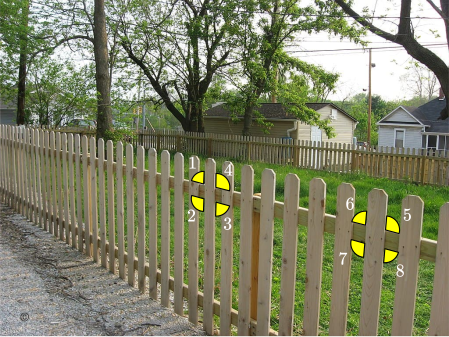
Things were going great. While nailing up some boards 🔨, he noticed something. All of the vertical boards are parallel. Also, the horizontal stringers make four angles with each vertical board. Which angles are congruent? Dylan wonders.
a Which angles are congruent to ∠ 7?
{"type":"multichoice","form":{"alts":["∠ 1","∠ 2","∠ 3","∠ 4","∠ 5","∠ 6","∠ 8"],"noSort":true},"formTextBefore":"","formTextAfter":"","answer":[1,3,4]}
b Which angles are congruent to ∠ 1?
{"type":"multichoice","form":{"alts":["∠ 2","∠ 3","∠ 4","∠ 5","∠ 6","∠ 7","∠ 8"],"noSort":true},"formTextBefore":"","formTextAfter":"","answer":[1,4,6]}
Discussion
Share
Report error
Line Intersecting Two or More Lines
When a line l intersects two lines at two different points, the line l receives a special name.
Concept
Share
Report error
Transversal
A transversal is a line that intersects two or more lines at different points. 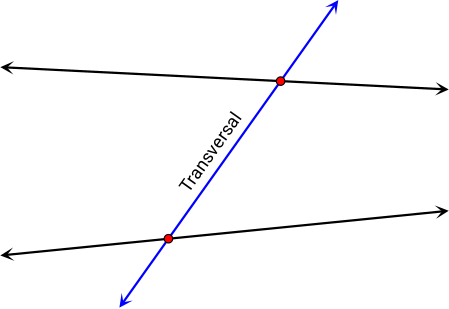 When a pair of lines are cut by a transversal, eight different angles are created. There are four angles around each point of intersection.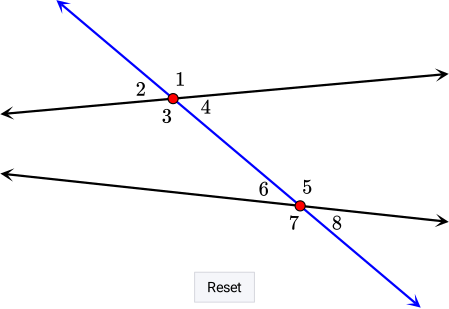
Discussion
Share
Report error
Angles Formed by a Transversal
The eight angles formed by a transversal are classified into different groups. These grouping are based on the angle positions relative to the lines involved. As an example, focus on the angles between the two lines and those that are not.
Concept
Share
Report error
Interior and Exterior Angles
When two lines l_1 and l_2 are cut by a transversal t, eight different angles are created — four around each point of intersection. These angles are classified into two groups according to their positions with respect to lines l_1 and l_2.
- Interior angles: the angles that are between the lines l_1 and l_2.
- Exterior angles: the angles that are outside the lines l_1 and l_2.
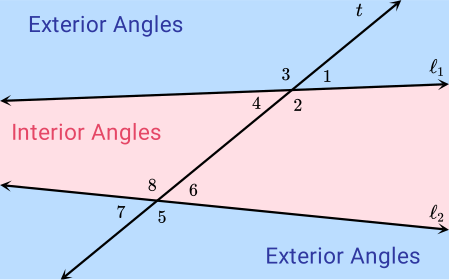
In the diagram, all the even-numbered angles are interior angles, and all the odd-numbered angles are exterior angles.
| Interior Angles | Exterior Angles |
|---|---|
| ∠ 2, ∠ 4, ∠ 6, ∠ 8 | ∠ 1, ∠ 3, ∠ 5, ∠ 7 |
Discussion
Share
Report error
Relationships Between Interior Angles
Of the eight angles formed by a transversal that intersects two lines, the four interior angles are also classified according to their position with respect to the transversal.
Concept
Share
Report error
Alternate Interior Angles
Consider a pair of lines cut by a transversal. The pairs of interior angles with different vertices that lie on opposite sides of the transversal are called alternate interior angles. 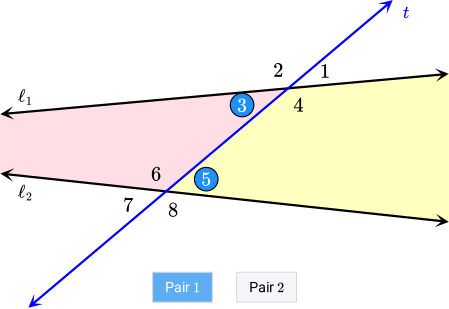 In the diagram, two pairs of angles can be identified as alternate interior angles.
Pair1: & ∠ 3 and ∠ 5 Pair2: & ∠ 4 and ∠ 6
If two parallel lines are cut by a transversal, then the alternate interior angles are congruent. The same logic in reverse can be applied. If two lines and a transversal form alternate interior angles that are congruent, then the lines are parallel.
In the diagram, two pairs of angles can be identified as alternate interior angles.
Pair1: & ∠ 3 and ∠ 5 Pair2: & ∠ 4 and ∠ 6
If two parallel lines are cut by a transversal, then the alternate interior angles are congruent. The same logic in reverse can be applied. If two lines and a transversal form alternate interior angles that are congruent, then the lines are parallel.
| If | Then |
|---|---|
| l_1 ∥ l_2 | ∠ 3 ≅ ∠ 5 and ∠ 4 ≅ ∠ 6 |
| ∠ 3 ≅ ∠ 5 or ∠ 4 ≅ ∠ 6 | l_1 ∥ l_2 |
Example
Share
Report error
The Louvre Museum
a Dylan really wants to makes art every minute of his free time. He finishes fixing the fence and runs to grab his canvas. It is just him and his canvas 🎨🖌️💗. He will continue painting a mosaic he began days ago. There are only eight regions left to be painted.
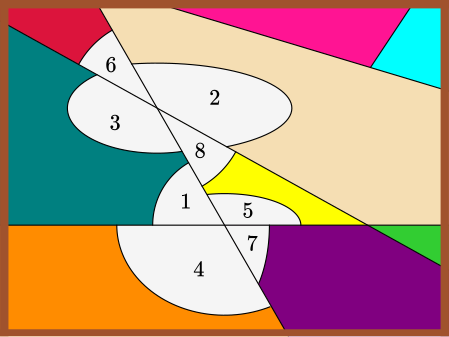
{"type":"multichoice","form":{"alts":["Region 1","Region 2","Region 3","Region 4","Region 5","Region 6","Region 7","Region 8"],"noSort":true},"formTextBefore":"","formTextAfter":"","answer":[0,7]}
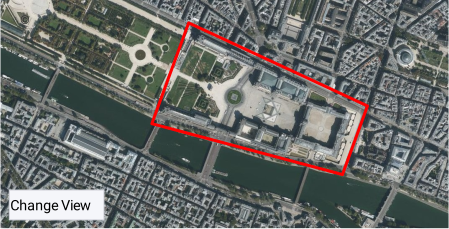
b Dylan's mosaic reminded his parents of some of the paintings they saw in the Louvre museum in Paris. They took out their photo album and Dylan excitedly flipped through it. Dylan saw the photo of the Louvre's entrance. Immediately, he could identify some parallel lines.
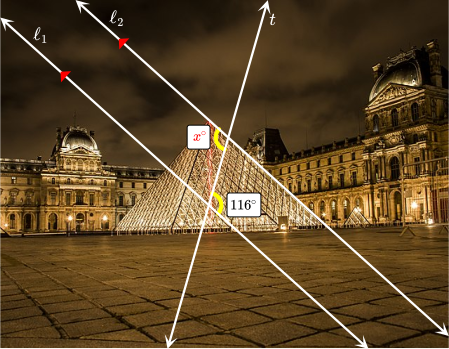
External credits: Diego Lopez Sebastian
{"type":"text","form":{"type":"math","options":{"comparison":"1","nofractofloat":false,"keypad":{"simple":true,"useShortLog":false,"variables":[],"constants":[]},"rendered":false},"text":" "},"formTextBefore":"x=","formTextAfter":null,"answer":{"text":["116"]}}
Hint
a The transversal is the line that goes from the top edge to the bottom edge of the canvas. The alternate interior angles are the interior angles with different vertices that lie on opposite sides of the transversal. Remember that the angles must also be acute.
b When the lines are parallel, the alternate interior angles are congruent.
Solution
a Let's start by identifying which of the lines in the mosaic is the transversal. Due to the position of the regions, the transversal is the line that goes from the top edge to the bottom edge of the canvas. Let l_1 and l_2 be the lines that the transversal intersects.
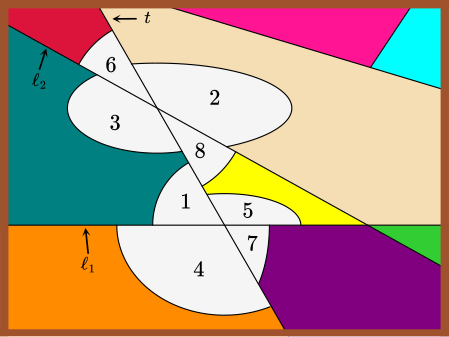
The interior angles are those angles that lie between the two lines that are cut. In the mosaic, the regions 1, 3, 5, and 8 correspond to interior angles. Focus on these regions.
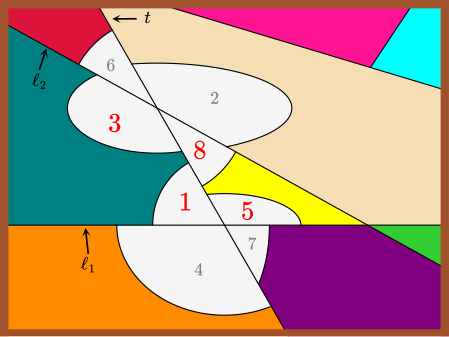
Alternate interior angles are interior angles with different vertices that lie on opposite sides of the transversal. Of the regions highlighted before, the following pairs correspond to alternate interior angles. Regions1 and 8 Regions3 and 5 Dylan only wants the alternate interior angles that are acute. The regions 1 and 8 correspond to acute angles. The regions 3 and 5 are obtuse angles. These can be verified with the help of a protractor. Dylan is now ready to paint the regions 1 and 8 blue.
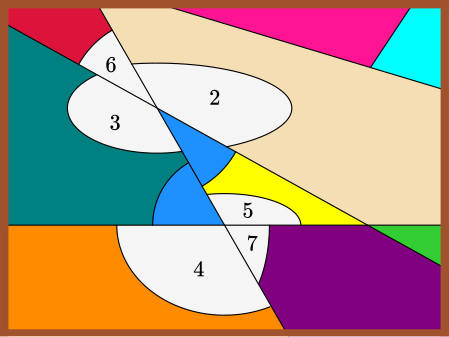
Nicely done! Now Dylan has six regions remaining to paint.
b The line t intersects the lines l_1 and l_2. Therefore, it is a transversal. Now, ignore the photo and focus on the three lines to have a clear picture of the lines. Also, label some points on the lines.
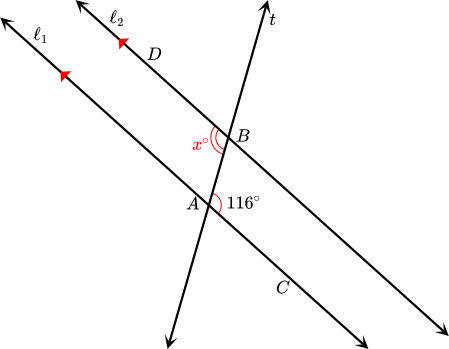
The angles ABD and CAB are interior angles with different vertices that lie on opposite sides of the transversal. Therefore, these two angles are alternate interior angles. Alternate Interior Angles ∠ ABD and ∠ CAB Since the lines l_1 and l_2 are parallel, the mentioned angles are congruent. As a result, they have the same measure. That is enough information for the value of x to be identified. ∠ ABD ≅ ∠ CAB ⇓ x = 116
Extra
Interesting Facts About the Louvre- It is the most visited art museum in the world.
- It is the largest museum in the world. It covers over 15 acres.
- Originally, it was constructed as a fortress by King Phillip of France in 1190. In the 14th century, the Louvre was turned into a royal residence. Since 1793, it was opened to the public as Muséum central des arts de la République.
- From 1803 to 1814 it was named Napoleon Museum.
- The Mona Lisa was stolen from the Louvre in 1911. This incident rose the popularity of the painting across the globe. It was recovered two years later.
- During World War II, the Louvre was emptied to protect all of the art pieces.
- There are five pyramids in the Louvre.
- In 2016, the second Louvre of the world was opened. It is located in Abu Dhabi.
Discussion
Share
Report error
Relationships Between Exterior Angles
It was just taught that the four interior angles can be divided into two pairs of alternate interior angles. The same can be said for exterior angles. They can also be grouped into two pairs.
Concept
Share
Report error
Alternate Exterior Angles
Consider a pair of lines cut by a transversal. The pairs of exterior angles with different vertices that lie on opposite sides of the transversal are called alternate exterior angles. 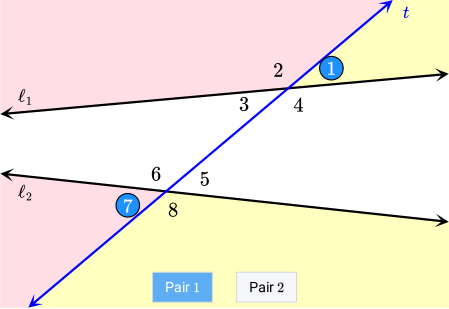 In the diagram, two pairs of angles can be identified as alternate exterior angles.
Pair1: & ∠ 1 and ∠ 7 Pair2: & ∠ 2 and ∠ 8
If two parallel lines are cut by a transversal, then the alternate exterior angles are congruent. The same logic in reverse can be applied. If two lines and a transversal form alternate exterior angles that are congruent, then the lines are parallel.
In the diagram, two pairs of angles can be identified as alternate exterior angles.
Pair1: & ∠ 1 and ∠ 7 Pair2: & ∠ 2 and ∠ 8
If two parallel lines are cut by a transversal, then the alternate exterior angles are congruent. The same logic in reverse can be applied. If two lines and a transversal form alternate exterior angles that are congruent, then the lines are parallel.
| If | Then |
|---|---|
| l_1 ∥ l_2 | ∠ 1 ≅ ∠ 7 and ∠ 2 ≅ ∠ 8 |
| ∠ 1 ≅ ∠ 7 or ∠ 2 ≅ ∠ 8 | l_1 ∥ l_2 |
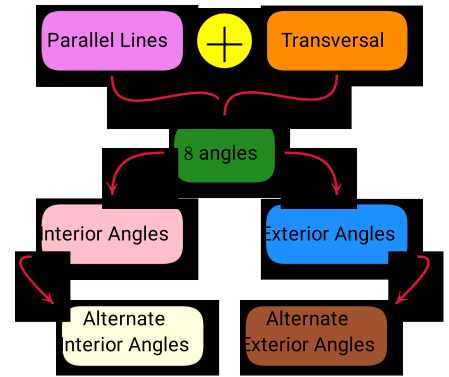
So far, the eight angles formed by a transversal and two parallel lines have been divided into two groups. In addition, each of these two groups has been divided into a subgroup.
Example
Share
Report error
La Plata City - Argentina
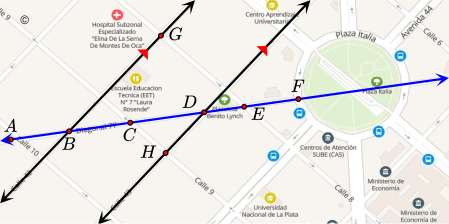
Dylan continued to flip through the photo book. A picture his parents took in La Plata, Argentina fascinated him. He did an internet search to learn more. He discovered that it is one of the best-planned cities of the world. It is shaped like a square grid with some diagonal avenues, squares, and traffic circles.

Astonished by the structure of the city, he zoomed in on the map and saw that many interior streets are parallel to each other. For example, he noticed that the streets named Calle 8 and Calle 9 are parallel.
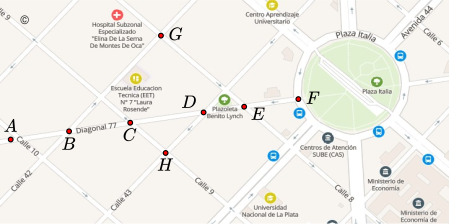
a Assume ∠ BCH has a measure of 129^(∘) and ∠ FEG has a measure of 3x^(∘). What is the value of x?
{"type":"text","form":{"type":"math","options":{"comparison":"1","nofractofloat":false,"keypad":{"simple":true,"useShortLog":false,"variables":[],"constants":[]},"rendered":false},"text":" "},"formTextBefore":"x=","formTextAfter":null,"answer":{"text":["43"]}}
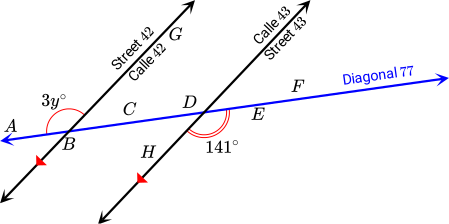
b Assume m∠ HDE= 141^(∘) and m∠ GBA = 3y^(∘). What is the value of y?
{"type":"text","form":{"type":"math","options":{"comparison":"1","nofractofloat":false,"keypad":{"simple":true,"useShortLog":false,"variables":[],"constants":[]},"rendered":false},"text":" "},"formTextBefore":"y=","formTextAfter":null,"answer":{"text":["47"]}}
Hint
a Use the fact that the given angles are alternate exterior angles. Also, the streets are parallel to each other. Note that the names of the streets are shown in its original form of Spanish. The diagrams of the Solution also show translations to English. The word
callein Spanish means
streetin English.
b Notice that streets named Calle 42 and Calle 43 are parallel to each other. The involved angles are alternate exterior angles. Note that the names of the streets are shown in its original form of Spanish. The diagrams of the Solution also show translations to English. The word
callein Spanish means
streetin English.
Solution
a It is important to have a clear picture of the mentioned angles. Draw the angles on the map to get started.
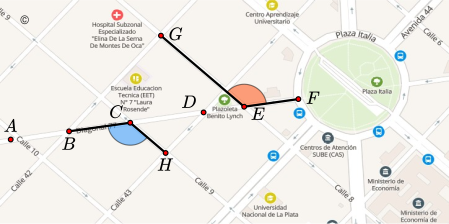
Notice that FE and CB lie over the street named Diagonal 77. This implies that these two segments lie over the same line. Also, GE lies over the street named Calle 8, and CH lies over Calle 9. That means the lines containing the segments are parallel since the two streets are parallel.
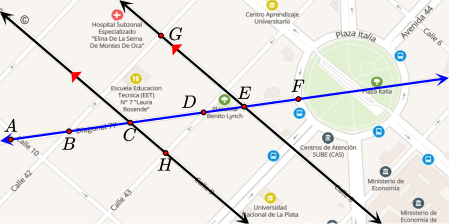
The diagram shows two parallel lines cut by a transversal. This means that ∠ BCH and ∠ FEG are alternate exterior angles.
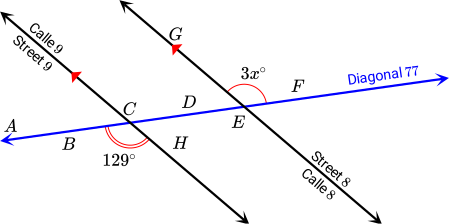
m∠ BCH = m∠ FEG
SubstituteII
m∠ BCH= 129, m∠ FEG= 3x
129 = 3x
DivEqn
.LHS /3.=.RHS /3.
43 = x
RearrangeEqn
Rearrange equation
x = 43
b Again, it is important to have a clear vision of the angles drawn on the map.
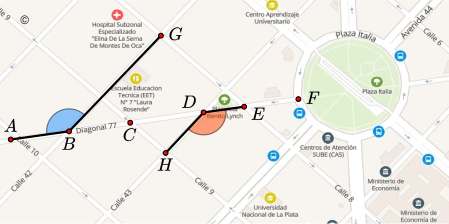
Note that AB and DE lie over the street named Diagonal 77. That means these two segments lie over the same line. Additionally, BG lies over Calle 42 and DH lies over Calle 43. These two streets are parallel. This implies that the lines containing the segments are also parallel.
The diagram shows two parallel lines cut by a transversal. That characteristic means that ∠ GBA and ∠ HDE are alternate exterior angles.
Discussion
Share
Report error
Interior Angles on the Same Side of the Transversal
The alternate interior angles lie on opposite sides of the transversal. Now it is time to get to know the interior angles with different vertices that lie on the same side of the transversal.
Concept
Share
Report error
Same-Side Interior Angles
Consider a pair of lines cut by a transversal. The pairs of interior angles with different vertices that lie on the same side of the transversal are called same-side interior angles or consecutive interior angles.
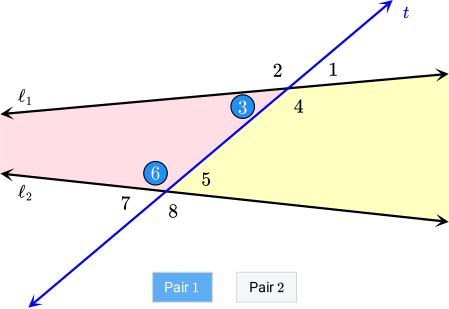 Alternatively, same-side interior angles are called co-interior angles. In the diagram, two pairs of same-side interior angles can be identified.
Pair1: & ∠ 3 and ∠ 6 Pair2: & ∠ 4 and ∠ 5
If two parallel lines are cut by a transversal, then the consecutive interior angles are supplementary. The same logic in reverse can be applied. If two lines and a transversal form consecutive interior angles that are supplementary, then the lines are parallel.
Alternatively, same-side interior angles are called co-interior angles. In the diagram, two pairs of same-side interior angles can be identified.
Pair1: & ∠ 3 and ∠ 6 Pair2: & ∠ 4 and ∠ 5
If two parallel lines are cut by a transversal, then the consecutive interior angles are supplementary. The same logic in reverse can be applied. If two lines and a transversal form consecutive interior angles that are supplementary, then the lines are parallel.
| If | Then |
|---|---|
| l_1 ∥ l_2 | m ∠ 3+m ∠ 6=180^(∘) and m ∠ 4 + m ∠ 5 = 180^(∘) |
| m ∠ 3+m ∠ 6=180^(∘) or m ∠ 4 + m ∠ 5 = 180^(∘) | l_1 ∥ l_2 |
Example
Share
Report error
Pyramids of Giza
Dylan is still mesmerized by the travel album. He is staring at a photo of the Giza Pyramids in Egypt. His parents teach him about them. They were built as tombs of Egyptian pharaohs. The tallest pyramid is called the Great Pyramid. There are seven wonders of the ancient world — only the pyramids are still standing.
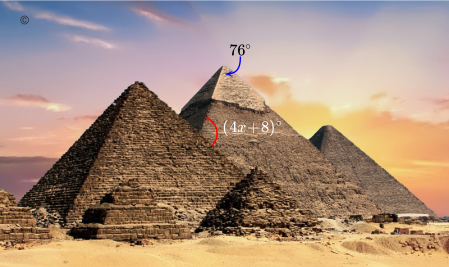
{"type":"text","form":{"type":"math","options":{"comparison":"1","nofractofloat":false,"keypad":{"simple":true,"useShortLog":false,"variables":[],"constants":[]},"rendered":false},"text":" "},"formTextBefore":"x=","formTextAfter":null,"answer":{"text":["24"]}}
Hint
Draw the sides of the angles marked in the photo. Notice that these angles are consecutive interior angles.
Solution
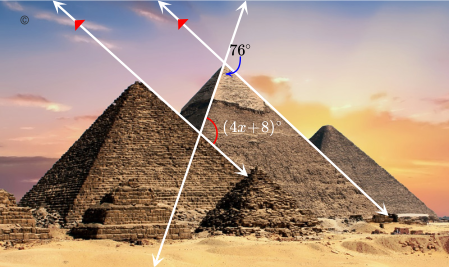
Start by drawing the sides of the angles marked in the photo to relate these two angles.
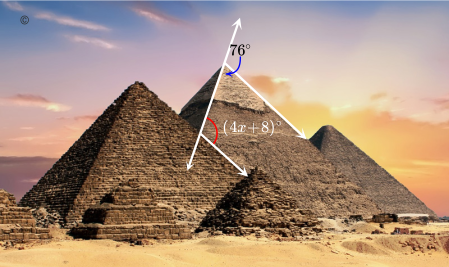
Notice that the non-common sides of the angles are parallel to each other. Additionally, the common side can be seen as a transversal. The marked angles lie between the parallel lines and they are on the same side of the transversal.
Extra
Seven Wonders of the Ancient World- The Pyramids of Giza
- Hanging Gardens of Babylon
- Temple of Artemis
- Statue of Zeus
- Mausoleum at Halicarnassus
- Colossus of Rhodes
- Lighthouse of Alexandria
Discussion
Share
Report error
Exterior Angles on the Same Side of the Transversal
It is now time to learn about the grouping of exterior angles that have different vertices but are on the same side of the transversal.
Concept
Share
Report error
Same-Side Exterior Angles
Consider a pair of lines cut by a transversal. The pairs of exterior angles with different vertices that lie on the same side of the transversal are called same-side exterior angles or co-exterior angles.
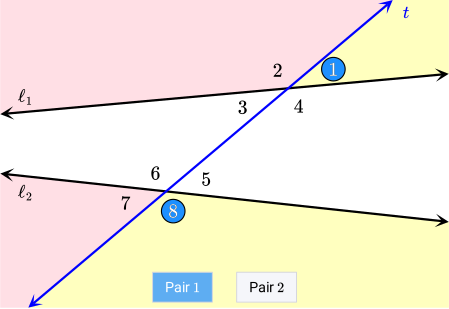 In the diagram, two pairs of same-side exterior angles can be identified.
Pair1: & ∠ 1 and ∠ 8 Pair2: & ∠ 2 and ∠ 7
If two parallel lines are cut by a transversal, then the same-side exterior angles are supplementary. The same logic in reverse can be applied. If two lines and a transversal form same-side exterior angles that are supplementary, then the lines are parallel.
In the diagram, two pairs of same-side exterior angles can be identified.
Pair1: & ∠ 1 and ∠ 8 Pair2: & ∠ 2 and ∠ 7
If two parallel lines are cut by a transversal, then the same-side exterior angles are supplementary. The same logic in reverse can be applied. If two lines and a transversal form same-side exterior angles that are supplementary, then the lines are parallel.
| If | Then |
|---|---|
| l_1 ∥ l_2 | m ∠ 1+m ∠ 8=180^(∘) and m ∠ 2 + m ∠ 7 = 180^(∘) |
| m ∠ 1+m ∠ 8=180^(∘) or m ∠ 2 + m ∠ 7 = 180^(∘) | l_1 ∥ l_2 |
Example
Share
Report error
Number of Countries in Africa
Dylan was loving the stories his parents were telling. He asked for them to tell another. One of his parents looked through the photos and saw an elephant 🐘. What a beautiful safari they had while in Zimbabwe.

Dylan's curiosity peaked. He asked for more details about Zimbabwe. His parents told him that it is a country in South East Africa whose flag is made up of many parallel lines. The flag reminds them of a riddle they were challenged with during the trip. Dylan's parent drew some angles on the flag to prepare the riddle.

His parent begins the riddle.
|
Consider what I drew on Zimbabwe's flag. The number of countries in all of Africa equals three times x. How many countries are there in Africa? |
{"type":"text","form":{"type":"math","options":{"comparison":"1","nofractofloat":false,"keypad":{"simple":true,"useShortLog":false,"variables":[],"constants":[]},"rendered":false},"text":" "},"formTextBefore":null,"formTextAfter":null,"answer":{"text":["54"]}}
Hint
Draw the sides of the angles marked on the flag. The horizontal sides are parallel to each other. The other sides can be connected to form a transversal. Notice that the marked angles are same-side exterior angles.
Solution
Try to relate the two marked angles in a way that the value of x can be found. It seems like a good idea to start by drawing the sides of these angles.

Notice that the horizontal sides are parallel to each other. Additionally, the sides lying on the border of the triangular region lie on the same line. For this reason, those two sides can be connected to form a transversal.

Dylan's parent drew the angles on top of the flag. Draw the angles now without the flag for a clearer view.
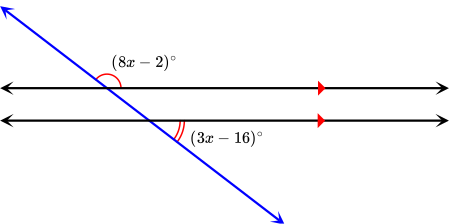
8x-2 + 3x-16 = 180
AddSubTerms
Add and subtract terms
11x - 18 = 180
AddEqn
LHS+18=RHS+18
11x = 198
DivEqn
.LHS /11.=.RHS /11.
x = 18
Discussion
Share
Report error
Relating Interior and Exterior Angles
When a transversal cuts two lines, the interior angles can be paired in two different ways: as alternate angles or same-side angles. Something similar happens with exterior angles. Notice that each of these pairs is made up of either two interior angles or two exterior angles.
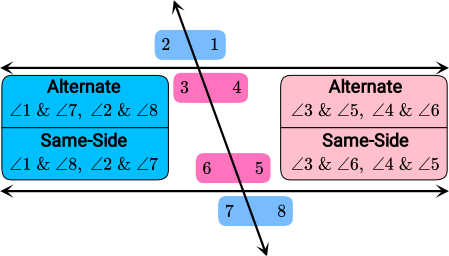
It is worth asking if an interior angle can be related to an exterior angle. The following concept establishes that type of relationship.
Concept
Share
Report error
Corresponding Angles
Consider a pair of lines cut by a transversal. The pairs of angles with different vertices that lie on the same position relative to the vertex are called corresponding angles. In the diagram, ∠ 1 and ∠ 5 are corresponding angles because they are both northeast of their vertices.
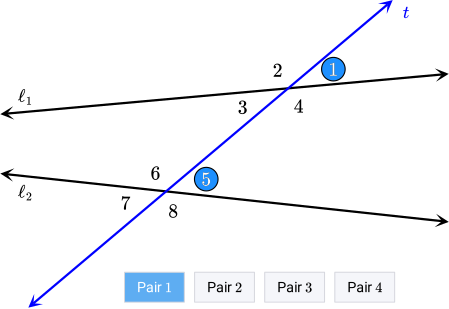 Alternatively, two angles are corresponding angles if they meet the following conditions.
- One angle is exterior and the other is interior.
- The angles have different vertices.
- The angles lie on the same side of the transversal.
In the diagram, four pairs of angles can be identified as corresponding angles.
| Pair | Position Relative to the Vertex | Position Relative to the Transversal |
|---|---|---|
| ∠ 1 and ∠ 5 | Northeast | Right |
| ∠ 2 and ∠ 6 | Northwest | Left |
| ∠ 3 and ∠ 7 | Southwest | Left |
| ∠ 4 and ∠ 8 | Southeast | Right |
If two parallel lines are cut by a transversal, then the corresponding angles are congruent. The same logic in reverse can be applied. If two lines and a transversal form corresponding angles that are congruent, then the lines are parallel.
| If | Then |
|---|---|
| l_1 ∥ l_2 | ∠ 1 ≅ ∠ 5, ∠ 2 ≅ ∠ 6, ∠ 3 ≅ ∠ 7, and ∠ 4 ≅ ∠ 8 |
| ∠ 1 ≅ ∠ 5, ∠ 2 ≅ ∠ 6, ∠ 3 ≅ ∠ 7, or ∠ 4 ≅ ∠ 8 | l_1 ∥ l_2 |
Example
Share
Report error
Bridges and Boats
Dylan is having an incredible weekend full of stories and learning. He is impressed with all the countries his parents have visited. So far, they have talked about France, Argentina, Egypt, and Zimbabwe. With a huge smile, Dylan's parents tell him that they have been to Japan too.

In Japan they sailed ⛵ along the longest suspension bridge in the world at the time. It is called Akashi Kaikyo Bridge. In disbelief, Dylan looked for those photos in the album.
a Dylan began to recognize things about the bridge. He notices how some of the diagonal beams of the bridge footings are parallel.
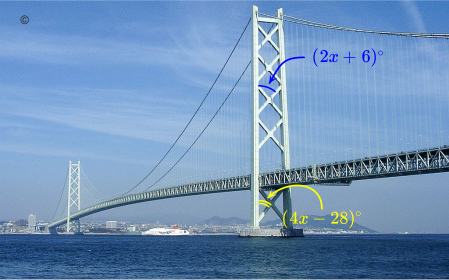
{"type":"text","form":{"type":"math","options":{"comparison":"1","nofractofloat":false,"keypad":{"simple":true,"useShortLog":false,"variables":[],"constants":[]},"rendered":false},"text":" "},"formTextBefore":null,"formTextAfter":"^(∘)","answer":{"text":["40"]}}
b Next, Dylan checks out a photo of their sailboat. He notices something in the middle of the sails. There are two bars parallel to each other.
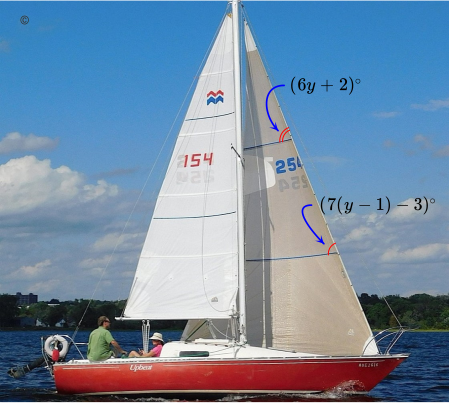
{"type":"text","form":{"type":"math","options":{"comparison":"1","nofractofloat":false,"keypad":{"simple":true,"useShortLog":false,"variables":[],"constants":[]},"rendered":false},"text":" "},"formTextBefore":null,"formTextAfter":"^(∘)","answer":{"text":["74"]}}
Hint
a Draw the sides of the angles labeled. The vertical sides of each angle lie over the vertical beam. As a result of that, they lie on the same line. The vertical beam acts like a transversal. Notice that the angles are corresponding angles because they lie on the same position relative to their vertices.
b Both angles are northwest to their vertices. Note these angles are corresponding angles.
Solution
a Try to find a relationship about the given angles to find the measure of the lower angle. It is a good idea to begin by drawing the sides of each angle.
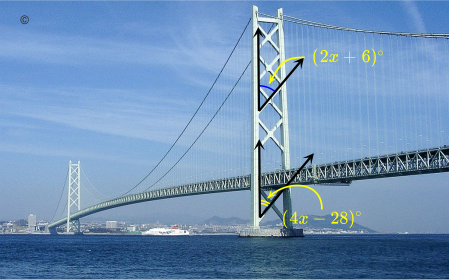
Notice that the vertical sides lie on the left vertical beam. That implies they lie on the same line. This line acts like a transversal cutting the two parallel diagonal beams.
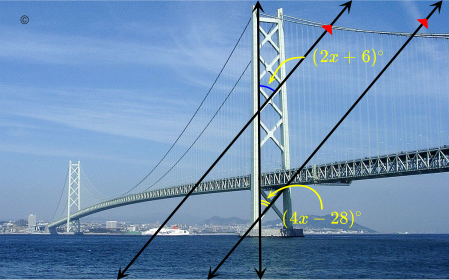
Draw the given information without the photo in the background for a clearer visual of the angles, lines, and transversal.
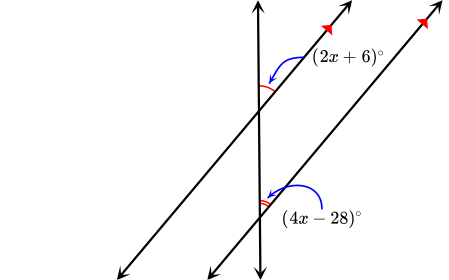
2x+6 = 4x-28
SubEqn
LHS-2x=RHS-2x
6 = 2x-28
AddEqn
LHS+28=RHS+28
34 = 2x
DivEqn
.LHS /2.=.RHS /2.
17 = x
RearrangeEqn
Rearrange equation
x = 17
(4x-28)^(∘)
Substitute
x= 17
(4* 17 - 28)^(∘)
Multiply
Multiply
(68 - 28)^(∘)
SubTerm
Subtract term
40^(∘)
b Start by drawing the lines containing the sides of the angles labeled.
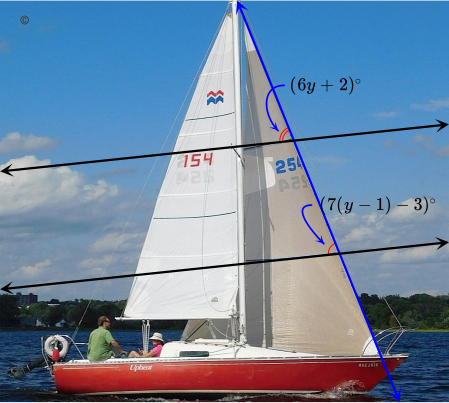
The two diagonal bars are parallel to each other according to what Dylan sees. The upper angle is exterior while the lower angle is an interior angle. Additionally, both angles lie on the same side of the transversal.
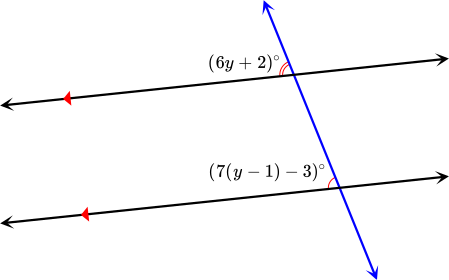
6y+2 = 7(y-1)-3
Distr
Distribute 7
6y+2 = 7y-7-3
SubTerm
Subtract term
6y+2 = 7y-10
SubEqn
LHS-6y=RHS-6y
2 = y-10
AddEqn
LHS+10=RHS+10
12 = y
RearrangeEqn
Rearrange equation
y = 12
Extra
World Longest Suspension BridgeThe Akashi Kaikyo Bridge was the longest suspension bridge in the world from April 1998 to March 2022. It connects the city of Kobe with Iwaya. In March 2022, the 1915 Çanakkale Bridge was opened in Türkiye. This bridge is 2023 meters long, only 32 meters longer than the Akashi Kaikyo Bridge.
Pop Quiz
Share
Report error
Identifying Pairs of Angles
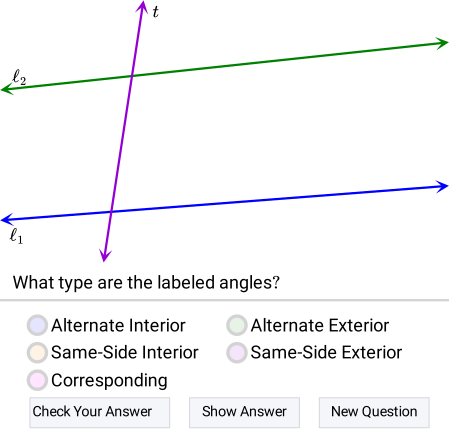
Consider two lines l_1 and l_2 that are cut by the transversal t. Identify the pair of angles labeled.
Closure
Share
Report error
Parallel Lines and Transversals
Dylan was fixing the fence of his home. He noticed that all the vertical boards were parallel, and the horizontal stringers formed angles with each vertical board.
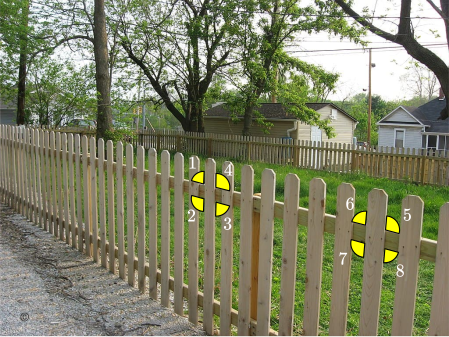
Making this discovery about the fence made him wonder about two things.
- Which angles are congruent to ∠ 7?
- Which angles are congruent to ∠ 1?
These two questions can be answered thanks to all of the information learned in this lesson. To start, focus on ∠ 7.
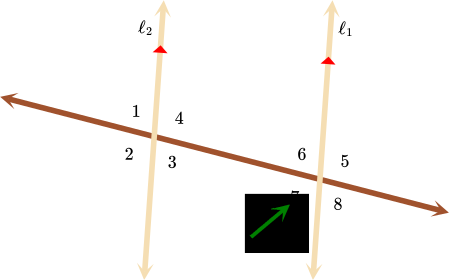
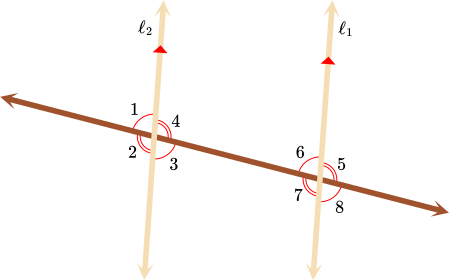
The diagram shows the lines of two vertical boards and the horizontal stringer. Notice that ∠ 7 can be related to some of the other angles according to its position relative to the transversal and to the parallel lines.
| Angles | Relation |
|---|---|
| ∠ 7 and ∠ 4 | Alternate Interior Angles |
| ∠ 7 and ∠ 3 | Consecutive Interior Angles |
| ∠ 7 and ∠ 2 | Corresponding Angles |
| ∠ 7 and ∠ 5 | Vertical Angles |
Since ∠ 7 and ∠ 5 are vertical, they are congruent. However, there is more! Because the lines l_1 and l_2 are parallel, some of the first three pairs of angles are congruent and some are supplementary.
| Angles | Relation | Relationship Between Measures |
|---|---|---|
| ∠ 7 and ∠ 4 | Alternate Interior Angles | Congruent |
| ∠ 7 and ∠ 3 | Consecutive Interior Angles | Supplementary |
| ∠ 7 and ∠ 2 | Corresponding Angles | Congruent |
| ∠ 7 and ∠ 5 | Vertical Angles | Congruent |
The angles congruent to ∠ 1 can be determined following a similar method. Again, study the given diagram. This time, write the relations for ∠ 1 in relation to ∠ 8, ∠ 5, ∠ 6, and ∠ 7.
| Angles | Relation | Relationship Between Measures |
|---|---|---|
| ∠ 1 and ∠ 8 | Alternate Exterior Angles | Congruent |
| ∠ 1 and ∠ 5 | Same-Side Exterior Angles | Supplementary |
| ∠ 1 and ∠ 6 | Corresponding Angles | Congruent |
| ∠ 1 and ∠ 3 | Vertical Angles | Congruent |
It is time to update the diagram. Recall that congruent angles are denoted with the same number of angle markers.
Angles and Transversals
Exercise 2.1
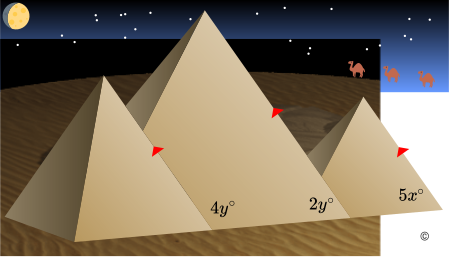
In geography class, Heichi saw a picture of the pyramids of Giza. He was inspired to design the following scene.
{"type":"text","form":{"type":"math","options":{"comparison":"1","nofractofloat":false,"keypad":{"simple":true,"useShortLog":false,"variables":[],"constants":[]},"rendered":false},"text":" "},"formTextBefore":"x=","formTextAfter":null,"answer":{"text":["12"]}}
security
report
code
security
report
code
Notice that the line passing through the three bases is a transversal that cuts the three right-hand sides. Let's make a diagram to illustrate it.
The angles with measures 5x^(∘) and 2y^(∘) are on the same position relative to their vertices — both are located northwest. Then, these angles are corresponding angles. The corresponding angles are congruent because the lines l_2 and l_3 are parallel. As a result, the angles have the same measure. 5x^(∘) &= 2y^(∘) &⇓ x &= 2y/5 As the equation shows, we can determine the value of x if we know the value of y.
Finding the Value of y
The angles with measures 4y^(∘) and 2y^(∘) are between lines l_1 and l_2 and on the same side of the transversal. With these characteristics, these two angles are consecutive interior angles. Even more, these angles are supplementary because the lines l_1 and l_2 are parallel. Their measures add up to 180^(∘). 4y^(∘) + 2y^(∘) = 180^(∘) Let's solve the equation for y.
Finding the Value of x
Let's substitute y=30 into the equation we wrote at the beginning. This way we will find the value of x.
Our calculations tell us that the value of x is 12. Lastly, let's update Heichi's diagram.
security
report
code
Consider two parallel lines l_1 and l_2 and a transversal t. If t is perpendicular to l_1, which of the following statements are true?
{"type":"multichoice","form":{"alts":["I.The transversal is also perpendicular to l_2.","II.Of the angles formed, any pair is supplementary.","III.The eight angles formed are congruent.","IV.The eight angles are right angles."],"noSort":true},"formTextBefore":"","formTextAfter":"","answer":[0,1,2,3]}
security
report
code
security
report
code
Let's begin by drawing a pair of parallel lines l_1 and l_2. Also, let's draw a transversal t that is perpendicular to l_1.
Corresponding angles are congruent when the lines being cut are parallel. This means that the upper-right exterior angle is also a right angle.
The transversal is also perpendicular to l_2, by definition of perpendicular lines. Statement I is true. I.The transversal is also perpendicular tol_2. ✓ Recall that when two lines are perpendicular, they form four right angles. For this reason, the eight angles in the diagram are right angles.
All right angles have the same measure. This implies that the eight angles are congruent. We conclude that statements III and IV are true. III.& The eight angles formed are congruent. ✓ IV.& The eight angles are right angles. ✓ Finally, notice that each angle has a measure of 90^(∘). As a result, the sum of the measures of any two angles is equal to 180^(∘). This characteristic suggests that any pair of angles are supplementary. Statement II is also true. II.& Of the angles formed, any pair is & supplementary. ✓ All four given statements are true.
security
report
code
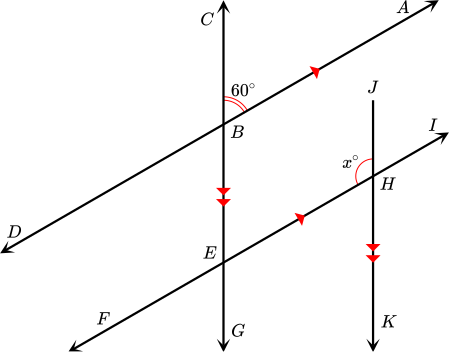
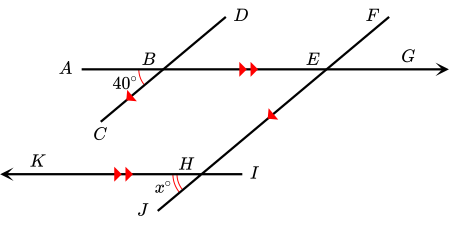
Find the value of x in each of the following diagrams.
{"type":"text","form":{"type":"math","options":{"comparison":"1","nofractofloat":false,"keypad":{"simple":true,"useShortLog":false,"variables":[],"constants":[]},"rendered":false},"text":" "},"formTextBefore":"x=","formTextAfter":null,"answer":{"text":["120"]}}
{"type":"text","form":{"type":"math","options":{"comparison":"1","nofractofloat":false,"keypad":{"simple":true,"useShortLog":false,"variables":[],"constants":[]},"rendered":false},"text":" "},"formTextBefore":"x=","formTextAfter":null,"answer":{"text":["40"]}}
security
report
code
security
report
code
Let's try to relate ∠ ABC to ∠ JHE somehow. These angles have nothing in common. Let's use the angles formed at angle E to connect them. Notice that AD is parallel to FI and CG is a transversal.
We can see that ∠ BEH and ∠ ABC are corresponding angles. Also, they are congruent because FI and AD are parallel. This implies that m∠ BEH = 60^(∘).
We also see that ∠ BEH and ∠ JHE are same-side interior angles.
Now focus on ∠ BEH and ∠ JHE. They are same-side interior angles formed by CG, JK, and FI. Also, these angles are supplementary because CG ∥ JK. In other words, their measures add up to 180^(∘). We can find the value of x using this information.
Let's relate ∠ JHK and ∠ ABC to determine the value of x. These two angles have nothing in common. Then, let's try to relate them using the angles formed at E. Notice that CD is parallel to FJ and AG is a transversal.
We see that ∠ ABC and ∠ GEF are alternate exterior angles. Since CD and FJ are parallel, these angles are congruent. We can then say that m∠ GEF = 40^(∘).
The diagram shows that ∠ GEF and ∠ JHK are alternate exterior angles. Even more, the angles are congruent because AG and IK are parallel. ∠ JHK &≅ ∠ GEF &⇓ m∠ JHK &= m∠ GEF &⇓ x &= 40 The value of x is 40.
security
report
code
Consider the following diagram.
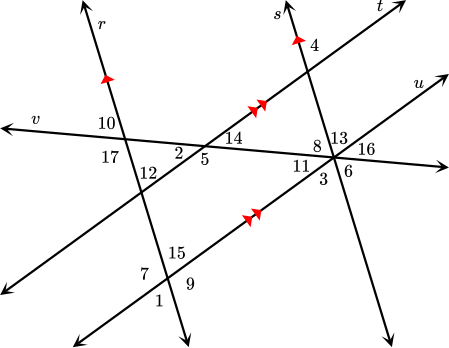
{"type":"text","form":{"type":"math","options":{"comparison":"1","nofractofloat":false,"keypad":{"simple":true,"useShortLog":false,"variables":[],"constants":[]},"rendered":false},"text":" "},"formTextBefore":"m∠ 10 =","formTextAfter":"^(∘)","answer":{"text":["68"]}}
{"type":"text","form":{"type":"math","options":{"comparison":"1","nofractofloat":false,"keypad":{"simple":true,"useShortLog":false,"variables":[],"constants":[]},"rendered":false},"text":" "},"formTextBefore":"m∠ 6 =","formTextAfter":"^(∘)","answer":{"text":["63"]}}
security
report
code
security
report
code
Notice that ∠ 10 is formed by the transversal v and the line r. Also line r is parallel to line s. We can determine the measure of ∠ 10 if we know the measure of one of the angles formed by s and v. With this in mind, let's try to find the measure of one of these angles.
The diagram shows that ∠ 10 and ∠ 17 are supplementary. Also, ∠ 17 and the angle formed by ∠ 3 and ∠ 11 are corresponding angles and so, they are congruent.
We can determine the measure of ∠ 17 if we find the measures of ∠ 3 and ∠ 11. Once done, we can find the measure of ∠ 10. Let's write two equations using this information. m∠ 10 + m∠ 17 = 180^(∘) & (I) m∠ 17 = m∠ 3 + m∠ 11 & (II) Our plan became to find the measures of ∠ 3 and ∠ 11. Funny, huh? Notice that ∠ 1 and ∠ 3 are corresponding angles. Also, these angles are congruent because r and s are parallel. m∠ 3=71^(∘) Similarly, ∠ 2 and ∠ 11 are corresponding angles. Even more, these angles are congruent because t∥ u and v is a transversal. m∠ 11=41^(∘) Let's now substitute the measures of ∠ 3 and ∠ 11 into Equation II.
Finally, let's substitute the measure of ∠ 17 into Equation I.
Let's take a look at the angles formed by the transversal s and the parallel lines t and u.
We can see that ∠ 4 can be related to some of the angles formed below, but not directly to ∠ 6. This is because ∠ 6 is formed by the other transversal. We also have that ∠ 3 and ∠ 4 are congruent because t∥ u and the angles are alternate exterior angles. ∠ 3 &≅ ∠ 4 &⇓ m∠ 3 &= 77^(∘) Let's study the angles formed by the transversal v and the parallel lines t and u.
The diagram shows that ∠ 5 and the angle formed by ∠ 3 and ∠ 6 are corresponding angles. Therefore, they are congruent. This means that the measure of ∠ 5 is equal to the sum of the measures of ∠ 3 and ∠ 6. m∠ 5 = m∠ 3 + m∠ 6 We can determine the measure of ∠ 6 by solving this equation. Remember that we were given the measure of ∠ 5 and we already found the measure of ∠ 3.
security
report
code
Consider the following diagram.
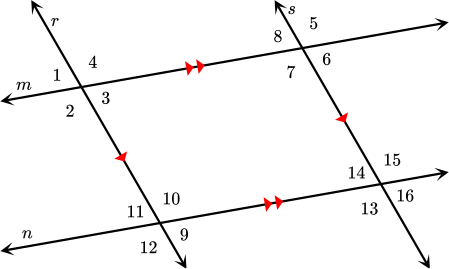
Use the diagram's characteristics to complete the following sentences.
|
∠ 5 and are corresponding angles. |
{"type":"multichoice","form":{"alts":["∠ 15","∠ 4","∠ 10","∠ 1","∠ 16","∠ 12"],"noSort":false},"formTextBefore":"","formTextAfter":"","answer":[0,1]}
|
∠ 3 and ∠ 13 are . |
{"type":"choice","form":{"alts":["Supplementary Angles","Same-Side Interior Angles","Congruent Angles","Alternate Interior Angles","Corresponding Angles"],"noSort":false},"formTextBefore":"","formTextAfter":"","answer":0}
|
∠ 10 and are alternate interior angles. |
{"type":"multichoice","form":{"alts":["∠ 2","∠ 13","∠ 3","∠ 14","∠ 1","∠ 16"],"noSort":false},"formTextBefore":"","formTextAfter":"","answer":[0,1]}
security
report
code
security
report
code
Our task is to identify those angles that are corresponding to ∠ 5. With this in mind, let's recall the definition of corresponding angles.
Corresponding Angles |- Consider a pair of lines cut by a transversal. The pairs of angles with different vertices that lie on the same position relative to the vertex are called corresponding angles.
Let's consider only one pair of parallel lines and a transversal at a time. We can start with lines r and s and the transversal m.
Notice that ∠ 4 and ∠ 5 both lie northeast of their vertices. This means they are corresponding angles. Let's now focus on the parallel lines m and n and the transversal s.
We see that ∠ 15 is northeast of the vertex, as is ∠ 5. Then, ∠ 5 and ∠ 15 are also corresponding angles. & ∠ 5and ∠ 4are corresponding angles. & ∠ 5and ∠ 15 are corresponding angles. Be aware that none of the angles formed by lines n and r can be corresponding to ∠ 5. This is because they do not have a line that is common to ∠ 5.
The first thing we note is that ∠ 3 and ∠ 13 are not formed by the same transversal. As a result, this pair of angles cannot be corresponding, nor alternate interior or exterior, nor same-side interior or exterior angles.
However, we can still relate them. Notice that ∠ 3 and ∠ 9 are corresponding angles — both are southeast of their vertices. Then, these angles are congruent. Also, the diagrams shows that ∠ 9 and ∠ 13 are same-side interior angles.
Both ∠ 9 and ∠ 13 are formed by two parallel lines and a transversal. This implies that these angles are supplementary and so, their measures add up to 180^(∘). m∠ 9 + m∠ 13 = 180^(∘) Remember that ∠ 3 ≅ ∠ 9 and so, they have the same measure. For this reason, we can substitute m∠ 3 for m∠ 9 into the equation. m∠ 3 + m∠ 13 = 180^(∘) The last equation implies that ∠ 3 and ∠ 13 are supplementary angles. This is the relation we were looking for!
This time we are asked to identify the angles that are alternate interior with ∠ 10. Then, let's recall that definition first.
Alternate Interior Angles |- Consider a pair of lines cut by a transversal. The pairs of interior angles with different vertices that lie on opposite sides of the transversal are called alternate interior angles.
With the definition in mind, let's consider the parallel lines m and n and the transversal r.
Notice that ∠ 2 is an interior angle whose vertex is different from the vertex of ∠ 10. Additionally, ∠ 2 and ∠ 10 are on opposite sides of the transversal. This implies that ∠ 10 and ∠ 2 are alternate interior angles. Let's move on and focus on the parallel lines r and s and the transversal n.
As before, we see that ∠ 10 and ∠ 13 are on opposite sides of the transversal, have different vertices, and are interior angles. All these characteristics make them alternate interior angles. & ∠ 10and ∠ 2are alternate interior angles. & ∠ 10and ∠ 13 are alternate interior angles. None of the angles formed by lines m and s can be alternate interior with ∠ 10. This is because they do not have a line in common to the lines forming ∠ 10.
security
report
code
Angles and Transversals
Recommended exercises
To get personalized recommended exercises, please login first.
Loading content
≤
>
■2
■▢
e▢
7
8
9
×
÷■1
=
=
√▢
▢√
∫▢▢
4
5
6
+
−
≤
<
log
ln
log▢
1
2
3
()
∣
sin
cos
tan
0
.
π
x
y
Loading content