2. Transformations and Rigid Motions of Figures
Sign In
An error ocurred, try again later!
Chapter 1
2.
Transformations and Rigid Motions of Figures
Transformations in geometry involve changing the position, size, or orientation of shapes. Rigid motions, a subset of transformations, only change the position and orientation without altering the size or shape. Examples of rigid motions include translations, rotations, and reflections. In the context of the coordinate plane, transformations can be visualized as mappings from one set of points to another. For instance, reflecting a shape across a vertical line will only change the x-coordinates of its points. The study of these transformations is crucial for understanding various geometric concepts and their applications in the real world, such as in car movements or reflections in mirrors.
Show less Show more expand_more 


Lesson Settings & Tools
| | 13 Theory slides |
| | 9 Exercises - Grade E - A |
| | Each lesson is meant to take 1-2 classroom sessions |
Transformations and Rigid Motions of Figures
Slide of 13
In Algebra, a function is a relation in which each input value is mapped to exactly one output value. This notion of function can be extended to Geometry. However, the inputs and outputs are not going to be numbers but points.
Catch-Up and Review
Here are a few recommended readings before getting started with this lesson.
Explore
Share
Report error
Transforming Polygons
In the applet below, four transformations can be applied to different polygons. Each transformation will affect the polygons in different ways.
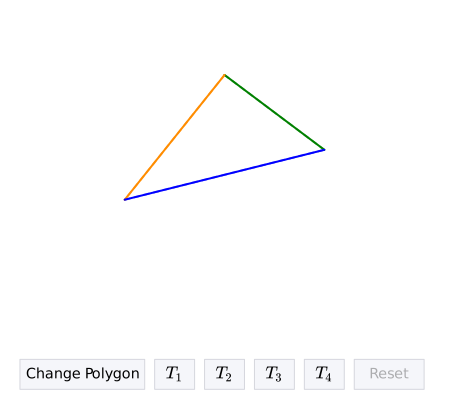 Compare the original polygon and the polygon obtained after applying a transformation. In a few words, describe the effect of each transformation.
Explore
Share
Report error
Mapping Polygons With Transformations
Consider the following pair of triangles. Here, △ ABC can be translated and rotated around point P. Is there a way of combining these two transformations so that △ ABC is mapped onto △ XYZ? If so, describe the steps used. 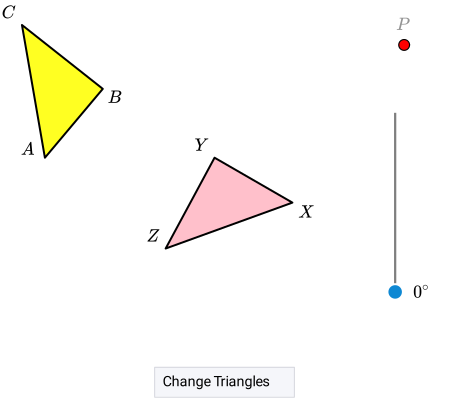 Do not worry if the triangles cannot be mapped onto each other. Rather, consider the function f(x)=x^2. For that function, there is no real value of x for which the output is -1! Remember this concept for later.
Discussion
Share
Report error
Transformations as Functions
As stated at the beginning of this lesson, in Geometry, there are functions whose inputs and outputs are points. Such functions are called transformations.
Concept
Share
Report error
Transformation
A transformation is a function that changes a figure in a particular way — it can change the position, size, or orientation of a figure. The original figure is called the preimage and the figure produced is called the image of the transformation. A prime symbol is often added to the label of a transformed point to denote that it is an image.
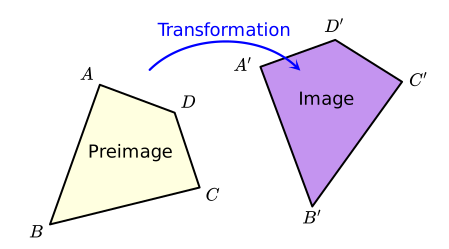
Transformations are sometimes expressed as a mapping because they map the inputs to the outputs. Note that an input can be a single point. T(x,y) → (x',y') Here, T is the transformation, x and y are the coordinates of the point of the preimage, and x' and y' are the coordinates of the point of the image.
Example
Share
Report error
Translating a Polygon
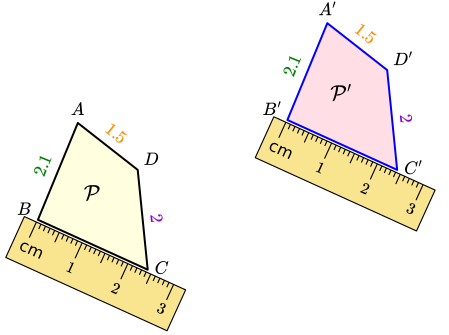
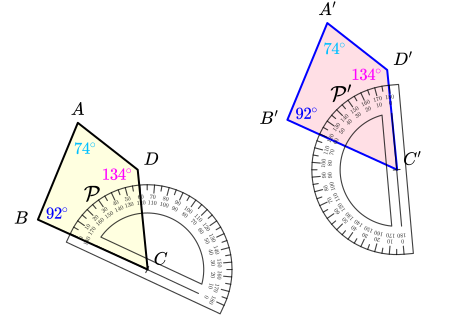
Consider a transformation T that translates a polygon. Below, its effect on polygon P is shown.
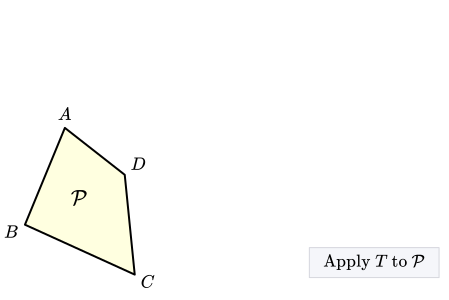 Compare the side lengths and angle measures between the preimage and the image. Based on this observation, what can be said about T?
Answer
Both P and P' have the same side lengths and angle measures. For this reason, it can be established that T does not affect the shape of P, which means that T preserves the side lengths and angle measures.
Hint
Use a ruler to find the side lengths of both polygons. To find the angle measures, use a protractor. Make a table comparing the dimensions of P and P'.
Solution
With the aid of a ruler, the side lengths of both polygons can be found.
Additionally, with the help of a protractor, the angle measures of both polygons can be determined.
It is beneficial to summarize the information about the side lengths and angle measures of both polygons in a table.
| Dimensions of P | Dimensions of P' |
|---|---|
| AB= 2.1 cm | A'B'= 2.1 cm |
| BC= 2.4 cm | B'C'= 2.4 cm |
| CD= 2 cm | C'D'= 2 cm |
| AD= 1.5 cm | A'D'= 1.5 cm |
| m∠ A=74^(∘) | m∠ A'=74^(∘) |
| m∠ B= 92^(∘) | m∠ B'= 92^(∘) |
| m∠ C=60^(∘) | m∠ C'=60^(∘) |
| m∠ D= 134^(∘) | m∠ D'= 134^(∘) |
As it can be seen in the table, both polygons P and P' have the same side lengths and angle measures. Therefore, it can be concluded that T does not affect the shape of P. In fact, T only affects the position of the polygon.
The transformation T preserves side lengths and angle measures.
It is important to note that the conclusion does not depend on the polygon but on the effect of T on the polygon. By transforming different polygons, the same conclusion can be obtained.
Example
Share
Report error
Rotating a Polygon
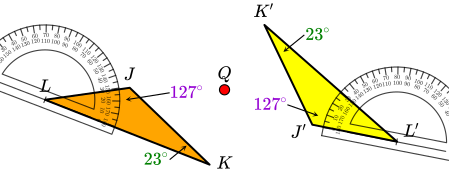
A transformation T rotates a polygon around a fixed point Q. Magdalena and Ali are trying to determine whether or not T modifies the shape of the polygon. Magdalena thinks that T does not change the shape, while Ali believes it does. They decided to apply T to a triangle.
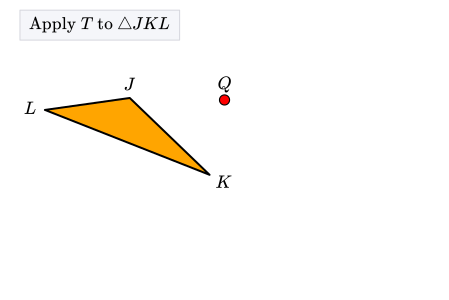 Compare the side lengths and angle measures between the preimage and the image. Who is correct?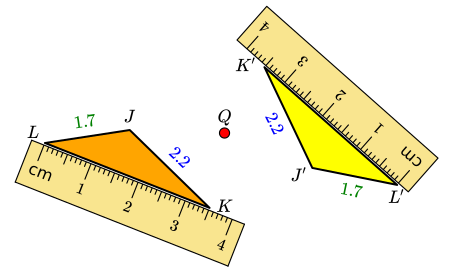
{"type":"choice","form":{"alts":["Ali","Magdalena"],"noSort":false},"formTextBefore":"","formTextAfter":"","answer":1}
Hint
For each triangle, use a ruler and a protractor to find the side lengths and angle measures, respectively. Make a table comparing the dimensions of △ JKL and △ J'K'L'.
Solution
With the aid of a ruler, the side lengths of both triangles can be found.
Next, with the help of a protractor, the angle measures of both triangles can be found.
The dimensions found can be summarized in a table.
| Dimensions of △ JKL | Dimensions of △ J'K'L' |
|---|---|
| JK= 2.2 cm | J'K'= 2.2 cm |
| KL= 3.5 cm | K'L'= 3.5 cm |
| JL= 1.7 cm | J'L'= 1.7 cm |
| m∠ J= 127^(∘) | m∠ J'= 127^(∘) |
| m∠ K= 23^(∘) | m∠ K'= 23^(∘) |
| m∠ L= 30^(∘) | m∠ L'= 30^(∘) |
As the table shows, both △ JKL and △ J'K'L' have the same side lengths and angle measures. Therefore, T does not affect the shape of the polygon. Consequently, Magdalena is correct.
The transformation T preserves side lengths and angle measures.
It is important to note that the conclusion does not depend on the polygon chosen. Instead, the conclusion depends on the effect of T on the polygon. By using different polygons, the same conclusion can be obtained.
Discussion
Share
Report error
Rigid Motions and Their Properties
Notice that the two transformations previously studied share the same property. The transformations neither affected the size nor the shape of the polygon. Still, they did affect the polygon's position on the plane. These types of transformations are called rigid motions.
Concept
Share
Report error
Rigid Motion
A rigid motion, or isometry, is a transformation that preserves the distance between any two points on the preimage. AB=A'B' The following diagram displays two logos. The logo with the points A and B is the preimage, and the logo with the points A' and B' is the image. The image is the result of a rigid motion because the distances between all points are preserved.

Extra
A Composition of Rigid MotionsA composition of a translation, a rotation, and a reflection is also a rigid motion because it preserves the distance between any two points on the preimage.
 Notice that this type of transformation also preserves the angle measures of the figure. However, its position and orientation can sometimes be affected.
Example
Share
Report error
Reflecting a Polygon
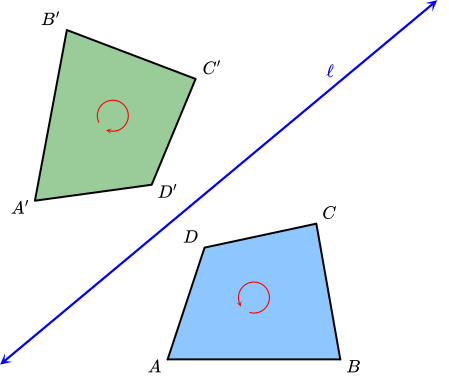
Ali and Magdalena are now working with a new transformation T. This transformation reflects a figure across a line as if the line was a mirror. In one of the attempts, they used a quadrilateral.
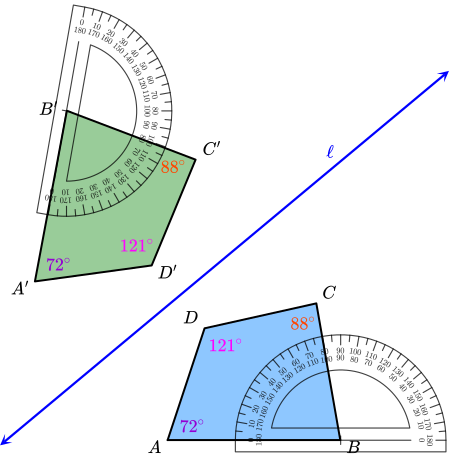
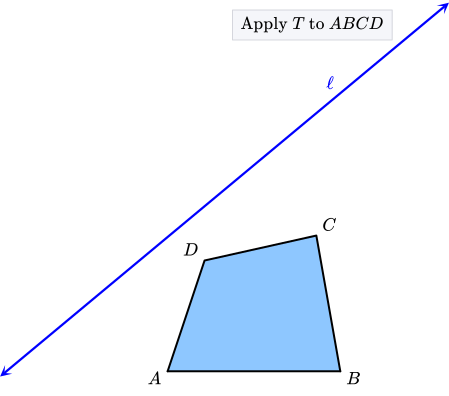 After seeing the result, Ali concluded that T is a rigid motion. However, Magdalena said it is not. Who is correct? Why does Magdalena think that T is not a rigid motion?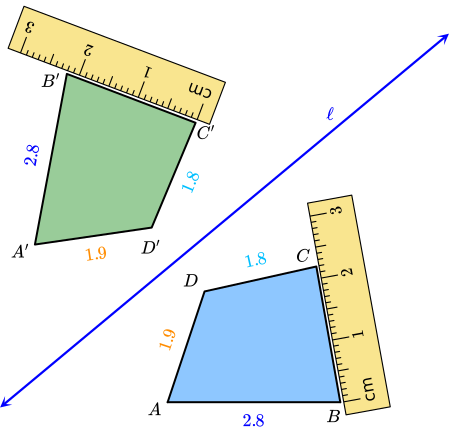
{"type":"choice","form":{"alts":["Ali","Magdalena"],"noSort":false},"formTextBefore":"","formTextAfter":"","answer":0}
Answer
Ali is correct, T is a rigid motion. Magdalena could be confused because the transformation changes the orientation of the quadrilateral.
Solution
Using a ruler, the side lengths of both quadrilaterals can be found.
Next, with a protractor, the angle measures can be found.
In the table, all the dimensions found are summarized putting on the same row the dimensions of corresponding parts. For example, AB and A'B' will be in the same row.
| Dimensions of ABCD | Dimensions of A'B'C'D' |
|---|---|
| AB= 2.8 cm | A'B'= 2.8 cm |
| BC= 2.2 cm | B'C'= 2.2 cm |
| CD=1.8 cm | C'D'=1.8 cm |
| AD= 1.9 cm | A'D'= 1.9 cm |
| m∠ A= 72^(∘) | m∠ A'= 72^(∘) |
| m∠ B=80^(∘) | m∠ B'=80^(∘) |
| m∠ C= 88^(∘) | m∠ C'= 88^(∘) |
| m∠ D= 121^(∘) | m∠ D'= 121^(∘) |
As the table shows, both quadrilaterals ABCD and A'B'C'D' have the same side lengths and angle measures. This means that T does not affect the shape of the polygon. Consequently, Ali is correct.
The transformation T is a rigid motion.
Although T is a rigid motion, notice that the orientation of the preimage and the image are not the same. In the preimage, the vertices from A to D are positioned counterclockwise, while in the image, they are positioned clockwise.
This fact could be what made Magdalena think that T is not a rigid motion. Notice that the transformations studied before preserve orientations.
Explore
Share
Report error
Rigid Transformations
Consider a triangle and its image under a rigid motion drawn on a sketch pad. If the transformation is a translation or a rotation, by using a tracing paper the preimage can be mapped onto the image without peeling off the tracing paper from the sketch pad.
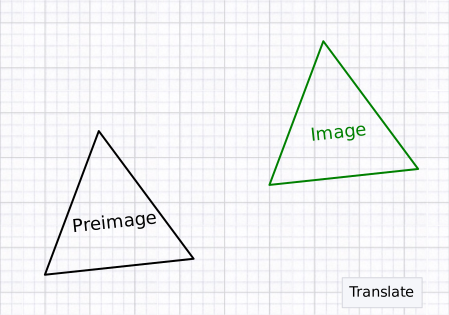 Conversely, suppose that transformation is a reflection. In that case, it is not possible to map the preimage onto the image without peeling off the tracing paper from the sketch pad. The reason is that reflections change the orientation of the figures.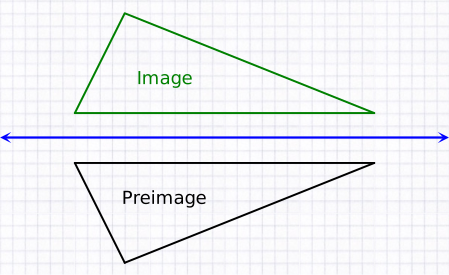
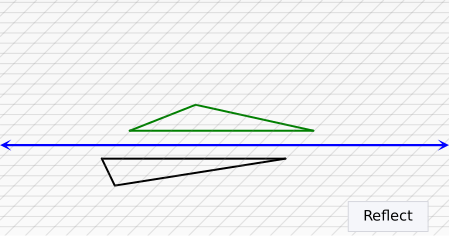 For this reason, reflections are sometimes called rigid transformations instead of rigid motions. Although all the transformations studied so far were applied to polygons, keep in mind that transformations can be applied to any point on the coordinate plane. The reason for using geometric shapes is that they make it easier to see the effect produced by a transformation and whether the transformation is a rigid motion or not.
Mapping the preimage onto the image would necessitate folding the tracing paper along the line of reflection. However, by doing this the tracing paper peels off the sketch pad making a three-dimensional movement.
Example
Share
Report error
Applying Different Transformations
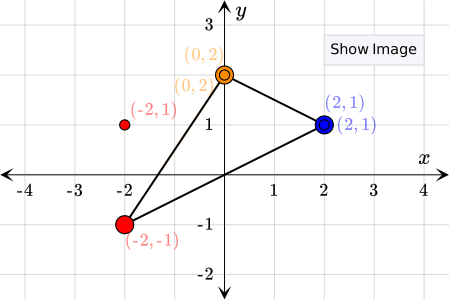
Consider a triangle with vertices A(-2,-1), B(2,1), and C(0,2).
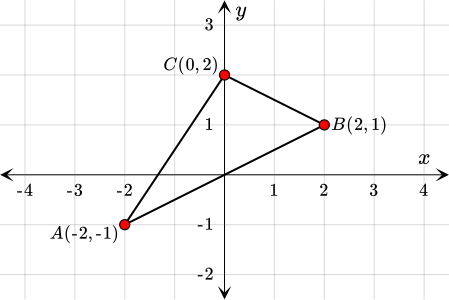
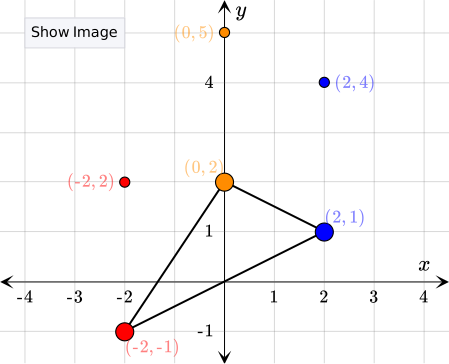
a Draw the image of △ ABC after increasing the y-coordinate of each point by 3 units.
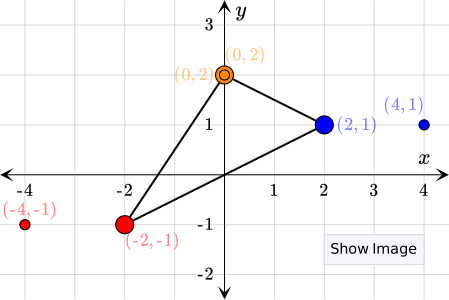
b Draw the image of △ ABC after doubling the x-coordinate of each point.
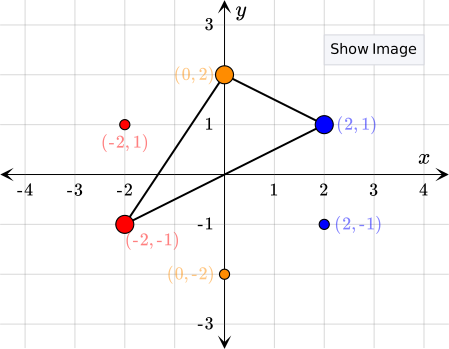
c Draw the image of △ ABC after changing the sign of the y-coordinate of each point.
d Draw the image of △ ABC after taking the absolute value of the y-coordinate of each point.
e Which of the above options represent rigid motions?
{"type":"multichoice","form":{"alts":["A","B","C","D"],"noSort":true},"formTextBefore":"","formTextAfter":"","answer":[0,2]}
Answer
a 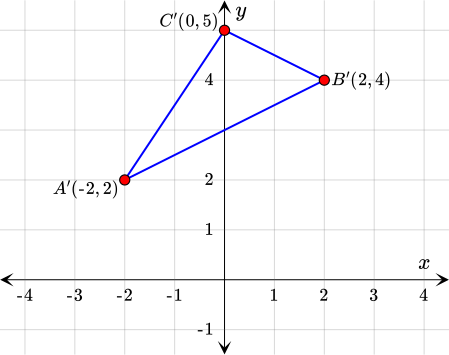
b 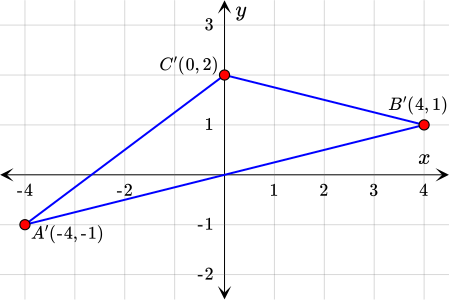
c 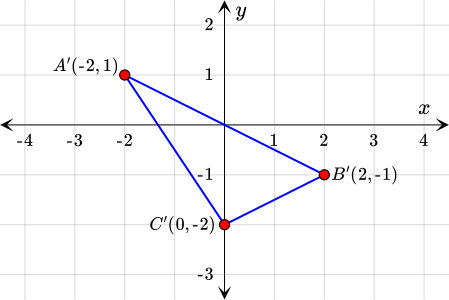
d 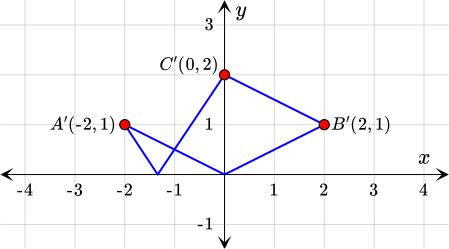
e A and C are rigid motions. The operation given in part D is not even a transformation.
Solution
a This first operation requires adding 3 units to the y-coordinate of each point while keeping the same x-coordinate. Start by performing this operation on the vertices of △ ABC.
| Original Vertex | Add 3 to Each y-Coordinate | New Vertex |
|---|---|---|
| A(-2,-1) | (-2,-1 + 3) | A'(-2,2) |
| B(2,1) | (2,1 + 3) | B'(2,4) |
| C(0,2) | (0,2 + 3) | C'(0,5) |
b Doubling each x-coordinate is the same as multiplying them by 2. This time, the y-coordinate remains unchanged.
| Original Vertex | Double each x-Coordinate | New Vertex |
|---|---|---|
| A(-2,-1) | ( 2(-2),-1) | A'(-4,-1) |
| B(2,1) | ( 2(2),1) | B'(4,1) |
| C(0,2) | ( 2(0),2) | C'(0,2) |
c Changing the sign of each y-coordinate is the same as multiplying them by -1. Here, the x-coordinates remain the same.
| Original Vertex | Multiply Each y-Coordinate by -1 | New Vertex |
|---|---|---|
| A(-2,-1) | (-2,-1( -1)) | A'(-2,1) |
| B(2,1) | (2,1( -1)) | B'(2,-1) |
| C(0,2) | (0,2( -1)) | C'(0,-2) |
d Recall that the absolute value of a positive number is the same number. Conversely, the absolute value of a negative number is its opposite.
| Original Vertex | Taking the Absolute Value of Each y-Coordinate | New Vertex |
|---|---|---|
| A(-2,-1) | (-2,|-1|) | A'(-2,1) |
| B(2,1) | (2,|1|) | B'(2,1) |
| C(0,2) | (0,|2|) | C'(0,2) |
foldedthe part of the triangle that is below the x-axis along the x-axis. Consider also the points P(-1,-0.5) and Q(-1,0.5).
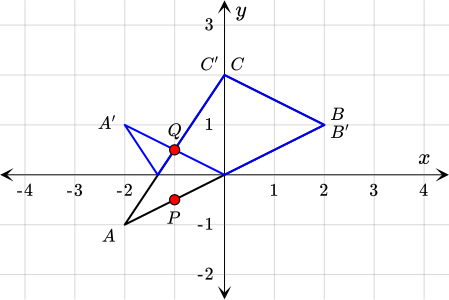
These two points have the same image under this operation — P'(-0.5,0.5) and Q'(-0.5,0.5). This means that this is not a one-to-one operation. Consequently, it is not even a transformation!
e As previously stated, the transformations in parts A and C are rigid motions.
Discussion
Share
Report error
Combining Transformations
Consider the fact that two or more functions can be applied one after the other to an input. Similarly, two or more transformations can be applied one after the other to a preimage.
Concept
Share
Report error
Composition of Transformations
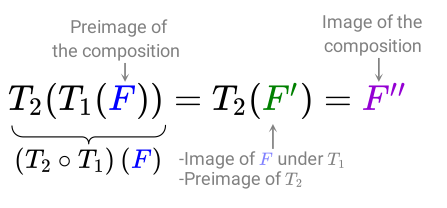
A composition of transformations, or sequence of transformations, is a combination of two or more transformations. In a composition, the image produced by the first transformation is the preimage of the second transformation. The notation is similar to the notation used for functions in algebra.
Example
Share
Report error
Applying a Composition of Transformations
Magdalena and Ali were each given a rigid motion that they have to apply to pentagon ABCDE one after the other in a particular order.
- Magdalena has to perform a translation of 2 units to the right and 1 down.
- Ali has to perform a 90^(∘) counterclockwise rotation about the origin.
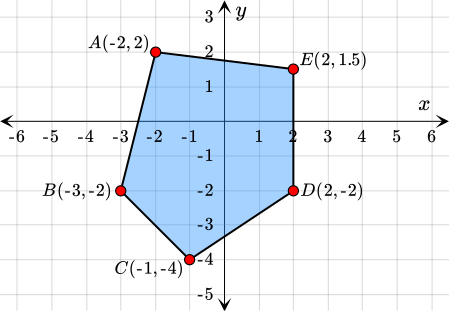
Their teacher said that after applying both transformations in the correct order, the image of B(-3,-2) is B''(4,-4). Who should apply the transformation first?
{"type":"choice","form":{"alts":["Ali","Magdalena"],"noSort":false},"formTextBefore":"","formTextAfter":"","answer":0}
{"type":"text","form":{"type":"point2d","options":{"comparison":"1","nofractofloat":false,"keypad":{"simple":true,"useShortLog":false,"variables":[],"constants":[]},"rendered":false,"decimal":false,"function":false},"text":" "},"formTextBefore":null,"formTextAfter":null,"answer":{"text1":"5","text2":"1"}}
Hint
If the point (x,y) is rotated 90^(∘) counterclockwise about the origin, its new coordinates will be (- y,x).
Solution
Both compositions should be tried to determine what is the correct order. First, perform the translation followed by the rotation. Then, perform the rotation followed by the translation.
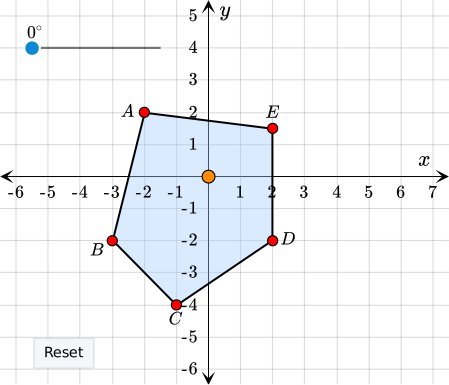 The table contains B'' and C'' — the images of B and C — after each composition is performed.
| Preimage | Translation Followed by Rotation | Rotation Followed by Translation |
|---|---|---|
| B(-3, -2) | B''(3,-1) | B''(4,-4) |
| C(-1, -4) | C''(5,1) | C''(6,-2) |
The teacher said that performing the transformations in the correct order maps B(-3,-2) onto B''(4,-4). This means that the correct order is the rotation followed by the translation. Therefore, Ali goes first. If the transformations are not performed in the correct order, the image of C(-1, -4) is C''(5,1).
Closure
Share
Report error
Transformations in the Real World
Keep in mind that transformations transcend beyond paper and can be used for many purposes. In the real world, transformations occur everywhere. For example, in nature, lakes perform reflections of landscapes.

Also, different types of transformations can be seen by observing a car, either in rest or in movement.
- A car moving in a straight line represents a translation.
- The wheels of a moving car show rotations.
- Rear-view and side-view mirrors make reflections.
- Even car windows make reflections, and depending on the object's position, they can also make distortions.

Transformations and Rigid Motions of Figures
Exercise 3.1
Consider the following transformation.
{"type":"text","form":{"type":"point2d","options":{"comparison":"1","nofractofloat":false,"keypad":{"simple":true,"useShortLog":false,"variables":["x"],"constants":["PI"]},"rendered":false,"decimal":false,"function":false},"text":" "},"formTextBefore":"O","formTextAfter":null,"answer":{"text1":"3","text2":"0"}}
{"type":"text","form":{"type":"point2d","options":{"comparison":"1","nofractofloat":false,"keypad":{"simple":true,"useShortLog":false,"variables":["x"],"constants":["PI"]},"rendered":false,"decimal":false,"function":false},"text":" "},"formTextBefore":"O","formTextAfter":null,"answer":{"text1":"3","text2":"6"}}
security
report
code
security
report
code
The given transformation tells us to go from P to O by adding 5 to the x-coordinate and 1 to the y-coordinate. This describes a translation. With this information, we can write two equations. Translation:& (x,y) → (x + 5,y + 1) P ( x_P,y_P):& ( a-1,a) O ( x_O,y_O):& ( 2b+1,3b-3) [-1em] Equation (I):& a-1 + 5= 2b+1 Equation (II):& a + 1= 3b-3 If we combine these equations, we get a system of equations which we can solve by using the Substitution Method.
Now we can determine the coordinates of O by substituting b= 1 into the expressions. O(2( 1)+1,3( 1)-3) → O(3,0)
Again, like in Part A we have a transformation which takes us from P to O. This time, we must multiply the x- and y-coordinate by 3, which means we are dealing with a dilation. We can write two equations using this information. Dilation:& (x,y) → ( 3x, 3y) P ( x_P,y_P):& ( 2a-3,b-1) O ( x_O,y_O):& ( b,2a+2) [-1em] Equation (I):& 3( 2a-3)= b Equation (II):& 3( b-1)= 2a+2 If we combine these equations, we get a system of equations which we can solve by using the Substitution Method.
Now we can determine the coordinates of O by substituting b= 3, and a= 2 into the expressions. O( 3,2( 2)+2) → O(3,6)
security
report
code
Transformations and Rigid Motions of Figures
Recommended exercises
To get personalized recommended exercises, please login first.
Loading content
≤
>
■2
■▢
e▢
7
8
9
×
÷■1
=
=
√▢
▢√
∫▢▢
4
5
6
+
−
≤
<
log
ln
log▢
1
2
3
()
∣
sin
cos
tan
0
.
π
x
y
Loading content