3. Sums of Geometric Series
Sign In
An error ocurred, try again later!
Chapter 8
3.
Sums of Geometric Series
This lesson delves into the concept of geometric series, a sequence where terms increase by a constant ratio. The focus is on understanding how to determine the sum of these series, both for finite and infinite cases. Real-life examples, such as the spread of a viral disease in a school and the behavior of a bouncing ball, are used to illustrate the concept. The lesson emphasizes the conditions under which a series converges to a specific number and when it doesn't. It also touches upon the importance of the common ratio in determining the behavior of the series. The lessons are designed to provide a comprehensive understanding, preparing students for more advanced topics.
Show less Show more expand_more 


Lesson Settings & Tools
| | 15 Theory slides |
| | 12 Exercises - Grade E - A |
| | Each lesson is meant to take 1-2 classroom sessions |
Sums of Geometric Series
Slide of 15
In the case where the terms of a sequence increase by a constant ratio, the sum of the sequence can be modeled by geometric series. This lesson will introduce how to find the sum of geometric series for both finite and infinite cases.
Catch-Up and Review
Here are a few recommended readings before getting started with this lesson.
Challenge
Share
Report error
Finding the Sum
Consider the following sum of a sequence. 1/2 + 1/20 + 1/200 + 1/2000 + ⋯
a Is the sum finite or infinite?
{"type":"choice","form":{"alts":["Finite","Infinite"],"noSort":false},"formTextBefore":"","formTextAfter":"","answer":0}
{"type":"text","form":{"type":"math","options":{"comparison":"1","nofractofloat":false,"keypad":{"simple":true,"useShortLog":false,"variables":[],"constants":[]},"rendered":false},"text":" "},"formTextBefore":null,"formTextAfter":null,"answer":{"text":["0.56"]}}
Discussion
Share
Report error
Geometric Series
A geometric series is the sum of the terms of a geometric sequence. c|c Geometric & Geometric Sequence & Series [0.5em] 1,2,4,8,... & 1+2+4+8+⋯ The explicit rule of the geometric sequence above is a_n=2^(n-1). This rule can be used to write the series using sigma notation. ccc Sum of & & Sum of Infinite Terms & & nTerms [0.5em] ∑ _(i=1)^(∞) 2^(i-1) & & ∑ _(i=1)^n 2^(i-1)
The sum of an infinite or a finite geometric series can be found by using its corresponding formula.Pop Quiz
Share
Report error
Identifying Geometric Series
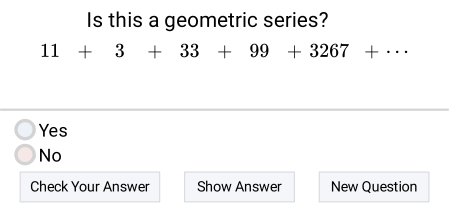
The following applet shows the first five terms of a sum. Identify whether the given sum is a geometric series or not.
Discussion
Share
Report error
Finite Geometric Series
Let a_1 and r be the first term and the common ratio, respectively, of a geometric sequence with n terms, where r≠1. The sum of the related finite geometric series can be found by using the following formula.
S_n=a_1(1-r^n)/1-r, r≠ 1
Proof
Finite SumTo derive the formula for a geometric series, a geometric sequence of n terms with the first term a_1 and the common ratio r will be considered. a_1, a_1r, a_1r^2, ... , a_1r^(n-1)
All the terms will be added to express the series and a_1 will be factored out.
Then, both sides of the equation will be multiplied by (1-r) and the resulting equation simplified.
Notice that the like terms are ordered in minus-plus pairs. This means that after simplifying, they will cancel out and only the first and last terms will remain.
The formula for the sum of a finite geometric series has been derived.
S_n=a_1(1+r+r^2+...+r^(n-1))
MultEqn
LHS * (1-r)=RHS* (1-r)
S_n(1-r)=a_1(1+r+r^2+...+r^(n-1))(1-r)
Distr
Distribute (1-r)
S_n(1-r)=a_1(1(1-r)+r(1-r)+r^2(1-r)+...+r^(n-1)(1-r))
Multiply
Multiply
S_n(1-r)=a_1(1-r+r-r^2+r^2-r^3+...+r^(n-1)-r^n)
S_n(1-r)=a_1(1-r+r-r^2+r^2-r^3+...+r^(n-2)-r^(n-1)+r^(n-1)-r^n)
AddSubTerms
Add and subtract terms
S_n(1-r)=a_1(1-r^n)
DivEqn
.LHS /(1-r).=.RHS /(1-r).
S_n=a_1(1-r^n)/1-r
S_n=a_1(1-r^n)/1-r
Example
Share
Report error
The Number of Cases of Sickness at School
Tearrik goes to North High School. One day he suddenly started feeling sick at school. Later it was determined that according to school records, Tearrik's three best friends started feeling sick the next day, nine more students stayed home sick on the third day, and so on.
 Within a few days, it was discovered that a new kind of viral disease was spreading rapidly through the school, with each infected student transmitting the virus to three other students each day.
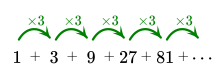 This means that a common ratio exists between the number of newly-infected students each day. Therefore, their sum represents a geometric series. With this in mind, an explicit rule can be written to find the number of newly-infected students on the n^\text{th} day.
a_n=a_1 * r^(n-1)
Since only Tearrik fell ill on the first day, the first term of the sequence is a_1= 1 and the common ratio r= 3. Substitute these values into the formula to find the explicit rule for this sequence.
The number of newly-infected students on the n^\text{th} day can be represented by the formula a_n=3^(n-1).
S_n=a_1(1-r^n)/1-r
Since the total number of infected students on the 7^\text{th} day is required, n= 7 will be substituted into the formula. Remember that the first term a_1 is 1 and the common ratio r is 3.
If the school does not suspend classes, there will be 1093 infected students in 7 days.
This means that a common ratio exists between the number of newly-infected students each day. Therefore, their sum represents a geometric series. With this in mind, an explicit rule can be written to find the number of newly-infected students on the n^\text{th} day.
a_n=a_1 * r^(n-1)
Since only Tearrik fell ill on the first day, the first term of the sequence is a_1= 1 and the common ratio r= 3. Substitute these values into the formula to find the explicit rule for this sequence.
The number of newly-infected students on the n^\text{th} day can be represented by the formula a_n=3^(n-1).
S_n=a_1(1-r^n)/1-r
Since the total number of infected students on the 7^\text{th} day is required, n= 7 will be substituted into the formula. Remember that the first term a_1 is 1 and the common ratio r is 3.
If the school does not suspend classes, there will be 1093 infected students in 7 days.
a Write an explicit rule to represent the number of students who become infected on a given day.
{"type":"text","form":{"type":"math","options":{"comparison":"1","nofractofloat":false,"keypad":{"simple":false,"useShortLog":false,"variables":["n"],"constants":[]},"rendered":false},"text":" "},"formTextBefore":"a_n=","formTextAfter":null,"answer":{"text":["3^{n-1}","\\dfrac{3^n}{3}"]}}
b Calculate the total number of infected students that there would be in 7 days if the school does not suspend classes.
{"type":"text","form":{"type":"math","options":{"comparison":"1","nofractofloat":false,"keypad":{"simple":true,"useShortLog":false,"variables":[],"constants":[]},"rendered":false},"text":" "},"formTextBefore":null,"formTextAfter":"students","answer":{"text":["1093"]}}
Hint
a The number of newly-infected students each day makes a geometric sequence.
b Use the formula for the sum of a geometric series.
Solution
a It is given that the number of newly-infected students is triple the number of students that were infected the day before.
a_n=a_1 * r^(n-1)
SubstituteII
a_1= 1, r= 3
a_n= 1 * 3^(n-1)
IdPropMult
Identity Property of Multiplication
a_n=3^(n-1)
b To calculate the total number of infected students on any given day, the formula for the sum of a finite geometric series will be used.
S_n=a_1(1-r^n)/1-r
SubstituteValues
Substitute values
S_7=1(1- 3^7)/1- 3
▼
Evaluate right-hand side
IdPropMult
Identity Property of Multiplication
S_7=1-3^7/1-3
ExpandFrac
a/b=a * (-1)/b * (-1)
S_7=3^7-1/3-1
CalcPow
Calculate power
S_7=2187-1/3-1
SubTerms
Subtract terms
S_7=2186/2
CalcQuot
Calculate quotient
S_7=1093
Example
Share
Report error
Geometric Series in Sigma Notation
As the number of infected students increased, the school decided to start a quarantine period. During the quarantine period at North High School, lessons started being taught online. In one of his math lessons, Tearrik's math teacher introduced a geometric series an example written using sigma notation.
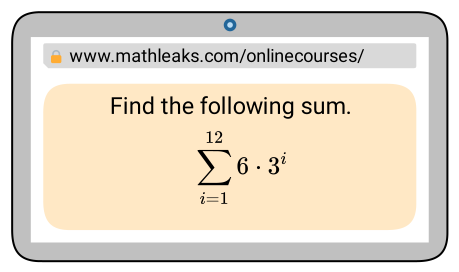
{"type":"text","form":{"type":"math","options":{"comparison":"1","nofractofloat":false,"keypad":{"simple":true,"useShortLog":false,"variables":["x"],"constants":["PI"]},"rendered":false},"text":" "},"formTextBefore":"Sum:","formTextAfter":null,"answer":{"text":["4782960"]}}
Hint
Use the formula for the sum of a finite geometric series.
Solution
The given sum is a finite geometric series. Therefore, the formula for the sum of a finite geometric series can be used to find this sum.
S_n=a_1(1-r^n)/1-r , r ≠ 1
In this formula, a_1 is the first term, r is the common ratio, and n is the number of terms. First, substitute i=1 into the expression given on the right side of the sigma notation to find a_1.
The first term is 18. Notice that the summation index i is placed as a single exponent of 3, meaning that the next term can be found by multiplying the previous one by 3. This makes the common ratio r=3. Another way to find r is to divide the second term by the first. Start by substituting i=2 into the given expression.
Now calculate the ratio of a_2 to a_1. a_2/a_1=54/18 ⇒ r=3
The common ratio was found to be 3. Since the lower limit of the sigma notation is 1 and the upper limit of the sigma notation is 12, there are 12 terms in the series in total, so n= 12. The sum can be calculated with these values. To do so, substitute all the values into the formula for S_n and simplify.
Pop Quiz
Share
Report error
Calculating Finite Geometric Series
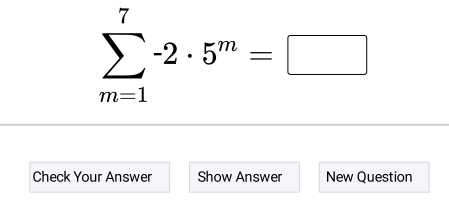
Calculate the sum of all the terms of the given finite geometric series written in summation notation. Remember that the formula for the sum of a geometric series can be used rather than adding the terms one by one.
Discussion
Share
Report error
Infinite Geometric Series
Let a_1 and r be the first term and the common ratio, respectively, of a geometric sequence with n terms, where r≠1. For an infinite series, if the common ratio r is greater than - 1 and less than 1 — in other words, if |r|<1 — then the sum can be found by using the following formula.
S_(∞)=a_1/1-r, - 1
This means that the sum converges on a number. If the common ratio r is less than or equal to - 1 or greater than or equal to 1 — if |r| ≥ 1 — then the sum diverges. In such cases, there is no sum for the infinite geometric series.
Proof
Infinite SumTo derive the formula for the sum of an infinite geometric series with -1number between -1 and 1, the value of r^n becomes very small as the value of n increases. In other words, it gets closer to 0 as n approaches infinity.
r^n [n→ ∞] 0
Therefore, r^n=0 can be substituted into the standard formula and the resulting equation simplified.
The formula for the sum of an infinite geometric series with -1
S_n=a_1(1-r^n)/1-r
SubstituteII
r^n= 0, n= ∞
S_(∞)=a_1(1- 0)/1-r
SubTerm
Subtract term
S_(∞)=a_1 (1)/1-r
IdPropMult
Identity Property of Multiplication
S_(∞)=a_1/1-r
S_(∞)=a_1/1-r
Example
Share
Report error
Solving Examples of Geometric Series
In the next math lesson, Tearrik's math teacher continued with the topic geometric series and this time she introduced the first few terms of two different geometric series as examples.
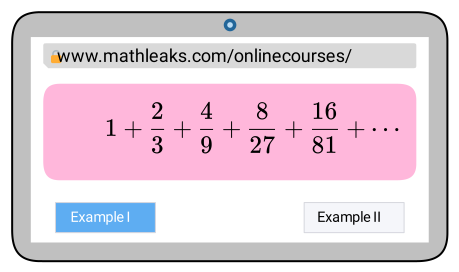
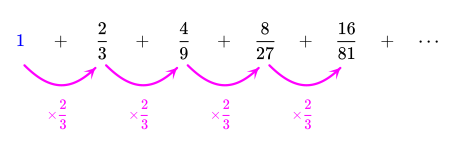 As shown, the common ratio is 23. Since the absolute value of 23 less than 1, it means that the sum of the series does converge to a number.
|r|=|2/3| ⇒ |r|=2/3 < 1
Therefore, it is possible to find its sum by using the formula for the sum of an infinite series.
S_(∞)=a_1/1-r
To find the sum, substitute a_1= 1 and r= 23 into the formula and evaluate.
The sum of the infinite geometric series given in Example I is 3.
The common ratio of the given series in Example II is - 54.
As shown, the common ratio is 23. Since the absolute value of 23 less than 1, it means that the sum of the series does converge to a number.
|r|=|2/3| ⇒ |r|=2/3 < 1
Therefore, it is possible to find its sum by using the formula for the sum of an infinite series.
S_(∞)=a_1/1-r
To find the sum, substitute a_1= 1 and r= 23 into the formula and evaluate.
The sum of the infinite geometric series given in Example I is 3.
The common ratio of the given series in Example II is - 54. 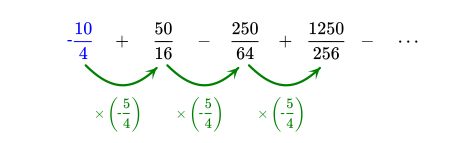
a Determine whether the geometric series in Example I converges or diverges. If it converges, find its sum.
b Determine whether the geometric series in Example II converges or diverges. If it converges, find its sum.
Answer
a Does the series converge or diverge? Converge
Sum: 3
b Does the series converge or diverge? Diverge
Sum: No sum.
Hint
a Consider the common ratio of the series. When does a series converge or diverge?
b What is the common ratio of the given series?
Solution
a To determine whether the sum of the series converges to a number or if the series does not have a sum, start by looking at the common ratio between the terms of the given series in Example I.
S_(∞)=a_1/1-r
SubstituteII
a_1= 1, r= 2/3
S_(∞)=1/1- 23
▼
Evaluate right-hand side
OneToFrac
Rewrite 1 as 3/3
S_(∞)=1/33- 23
SubFrac
Subtract fractions
S_(∞)=1/13
DivOneByFracD
1/a/b= b/a
S_(∞)=3/1
SimpQuot
Simplify quotient
S_(∞)=3
b Once again, start by identifying the common ratio of the given series. One way to find the common ratio is to divide the second term by the first term.
a_2/a_1
SubstituteII
a_1= - 104, a_2= 5016
5016/- 104
▼
Simplify
DivFracByFracD
.a /b./.c /d.=a/b*d/c
50/16 * (-4/10 )
MoveNegFracToNum
Put minus sign in numerator
50/16 * (-4/10 )
MultFrac
Multiply fractions
-200/160
ReduceFrac
a/b=.a /40./.b /40.
-5/4
MoveNegNumToFrac
Put minus sign in front of fraction
-5/4
Now the absolute value of the common ratio will be found. |r|=|-5/4| ⇒ |r|=5/4 > 1 Since the absolute value of the common ratio is greater than 1, the series diverges. Therefore, it is not possible to find a sum for this series.
Pop Quiz
Share
Report error
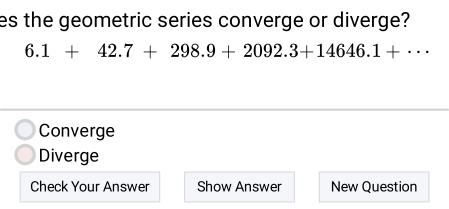
Does It Converge or Diverge?
Determine whether the given infinite geometric series converge or diverge. Remember that if the common ratio |r|<1, then the infinite series converges to a number, and that if |r| ≥ 1, then the series diverges.
Discussion
Share
Report error
Partial Sum of an Infinite Geometric Series
If the common ratio of an infinite geometric series is less than or equal to -1 or greater than or equal to 1, the sum of the series does not exist. However, it is possible to find a partial sum or the sum of the first several terms in the series. This partial series can be thought of as a finite series. As such, its sum can be found using the formula for a finite geometric series.
S_n=a_1(1-r^n)/1-r, r≠ 1
Example
Share
Report error
Calculating the Distance Traveled by the Ball
After recovering from his illness, Tearrik returns to school and continues to play basketball with his best friend Tadeo. Suppose that after the ball hits the rim of the basket, the ball falls 3 meters and rebounds to 85 % of the height of the previous bounce.
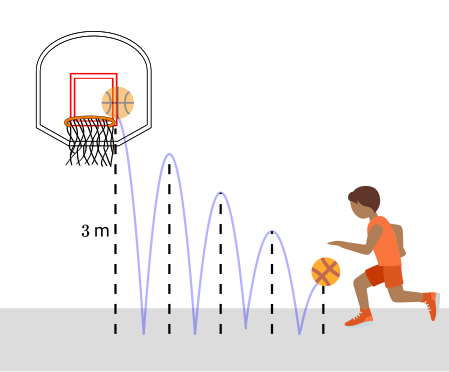
a Find the total vertical distance traveled by the ball before it comes to rest.
{"type":"text","form":{"type":"math","options":{"comparison":"1","nofractofloat":false,"keypad":{"simple":true,"useShortLog":false,"variables":[],"constants":[]},"rendered":false},"text":" "},"formTextBefore":null,"formTextAfter":"meters","answer":{"text":["37"]}}
b What would the sum of the vertical distance traveled by the ball be if Tadeo caught the ball at the top of the fourth bounce? Round the answer to two decimal places.
{"type":"text","form":{"type":"math","options":{"comparison":"1","nofractofloat":false,"keypad":{"simple":true,"useShortLog":false,"variables":[],"constants":[]},"rendered":false},"text":" "},"formTextBefore":"About","formTextAfter":"meters","answer":{"text":["17.69"]}}
Hint
a The vertical distance traveled by the ball for one bounce will be 2 times 0.85 of the previous bounce since the ball rises and then falls the same distance.
b Use the formula for the partial sum of an infinite series.
Solution
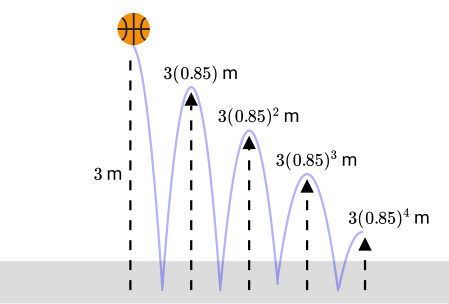
a It is given that after each bounce, the ball rises 85 % of the height of the previous bounce. Since the initial height of the ball is 3 meters, the first bounce will be 85 %=0.85 times the initial height.
Initial Height:& 3 m [0.5em] First Bounce:& 3 (0.85) m For the second bounce, the height of the ball will be 0.85 times the first bounce, 3 (0.85) meters. Second Bounce: 3 (0.85)(0.85) ⇒ 3 (0.85)^2 m The heights of the other bounces can be written by considering this pattern.
∑_(n=1)^(∞)6(0.85)^n=6(0.85)/1-0.85
∑_(n=1)^(∞)6(0.85)^n=34
b This time the ball is caught at the top of the fourth bounce. To find the vertical distance traveled by the ball, start by considering the vertical distance traveled for each bounce until the end of the third bounce. Then, add the fourth vertical distance only once since the ball will rise and but be caught before it falls again.
Example
Share
Report error
Who Will Save More Money?
Now that they are completely recovered, Tearrik and Tadeo decide to save money so they can go to the NBA finals next year, 15 months from now. They start chatting about their own ways to save money.

{"type":"choice","form":{"alts":["Tadeo","Tearrik"],"noSort":false},"formTextBefore":"","formTextAfter":"","answer":1}
Hint
Recall that a series is geometric if it has a common ratio.
Solution
To determine who will save more money in 15 months, the total amounts saved will be calculated one at a time.
Tadeo's Savings
Tadeo is planning to save 100 dollars every month. This means that his savings will increase linearly by a constant rate of 100 dollars. Therefore, multiply 100 dollars by 15 months to find the total amount of money he will have saved in 15 months. 100 * 15 = 1500 After 15 months, Tadeo will have saved 1500 dollars.
Tearrik's Savings
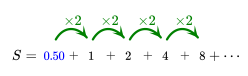
Tearrik will start by saving only $ 0.50 the first month. Then, he will increase the amount of money he saves every month by doubling the previous amount.
Conclusion
Notice that Tearrik's savings will increase rapidly although he starts with an extremely small amount. On the other hand, Tadeo will save the same amount of money each month and his savings will therefore increase at a constant rate. Finally, after 15 months, Tearrik will have saved much more money than Tadeo.
Closure
Share
Report error
Finding the Sum
At the beginning of the lesson, the following sum of a sequence was presented. 1/2+1/20+1/200+1/2000+ ⋯
a Is the sum finite or infinite?
{"type":"choice","form":{"alts":["Finite","Infinite"],"noSort":false},"formTextBefore":"","formTextAfter":"","answer":0}
{"type":"text","form":{"type":"math","options":{"comparison":"1","nofractofloat":false,"keypad":{"simple":true,"useShortLog":false,"variables":[],"constants":[]},"rendered":false},"text":" "},"formTextBefore":null,"formTextAfter":null,"answer":{"text":["0.56"]}}
Hint
a Check the common ratio between the terms of the sum.
b Recall the formula for the sum of an infinite series.
Solution
a As can be seen, the given sequence has infinitely many terms. That said, it can still have a finite sum. To check whether the sum converges to a number or not, the common ratio between the terms will be identified. To do so, the ratio of the second term to the first term will be calculated.
a_2/a_1
SubstituteII
a_1= 1/2, a_2= 1/20
120/12
DivFracByFracD
.a /b./.c /d.=a/b*d/c
1/20 * 2/1
MultFrac
Multiply fractions
2/20
ReduceFrac
a/b=.a /2./.b /2.
1/10
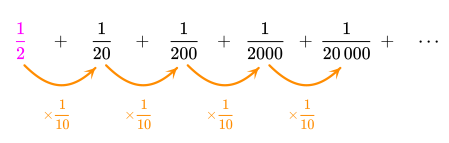
Therefore, the sum represents a geometric series. Notice that the absolute value of the common ratio | r|=| 110| is less than 1. | r|=| 1/10| ⇒ |r|=1/10 < 1 This means that the sum is finite and can be calculated by using the formula for the sum of an infinite series.
b As it is mentioned in Part A, the sum is finite. Having a geometric series with a common ratio less than 1, the sum of this series will be calculated by using the formula for the sum of an infinite series.
S_(∞)=a_1/1-r
SubstituteII
a_1= 12, r= 110
S_(∞)=12/1- 110
▼
Evaluate right-hand side
OneToFrac
Rewrite 1 as 10/10
S_(∞)=12/1010- 110
SubFrac
Subtract fractions
S_(∞)=12/910
DivFracByFracD
.a /b./.c /d.=a/b*d/c
S_(∞)=1/2 * 10/9
MultFrac
Multiply fractions
S_(∞)=10/18
ReduceFrac
a/b=.a /2./.b /2.
S_(∞)=5/9
UseCalc
Use a calculator
S_(∞)=0.555555 ...
RoundDec
Round to 2 decimal place(s)
S_(∞) ≈ 0.56
Sums of Geometric Series
Exercise 1.1
Consider the following series. 96+48+24+12+6+...
{"type":"choice","form":{"alts":["Yes","No"],"noSort":true},"formTextBefore":"","formTextAfter":"","answer":0}
{"type":"choice","form":{"alts":["1\/2","2","The series is not geometric.","0.2"],"noSort":false},"formTextBefore":"","formTextAfter":"","answer":0}
security
report
code
security
report
code
To determine whether the given series is a geometric series, we will calculate the ratios between consecutive terms.
The ratio between consecutive terms is the same. Therefore, the series is geometric.
As we found in Part A, the ratios between consecutive terms are all equal to 12. Therefore, the common ratio of the given geometric series is 12.
r=1/2
security
report
code
Consider the following series. 1/2 + 1/6 + 1/18 + 1/54 + 1/162 + ...
{"type":"choice","form":{"alts":["Yes","No"],"noSort":true},"formTextBefore":"","formTextAfter":"","answer":0}
{"type":"choice","form":{"alts":["1\/3","3","The series is not geometric.","0.3"],"noSort":false},"formTextBefore":"","formTextAfter":"","answer":0}
security
report
code
security
report
code
To determine whether the given series is a geometric series, we will calculate the ratios between consecutive terms.
The ratio between consecutive terms is the same. Therefore, the series is geometric.
As we found in Part A, the ratios between consecutive terms are all equal to 13. Therefore, the common ratio of the given geometric series is 13.
r=1/3
security
report
code
Consider the following geometric series.
∑_(i=1)^9 6(7)^(i-1)
Find the sum of this geometric series.
{"type":"text","form":{"type":"math","options":{"comparison":"1","nofractofloat":false,"keypad":{"simple":true,"useShortLog":false,"variables":["x"],"constants":["PI"]},"rendered":false},"text":" "},"formTextBefore":"S_n=","formTextAfter":null,"answer":{"text":["40353606"]}}
security
report
code
security
report
code
We want to evaluate the sum of the given geometric series. To do so, we will use the formula for the sum of a geometric series. S_n=a_1(1-r^n)/1-r In this formula, a_1 is the first term, r is the common ratio, and n is the number of terms. Let's start by paying close attention to the summation notation. ∑^9_(i= 1) 6 ( 7 )^(i-1) We can see that the common ratio of the series is 7. The lower limit is 1 and the upper limit is 9, so the number of terms is 9. Let's calculate the first term by substituting 1 for i into the indicated expression.
We are ready to evaluate the sum of the series. Let's substitute n= 9, r= 7, and a_1= 6 into the formula for the sum of a finite geometric series.
The sum of the series is 40 353 606.
security
report
code
Consider the following geometric series. 1/2 + 1/6 + 1/18 + 1/54 + 1/162 + ...
{"type":"choice","form":{"alts":["The series converges.","The series diverges."],"noSort":true},"formTextBefore":"","formTextAfter":"","answer":0}
{"type":"choice","form":{"alts":["1\/3","4\/3","3\/4","The series diverges."],"noSort":false},"formTextBefore":"","formTextAfter":"","answer":2}
security
report
code
security
report
code
Let's start by finding the common ratio of the geometric sequence. To do so, we can find the ratio between any two consecutive terms. For simplicity, we will find the ratio of the second term to the first term.
We found that the common ratio of our geometric sequence is 13. Recall that the absolute value of 13 is also 13. |1/3|=1/3 Since the absolute value of the common ratio is less than 1, the series converges.
From Part A, we already know that the series converges. To find its sum S, we will use the formula for the sum of an infinite geometric series.
S=a/1-r
Here, a is the first term of the series and r is the common ratio. We are given that the first term is 12 and we know from Part A that the common ratio is 13. Let's substitute these two values into the formula for the sum of an infinite geometric series and evaluate.
We found that the sum of the series is 34.
security
report
code
Consider the following geometric series. 0.2+0.202+0.20402+0.2060602+...
{"type":"choice","form":{"alts":["The series converges.","The series diverges."],"noSort":true},"formTextBefore":"","formTextAfter":"","answer":1}
{"type":"choice","form":{"alts":["0.8120802","1.01","1","The series diverges."],"noSort":false},"formTextBefore":"","formTextAfter":"","answer":3}
security
report
code
security
report
code
Let's start by finding the common ratio of the geometric sequence. To do so, we can find the ratio between any two consecutive terms. For simplicity, we will find the ratio of the second term to the first term.
We found that the common ratio of our geometric sequence is 1.01. Recall that the absolute value of 1.01 is also 1.01. |1.01|=1.01 Since the absolute value of the common ratio is greater than or equal to 1, the series diverges.
From Part A, we already know that the series diverges. Therefore, it is not possible to find its sum.
The series diverges.
security
report
code
Write the repeating decimal number as a fraction in its simplest form.
0.444...
{"type":"text","form":{"type":"math","options":{"comparison":"1","nofractofloat":false,"keypad":{"simple":true,"useShortLog":false,"variables":["x"],"constants":["PI"]},"rendered":false},"text":" "},"formTextBefore":null,"formTextAfter":null,"answer":{"text":["\\dfrac{4}{9}","4\/9"]}}
security
report
code
security
report
code
We want to write the repeating decimal 0.444 ... as a fraction. To do so, we will start by writing this number as a sum of decimals and then as a sum of fractions.
| Number | 0.444 ... |
|---|---|
| Sum of Decimals | 0.4+0.04+0.004+... |
| Sum of Fractions | 4/10+4/100+4/1000+... |
Consider the sum of fractions above. Note that we can think of it as a geometric series with first term a_1= 410. To find its common ratio r, we can find the ratio of any two terms of the series. For simplicity, we will find the ratio of a_2 to a_1.
Each term of the series can be found by multiplying the previous term by the common ratio 110.
Let's substitute r= 110 and a_1= 410 in the formula for the sum of an infinite geometric series.
We found that the series formed by the sum of the terms is 49. With this information we can express the given number as a fraction. 0.444 ... =4/9
security
report
code
Consider the following infinite geometric series.
4+12/5+36/25+108/125+324/625+...
Find the partial sum S_(12). Round the answer to two decimal places.
{"type":"text","form":{"type":"math","options":{"comparison":"1","nofractofloat":false,"keypad":{"simple":true,"useShortLog":false,"variables":["x"],"constants":["PI"]},"rendered":false},"text":" "},"formTextBefore":"S_(12)\u2248","formTextAfter":null,"answer":{"text":["9.98"]}}
security
report
code
security
report
code
We are given an infinite geometric series and want to find the sum of its first 12 terms. To do so, let's start by recalling the formula for the partial sum of an infinite geometric series. S_n=a_1(1-r^n)/1-r Here, S_n represents the sum of the first n terms and a_1 and r are its first term and common ratio, respectively. Since we want to find the sum of the first 12 terms, we know that n= 12. We can also see that the first term is a_1= 4. To find the common ratio r, we can find the ratio between any two consecutive terms. For simplicity, we will find the ratio of the second term to the first term.
We found that the common ratio of the geometric sequence is r= 35. We can now use the values we have to find the sum of the first 12 terms. Let's do it!
The sum of the first 12 terms of the series is approximately 9.98.
security
report
code
Sums of Geometric Series
Recommended exercises
To get personalized recommended exercises, please login first.
Loading content
≤
>
■2
■▢
e▢
7
8
9
×
÷■1
=
=
√▢
▢√
∫▢▢
4
5
6
+
−
≤
<
log
ln
log▢
1
2
3
()
∣
sin
cos
tan
0
.
π
x
y
Loading content