3. Standard Form of a Line
Sign In
An error ocurred, try again later!
Chapter 7
3.
Standard Form of a Line
Understanding the standard form of a line is crucial for interpreting and graphing linear equations effectively. This approach offers a structured way to represent relationships between variables, which is particularly useful in solving problems that involve multiple constraints. Rewriting equations into this format allows to simplify graphing and analysis tasks, making it easier to work with linear models in real-world scenarios such as economics, engineering, and data representation.
Show less Show more expand_more 


Lesson Settings & Tools
| | 12 Theory slides |
| | 12 Exercises - Grade E - A |
| | Each lesson is meant to take 1-2 classroom sessions |
Standard Form of a Line
Slide of 12
This lesson focuses on writing equations in standard form. Standard form is a special way to write equations for lines. It gives us important information about the slopes of the lines, intercepts, and how it relates to other lines. Understanding the standard form helps to solve equations, analyze systems of lines, and even predict where lines will meet or run parallel.
Catch-Up and Review
Here are some recommended readings before getting started with this lesson.
Explore
Share
Report error
Comparing the Slope-Intercept Form and Standard Form
The applet shows two different equations for the same line.
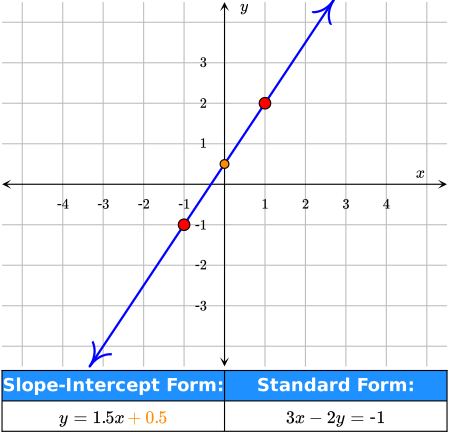 Explore this applet by considering the following questions.
- What are the similarities and differences between the equations?
- How do the coefficients of the equations change as the line changes?
Discussion
Share
Report error
Standard Form of a Line
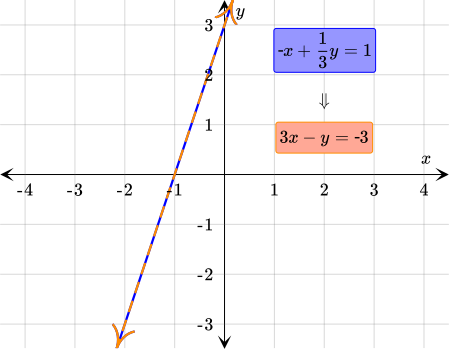
In the standard form of a line all x- and y-terms are on one side of the linear equation or function and the constant is on the other side.
Ax+By=C
In this form, A, B, and C are real numbers. It is important to know that A and B cannot both be 0. Different combinations of A, B, and C can represent the same line on a graph. It is preferred to use the smallest possible whole numbers for A, B, and C and it is also better if A is a positive number.
Pop Quiz
Share
Report error
Recognizing the Standard Form of a Line
The given linear equation shows the relationship between the variables x and y. Determine if the equation is written in standard form.

Discussion
Share
Report error
Graphing a Linear Equation in Standard Form
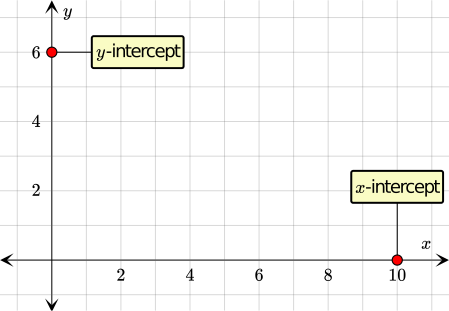
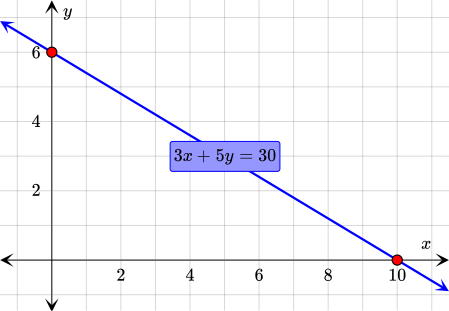
A linear function written in standard form has quickly identifiable x- and y-intercepts. Since two points determine a line, this provides enough information to graph the function. Consider the following linear equation written in standard form.
3x+5y=30
The graph of this function can be drawn in two steps.
1
Find the Intercepts
expand_more Begin by substituting y= 0 to find the x-intercept of the equation.
The x-intercept is (10,0). The y-intercept can be found in a similar way. Substitute x= 0 into the equation and solve for y.
The y-intercept is (0,6).
rc
Equation: & 3x+5y = 30 x-intercept: & (10,0) y-intercept: & (0,6)
3x+5y=30
Substitute
y= 0
3x+5( 0)=30
▼
Solve for x
ZeroPropMult
Zero Property of Multiplication
3x+0=30
IdPropAdd
Identity Property of Addition
3x = 30
DivEqn
.LHS /3.=.RHS /3.
x = 10
3x+5y=30
Substitute
x= 0
3( 0)+5y=30
▼
Solve for y
ZeroPropMult
Zero Property of Multiplication
0+5y=30
IdPropAdd
Identity Property of Addition
5y = 30
DivEqn
.LHS /5.=.RHS /5.
y = 6
2
Plot the Intercepts
expand_more Now it is time to plot the intercepts in a coordinate plane.
3
Draw the Line Passing Through the Intercepts
expand_more Lastly, draw a line passing through these points.
Extra
General Formulas for the Intercepts of an Equation in Standard FormNote that general formulas for the intercepts can be derived for any linear function written in standard form Ax+ By= C.
| Assumption | x-intercept | y-intercept |
|---|---|---|
| A≠ 0, B≠ 0 | (C/A,0) | (0,C/B) |
| A= 0, B≠ 0 | The line is horizontal, y= C B, so it does not cross the x-axis. | (0,C/B) |
| A≠ 0, B= 0 | (C/A,0) | The line is vertical, x= C A, so it does not cross the y-axis. |
Example
Share
Report error
Stationery Shopping
Tearrik is excited to buy school supplies. He plans to buy some cool pencils and notebooks.

The pencils he wants cost $2 each, and the notebooks he likes cost $5 each. He has $ 20 to spend. The following linear equation models this situation. 2x+5y=20 In this equation, x represents the number of pencils and y represents the number of notebooks.
a Find the intercepts of the line whose equation is written in standard form.
b Graph the line.
c Interpret the intercepts in the context.
Answer
a x-intercept: (10,0)
y-intercept: (0,4)
y-intercept: (0,4)
b 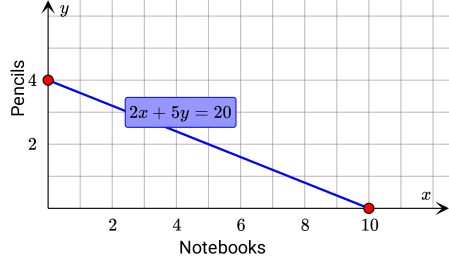
c See solution.
Hint
b Plot the intercepts and connect them with a line segment.
c Remember that the number of pencils and notebooks cannot be negative.
Solution
a The equation models the total cost of stationery that Tearrik buys. The number of pencils purchased is represented by x and the number of notebooks purchased is represented by x.
2x+5y=20
Substitute
y= 0
2x+5( 0)=20
▼
Solve for x
ZeroPropMult
Zero Property of Multiplication
2x+0=20
IdPropAdd
Identity Property of Addition
2x=20
DivEqn
.LHS /2.=.RHS /2.
x=10
2x+5y=20
Substitute
x= 0
2( 0)+5y=20
▼
Solve for y
ZeroPropMult
Zero Property of Multiplication
0+5y=20
IdPropAdd
Identity Property of Addition
5y=20
DivEqn
.LHS /5.=.RHS /5.
y=4
b When graphing the line, the intercepts found in Part A can be used.
rc Equation: & 2x+5y = 20 [0.5em] x-intercept: & (10,0) [0.5em] y-intercept: & (0,4) Plot the intercepts on a coordinate plane. Then, connect the intercepts with a line.
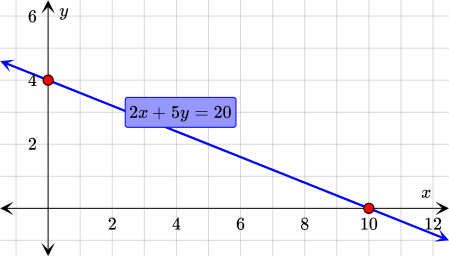
The number of stationery purchased cannot be negative. In other words, stores do not sale a negative amount of products. This means that only positive values of x and y is considered in this context.
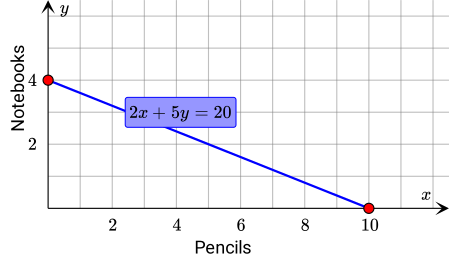
c Look at the intercepts in the graph to interpret them in the context.
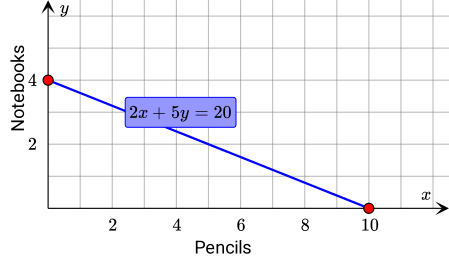
First, the x-intercept means that if Tearrik does not buy any notebooks, he can buy 10 pencils with all of his money. Whereas, the y-intercept means that if Tearrik does not buy pencils, he can buy 4 notebooks using all of his money.
Discussion
Share
Report error
Writing a Linear Equation in Standard Form
Any linear equation can be rewritten in standard form. Consider the following linear equation that is written in slope-intercept form.
y = 4/5x + 2/3
Using the Properties of Equality, the equation can be rewritten in standard form.
Ax+By=C
Here, A, B, and C are real numbers and A and B cannot both be equal to 0. It can be noted that representing A, B, and C with the smallest possible integers is preferred, as well as A being positive.
1
Remove All Fractions
expand_more When a linear equation contains fractions, the first step is to remove all fractions. The equation is multiplied by the least common denominator of the fractions. In this case, it is the product of 5 and 3, which is 15. Using the Multiplication Property of Equality, the equation can be written as follows.
y= 4/5x + 2/3
MultEqn
LHS * 15=RHS* 15
15y=(4/5x+2/3)15
▼
Simplify right-hand side
Distr
Distribute 15
15y=4/5x* 15+2/3* 15
CommutativePropMult
Commutative Property of Multiplication
15y=4/5* 15* x+2/3* 15
MoveRightFacToNum
a/c* b = a* b/c
15y=4* 15/5x+2* 15/3
ReduceFrac
a/b=.a /5./.b /5.
15y=4* 3/1x+2* 15/3
ReduceFrac
a/b=.a /3./.b /3.
15y=4* 3/1x+2* 5/1
DivByOne
a/1=a
15y=4* 3x+2* 5
Multiply
Multiply
15 y = 12x + 10
2
Rearrange the Terms of the Equation
expand_more Now, move the terms containing variables to the left-hand side of the equation. In addition to this, move the constant to the right-hand side using the Subtraction Property of Equality.
Since a positive coefficient for x is preferable, the equation can be multiplied by - 1.
This equation is now in the standard form. Note that the values of A, B, and C are in their smallest possible integer forms.
Example
Share
Report error
Preparing for School
Tearrik wanted to remember some mathematical contexts before going back to school. He wants to remember slope-intercept form and standard form of a line. This is why he wrote an equation in slope-intercept form. y=4x-8
a Help Tearrik to rewrite the equation in standard form.
{"type":"text","form":{"type":"math","options":{"comparison":"1","nofractofloat":false,"keypad":{"simple":false,"useShortLog":false,"variables":["x"],"constants":["PI"]},"rendered":false},"text":" "},"formTextBefore":null,"formTextAfter":null,"answer":{"text":["4x-y=8"]}}
b Graph the line of the equation.
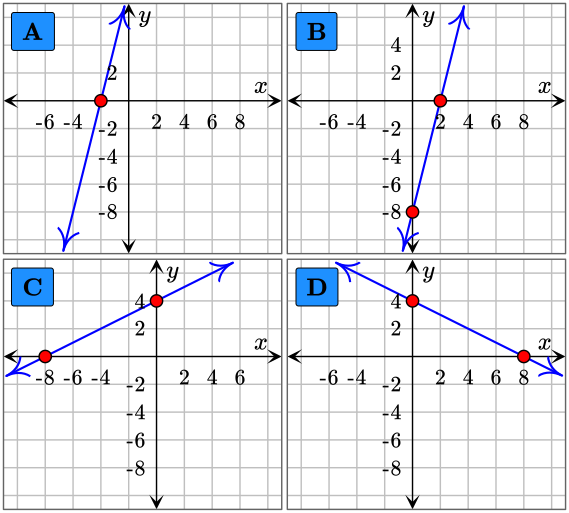
{"type":"choice","form":{"alts":["A","B","C","D"],"noSort":true},"formTextBefore":"","formTextAfter":"","answer":1}
Hint
a All x- and y-terms should be on one side of the linear equation and the constant should be on the other side in standard form.
b Plot the intercepts and connect them with a line.
Solution
a The equation that Tearrik wrote in slope-intercept form is given as follows.
y=4x-8
SubEqn
LHS-y=RHS-y
y-y=4x-8-y
SubTerms
Subtract terms
0=4x-8-y
AddEqn
LHS+8=RHS+8
0+8=4x-8-y+8
CommutativePropAdd
Commutative Property of Addition
0+8=4x-8+8-y
AddTerms
Add terms
8=4x-y
RearrangeEqn
Rearrange equation
4x-y=8
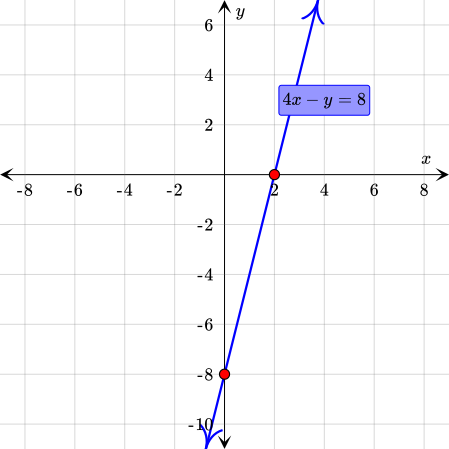
b The intercepts of a line are used to graph the line. First, find the x-intercept by substituting 0 for y.
4x-y=8
Substitute
x= 0
4( 0)-y=8
▼
Solve for y
ZeroPropMult
Zero Property of Multiplication
0-y=8
SubTerms
Subtract terms
- y=8
MultEqn
LHS * (-1)=RHS* (-1)
y=-8
Example
Share
Report error
Comparing Prices
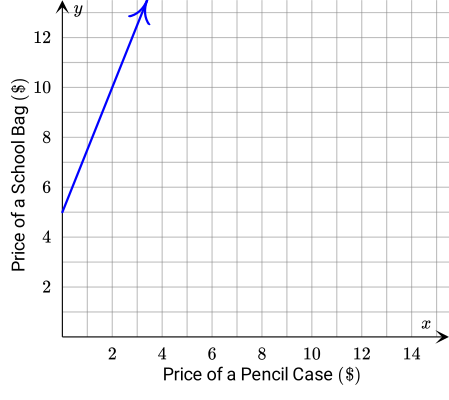
Tearrik realizes at the stationery shop that the price of five pencil cases equals $ 10 less than the price of two school bags. The graph below shows the relationship between the price of the school bag and the price of the pencil case.
a Write the equation in slope-intercept form.
{"type":"text","form":{"type":"math","options":{"comparison":"1","nofractofloat":false,"keypad":{"simple":false,"useShortLog":false,"variables":["x"],"constants":["PI"]},"rendered":false},"text":" "},"formTextBefore":null,"formTextAfter":null,"answer":{"text":["y=\\dfrac{5}{2}x+5"]}}
b Rewrite the equation in standard form.
{"type":"text","form":{"type":"math","options":{"comparison":"1","nofractofloat":false,"keypad":{"simple":false,"useShortLog":false,"variables":["x"],"constants":["PI"]},"rendered":false},"text":" "},"formTextBefore":null,"formTextAfter":null,"answer":{"text":["5x-2y=-10"]}}
Hint
a Remember that the coefficient of x is the slope, and the constant is the y-intercept in the slope-intercept form.
Solution
a The graph of the relationship between the price of a school bag and the price of the pencil case is given.
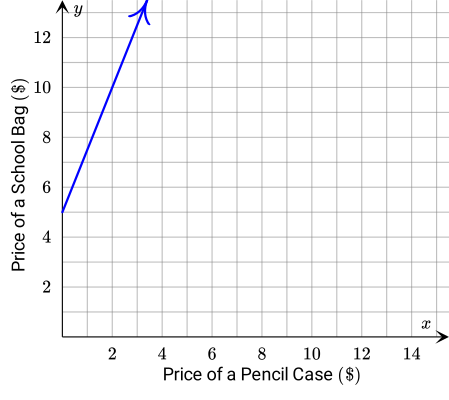
The y-intercept and the slope of the line is used to write the equation of the line in slope-intercept form. Let's first look at the y-intercept. Remember that the y-intercept of a line is the y-coordinate of the point where the line crosses the y-axis.
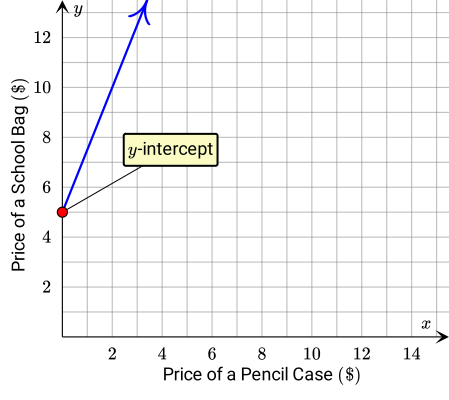
The y-intercept of the line is 5. Now find the ratio of the change in y-values to the change in x-values to find the slope.
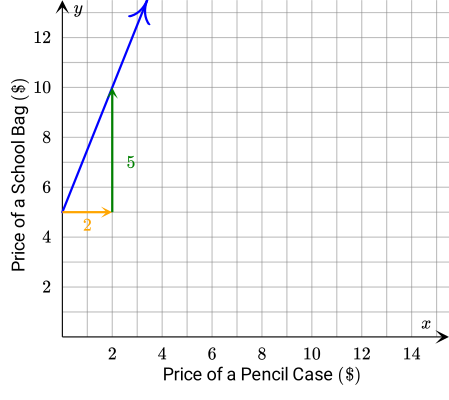
When the x-values increase by 2, y-values increase by 5. Slope&=changes iny-value/changes inx-value &⇓ Slope&=5/2 The value of the slope is the coefficient of variable x, and the y-intercept is the constant of the equation.
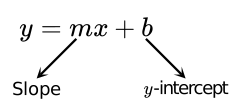
Substitute the values into the equation to write the equation of the graph in slope-intercept form. y&= mx+ n &⇓ y&= 52x+ 5
b All terms for the variables x and y are on one side of the linear equation and the constant is on the other side in standard form.
y= 52x+5
MultEqn
LHS * 2=RHS* 2
2y=2* 52x+10
▼
Multiply
MoveLeftFacToNum
a*b/c= a* b/c
2y= 2*52x+10
CancelCommonFac
Cancel out common factors
2y= 2*52x+10
SimpQuot
Simplify quotient
2y=5x+10
SubEqn
LHS- 2y+10=RHS- 2y+10
2y-( 2y+10)=5x+10-( 2y+10)
▼
Simplify equation
Distr
Distribute -1
2y-2y-10=5x+10-2y-10
CommutativePropAdd
Commutative Property of Addition
2y-2y-10=5x+10-10-2y
SubTerms
Subtract terms
- 10=5x-2y
RearrangeEqn
Rearrange equation
5x-2y=- 10
Pop Quiz
Share
Report error
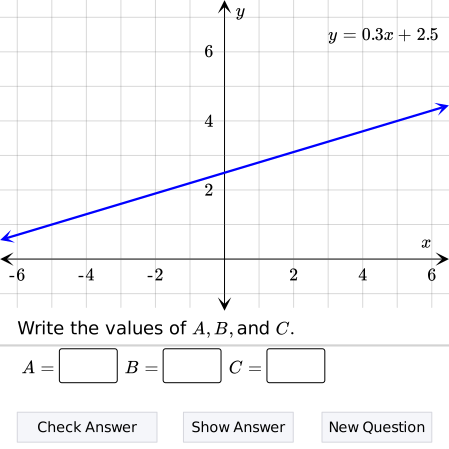
Finding the Values of A, B, and C
The standard form of a linear equation is written as follows. Ax+By= C In general, A, B, and C are real numbers. It is preferred for A, B, and C to be the smallest possible integers and for A to be positive. Find the values of A, B, and C by using the given line that has an equation in slope-intercept form. In the answers, make sure that A, B, and C are the smallest possible integers and that A is positive.
Pop Quiz
Share
Report error
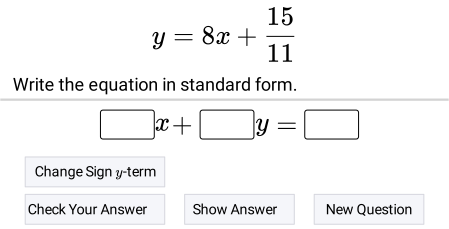
Converting the Slope-Intercept Form of a Line to Standard Form
The following equation displays the relationship between the variables x and y in slope-intercept form. Rewrite the equation in slope-intercept form in standard form.
Closure
Share
Report error
Exploring the Standard Form of a Line
In this lesson, the standard form of a line has been discussed, recognized, graphed, and applied to real-world examples. Ax+By=C In this form, A, B, and C are real numbers. The preferred properties for these numbers are as follows.
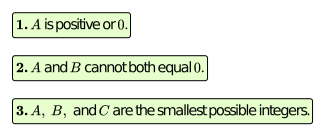
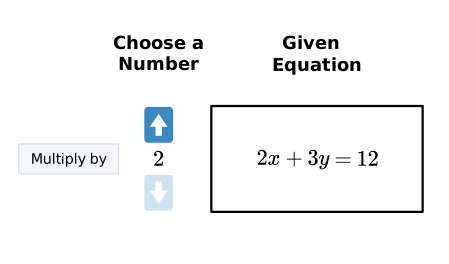
The number of equations in standard form that meets these properties is exactly one for each line. However, there are infinitely many equivalent equations in standard form. In other words, linear equations that describe the same line are equivalent. These equivalent equations can be written by using the Multiplication Property of Equality.
Standard Form of a Line
Exercise 3.1
Standard form of a line is written as follows. Ax+By=C In this equation, A, B, and C are real numbers, and A and B cannot both equal zero.
{"type":"text","form":{"type":"math","options":{"comparison":"1","nofractofloat":false,"keypad":{"simple":false,"useShortLog":false,"variables":["A","B","C","x","y"],"constants":["PI"]},"rendered":false},"text":" "},"formTextBefore":"x-intercept:","formTextAfter":null,"answer":{"text":["\\dfrac{C}{A}"]}}
{"type":"text","form":{"type":"math","options":{"comparison":"1","nofractofloat":false,"keypad":{"simple":false,"useShortLog":false,"variables":["A","B","C","x","y"],"constants":["PI"]},"rendered":false},"text":" "},"formTextBefore":"y-intercept:","formTextAfter":null,"answer":{"text":["\\dfrac{B}{A}"]}}
security
report
code
security
report
code
Remember that the x-intercept of a graph is the x-coordinate of the point where the graph intersects the x-axis. The coordinates of the x-intercept can be written as (x,0). We can substitute 0 for y in the standard form of an equation and solve for the corresponding x value in terms of A, B, and C.
The x-intercept in terms of A, B, and C can be written as CA.
Similar to write the x-intercept, the y-intercept of a graph is the y-coordinate of the point where the graph intersects the x-axis. The coordinates of the y-intercept can be written as (0,y). We can substitute 0 for x in the standard form of an equation and solve for the corresponding x value in terms of A, B, and C.
We found that the y-intercept is given by CB.
security
report
code
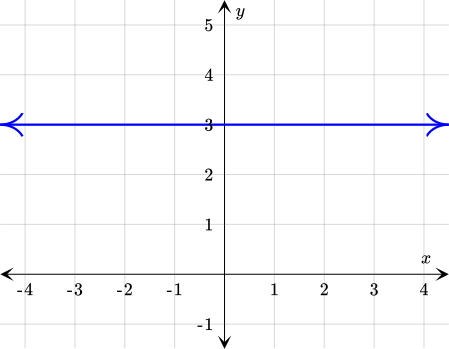
A horizontal line is given.
{"type":"choice","form":{"alts":["3y=1 where A=0, B=3, and C=1","y=3 where A=0, B=1, and C=3","3x+y=0 where A=3, B=1, and C=0","x+3y=0 where A=3, B=0, and C=5"],"noSort":false},"formTextBefore":"","formTextAfter":"","answer":1}
security
report
code
security
report
code
We want to write the equation of the given horizontal line in standard form. We can first write the equation of the line in slope-intercept form. Then, we can convert it to standard from. Let's begin by finding the slope of the line. Choose two points on the line.
We can find the slope using the slope formula.
The slope of this line is 0. Let's take a look at the graph to see the y-intercept.
The line crosses the y-axis at the point (0,3), which means the y-intercept of the line is 3. Now we can write the equation in slope-intercept form.
The equation of the line in slope-intercept form is y=3. Let's convert the equation into standard form. Also, we can make a conclusion about the values of the coefficients. Ax+By=C ⇓ 0x+ 1y= 3 The equation of the line in standard form is y=3 and A= 0, B= 1, and C= 3.
security
report
code
Standard Form of a Line
Recommended exercises
To get personalized recommended exercises, please login first.
Loading content
≤
>
■2
■▢
e▢
7
8
9
×
÷■1
=
=
√▢
▢√
∫▢▢
4
5
6
+
−
≤
<
log
ln
log▢
1
2
3
()
∣
sin
cos
tan
0
.
π
x
y
Loading content