Rule

Interior Angles Theorem

The sum of the measures of the interior angles of a triangle is 180^(∘).
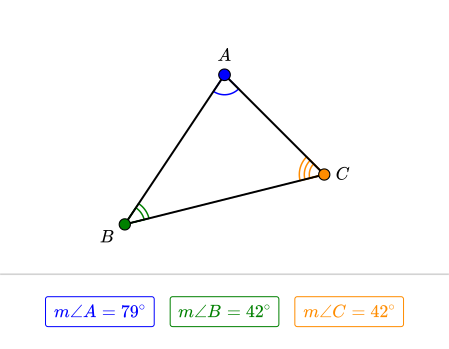
The triangle ABC with movable vertices A, B, and C and the angle measures written
Based on this diagram, the following relation holds true.


m∠ A+m∠ B + m∠ C=180^(∘)

This theorem is also known as the Triangle Angle Sum Theorem.

Proof

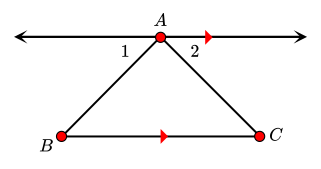
Consider a triangle with vertices A, B, and C, and the parallel line to BC through A. Let ∠ 1 and ∠ 2 be the angles outside △ ABC formed by this line and the sides AB and AC.

Triangle ABC with the line parallel to BC

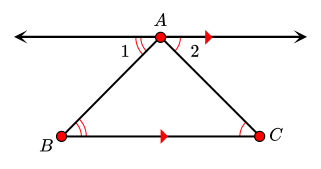
By the Alternate Interior Angles Theorem, ∠B is congruent to ∠1 and ∠C is congruent to ∠2.

Two pairs of alternate interior angles

By the definition of congruent angles, ∠ 1 and ∠ B have the same measure. For the same reason, ∠ 2 and ∠ C also have the same measure. ccc ∠B≅∠1 & ∠C≅∠2 ⇕ & ⇕ m∠B= m∠1 & m ∠C=m∠2 Furthermore, in the diagram it can be seen that ∠BAC, ∠1, and ∠2 form a straight angle. Therefore, by the Angle Addition Postulate their measures add to 180^(∘). m∠BAC+m∠1+m∠2=180^(∘) By the Substitution Property of Equality, the sum of the measures of ∠ BAC, ∠ B, and ∠ C is equal to 180^(∘). m∠BAC+m∠1+m∠2=180^(∘) ⇓ m∠BAC+m∠B+m∠C=180^(∘) Finally, in △ ABC, ∠ BAC can be named ∠ A.


m∠BAC+m∠B+m∠C=180^(∘) ⇓ m∠A+m∠B+m∠C=180^(∘)

Exercises