6. Solving System of Equations Algebraically
Sign In
An error ocurred, try again later!
Chapter 7
6.
Solving System of Equations Algebraically
This lesson introduces methods to solve systems of equations algebraically, focusing on substitution and elimination. It explains how these techniques help determine if a system has one, none, or infinitely many solutions. The concepts are practical for analyzing and solving real-world problems involving multiple variables.
Show less Show more expand_more 


Lesson Settings & Tools
| | 14 Theory slides |
| | 11 Exercises - Grade E - A |
| | Each lesson is meant to take 1-2 classroom sessions |
Solving System of Equations Algebraically
Slide of 14
Systems of equations are used to relate the values of two or more variables. There are different methods of solving a system of equations. This lesson will present these methods and show how to use them.
Catch-Up and Review
Here are a few recommended readings before getting started with this lesson.
Challenge
Share
Report error
Books and Movies About Space
Vincenzo is fascinated by all things related to space and astronauts. He spends a lot of his free time reading books and watching movies about space travel, distant galaxies, and rocket science.

{"type":"text","form":{"type":"math","options":{"comparison":"1","nofractofloat":false,"keypad":{"simple":true,"useShortLog":false,"variables":["x"],"constants":["PI"]},"rendered":false},"text":" "},"formTextBefore":"Number of movies=","formTextAfter":null,"answer":{"text":["18"]}}
{"type":"text","form":{"type":"math","options":{"comparison":"1","nofractofloat":false,"keypad":{"simple":true,"useShortLog":false,"variables":["x"],"constants":["PI"]},"rendered":false},"text":" "},"formTextBefore":"Number of books=","formTextAfter":null,"answer":{"text":["9"]}}
Discussion
Share
Report error
Substitution Method of Solving a System of Equations
There are several methods for solving a system of equations. One of the most popular methods is the Substitution Method.
Method
Share
Report error
Substitution Method
The Substitution Method is an algebraic method for finding the solutions of a system of equations. It consists of substituting an equivalent expression for a variable in one of the equations of the system. Consider, for example, the following system of linear equations.
y-4=2x & (I) 9x+6=3y & (II)
To solve the system by using the Substitution Method, there are four steps to follow.
1
Isolate One Variable in Any of the Equations
expand_more The first step is to isolate any variable in any of the equations. For simplicity, in this case, the y-variable will be isolated in Equation (I).
2
Substitute the Expression
expand_more Substitute the new expression for the variable in the equation where the variable was not isolated. In this case, 2x+4 will be substituted for y in Equation (II).
Now Equation (II) only has one variable, which is x.
3
Solve the Equation With One Variable
expand_more Solve the equation that contains only one variable. In this case, Equation (II) will be solved for x.
The value of the x-variable is 2.
4
Substitute the Value of the Variable Into the Other Equation
expand_more Now that the value of one of the variables is known, it can be substituted into the equation that has not been considered yet. Here, x= 2 will be substituted into Equation (I).
The value of the y-variable in this system is 8. Therefore, the solution to the system of equations, which is the point of intersection of the lines, is (2,8) or x=2, y=8.
Example
Share
Report error
First Time Spacewalking
After reading another book about space, Vincenzo quickly fell asleep and dreamed that he was an astronaut spacewalking for the first time. What an amazing experience!
 Vincenzo received a task to install some external parts to the spaceship. The number of parts p he installed and the number of minutes m he spent in the open space are related by a system of equations.
p+4m=42 8p-5m=3
Vincenzo received a task to install some external parts to the spaceship. The number of parts p he installed and the number of minutes m he spent in the open space are related by a system of equations.
p+4m=42 8p-5m=3
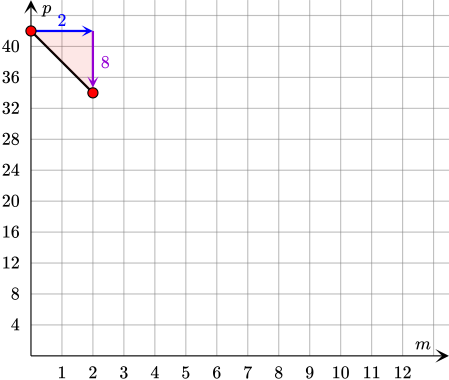
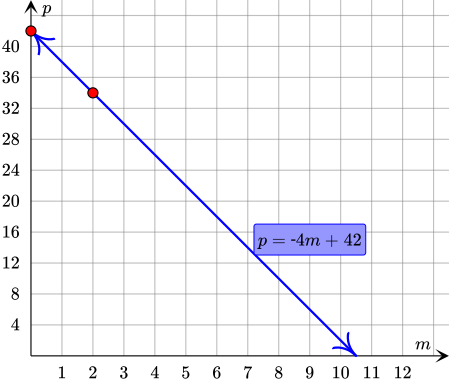 The second equation can be graphed by following the same process.
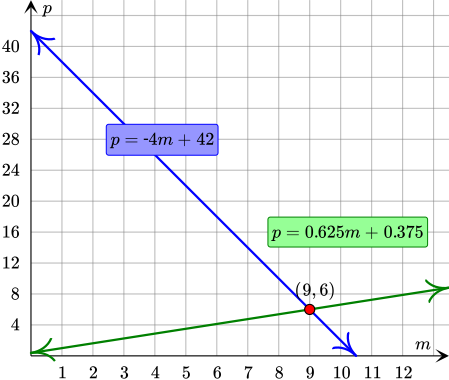
 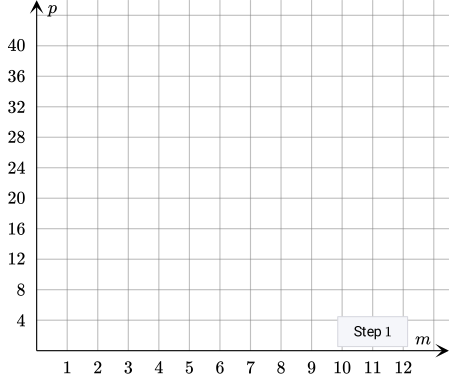 The solution of the system of equations is represented by the point of intersection of the lines. If the point of intersection lies on lattice lines or their intersections, the exact solution will be determined. Otherwise, only an estimate of the solution might be found.
 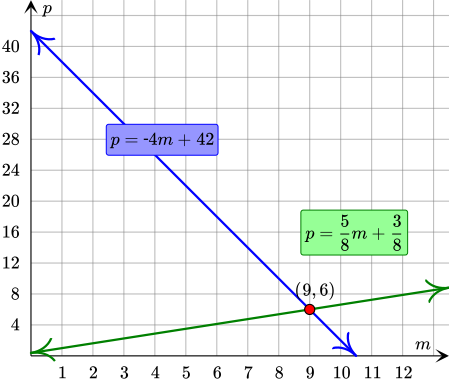 The value of m is found to be 9. Now it can be substituted in either of the original equations. Notice that p is already isolated in the first equation, so it might be convenient to substitute the value of m into this equation and evaluate p.
The solution to the system of equations is p=6 and m=9.
ccc
Graphing & & Substitution Method & & Method ↘ & & ↙ & (9,6) &
However, in this case, the Substitution Method can be more convenient because it is shorter and gives the exact solution. By comparison, the graphing method requires the equations to be in slope-intercept form and does not always result in finding the exact solution.
The value of m is found to be 9. Now it can be substituted in either of the original equations. Notice that p is already isolated in the first equation, so it might be convenient to substitute the value of m into this equation and evaluate p.
The solution to the system of equations is p=6 and m=9.
ccc
Graphing & & Substitution Method & & Method ↘ & & ↙ & (9,6) &
However, in this case, the Substitution Method can be more convenient because it is shorter and gives the exact solution. By comparison, the graphing method requires the equations to be in slope-intercept form and does not always result in finding the exact solution.
External credits: @catalyststuff
a Solve the system by graphing.
b Solve the system by substitution.
c Are the solutions the same? Which method of solving is more useful in this case and why?
Answer
a Graph:
Solution: m=9, p=6
b m=9, p=6
c The solutions are the same. In this case, the Substitution Method is more useful for a number of reasons.
Hint
a Rewrite the equations in slope-intercept form. Then use the slope and y-intercept to graph each equation.
b Isolate p in the first equation and substitute the corresponding expression into the second equation to find m. Then substitute the value of m into the first equation and find p.
c Identify which method is shorter. Does either method require the equations to be in a specific form? Do they both result in finding the exact solutions every time?
Solution
a In order to solve the system of equations by graphing, both equations should be written in slope-intercept form.
8p-5m=3
▼
Write in slope-intercept form
AddEqn
LHS+5m=RHS+5m
8p=3+5m
DivEqn
.LHS /8.=.RHS /8.
p=3+5m/8
WriteSumFrac
Write as a sum of fractions
p=3/8+5m/8
MovePartNumRight
a* b/c=a/c* b
p=3/8+5/8m
CommutativePropAdd
Commutative Property of Addition
p=5/8m+3/8
Draw a line through the two plotted points to get the graph of the first equation.
The lines intersect at (9,6). Therefore, m=9 and p=6, which indicates that Vincenzo spent 9 minutes spacewalking and installed 6 parts on the spaceship.
b The system of equations will now be solved by using the Substitution Method. Start by isolating the variable p and substituting the corresponding expression into the second equation.
p+4m=42 & (I) 8p-5m=3 & (II)
SubEqn
(I): LHS-4m=RHS-4m
p=42-4m 8p-5m=3
Substitute
(II): p= 42-4m
p=42-4m 8( 42-4m)-5m=3
Distr
(II): Distribute 8
p=42-4m 336-32m-5m=3
SubTerm
(II): Subtract term
p=42-4m 336-37m=3
SubEqn
(II): LHS-336=RHS-336
p=42-4m - 37m=- 333
DivEqn
(II): .LHS /(- 37).=.RHS /(- 37).
p=42-4m m=9
p=42-4m m=9
Substitute
(I): m= 9
p=42-4( 9) m=9
Multiply
(I): Multiply
p=42-36 m=9
SubTerm
(I): Subtract term
p=6 m=9
c Both methods of solving the system of equations gave the same solution. Therefore, both methods of solving are correct.
Example
Share
Report error
Distances Between Planets
In his dreams, Vincenzo gets to travel to planets far far away. Traveling to two distant planets Lunaris and Exosia from Earth takes 137 years and 680 years, respectively.
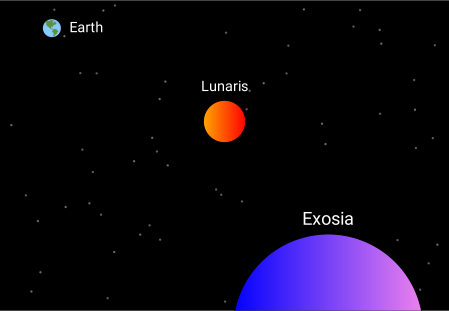 The distances from Earth to Lunaris l and to Exosia e are given by the following system of equations.
2l+2=e l+3e=97
The distances from Earth to Lunaris l and to Exosia e are given by the following system of equations.
2l+2=e l+3e=97
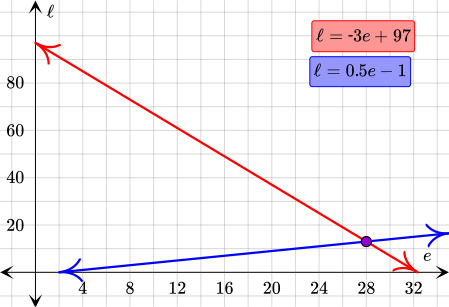
a Solve the system by using the Substitution Method.
b Check the solution by substituting it into both equations of the system.
c Graph the system of equations and analyze the coordinates of the point of intersection.
Answer
a l=13 and e=28
b See solution.
c Graph:
Hint
a Isolate one variable in one of the equations. Substitute the corresponding expression into the other equation to solve for the other variable.
b Substitute the solution from Part A into the system of equations and see if true statements are found.
c Rewrite each equation in slope-intercept form. Then, graph the equations using the y-intercepts and slopes.
Solution
a The system of equations will be solved by using the Substitution Method. Start by isolating one variable in one equation. Notice that e is already isolated in the first equation.
e=2l+2 l=13
Substitute
(I): l= 13
e=2( 13)+2 l=13
Multiply
(I): Multiply
e=26+2 l=13
SubTerm
(I): Subtract term
e=28 l=13
b To check the solution, substitute 13 for l and 28 for e into the system of equations. If both equations result in true statements after simplification, the solution is correct.
l2l+2=e l+3e=97
SubstituteII
l= 13, e= 28
l2( 13)+2? = 28 13+3( 28)? =97
Multiply
Multiply
l26+2? =28 13+84? =97
AddTerms
Add terms
l28=28 ✓ 97=97 ✓
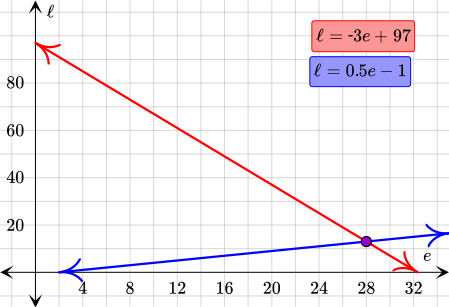
c To solve the system of equations by graphing, start by rewriting both equations in slope-intercept form. Consider l as the y-variable and e as the x-variable. Start with Equation (I).
The point of intersection lies on a lattice line where e=28. However, it can be difficult to determine the exact value of l just by looking at the graph. It can have values from 11 to 14. In Part A it was found that l is 13. The graph does support that value, so the solution is (28,13).
Discussion
Share
Report error
Elimination Method
Given a system of two equations in two variables, replacing one equation with the sum of that equation and a multiple of the other equation produces an equivalent system. This fact is used to solve systems of equations by the Elimination Method. Consider an example system of linear equations.
3x+2y=6 & (I) y=2x-11 & (II)
To solve the system by using the Elimination Method, there are five steps to follow.
1
Write the Equations in the Same Form
expand_more First, all like terms must be gathered on the same sides of the equations. In Equation (I), the variable terms are on the same side of the equation. However, the variable terms are on both sides of the equations in Equation (II). Like terms can be gathered on the same sides of the equations by applying the Properties of Equality.
2
Multiply an Equation
expand_more Multiply one of the equations by a constant so that one of the variable terms of the resulting equation is equal to or is the opposite of the corresponding variable term in the other equation. In this case, multiplying Equation (II) by - 2 will produce opposite coefficients for the y-variable. - 2 (- 2x+y)= - 2(- 11) ⇕ 4x-2y= 22 Both the original and the resulting equations have the same solutions because they are equivalent equations.
3
Add the New Equation and the Other Equation
expand_more After the rewrites, the system of equations looks the following way.
3x + 2y=6 4x - 2y=22
Add these two equations by adding the right-hand sides together and the left-hand sides together. This way one variable will be eliminated.
Note that this step results in an equation in only one variable. This equation can be solved by dividing both sides by 7.
3x+2y+( 4x-2y)=6+ 22
▼
Simplify
RemovePar
Remove parentheses
3x+2y+4x-2y=6+22
CommutativePropAdd
Commutative Property of Addition
3x+4x+2y-2y=6+22
AddSubTerms
Add and subtract terms
7x= 28
4
Write an Equivalent System
expand_more Substitute the value for the solved equation in one variable for any of the equations of the system. This produces an equivalent system of equations. In this case, Equation (I) will be replaced. & 3x+2y=6 & (I) - 2x+y=- 11 & (II) & ⇕ & x= 4 - 2x+y=- 11 Note that the first equation is the solution value of x.
5
Solve the Equivalent System
expand_more To solve the new system, substitute the found value into the other equation. In this case, 4 will be substituted into Equation (II) for x to find the value of y.
In this system, the value of y is - 3. Therefore, the solution to the system of equations, which is the point of intersection of the lines, is (4,- 3), or x=4, y=- 3.
Example
Share
Report error
Pit Stop on Exosia
Vincenzo and his team reached the planet Exosia and made a short stop there to refuel and repair their spaceship. The people of Exosia help Vincenzo and his crew make some modifications to their ship so they can travel at even greater speeds!
 Their initial maximum speed s and the improved intergalactic superspeed n are related by the following system of equations.
2n-s=37 7s-4n=- 19
Their initial maximum speed s and the improved intergalactic superspeed n are related by the following system of equations.
2n-s=37 7s-4n=- 19
 Equation (I) simplified to s=11. This value can be substituted into Equation (II) to calculate the value of n.
The solution is s=11 and n=24. Keep in mind that the Elimination Method works because equivalent systems share the same solution.
Equation (I) simplified to s=11. This value can be substituted into Equation (II) to calculate the value of n.
The solution is s=11 and n=24. Keep in mind that the Elimination Method works because equivalent systems share the same solution.
External credits: @catalyststuff
a Solve this system by graphing.
b Solve the same system by elimination.
c Are the solutions the same?
Answer
a Graph:
b s=11, n=24
c Yes
Hint
a Rewrite each equation in slope-intercept form. Then, graph both equations on the same coordinate plane.
b Multiply the first equation by 2 and add the equations together to eliminate n and solve for s.
c Compare the solutions found by each method.
Solution
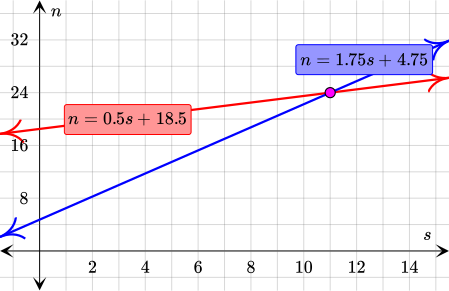
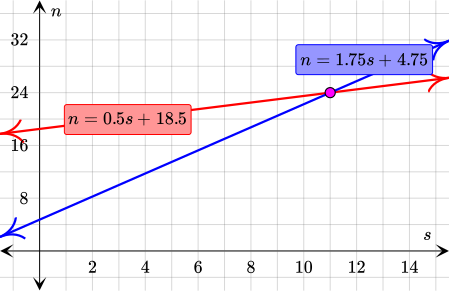
a The system of equations can be solved graphically by first rewriting each equation in slope-intercept form. Consider n as the y-variable and s as the x-variable.
2n-s=37 & (I) 7s-4n=- 19 & (II)
n=0.5s+18.5 n=1.75s+4.75
Looking at the graph, the solution appears to be s=11 and n=24.
b Notice that Equation (I) can be multiplied by 2 so that the n-terms can be eliminated by adding the equations.
2n-s=37 & (I) 7s-4n=- 19 & (II)
MultEqn
(I): LHS * 2=RHS* 2
4n-2s=74 7s-4n=- 19
SysEqnAdd
(I): Add (II)
4n-2s+( 7s-4n) =74+ ( - 19) 7s-4n=- 19
▼
(I): Solve for s
AddNeg
(I): a+(- b)=a-b
4n-2s+7s-4n =74-19 7s-4n=- 19
AddSubTerms
(I): Add and subtract terms
5s=55 7s-4n=- 19
DivEqn
(I): .LHS /5.=.RHS /5.
s = 11 7s-4n=- 19
c Finally, the solutions found by using the two different methods can be compared.
Graphing Method:& s=11, n=24 Elimination Method:& s=11, n=24 Both methods resulted in the same solution, which means that they are both correct. Comparing the methods, using the Elimination Method might be a little easier and quicker than graphing the equations. This method also always results in finding the exact solution, while graphing sometimes results in finding just an estimation of the solution.
Example
Share
Report error
Discovering a New Galaxy
After refueling and repairing the spaceship, Vincenzo continued his way across space. His destination is a new galaxy called the Stellar Nebula.

Vincenzo used a laser measuring device on the spaceship to determine the dimensions of the galaxy. Its width w and height h are related by the following system of equations. 3w-4h=6 5h=78-w
a Solve the system by using the Elimination Method.
Answer
a w=18, h=12
c See solution.
Hint
a Add w to both sides of the second equation, then multiply it by 3. Subtract the equations to eliminate w. Solve the resulting equation for h.
b Substitute the values from Part A into the original system of equations.
Solution
a Start by recalling that the Elimination Method is a method of eliminating one variable from a system of equations. This is done by first rewriting the coefficients to be the same or opposites, then adding or subtracting the equations. First, rewrite Equation (II) by adding w to both sides and multiplying by 3.
3w-4h=6 & (I) 5h=78-w & (II)
AddEqn
(II): LHS+w=RHS+w
3w-4h=6 5h+w=78
MultEqn
(II): LHS * 3=RHS* 3
3w-4h=6 15h+3w=234
SysEqnSub
(II): Subtract (I)
3w-4h=6 15h+3w-( 3w-4h)=234- 6
▼
(I): Solve for h
Distr
(II): Distribute - 1
3w-4h=6 15h+3w-3w-(- 4h)=234-6
SubNeg
(II): a-(- b)=a+b
3w-4h=6 15h+3w-3w+4h=234-6
CommutativePropAdd
(II): Commutative Property of Addition
3w-4h=6 15h+4h+3w-3w=234-6
AddSubTerms
(II): Add and subtract terms
3w-4h=6 19h=228
DivEqn
(II): .LHS /19.=.RHS /19.
3w-4h=6 h=12
b To verify the solution, substitute the values found in Part A into the system of equations and simplify.
| Equation (I) | Equation (II) | |
|---|---|---|
| Equation | 3w-4h=6 | 5h=78-w |
| Substitute | 3( 18)-4( 12)? =6 | 5( 12)? =78- 18 |
| Simplify | 6 = 6 ✓ | 60 = 60 ✓ |
The values verify both equations of the system. Therefore, the solution is correct!
Pop Quiz
Share
Report error
Checking the Solutions of Systems of Equations
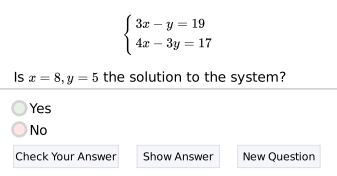
Consider the given system of linear equations. Check whether the values of x and y correspond to a solution to the system.
Pop Quiz
Share
Report error
Practice Solving Systems of Linear Equations
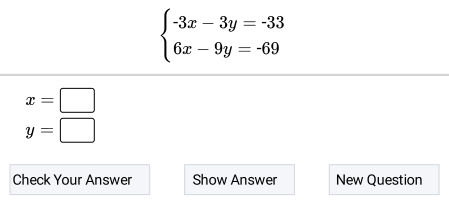
Solve the system of linear equations to find the values of x and y.
Discussion
Share
Report error
Numbers of Solution to Systems of Equations
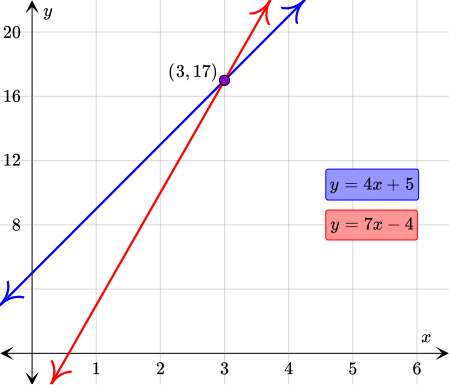
Solving a system of equations can result in three different scenarios. One possible scenario is when a system of equations has exactly one solution. y=4x+5 7x-y=4 ⇓ x=3 y=17 The graph of this system of equations consists of two intersecting lines. The coordinates of the intersection point correspond to the solution of the system of equations.
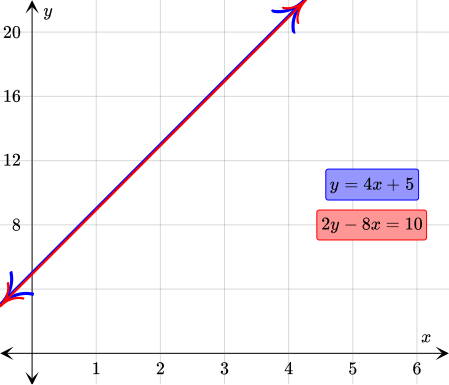
Another possible scenario is when solving a system of equations results in an identity. y=4x+5 2y-8x=10 ⇔ y=4x+5 10=10 ✓ In this case, the system of equations has infinitely many solutions and the graph of the system is two coincidental lines.
The last possible scenario is when solving a system of equations results in a false statement. y=4x+5 2x-0.5y=3 ⇔ y=4x+5 - 2.5=3 * This means that the system of equations has no solution. The graph of this type of system of equations is two parallel lines.
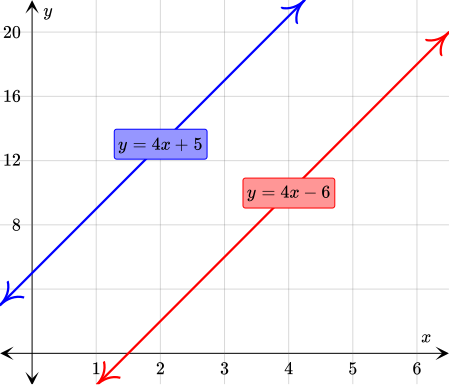
These three scenarios are summarized in a table.
| Number of Solutions | Graph |
|---|---|
| One solution | Intersecting lines |
| Infinitely many solutions | Coincidental lines |
| No solution | Parallel lines |
Example
Share
Report error
Stars and Planets in the Stellar Nebula
Vincenzo was amazed by the beauty of the newly discovered galaxy Stellar Nebula. It shined with blue and purple colors as he approached in his spaceship.
 The Stellar Nebula has p million planets and s million stars. These numbers are related by the following system of equations. 6s-15p=57 19+5p=2s
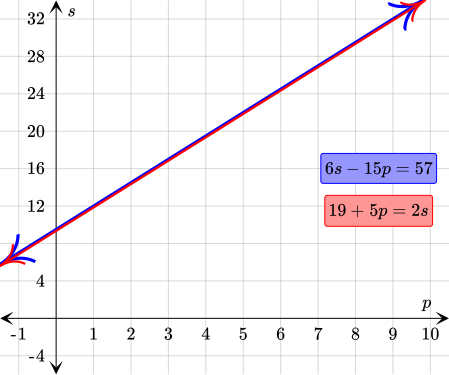
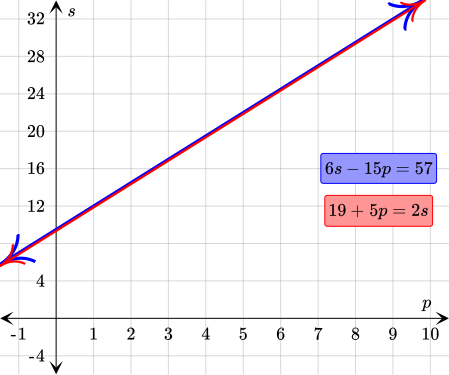
a Solve the system of equations.
b Graph the system of equations on a coordinate plane. How do the lines relate to each other?
Answer
a Infinitely many solutions
b The lines are coincidental.
Hint
a Solve the system of equations by using the Substitution or Elimination Methods.
b Rewrite the equations in slope-intercept form and graph them. How many common points do their graphs have?
Solution
a Start by analyzing the given system of equations.
6s-15p=57 & (I) 19+5p=2s & (II)
MultEqn
(II): LHS * 3=RHS* 3
6s-15p=57 57+15p=6s
RearrangeEqn
(II): Rearrange equation
6s-15p=57 6s=57+15p
SysEqnSub
(I): Subtract ( II)
6s-15p- 6s=57-( 57+15p) 6s=57+15p
SubTerm
(I): Subtract term
- 15p=- 15p 6s=57+15p
b To graph the system of equations on a coordinate plane, first, rewrite both equations so that they are in slope-intercept form. Consider s as the y-variable and p as the x-variable.
6s-15p=57 & (I) 19+5p=2s & (II)
▼
(I), (II): Write in slope-intercept form
AddEqn
(I): LHS+15p=RHS+15p
6s=15p+57 19+5p=2s
DivEqn
(I): .LHS /6.=.RHS /6.
s=2.5p+9.5 19+5p=2s
RearrangeEqn
(II): Rearrange equation
s=2.5p+9.5 2s=19+5p
DivEqn
(II): .LHS /2.=.RHS /2.
s=2.5p+9.5 s=9.5+2.5p
CommutativePropAdd
(II): Commutative Property of Addition
s=2.5p+9.5 s=2.5p+9.5
Since the lines have the same equation, their graphs are coincidental lines. This piece of information highlights the fact that the lines have infinitely many common points. This means the system of equations has infinitely many solutions.
Example
Share
Report error
Exploring a Black Hole
While exploring the new galaxy, Vincenzo and his team noticed a black hole on the edge of the galaxy. Curious, they flew closer to the black hole to register some of its characteristics.
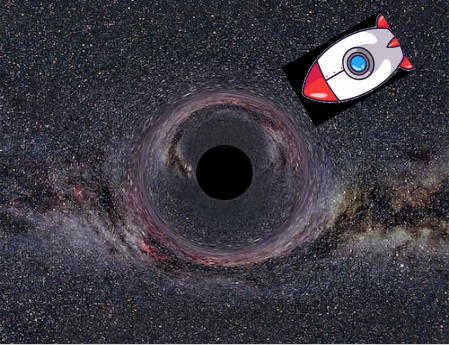
They tried to measure the density d and mass m of the black hole and got the following system of equations. 16d=- 8m+20 m=4-2d
a Solve the system of equations.
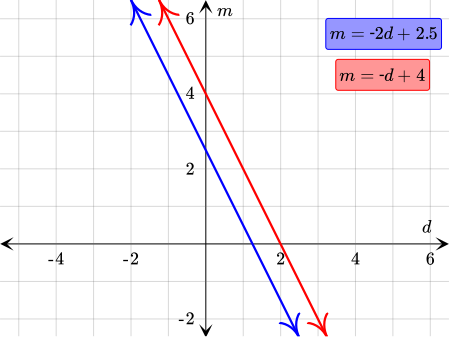
b Graph the system of equations on a coordinate plane. How do the lines relate to each other?
Answer
a No solution
b The lines are parallel.
Hint
a Solve the system of equations by using the Substitution or the Elimination Method.
b Rewrite the equations in slope-intercept form and graph them. How many common points do their graphs have?
Solution
a Start by analyzing the given system of equations.
16d=- 8m+20 & (I) m=4-2d & (II)
Substitute
(I): m= 4-2d
16d=- 8( 4-2d)+20 m=4-2d
Distr
(I): Distribute - 8
16d=- 32+16d+20 m=4-2d
AddTerms
(I): Add terms
16d=16d-12 m=4-2d
SubEqn
(I): LHS-16d=RHS-16d
0≠ - 12 m=4-2d
b To graph the system of equations on a coordinate plane, start by rewriting both equations so that they are in slope-intercept form. Consider m as the y-variable and d as the x-variable.
16d=- 8m+20 & (I) m=4-2d & (II)
▼
(I), (II): Write in slope-intercept form
CommutativePropAdd
(II): Commutative Property of Addition
16d=- 8m+20 m=- 2d+4
RearrangeEqn
(I): Rearrange equation
- 8m+20=16d m=- 2d+4
SubEqn
(I): LHS-20=RHS-20
- 8m=16d-20 m=- 2d+4
DivEqn
(I): .LHS /(- 8).=.RHS /(- 8).
m=- 2d+2.5 m=- 2d+4
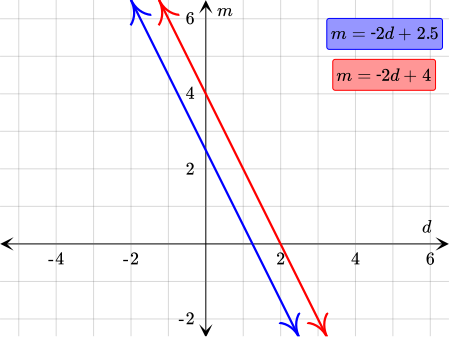
The lines are parallel. Since they do not intersect, there is no solution to the system of equations. Vincenzo's team was getting closer and closer to the dark hole when, suddenly, he woke up. Wow, what a cool dream he had tonight!
Closure
Share
Report error
Finding the Number of Books and Movies
Vincenzo spends a lot of his free time reading books and watching movies about space travel, distant galaxies, and rocket science.

{"type":"text","form":{"type":"math","options":{"comparison":"1","nofractofloat":false,"keypad":{"simple":true,"useShortLog":false,"variables":["x"],"constants":["PI"]},"rendered":false},"text":" "},"formTextBefore":"Number of movies=","formTextAfter":null,"answer":{"text":["18"]}}
{"type":"text","form":{"type":"math","options":{"comparison":"1","nofractofloat":false,"keypad":{"simple":true,"useShortLog":false,"variables":["x"],"constants":["PI"]},"rendered":false},"text":" "},"formTextBefore":"Number of books=","formTextAfter":null,"answer":{"text":["9"]}}
Hint
Write two equations that describe the total number of movies and books about space that Vincenzo has watched or read. Then solve the system of equations by using the Substitution Method.
Solution
Let b be the number of books and m be the number of movies about space that Vincenzo has read or watched. It is given that the total number of books and movies is 27. This means that the first equation can be written by adding b and m and setting the sum equal to 27. b+m=27
The number of movies is 9 more than the number of books. Using this information, a second linear equation can be written.
m=b+9
These two equations form a system of equations.
b+m=27 m=b+9
Since m is already isolated in Equation (II), solve the system by using the Substitution Method.
This means that Vincenzo has read 9 books and watched 18 movies about space.
b+m=27 & (I) m=b+9 & (II)
Substitute
(I): m= b+9
b+ b+9=27 m=b+9
AddTerms
(I): Add terms
2b+9=27 m=b+9
SubEqn
(I): LHS-9=RHS-9
2b=18 m=b+9
DivEqn
(I): .LHS /2.=.RHS /2.
b=9 m=b+9
Substitute
(II): b= 9
b=9 m= 9+9
AddTerms
(II): Add terms
b=9 m=18
Solving System of Equations Algebraically
Exercises
How many solutions does each system of equations have?
{"type":"choice","form":{"alts":["No solution","One solution","Infinitely many solutions"],"noSort":true},"formTextBefore":"","formTextAfter":"","answer":1}
{"type":"choice","form":{"alts":["No solution","One solution","Infinitely many solutions"],"noSort":true},"formTextBefore":"","formTextAfter":"","answer":0}
{"type":"choice","form":{"alts":["No solution","One solution","Infinitely many solutions"],"noSort":true},"formTextBefore":"","formTextAfter":"","answer":2}
security
report
code
security
report
code
We are given a system of equations and want to find the number of solutions. y = 7x + 5 y = - 7x + 5 We can compare the lines by paying close attention to their slopes and y-intercepts. y = 7x + 5 y = - 7x + 5 The lines have different slopes, which means that they intersect at exactly one point. Therefore, the system has exactly one solution. Let's graph both lines on the same coordinate plane to check our answer.
As we can see, the lines do, in fact, intersect at one point!
We are given the following system of equations. 2y+8=6x & (I) 9x-3y=- 6 & (II) Let's begin by rewriting both equations in slope-intercept form. y= mx+ b Let's start with Equation (I).
Let's now write Equation (II) in slope-intercept form. Just as we did with Equation (I), we will isolate y and then rearrange the terms so that they are in the correct order.
Now we can compare the lines by paying close attention to their slopes and y-intercepts. 2y+8=6x 9x-3y=- 6 ⇔ y= 3x - 4 y= 3x+ 2 The lines have the same slope but different y-intercepts. This means that they are parallel lines and the system has no solutions. Let's draw both lines on the same coordinate plane to check our answer.
Now that we have graphed the lines, we can confirm that the lines do not intersect. Therefore, the system has no solution.
We are given a system of equations and want to find the number of solutions. x + 5y = 0 20y=- 4x We will begin by rewriting both equations in slope-intercept form.
Let's compare the lines by paying close attention to their slopes and y-intercepts. x + 5y = 0 20y=- 4x ⇔ y = - 0.2 x+ 0 y = - 0.2 x+ 0 The lines have the same slope and the same y-intercept. This means that they are the same line and intersect at infinitely many points. Therefore, the system has an infinite number of solutions. We can draw both lines on the same coordinate plane to check our answer.
Now that we have graphed the lines, we can confirm that they do, in fact, intersect at infinitely many points, so there are an infinite number of solutions.
security
report
code
Solve the system of equations using the Substitution Method.
{"type":"text","form":{"type":"equation","options":{"comparison":"1","nofractofloat":false,"keypad":{"simple":true,"useShortLog":false,"variables":["x"],"constants":["PI"]},"rendered":false},"text":"","description":[{"id":0,"text":"x"},{"id":1,"text":"y"}]},"formTextBefore":null,"formTextAfter":null,"answer":{"text":[{"id":0,"text":"11"},{"id":1,"text":"2"}],"noSolution":false,"infiniteSolution":false}}
{"type":"text","form":{"type":"equation","options":{"comparison":"1","nofractofloat":false,"keypad":{"simple":true,"useShortLog":false,"variables":["x"],"constants":["PI"]},"rendered":false},"text":"","description":[{"id":0,"text":"x"},{"id":1,"text":"y"}]},"formTextBefore":null,"formTextAfter":null,"answer":{"text":[{"id":0,"text":""},{"id":1,"text":""}],"noSolution":true,"infiniteSolution":false}}
security
report
code
security
report
code
We are given the following system of equations. x-y=9 7y=2x-8 We are asked to solve it using the Substitution Method. Let's start by isolating x in the first equation and substituting the corresponding expression into the second equation.
Great! Now, to find the value of x, we need to substitute y=2 into Equation (I).
The solution is x=11 and y=2.
First, let's analyze the given system of equations. y= 14x-5 & (I) 8y-2x=- 16 & (II) We can see that y is already isolated in Equation (I). Let's substitute the corresponding expression for y into Equation (II) and solve for x.
Solving this system of equations resulted in a contradiction, since - 40 can never be equal to - 16. Therefore, the lines are parallel and do not have a point of intersection.
security
report
code
Solve the system of equations using the Elimination Method. Write the answer as a point (x,y) or (a,b).
{"type":"text","form":{"type":"point2d","options":{"comparison":"1","nofractofloat":false,"keypad":{"simple":true,"useShortLog":false,"variables":["x"],"constants":["PI"]},"rendered":false,"decimal":false,"function":false},"text":" "},"formTextBefore":null,"formTextAfter":null,"answer":{"text1":"59","text2":"85"}}
{"type":"text","form":{"type":"point2d","options":{"comparison":"1","nofractofloat":false,"keypad":{"simple":true,"useShortLog":false,"variables":["x"],"constants":["PI"]},"rendered":false,"decimal":false,"function":false},"text":" "},"formTextBefore":null,"formTextAfter":null,"answer":{"text1":"1","text2":"4"}}
security
report
code
security
report
code
We want to solve the given system of linear equations by using the Elimination Method. Our goal is to eliminate one of the variable terms by adding or subtracting the equations. This means that either the x- or the y-terms must cancel each other out. y- x = 26 & (I) y+ x=144 & (II) We can see that the x-terms will eliminate each other if we add Equation (I) to Equation (II).
Now we can solve for x by substituting the value of y into either equation and simplifying.
The solution to the system of equations is (59,85).
Let's start by analyzing the given system of equations. 6 a+3 b=18 & (I) - 2 a+6 b=22 & (II) Currently, neither of the variable terms in this system will cancel out. We need to find a common multiple between two variable like terms in the system. If we multiply Equation (II) by 3, the a-terms will have opposite coefficients. & 6 a+3 b=18 3(- 2 a+6 b)=3(22) & ⇓ & 6a+3 b=18 - 6a+18 b=66 We can see that the a-terms will be eliminated if we add Equation (I) to Equation (II).
Now we can solve for a by substituting the value of b into either equation and simplifying.
The solution to the system of equations is (1,4).
security
report
code
Solve each system of equations using the best method.
{"type":"text","form":{"type":"equation","options":{"comparison":"1","nofractofloat":false,"keypad":{"simple":true,"useShortLog":false,"variables":["x"],"constants":["PI"]},"rendered":false},"text":"","description":[{"id":0,"text":"x"},{"id":1,"text":"y"}]},"formTextBefore":null,"formTextAfter":null,"answer":{"text":[{"id":0,"text":"0.8"},{"id":1,"text":"1.6"}],"noSolution":false,"infiniteSolution":false}}
{"type":"text","form":{"type":"equation","options":{"comparison":"1","nofractofloat":false,"keypad":{"simple":true,"useShortLog":false,"variables":["x"],"constants":["PI"]},"rendered":false},"text":"","description":[{"id":0,"text":"x"},{"id":1,"text":"y"}]},"formTextBefore":null,"formTextAfter":null,"answer":{"text":[{"id":0,"text":"4\/3"},{"id":1,"text":"11\/3"}],"noSolution":false,"infiniteSolution":false}}
security
report
code
security
report
code
Let's start by analyzing the given system of equations. y = - 3x + 4 2x + 4y = 8 We can see that y is isolated on the left-hand side in Equation (I). This means that we use the Substitution Method to substitute - 3x + 4 for y in Equation (II). This will result in an equation where the only unknown is x. Let's do it!
We found that x equals 0.8. Now we can substitute this value into Equation (I) for x and calculate the value of y.
The solution to the system of equations is x=0.8 and y=1.6, or the point (0.8,1.6).
We will start by considering the given system of equations. x+y=5 2x-y=- 1 Notice that the y-terms have opposite coefficients in the equations. If we add the equations, y will be eliminated, resulting in an equation with only the variable x. Let's use the Elimination Method to solve this system of equations.
Now that we know the value of x, let's substitute it into the second equation and solve for y.
We can conclude that x is 43 and y is 113.
security
report
code
Solving System of Equations Algebraically
Recommended exercises
To get personalized recommended exercises, please login first.
Loading content
≤
>
■2
■▢
e▢
7
8
9
×
÷■1
=
=
√▢
▢√
∫▢▢
4
5
6
+
−
≤
<
log
ln
log▢
1
2
3
()
∣
sin
cos
tan
0
.
π
x
y
Loading content